- World production estimated above consumption in 2023/24, according to the USDA;
- Improvement in productivity with the harvest progress in Brazil;
- USDA cuts Brazil's crop by just 1 million tonnes;
- Crop should be favorable in Argentina;
- Concerns about the pace of global demand;
- Weak US export sales;
- Production estimates cut by CONAB, USDA, and ABIOVE;
- USDA revises Chinese exports upwards;
- Hot and dry weather affected crop conditions in Argentina;
- The Argentine situation still favors holding soybean as insurance.
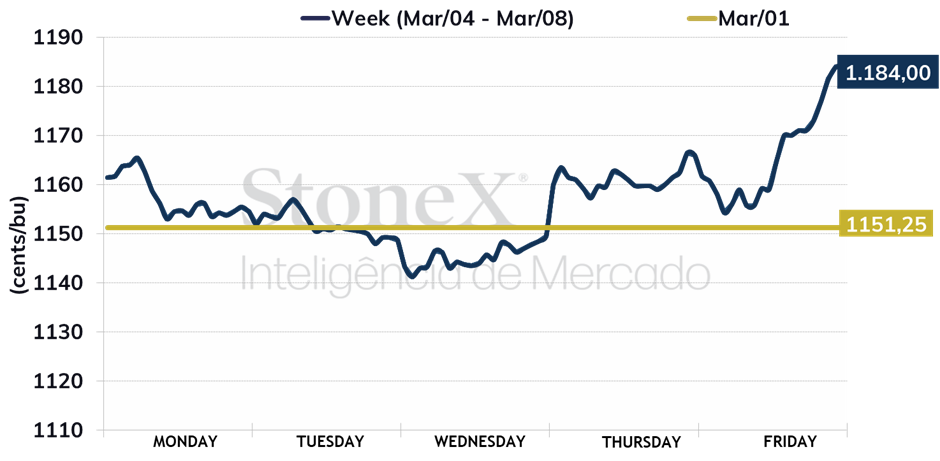
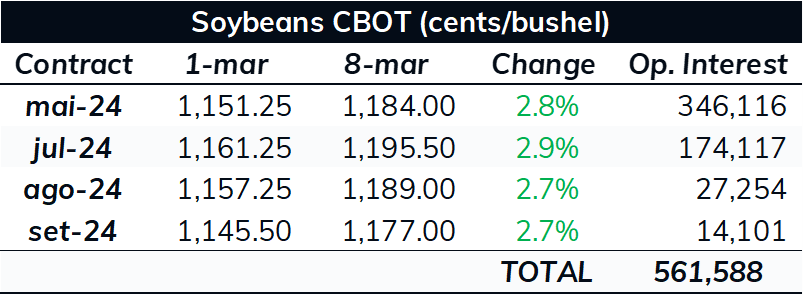
Last week, soybean quotes in Chicago were predominantly in an uptrend. The May contract ended Friday (11) at 1184 cents per bushel, with gains of 2.8%.
These gains can be mainly explained by a correction, short covering, and the USDA's revision of Chinese data. In any case, there were no major changes in the global supply and demand scenario.
The South American crop must record a positive balance, with Argentine production more than compensating for Brazilian losses.
As highlighted in last week's report, StoneX Brazil updated its crop estimate for 2023/24, raising production to 151.55 million tonnes (0.8% higher than the last report). Positive adjustments were made in states in the North and Northeast and in Goiás, where good levels of later precipitation benefited the crops, favoring a better yield.
Thus, despite crop losses, remembering that initial estimates pointed to 165 million tonnes, this result, combined with the expected output for Argentina, ensures that the global supply and demand balance continues to point to a more comfortable scenario.
It is important to note that there is some divergence between the crop estimates released by various market institutions. On average, most figures hover around 150 million tonnes for Brazilian production 23/24. It is worth mentioning that CONAB will update its monthly survey tomorrow, while USDA continues to bring a higher figure, at 155 million tonnes, even with the last revision, on Friday (08).
In Argentina, the Buenos Aires Exchange estimates the 23/24 crop at 52.5 million tonnes, highlighting the recent beneficial rains, with 82% of the crops in good/excellent conditions. On the other hand, the figure of the Rosario Exchange is at 49.5 million, with the institution having made a negative adjustment due to the warmer and drier pattern recorded in January. Despite this difference between the figures, the country is moving towards a strong result, recovering from the sharp drop recorded in the 22/23 cycle.
The USDA's monthly report, released on Friday (08), brought a small cut to the Brazilian crop of just 1 million tonnes, remaining at the top end of market figures at 155 million tonnes. The expected production in this 23/24 cycle was maintained at 50 million tonnes for Argentina.
The USDA's supply and demand variables did not change compared to last month, while the USDA revised Chinese figures for the last three crops, focusing on grinding and exports. Thus, the Department indicated a greater resilience of Chinese soybean demand, even during the pandemic. On the other hand, the increase in import figures is significantly different from the official data from the Chinese customs, with USDA indicating imports of about 5 million tonnes above what is reported by the Chinese government. While the USDA raised Chinese imports, official sources cut the crop figure for 22/23, from 100.85 to 99 million tonnes.
Usually, there are no major divergences between USDA and official data regarding China's imports and exports, but this bullish revision cheered up the markets, with quotes rising on Friday (08).
Despite these revisions to the Chinese balance, global production in 23/24 remains about 15 million tonnes above the estimated consumption, maintaining a more comfortable scenario.
In terms of exports, Brazilian soybeans remain more competitive than American soybeans. This, coupled with China's weaker product purchases from the US, fuels more negative expectations for American shipments in the 23/24 cycle.
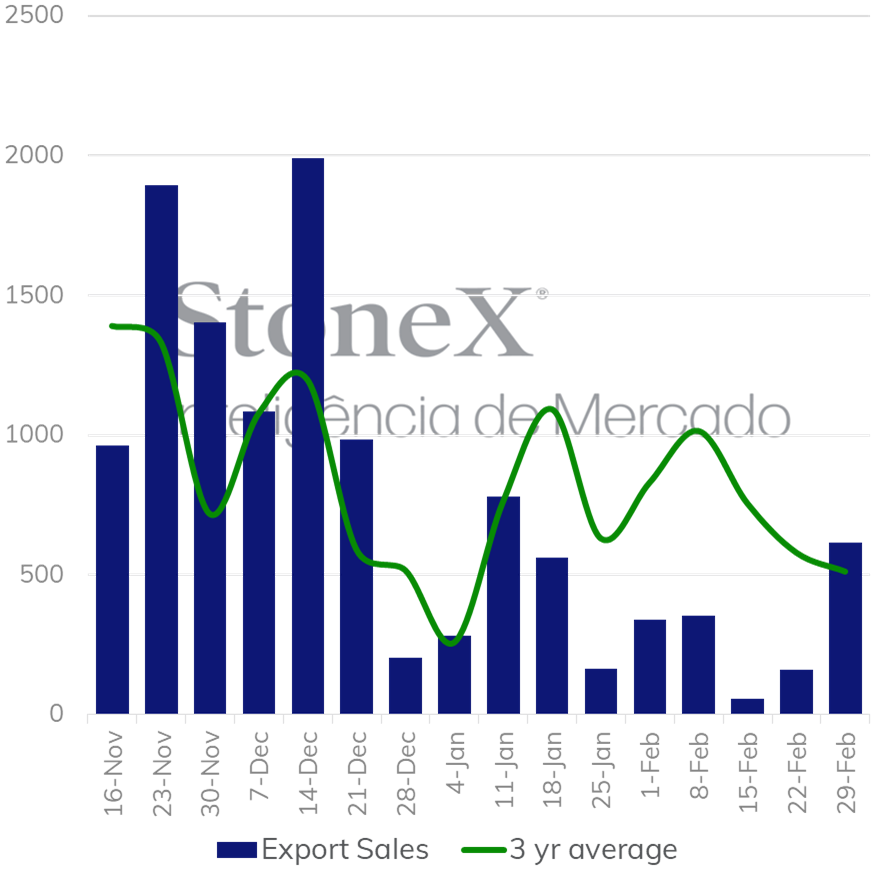
US export sales in the week ended on 02/29 reached 613.5 thousand tonnes, at the top of the estimates, which ranged from 175 to 600 thousand. Even with this result, the country's sales are 39.4 million tonnes in the accumulated total, versus 48.7 million in the same period last year. The USDA expects US exports to be 7.4 million tonnes lower than in the 22/23 cycle. Thus, even considering the lowest estimate, the accumulated illustrates the weaker pace of American sales.
This week, the highlights are the monthly release from CONAB on Tuesday (12), the US grinding data from NOPA on Friday (15), and the usual export data.