- Bearish Factors
- World production in 24/25 widens the gap compared to consumption, according to the USDA.
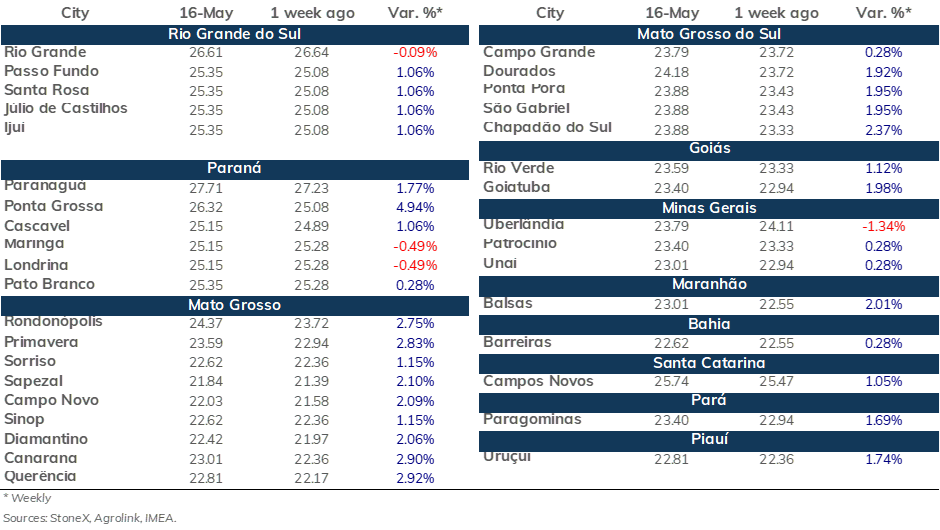
- Improvement in productivity with the harvest progress in Brazil;
- USDA estimates Brazilian crop for 23/24 at 154 million tonnes;
- CONAB raises soybean crop 23/24;
- Concerns about the pace of global demand;
- Area growth prospects in the USA.
- Bullish factors
- Impact of rains on the planting progress in the US;
- Crop losses in Rio Grande do Sul due to floods;
- Buenos Aires Exchange expressed concern about harvest progress and yield in the country's northern region and reduced the crop estimate to 50.5 million tonnes.
- Spec funds reduce short position;
- USDA continues to bet on very heated Chinese imports.
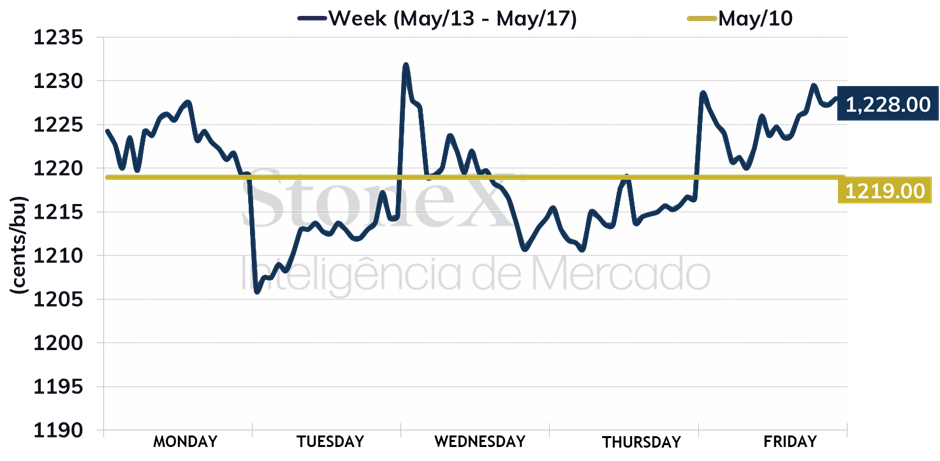
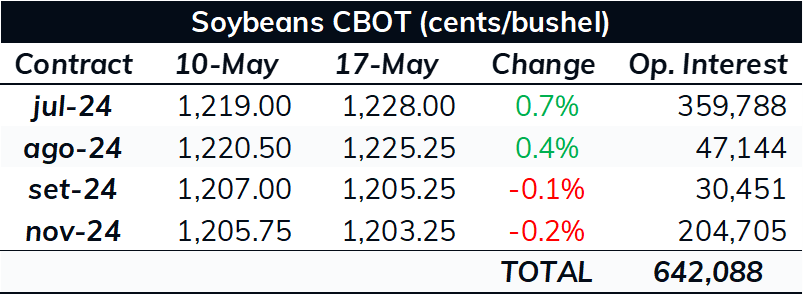
The soybean quotes showed little variation in last week's first four trading days, but the significant increase on Friday (17) conditioned the positive closing. The July contract ended at 1228 cents per bushel, a gain of 0.7%. On the other hand, contracts for the new crop ended the week slightly lower.
This contract rise closer to the end of the week's trading session was conditioned by renewed concerns about the Brazilian crop, with rain forecasts in Rio Grande do Sul. Furthermore, the planting progress in the US remains on the radar, with occurrences of precipitation resulting in delays.
The harvest of the 23/24 soybean crop in Brazil is nearing completion, reaching 97.8% of the total last Friday (17), with work completed in most states, while the situation in Rio Grande do Sul continues to be monitored. The harvest in the state reached 86%, with producers advancing as much as they could after the floods. It is worth mentioning that, even with the harvest progressing, many soybeans are being taken out of the field with excessive moisture and quality issues. Thus, StoneX's estimate of a 3 mmt loss in the country's soybean crop still does not consider these quality issues, which, although they do not represent a crop loss, result in the product's devaluation, with discounts applied to the price. For the next few days, the forecasts still indicate the occurrence of rain in the state, which, even in smaller amounts, brings concern at a time when the damages are still being evaluated.
It is worth mentioning that CONAB updated its monthly crop survey on Tuesday (14) but has not yet fully assessed the losses from excessive rains in Rio Grande do Sul, with a more precise adjustment expected in the next release. Thus, the soybean production estimate for 23/24 in Brazil increased by almost 1.2 million tonnes, reaching 147.7 million due to revisions in acreage, especially in the states of Maranhão, Goiás, Pará, Mato Grosso, Rio Grande do Sul, and Minas Gerais. On the other hand, there was a slight cut in the expected national average productivity, which went from 3.24 to 3.23 tonnes per hectare, due to climatic issues, with a cut in productivity in Rio Grande do Sul to 3.17 tonnes per hectare, which would still indicate a normal harvest. Still, new adjustments are likely to occur in the future.
Regarding the weather, in the US, the planting progress continues to register a lagging rhythm compared to the initial weeks due to rains in the Midwest. Until Sunday, the USDA indicated that the 24/25 crop planting was 35% complete, a percentage below the same period last year, when it reached 45%, and 1 percentage point above the five-year average, at 34%. Until next Friday (24), heavier rains are still expected in parts of the Midwest, focusing on northern Nebraska, eastern South Dakota, and Minnesota. Starting this weekend, the precipitation should become lighter, favoring soil moisture without causing major problems for the planting progress.
Regarding the Argentine crop, the harvest reached 63.7% last Wednesday (15), according to the Buenos Aires Exchange, a weekly advance of 15.8 p.p.
Nonetheless, it is worth noting that the exchange brought another small reduction in the expected soybean crop for the country, which decreased from 51 to 50.5 million tonnes, with a highlight on the lower yields in the north of Santiago del Estero and Chaco, which are proving to be lower than expected. This level is in line with what was expected by the USDA, at 50 million tonnes and still represents a significant rebound compared to last year, which was greatly affected by La Niña.
On the demand side, US exports remain on the radar, with sales of the 23/24 crop in the week ended on 05/09 totaling 265.7 thousand tonnes below the lower end of the estimates, which ranged from 300 to 550 thousand tonnes, with China not being among the destinations. In total, 42.6 million tonnes were traded, with USDA's export estimate for the cycle at 46.3 million tonnes, with just less than four months until the end of the crop year.
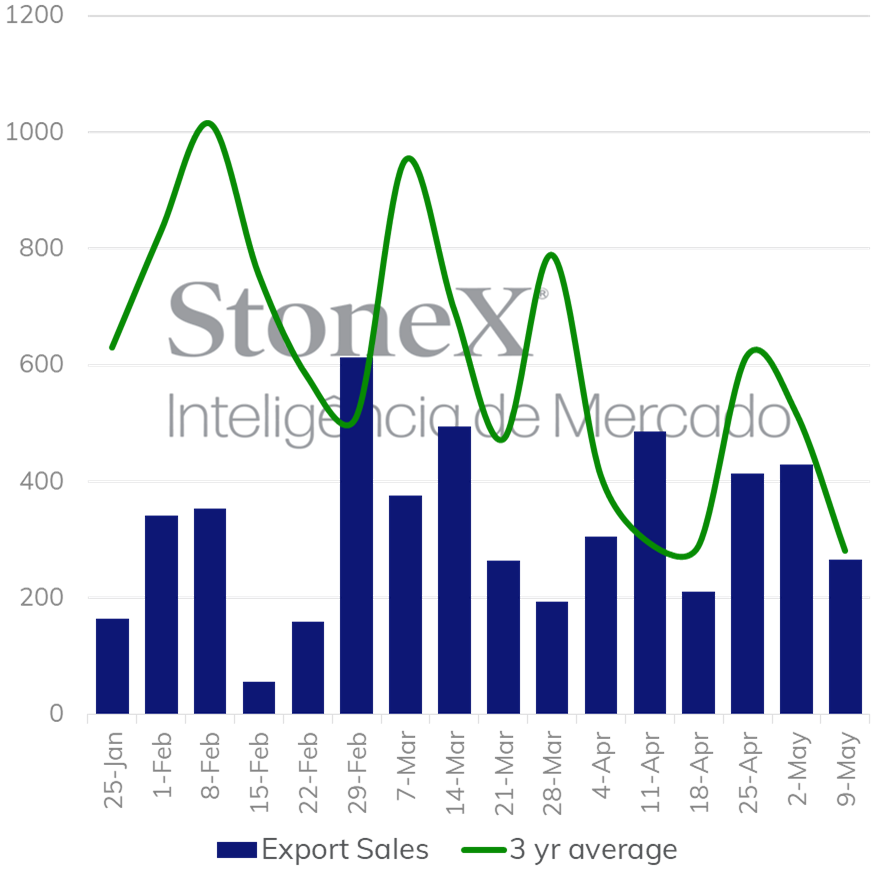
China's smaller participation has been a trend, with Brazil's product remaining more competitive than the American one, and geopolitical issues with the USA are always on the radar.
Last week, the Biden Administration announced higher tariffs for Chinese products but did not include used cooking oil (UCO) on the list of affected products. The flow of UCO from China to the USA has improved the country's oil supply and demand balance.
The data on soybean grinding in the US was also released by the National Oilseed Processors Association (NOPA), which reported 4.52 million tonnes for April, representing a sharp decline compared to March and well below the market's expected average of 4.98 million tonnes. There were rumors of plants undergoing maintenance in the Midwest, but this outcome was not expected. It is worth noting that soybean oil stocks fell to 796.1 thousand tonnes, which would still be a high level considering the drop in grinding, indicating weaker demand for the product. Even with this result, USDA's grinding estimate for the 23/24 cycle, at 62.6 million tonnes, would still be reached.
The weather should continue on the radar this week that begins, both in the USA and here in Brazil. This Monday (20), USDA will update its crop progress report. Furthermore, the progress of the demand is also closely monitored.