- Bearish Factors
- World production in 24/25 widens the gap compared to consumption, according to the USDA.
- Improvement in productivity with the harvest progress in Brazil;
- Crushing margins more pressured in China;
- Concerns about the pace of global demand;
- Growth prospects for areas in the US.
- Bullish factors
- Drier weather in the eastern US belt.
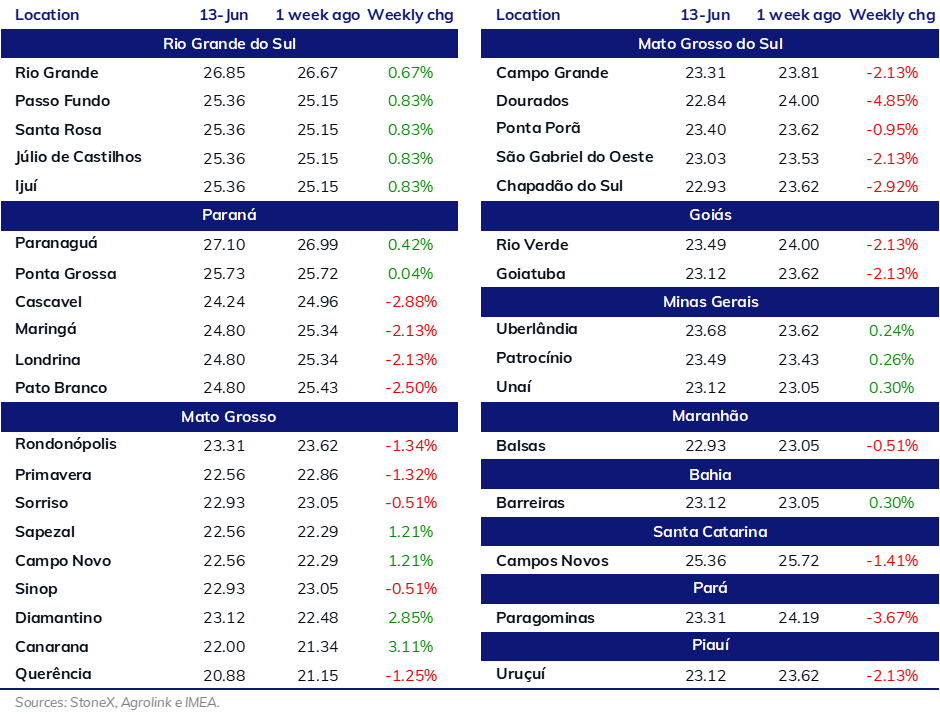
- Crop losses in Rio Grande do Sul, due to floods;
- Spec funds reduce short position;
- USDA continues to bet on very heated Chinese imports.
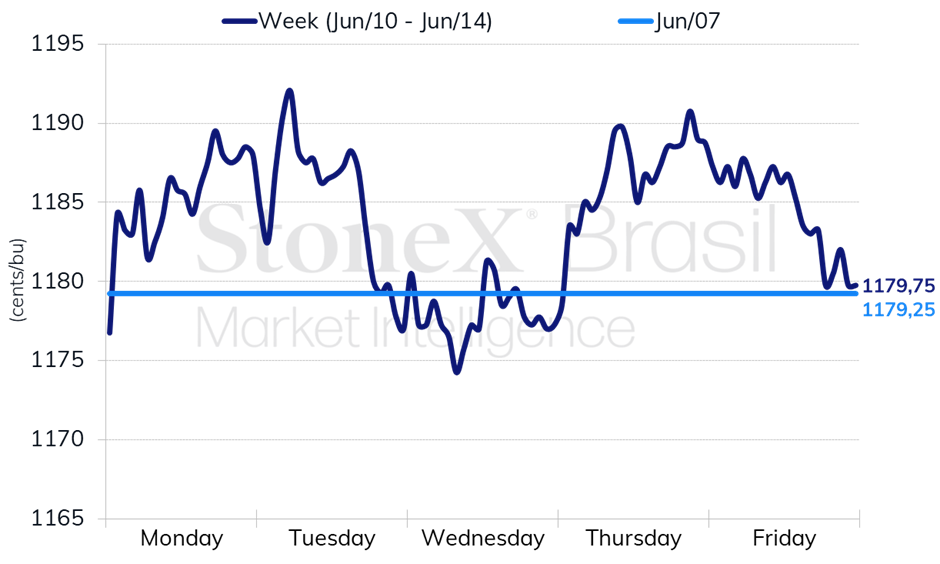
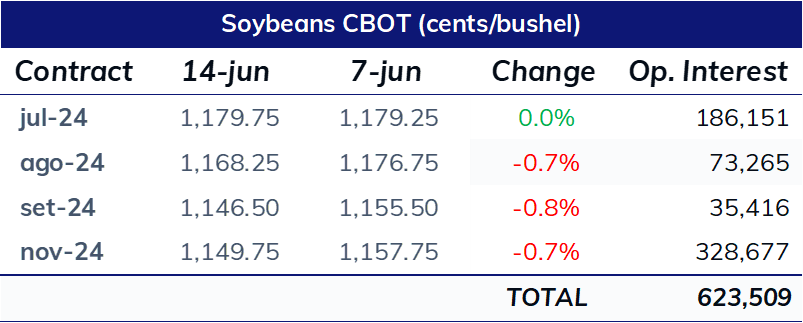
The soybean quotes in Chicago alternated between positive and negative fields last week and ended the period nearly unchanged. The July contract ended Friday's session (14) at 1179.75 cents per bushel. The most distant contracts trended lower in the week.
The progress of the US crop remains a central factor in the movement of quotes, with the pace of work in the field and the weather on the radar. In the week ended on 06/09, the planting of the country's 24/25 crop reached 87% of the total, remaining above the five-year average of 84%, although below the level recorded in the same period last year, at 95%. Despite some delays, mainly in May, the pace of soybean planting has always remained above average, reducing concerns about the potential negative impacts of delays.
The weather forecasts also contributed to moving prices. Some models indicating a drier climate, especially in the eastern part of the American belt, brought concerns, but it is still early for the soybean. From July and especially in August, the behavior of the weather tends to be more concerning. During this past weekend, heavier rains were recorded in the west and northwest of the producing region and forecasts indicate that these areas are expected to remain wetter, while the east of the producing region becomes drier until the next weekend. Starting on Saturday (22), the rainfall pattern should become more regular again, without major droughts or excessive precipitation volumes.
The monthly USDA report release did not bring any major news. It is worth noting that for the 23/24 US crop, there was a small cut in crushing that was reflected in the estimated ending stocks, going from 9.25 to 9.53 million tonnes, remembering that at the end of June, the quarterly stocks position will be released, along with the acreage planted for the 24/25 crop.
These slightly larger stocks were the only change carried over to the 24/25 North American crop. In addition to the acreage, which will be included in the July report, the productivity of the new crop is only expected to be changed starting in August, with also qualitative data.
For Brazil, USDA cut the estimate for the 23/24 crop from 154 to 153 million tonnes, which still keeps the figure from the American Department as one of the highest among the various market estimates, even with the floods that affected the crop in Rio Grande do Sul, the second-largest producer of the oilseed this season.
For Argentina and China, the USDA did not bring any changes regarding the figures from May.
In Brazil, CONAB also updated its monthly crop survey, showing a slight increase in the national area and a decrease in average productivity. This led the estimated Brazilian production for 23/24 to increase to 147.35 million tonnes. It's worth mentioning that the Company reported a 9% drop in average productivity in Rio Grande do Sul due to torrential rains, which stood at 2985 kg per hectare, with the state's production at 20.2 million tonnes.
In Argentina, the soybean harvest is in its final stretch, having reached 96% by last Wednesday (June 12th). The yields of later plantings benefited from the rains that occurred in the second half of February, leading to results above expectations in some regions, such as northern La Pampa, western Buenos Aires, and southern Córdoba.
With that, the lower productivities, mainly obtained further north in the producing region, end up being balanced out. The Buenos Aires Exchange continues to maintain its soybean crop estimate for 23/24 at 50.5 million tonnes.
On the demand side, Chinese behavior is closely followed, with crushing margins more pressured as basis in Brazil react. Brazilian soybean for China remains more competitive than the American one leaving through the Gulf, but the impact of higher premiums on Chinese demand is closely monitored.
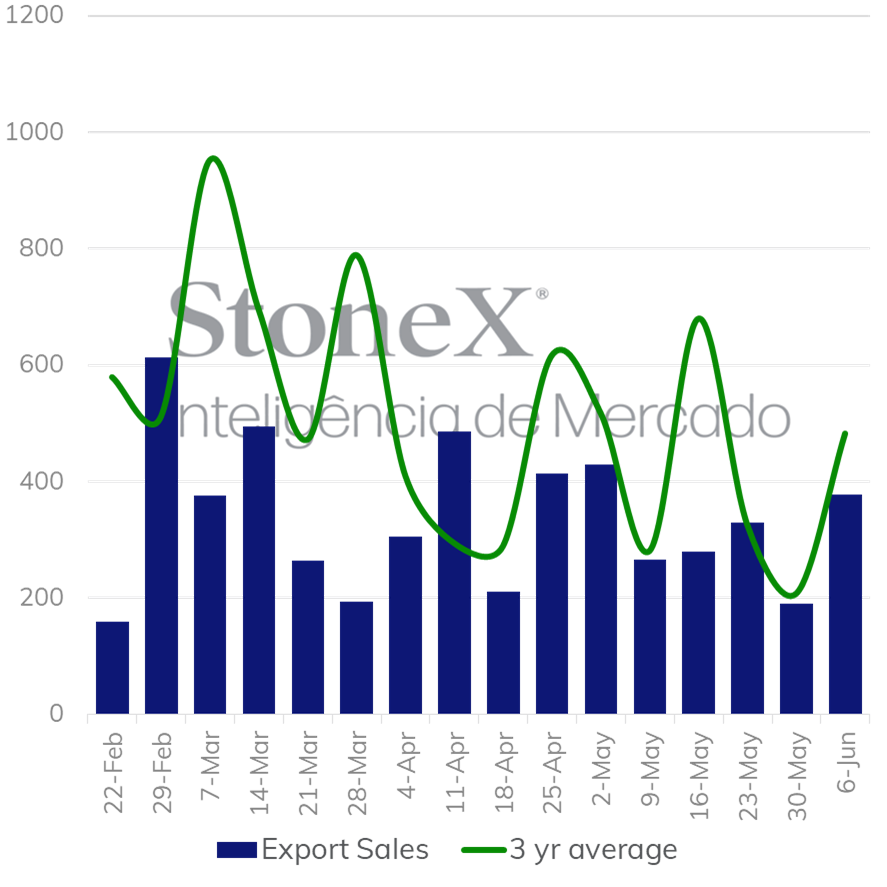
US export sales in the week ended on June 6th reached 377.1 thousand tonnes (tmt), a volume within the range of estimates, which ranged from 150 to 550 thousand tonnes. China was responsible for about a quarter of the weekly traded volume. In total, sales of the 23/24 North American crop are at 43.8 million tonnes, with USDA export projections up to August at 46.3 million tonnes.
This week, the market should continue to pay attention to the North American crop, with any weather issues being able to move the quotes. In Brazil, it is worth noting that the preliminary weekly export data also attract attention, with the first week of June registering shipments of 3.6 million tonnes.