- Bearish Factors
- Global production for 24/25 outpaces consumption, according to USDA;
- Improved productivity with advancing harvest in Brazil;
- Pressured crushing margins in China;
- Concerns about global demand pace;
- Favorable crop conditions in the US.
- Bullish Factors
- Crop losses in Rio Grande do Sul due to flooding;
- Speculative funds reduce short positions;
- Strong crushing activity in the US in May;
- USDA continues to predict very strong Chinese imports.
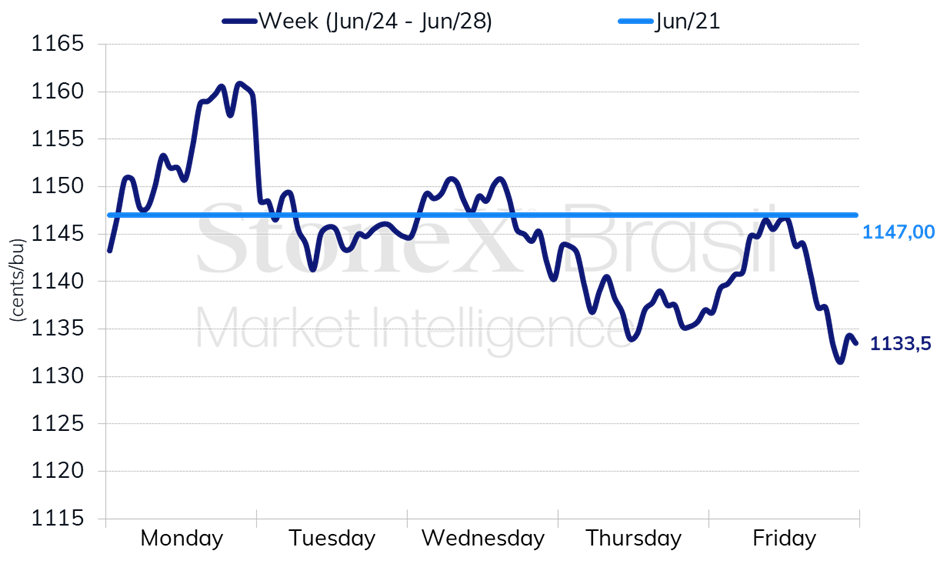
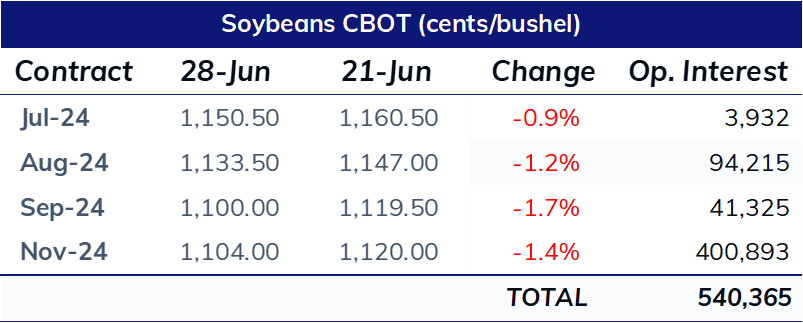
Last week, soybean prices fell in Chicago, with the August contract closing Friday’s session (28) at 1133.5 cents per bushel, a 1.2% drop for the period. The market remains focused on the US crop, closely monitoring the country's weather and the USDA's weekly crop condition updates. For the week ending June 23, there was a 3 percentage point drop in the good/excellent rating for soybeans, from 70% to 67%, while the market expected a decrease to 68%. The largest declines occurred in Illinois, Indiana, Ohio, and the Dakotas. Even so, all these states remain above the five-year average for the period. Additionally, it is still early for the soybean crop. If good/excellent conditions remain high until early August, the possibility of above-trend productivity is realistic.
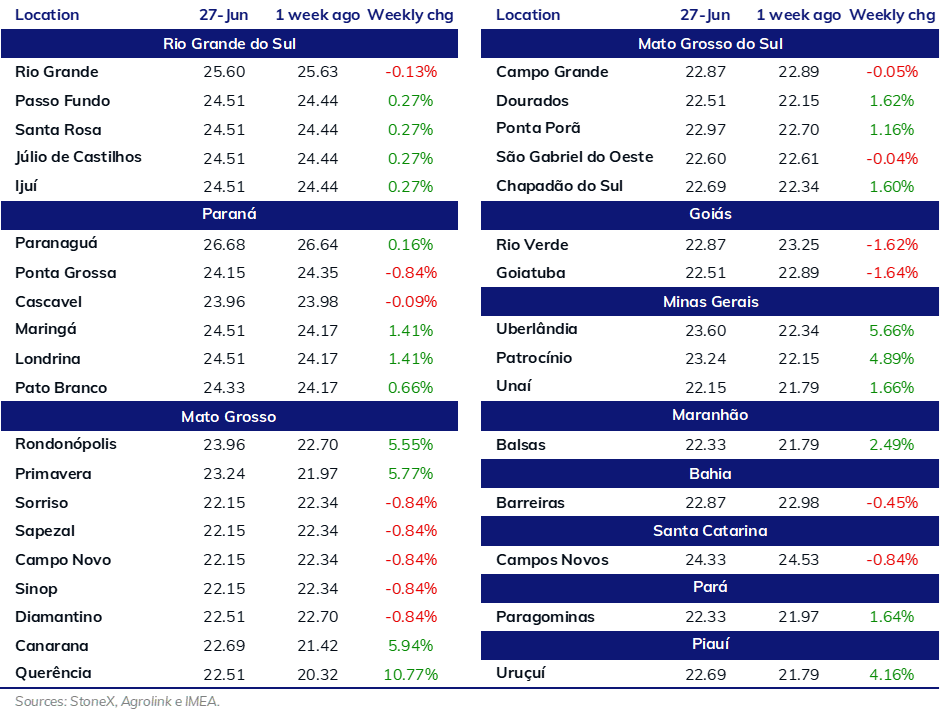
On the demand side, Brazilian exports remained strong in June, reaching 10.99 million tonnes by the 21st of the month. It is noteworthy that the exportable surplus of the 23/24 crop is smaller, as production was also lower, and last year's record of over 100 million tonnes will not be reached. Brazilian soybeans remain competitive, a situation reinforced by the recent depreciation of the Brazilian real. Even so, shipments in the second half of 2024 are expected to weaken due to soybean availability and significant domestic consumption, highlighting the 2 percentage point increase in the biodiesel blend mandate this year.
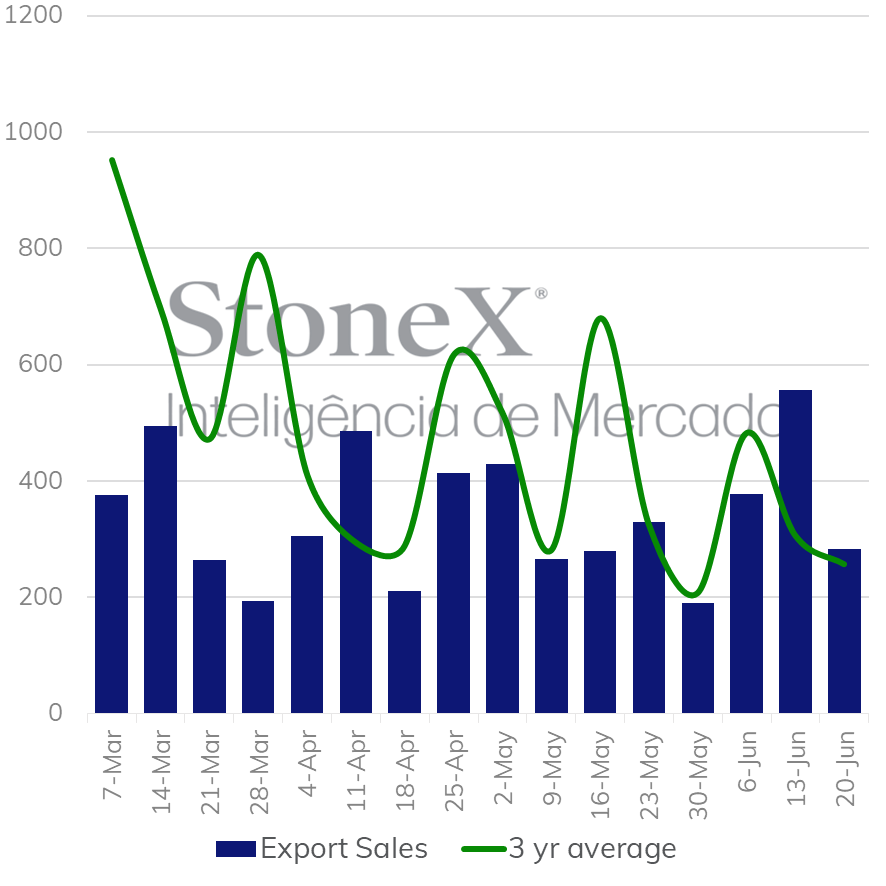
In the US, export sales for the 23/24 crop in the week ending July 20 were 282.9 thousand tonnes, below the estimated range of 300 to 600 thousand tonnes. A total of 44.6 million tonnes were negotiated, with China accounting for 78 thousand tonnes of the weekly sales. However, crushing margins in China are not favorable. Moreover, the possibility of adopting antidumping measures against pork products from Western countries reinforces the idea that China's pork industry continues to face challenges with tight margins.
Also on the demand side, soybean crushing in Argentina is on the radar, with 23/24 production recovering to around 50 million tonnes after a significant drop the previous year. Signs that processing levels have not yet returned to normal are being monitored. Last week's announcement of US soymeal sales to the Philippines was interpreted as a possible sign of tighter origin supply for soy products. Argentina stands out in soymeal and oil exports, and with production recovery this year, competition with Brazil and the US increases, especially for soymeal, given that domestic consumption in Brazil and the US remains high, driven by biofuels.
On Friday (28), the USDA's planted area and quarterly stock reports, highly anticipated by the market, were released. Regarding the area, the USDA indicated 34.84 million hectares, slightly below the average estimate of 35.11 million, and the planting intentions of 35 million hectares reported in March. Stocks on June 1st were 26.4 million tonnes, close to the market's average expectation of 26.18 million, indicating that the 23/24 crop consumption is in line with expectations. The report showed that US producers are holding more of their stocks due to more pressured prices, discouraging negotiations.
Right after the numbers were released, soybean prices in Chicago rose, but gains did not hold as the results did not indicate significant changes from the USDA's monthly supply and demand report (WASDE). In the next WASDE report, to be released on July 12, this new planted area will be incorporated, while adjustments to US productivity for 24/25 are expected to occur starting in August.
This week, the US crop is expected to continue influencing prices with the country’s crop progress report released today.