- Bearish factors
- World production in 24/25 widens the gap compared to consumption, according to the USDA;
- US court ruling unfavorable to biofuels;
- Pressured crushing margins in China;
- Concerns about the pace of global demand;
- Harvest completion in Argentina, strong crop;
- Favorable crop conditions in the USA.
- Bullish factors
- Incentive measures adopted by the Chinese government;
- Investment funds with a high short position;
- Heated crushing in the US;
- Conversion of plants to renewable diesel in California;
- USDA increases Chinese imports again.
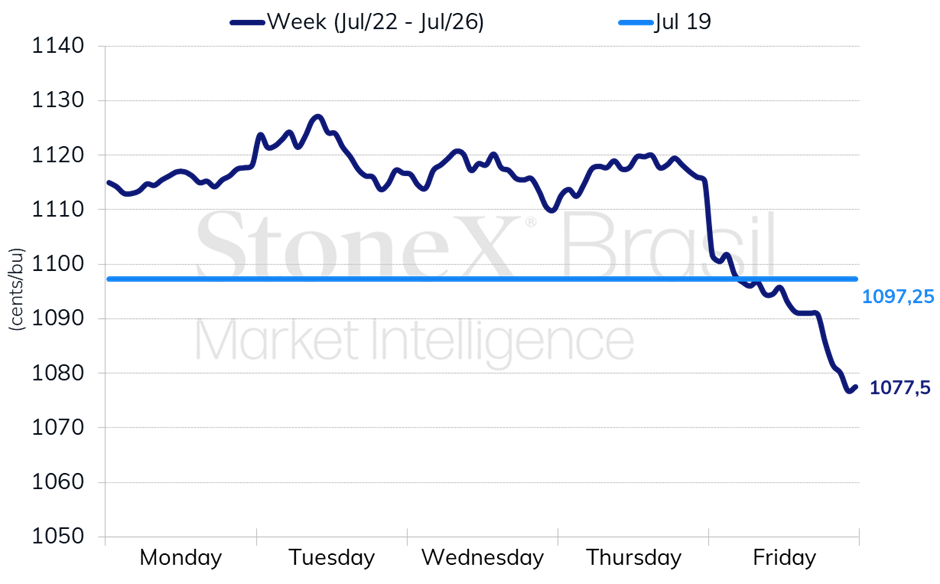
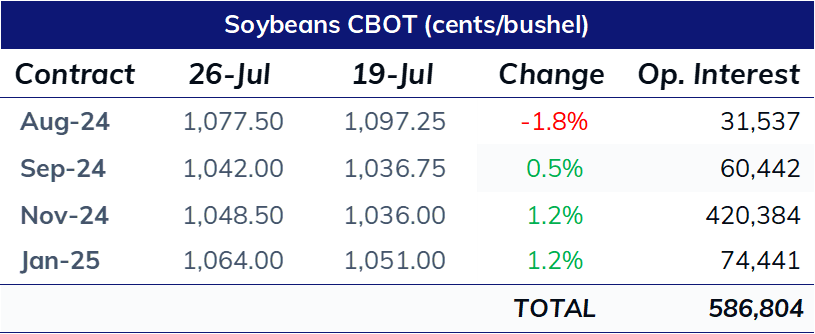
Soybean quotes in Chicago oscillated in the previous week to end the period with gains for the most distant contracts while the August expiration closed Friday (26) at 1077.5 cents per bushel, a 1.8% decrease in the period, influenced by lower volume.
It is worth highlighting the cuts in interest rates in China, interpreted as an effort by the country to stimulate its economy. With that, there was short-covering by the funds, after record levels were reached in the CFTC disclosure on 07/16.
Nonetheless, even with this effort from the Chinese government, there are doubts about the more direct impacts on the soybean complex, which is also related to other factors such as population growth. In any case, these incentive measures were well received, although it is still too early to perceive a more significant influence on the animal protein segment.
Despite this surprise with the interest rate cut by China, the American crop continues to be the center of attention, with its favorable progress maintaining pressure on soybean prices. The USDA's follow-up, for the week ending on July 21, once again maintained the good/excellent percentage of crops at 68%, a level well above the five-year average for the period. These favorable conditions, if maintained, can mean above-trend productivity.
The weather will continue to be closely monitored, with forecasts for this week indicating rain in most of the Midwest, with a focus on the eastern areas, while from next weekend, the pattern should become drier. Moreover, temperatures also tend to rise, after the milder levels of recent weeks. As soybean enters its critical grain-filling stage, if there is a persistent drought, for example, the current favorable scenario may change.
Regarding demand, it is worth noting that Brazil exported 7.7 million tonnes in the first three weeks of July, a still very high volume, which brought the total since the beginning of January to 71.9 million tonnes. As the 23/24 crop was smaller, due to weather issues, the next few months should be of weaker shipments. Anyway, even during the inter-crop period and with shipments having been very active in recent months, Brazilian soybean remains more competitive than the American one for China.
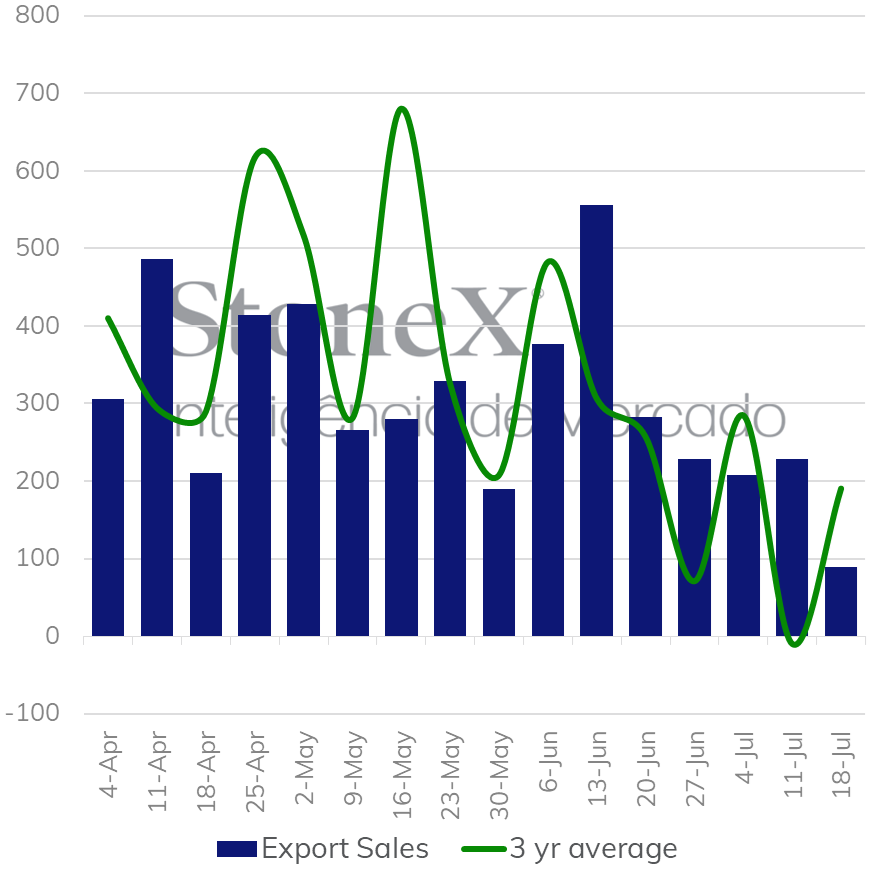
US export sales in the week ended July 18 reached only 88.6 thousand tonnes for the 23/24 crop and 829.7 thousand for the 24/25 cycle. In the case of the 23/24 crop, which ends in late August, even with this lower result, the USDA's export estimate for the cycle, at 46.3 million tonnes, is likely to be achieved.
On Friday (26), China announced new stimulus measures to boost consumption in the country, which could even reorganize/absorb some less profitable pork companies.
Nonetheless, soybean quotes fell sharply during the day, amid the good progress of the US 23/24 crop and under the influence of the sharp drop in soybean oil.
The vegetable oil was influenced by the news that a federal appeals court rejected a 2022 decision by the United States Environmental Protection Agency (EPA) that banned temporary exemptions from the need to blend biofuels into various small oil refineries, a measure that could reduce the demand for soybean oil. In recent years, the USA has been investing in the soybean oil-based biofuels segment, with a focus on renewable diesel, a situation that has strengthened and continues to strengthen domestic grinding. Thus, this decision has the potential to affect the domestic demand for American grain at a time when Brazil competes sharply in the export segment.
Any factor that may reduce the demand for soybeans always brings concerns, at a time when there are no major threats on the supply side, with the USDA estimating a significant difference between global soybean production and consumption.
With the significant drop in soybean quotes on the last trading day of the week, it is estimated that spec funds have resumed their short positions that had been covered in the early sessions of the period.
This week that begins, the American crop should continue to be the main factor on the supply side, with the weather and the possibility of a change to a drier pattern on the radar, with soybeans entering the grain-filling stage.
StoneX will release its first figures for the 24/25 crop in Brazil next Thursday (August 1).