- Bearish Factors
- Global production for 24/25 continues to outpace consumption, according to USDA;
- StoneX projects record productivity in the US;
- Concerns over the pace of global demand;
- StoneX forecasts record production for Brazil's 24/25 crop;
- Favorable crop conditions in the US;
- Delays in accumulated export sales from the 24/25 US crop year.
- Bullish Factors
- Incentive measures adopted by the Chinese government;
- Investment funds holding significant short positions;
- Strong soybean crushing activity in the US;
- Conversion of plants to renewable diesel in California;
- US considering limits on imports of used cooking oil (UCO);
- US soybeans are currently more competitive than Brazilian ones.
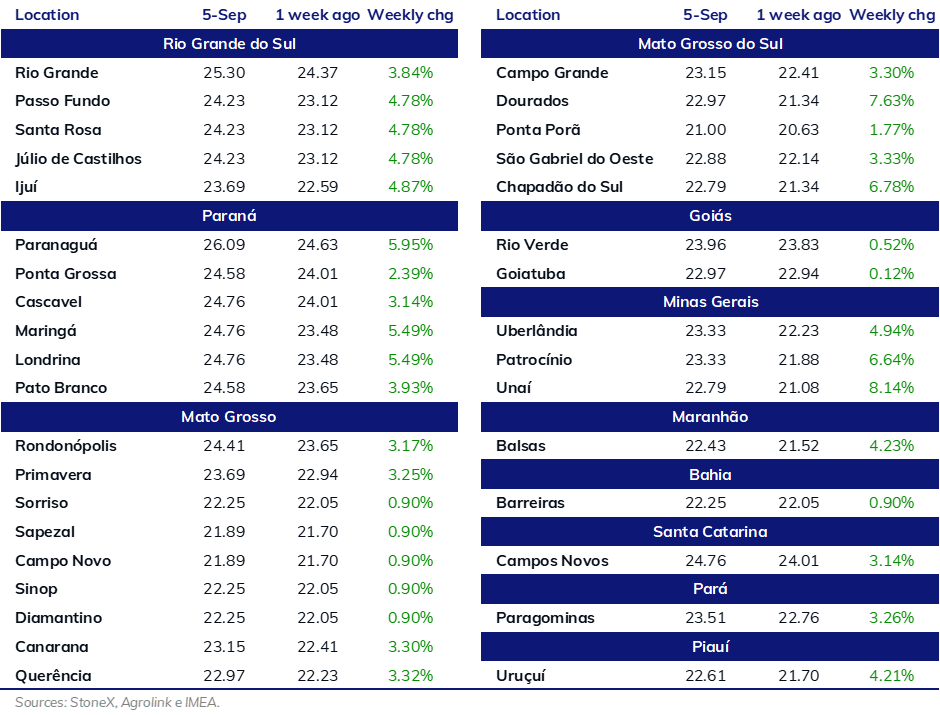
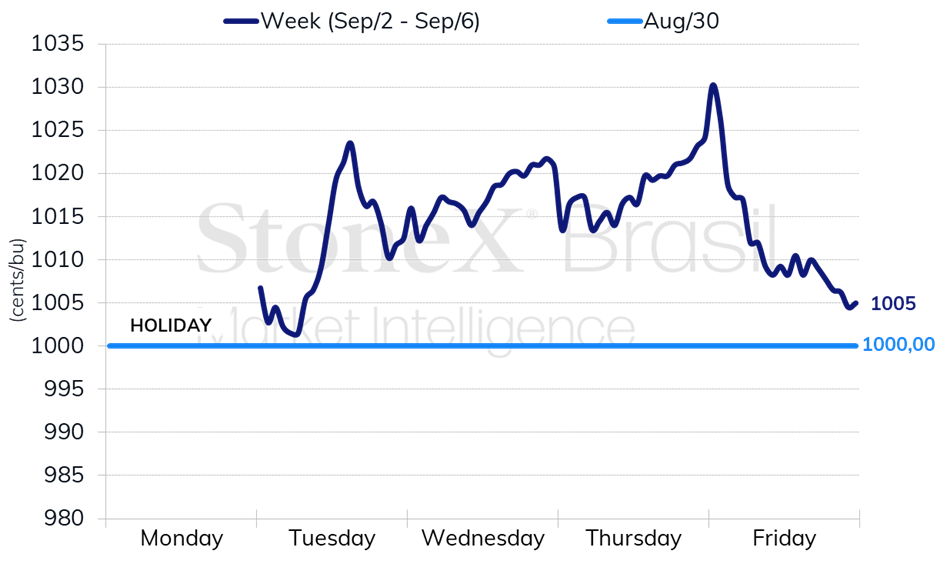
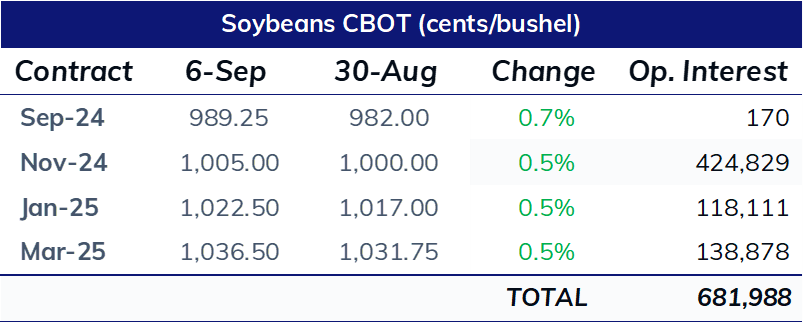
Soybean prices on the CBOT fluctuated last week but finished in positive territory. The November contract ended Friday (6) at 1,005 cents per bushel, a 0.5% gain for the week.
The progress of the North American crop remains under watch, with drier weather being a key factor. For the week ending September 1, crop conditions rated as good/excellent fell by 2 percentage points to 65%, still significantly higher than the 58% average for this period.
This slight decline has led to speculation about a potential record US crop, though current forecasts still point to the largest harvest in history, with record productivity likely. StoneX updated its estimate on Wednesday (4), following a productivity survey and incorporating USDA's official acreage. The expected yield increased from 3.54 to 3.56 tonnes per hectare, slightly below the USDA's August estimate of 3.58. This brings the production forecast to 124.5 million tonnes, just under the USDA’s projection of 124.9 million. The survey noted slight improvements in productivity across the major producing states, except Ohio. [Access the full data here.]
In Brazil, StoneX maintained its forecast for national soybean production at 165 million tonnes, representing a 10.8% increase compared to the 23/24 cycle.
As highlighted in the previous report, expected acreage growth is less than 1%, amid price pressures and the prospect of ample global supply. Regarding productivity, current projections remain in line with trend estimates, given that planting has not yet begun. To achieve these targets, favorable weather conditions are essential. However, much of the production region is currently experiencing drought. Thus, even if the sanitary vacuum ends before mid-September in some areas, drought conditions may hinder early planting.
On the demand side, the USDA released official July crushing data for the US, reporting a volume of 5.25 million tonnes, up 4.3% year-over-year. Typically, crushing volumes dip slightly at this time of year as plants undergo scheduled maintenance before the new crop harvest. Nevertheless, US crushing has remained strong, fueled by biofuel production, with a notable expansion in renewable diesel capacity.
Meanwhile, rumors persist that China is launching an anti-dumping investigation into Canadian canola in response to Canadian tariffs on Chinese electric vehicles. Canada is China’s largest canola supplier, and if these shipments are restricted, Canada may opt to crush and export the oil to the US to meet biofuel demand, thereby intensifying competition with soybean oil.
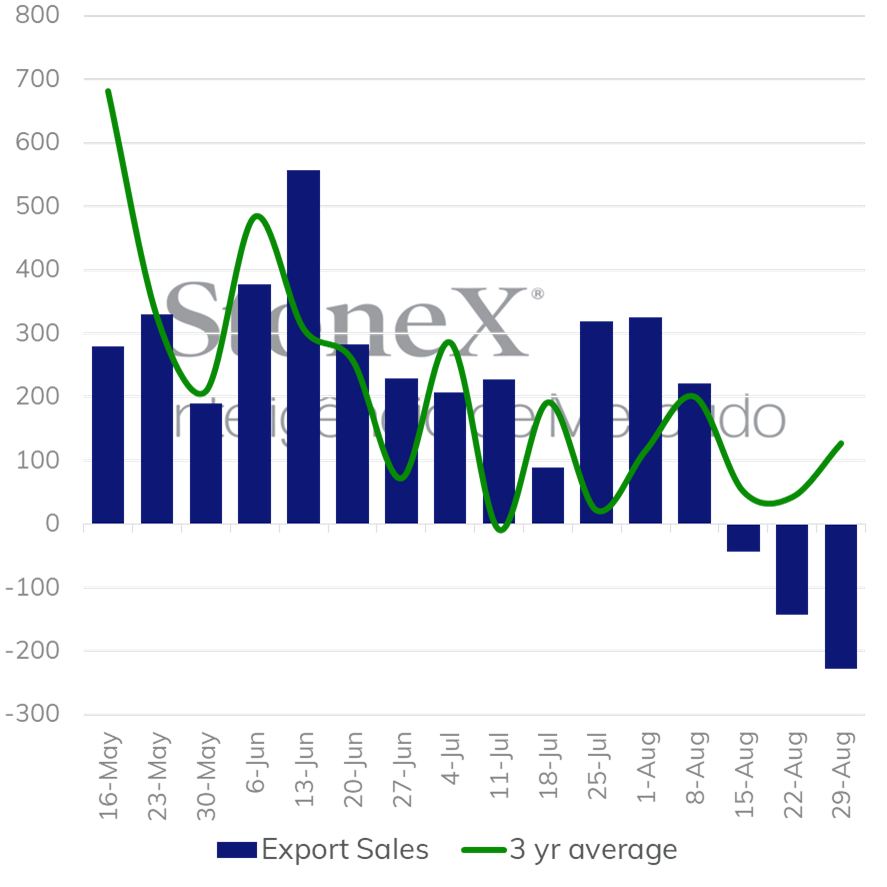
US export sales saw net cancellations of 227.9 thousand tonnes for the 23/24 crop year in the week ending August 29, while 1.66 million tonnes of soybeans from the 24/25 crop year were sold, within expectations of 800 thousand to 2 million tonnes. The 23/24 exports are on track to meet the US estimate of 46.3 million tonnes. However, sales for the new crop are slower than in previous years, with a shortfall of 4.1 million tonnes compared to the 23/24 cycle, despite USDA's expectation of a 4 million tonne annual increase in exports. Chinese purchases of the new crop are at their lowest level for this period in six years.
This week, attention will likely focus on updates to the US crop, especially with USDA’s monthly supply and demand report due next Thursday (12). In Brazil, weather will remain a key concern, with forecasts predicting continued drought across most of the country's producing regions over the next 15 days, though some heavier rainfall may occur in southern states.