- Bearish factors
- Global production for 24/25 considerably above consumption, according to USDA;
- Comfortable supply-demand balance in the US;
- Concerns about the pace of global demand;
- Record production estimate for Brazil's 24/25 crop;
- Favorable weather in South America;
- Uncertainty regarding subsidies for biofuels in the US.
- Bullish factors
- New stimulus measures adopted by the Chinese government;
- Short-covering by speculative funds;
- Strong production and consumption of renewable diesel in the US;
- Increased imports of vegetable oils by India.
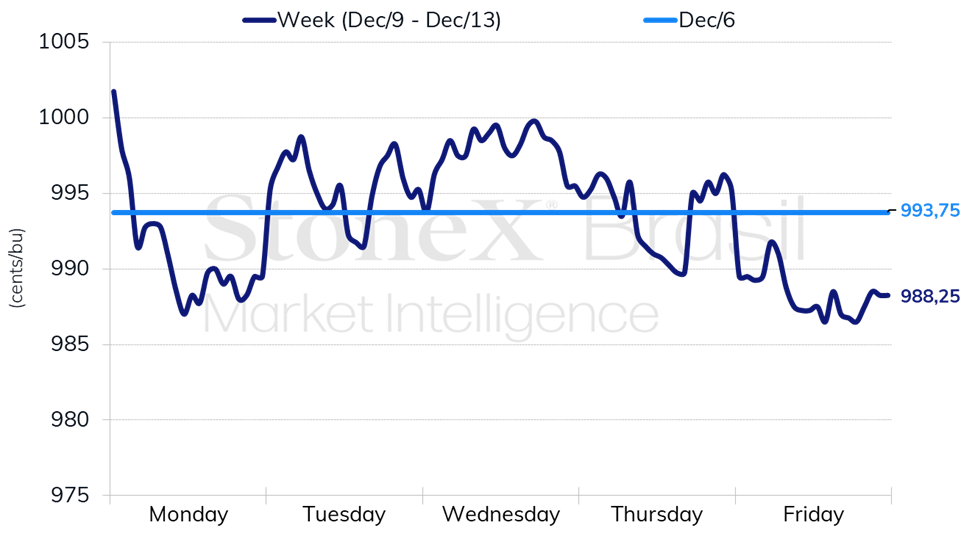
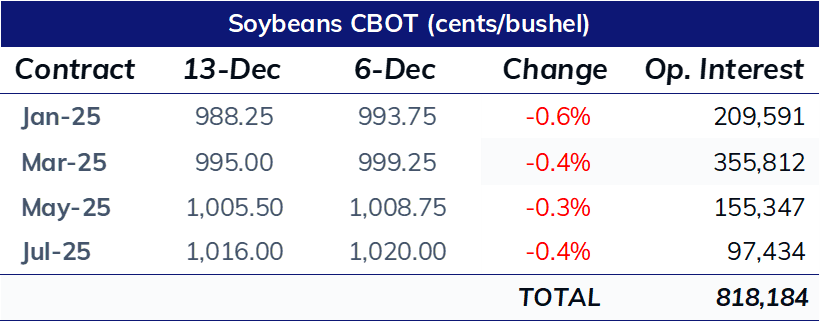
Soybean prices experienced another week of limited fluctuations in Chicago, remaining below USD 10.00 per bushel, reflecting favorable South American crop progress. The January contract closed on Friday (13th) at 988.25 cents per bushel, down 0.6% over the period.
In Brazil, planting of the 24/25 crop is nearing completion, reaching 97.4% last Friday (13th), according to StoneX. In Argentina, planting reached 64.7%, up 11 percentage points in a week, surpassing last year’s pace for the same period, according to the Buenos Aires Grain Exchange. Conditions remain favorable, with 99% of plants rated as normal or excellent.
Weather forecasts for the coming weeks indicate continued good rainfall across most of Brazil's production regions, which should benefit crop development, especially during reproductive phases critical for high yields. In Argentina, meanwhile, forecasts point to a drier pattern, but this is not a concern yet due to favorable soil moisture conditions. The province of Córdoba is the main area of concern. However, long-term forecasts do not suggest these drier conditions will persist for long.
Last week, Conab's Crop Survey reinforced the positive outlook for soybean crops in Brazil, with the estimated 24/25 production remaining stable compared to the previous report at 166.2 million tonnes—a record level consistent with StoneX estimates.
The USDA also updated its monthly supply and demand report. The department maintains its estimate for Brazil's crop at 169 million tonnes. For Argentina, USDA increased the 24/25 crop production estimate from 51 to 52 million tonnes, with an equivalent increase in crushing volume.
No changes were made to US and Chinese balance sheets, noting that USDA continues to estimate Chinese imports above the country's official figures. In November, China's soybean imports reached 7.15 million tonnes, slightly below the same month in 2023, but cumulative imports for October and November—the first two months of the 24/25 marketing year—were 1.2 million tonnes above the previous year.
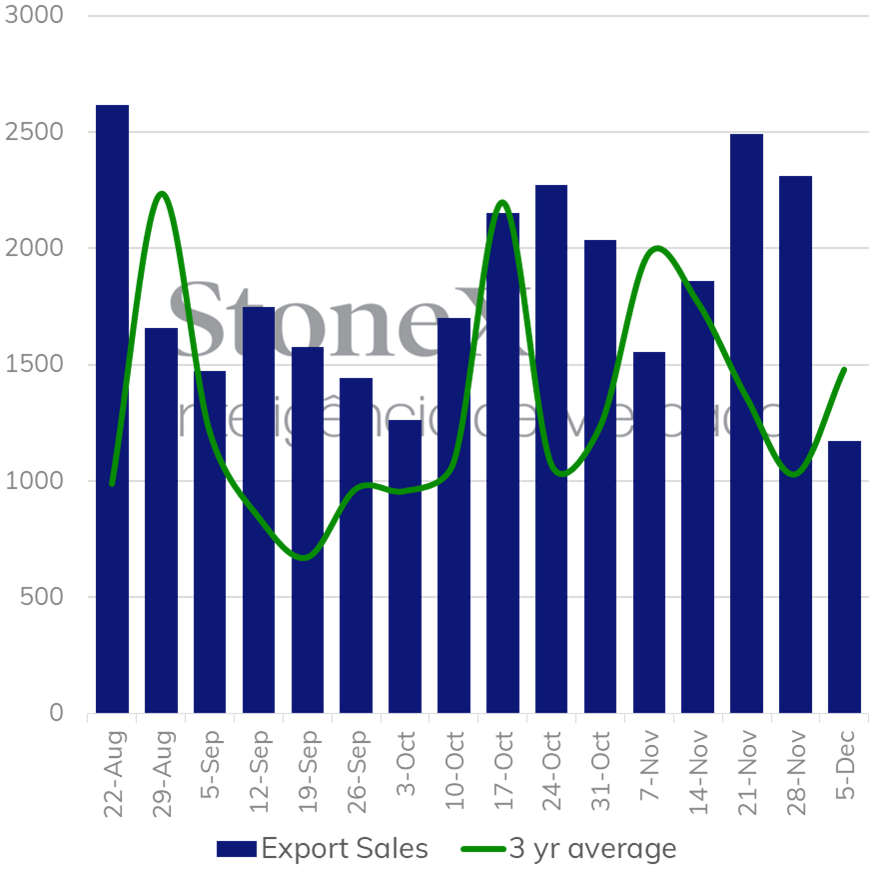
US export sales for the week ending December 5th were 1.17 million tonnes, at the low end of estimates ranging from 1.1 to 2.5 million tonnes. Still, cumulative sales to all destinations remain about 4 million tonnes ahead of last year's pace, with USDA estimating a 3.5 million tonne increase in annual exports.
Even so, it is important to highlight that Brazilian soybeans have gained competitiveness recently, despite US soybeans delivered to China still holding a slight advantage. With confirmation of a record crop in Brazil and harvest progress early next year, Brazilian soybeans are expected to become even more competitive.
In the US, uncertainties remain regarding the country's biofuel program, such as the renewal of credits after 2027 and the treatment of imported feedstocks. The renewable diesel sector has received significant investment in recent years, but its continued growth depends on policy predictability.
This week, attention should remain focused on South American crop progress and any news about biofuels in the US amid the transition of government. Additionally, speculation about potential tariffs under Trump remains ongoing.
It is also worth noting that the holiday season typically sees lower trading volumes, but with South American crops in the spotlight, any surprises could move the market.
On the next two Mondays (December 23rd and 30th), the soybean weekly report will be suspended, resuming on January 6th. Happy Holidays!!