- Bearish factors
- Global production for 24/25 exceeds consumption, according to USDA;
- U.S. supply and demand balance still comfortable;
- Concerns about the pace of global demand;
- Record production estimate for Brazilian crop 24/25;
- Full crop still expected in Argentina;
- Uncertainty about subsidies for biofuels in the U.S.
- Bullish factors
- New incentive measures adopted by the Chinese government;
- Short-covering by funds;
- U.S. 24/25 production cut;
- Drier weather in southern Brazil and Argentina;
- 24/25 soybean crop cut in RS due to weather conditions
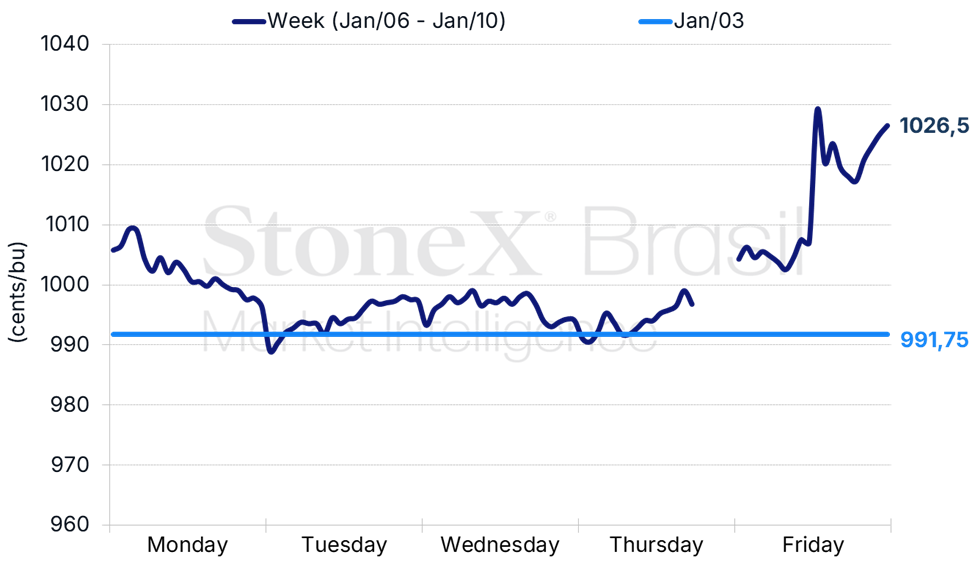
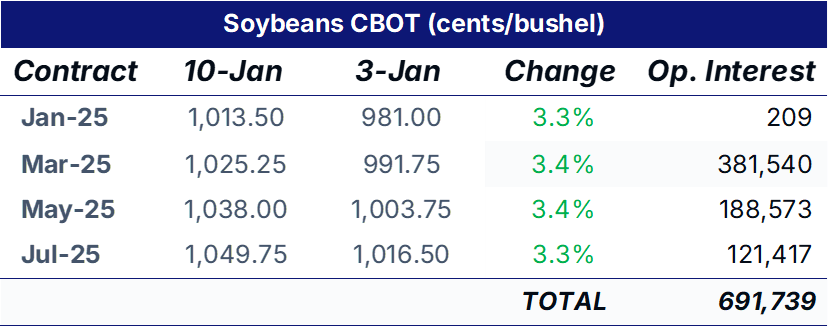
Last week, Chicago soybean prices rose amidst climate concerns in South America and after the USDA's monthly report update. The March contract ended Friday (10) at 1025.25 cents per bushel, up 3.4% for the period.
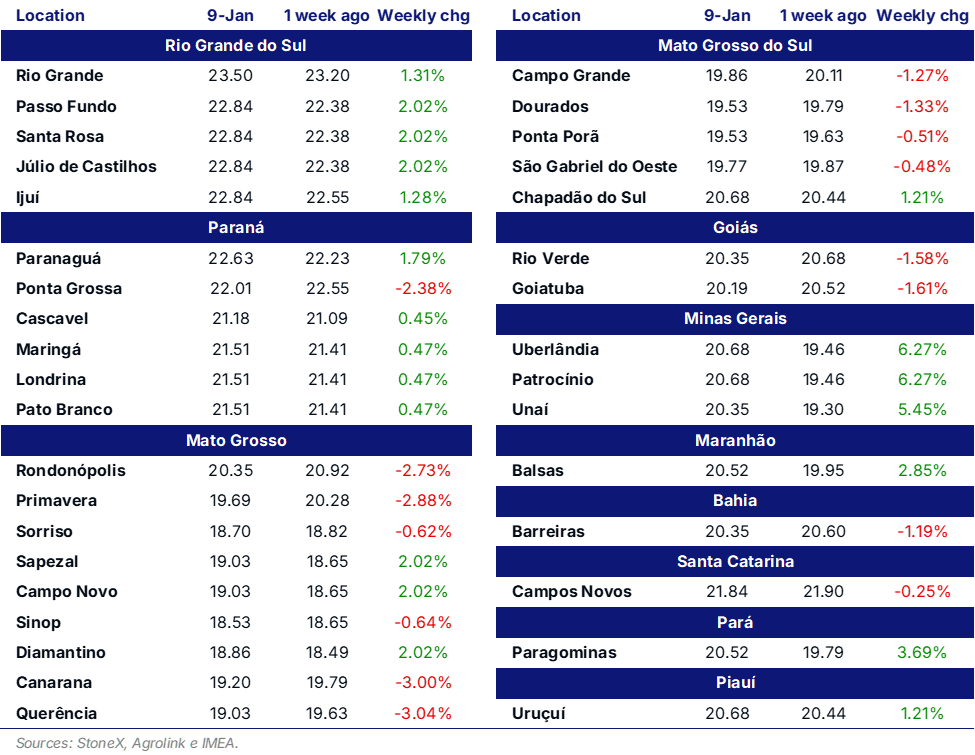
The South American crop is progressing with generally positive prospects, with record estimates in Brazil and a full crop in Argentina. However, drier weather in southern Brazil, São Paulo, and Mato Grosso do Sul in recent weeks, coupled with forecasts of significant rains only returning late January, has raised concerns and prompted productivity revisions in some areas.
Currently, Rio Grande do Sul is particularly under scrutiny as its soybean cycle is later, with part of the fields in critical development stages. According to a survey conducted by StoneX's Passo Fundo office, approximately 30% of the soybeans sown in the state are super early and early cycle and in critical development phases, totaling just over 2 million hectares out of the 6.9 million planted. Productivity losses, however, vary across different regions of the state, being most severe in areas such as the Northwest, Missões, and Central Region, which are key soybean production areas.
Therefore, Rio Grande do Sul's crop potential, previously estimated at 23.4 million tonnes, is now expected to reach around 20.98 million tonnes, a reduction of 10.5% or over 2.4 million tonnes. It should also be noted that this potential remains subject to further revisions, as the need for rainfall persists in several areas of the state.
Nonetheless, even with this reduction in Rio Grande do Sul's crop, the Brazilian 24/25 crop would still achieve a record, approaching 169 million tonnes. Moreover, while further cuts in the Center-South region of the country cannot be ruled out, other states may still record productivity and production levels higher than previously estimated. Early February will see StoneX release its crop update with revisions for the entire country, but based on current information, Brazilian production is expected to remain at record levels. Soybean harvesting has just begun, reaching 0.2% of the national average last Friday (10), according to StoneX's monitoring, with progress in the coming weeks beginning to consolidate estimated figures.
In Argentina, recent drier weather has also raised concerns, as the country’s soybean cycle is also later. Currently, according to the Buenos Aires Grain Exchange, 47% of the crops planted earlier in the season are in reproductive phases when rainfall is critical. Nonetheless, considering the total crop, which is 97% planted, the exchange’s survey indicates that 87% of the fields are in normal to excellent condition. Thus, for now, estimates still point to an expected crop, but weather remains a key factor.
With the harvest already underway in Brazil and Brazilian soybeans being more competitive than U.S. soybeans in Asian markets, the trend over the coming months is for Brazilian grains to increasingly regain dominance in the export market, which is usual given seasonality.
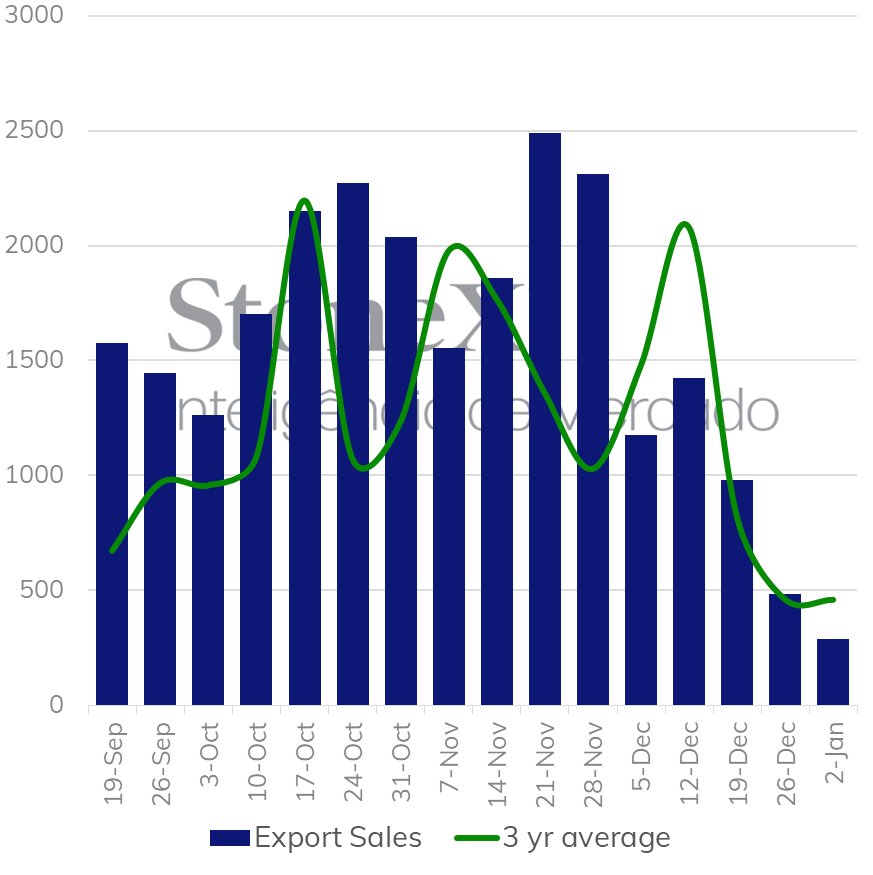
Currently, accumulated U.S. export sales for the 24/25 crop total 40.4 million tonnes, surpassing the same period last year, with negotiations with destinations other than China accelerating. For the week ending January 2nd, U.S. soybean export sales amounted to 288.7 thousand tonnes, below the lower end of estimates ranging from 400 thousand to 1.3 million tonnes. As the USDA projects an annual export increase to 49.7 million tonnes, these sales figures will continue to be closely monitored.
In the USDA’s monthly update released last Friday (10), there were no surprises on the U.S. demand side, but the 24/25 crop production revision was sharper than expected. The January report provides the “final number” for the country’s crop, and some reduction was anticipated, though the magnitude was unexpected.
The U.S. 24/25 crop production was revised down from 121.4 to 118.8 million tonnes, moving away from the previously projected record levels due to a reduction in average yield from 3.48 to 3.41 tonnes per hectare. Consequently, expected ending stocks for the ongoing cycle dropped by approximately 19%, reaching 10.34 million tonnes, with a stock-to-use ratio of 8.74%.
It’s noteworthy that the USDA did not revise production estimates for Brazil and Argentina or Chinese consumption. Thus, the lower U.S. production resulted in a reduction in global soybean production to 424.26 million tonnes, which is still nearly 19 million tonnes above projected global consumption.
Therefore, although the report provided support for soybean prices, the global balance remains comfortable. The primary factor that could alter this scenario remains the outcome of the South American crop.
This week, the market will continue to monitor weather conditions in Brazil and Argentina, with expectations of even drier weather in the southern part of the continent, and forecasts indicating more significant rainfall from next week onward.