- Bearish Factors
- Global production for 24/25 above consumption, according to USDA;
- Supply and demand balance still not tight in the US;
- Concerns about global demand pace;
- Estimated record production for Brazil's 24/25 crop;
- Uncertainty about subsidies for biofuels in the US.
- Bullish Factors
- New stimulus measures adopted by the Chinese government;
- Short-covering by funds;
- Reduction in US production for 24/25;
- Drier weather in southern Brazil and Argentina;
- Potential for Argentina's crop to fall below 50 million tonnes.
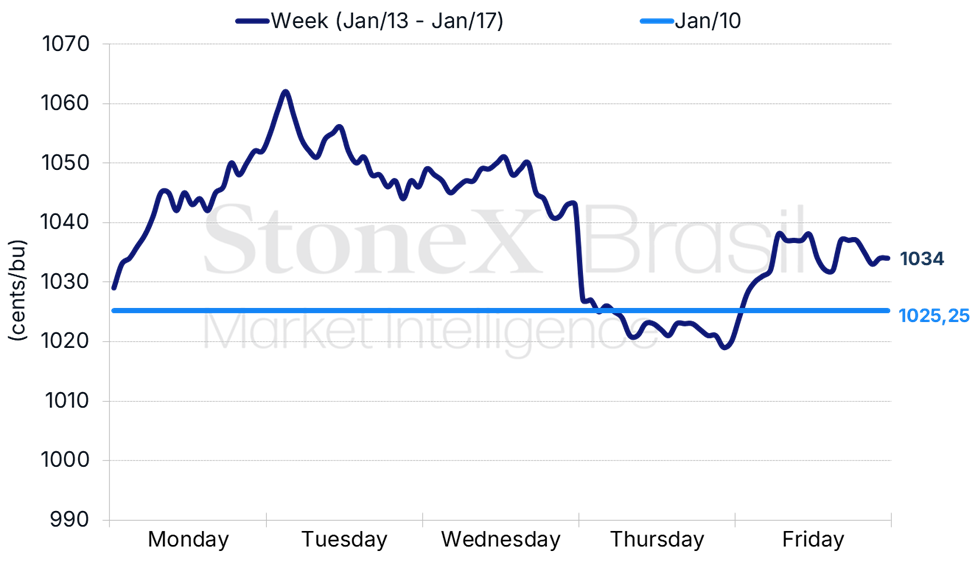
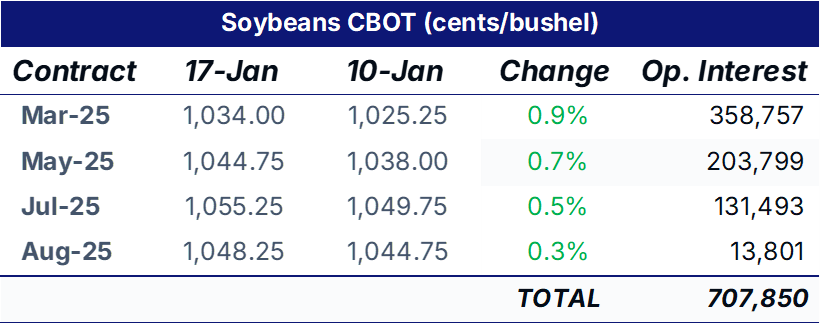
Last week, soybean prices continued to hold above USD 10.00 per bushel, despite declines in some sessions, and ended the week with gains, with March contracts closing at 1034 cents per bushel, a 0.9% weekly increase.
The soybean market continued to find support in climate concerns in South America, doubts about US biofuel programs, and speculation about the new Trump administration.
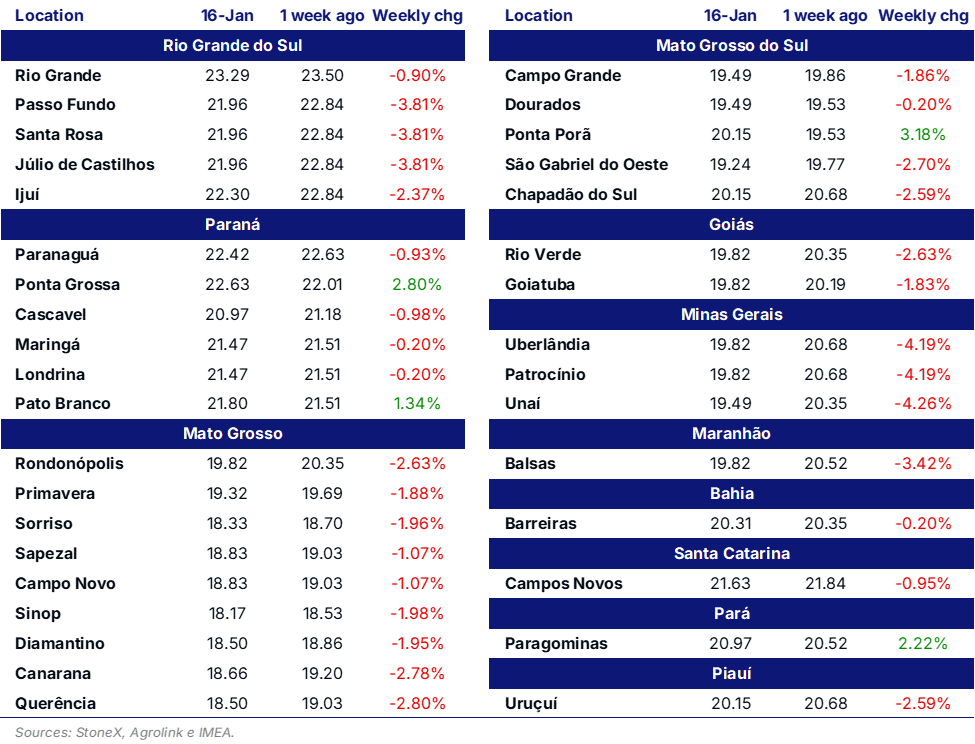
Regarding the crops in Brazil and Argentina, weather forecasts continue to point to drier conditions in southern Brazil and the neighboring country this week, with significant rainfall expected only in the 7 to 14-day range. As previously highlighted, StoneX has already estimated productivity losses in Rio Grande do Sul, especially considering ultra-early and early cycle varieties, which were in critical stages and are suffering more from the water deficit. Consequently, the potential harvest in Rio Grande do Sul, previously estimated at 23.4 million tonnes, has been revised to around 20.98 million tonnes.
It is worth noting that Mato Grosso do Sul is also facing weather-related challenges, along with some areas in Paraná. Nonetheless, it is essential to point out that even with a reduction in productivity in southern Brazil, the national crop is still expected to be a record one, with other states possibly seeing positive production revisions. As the harvest progresses, more accurate numbers will likely emerge in the coming weeks.
Argentina has also faced a similar situation of lack of rain, worsening crop conditions, with some estimates indicating that national soybean production may fall below 50 million tonnes.
Despite these climatic issues, for now, virtually all estimates continue to forecast a record crop for Brazil. Conab released its crop survey, keeping production practically unchanged at just over 166 million tonnes. USDA also did not adjust its numbers, estimating Brazilian production at 169 million tonnes.
In the US, besides speculation regarding potential Trump administration measures that could impact agribusiness, the market is monitoring biofuel programs with fears that the Republican government might not maintain the same incentives. On the other hand, there is some optimism regarding a possible ban/restriction on used cooking oil (UCO) imports, which could benefit the domestic soybean oil market.
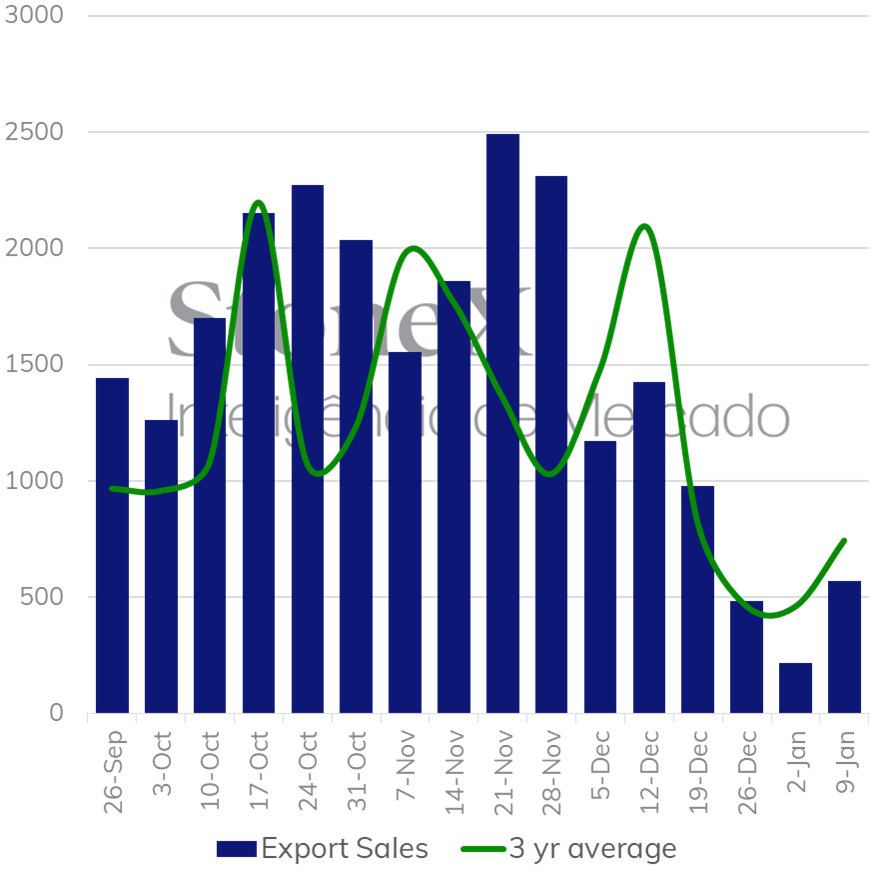
On the export side, the US remains less competitive than Brazil for China, a trend that should be reinforced as the Brazilian harvest progresses. US export sales for the 24/25 crop year reached 569,100 tonnes in the week ending 01/09, within the estimated range. Accumulated sales have reached 40.9 million tonnes compared to 37.4 million during the same period last year. This positive difference is due to sales to countries other than China, which are 4.4 million above last year, while sales to the Asian country are nearly 1 million tonnes weaker.
Another highlight is the activity of funds, with speculative agents covering short positions more intensely. The latest disclosure, for the week ending 01/14, indicates an increase of over 63,000 contracts in net long positions, which became positive at 34,800 contracts after speculative funds had been net short throughout 2024.
It is important to note, however, that even with a stronger influence of bullish factors in recent weeks, the global soybean supply and demand balance remains comfortable despite potential losses in South America. Thus, the climatic situation in the region will remain a key focus, as adverse weather could alter soybean availability expectations in the coming months.
Amidst this scenario, the main factor to monitor this week will be the weather, with the market evaluating forecasts and potential impacts on crops. Additionally, the first days of Trump's second term will also be closely watched.