- Bearish factors
- Global production for 24/25 exceeds consumption, according to the USDA;
- Supply and demand balance still not tight in the US;
- Concerns over the pace of global demand;
- Record production estimate for the Brazilian 24/25 harvest;
- Doubts about subsidies for biofuels in the US.
- Bullish factors
- New incentive measures adopted by the Chinese government;
- Short covering by funds;
- Reduction in US production for 24/25;
- Drier weather in southern Brazil and Argentina;
- Argentinian harvest estimates below 50 million tonnes.
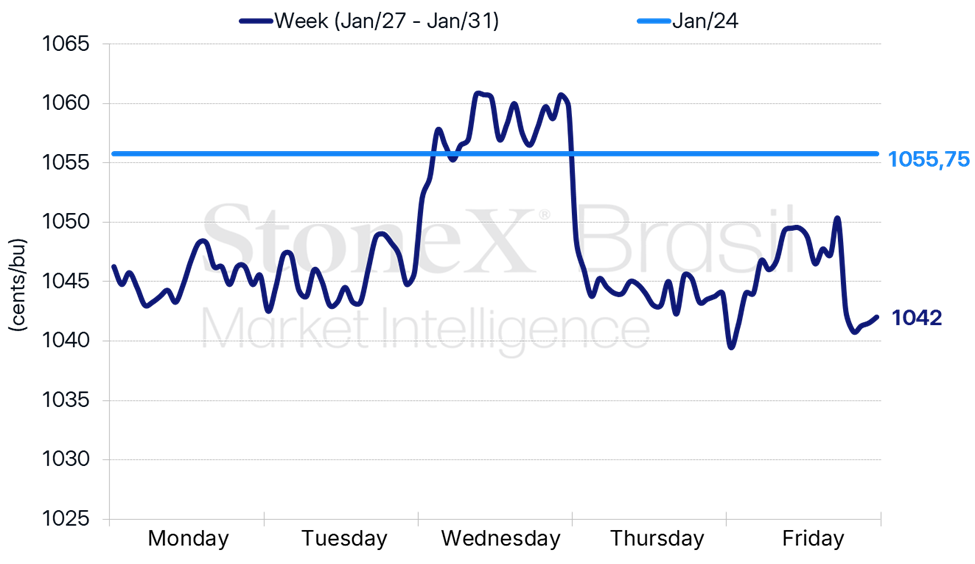
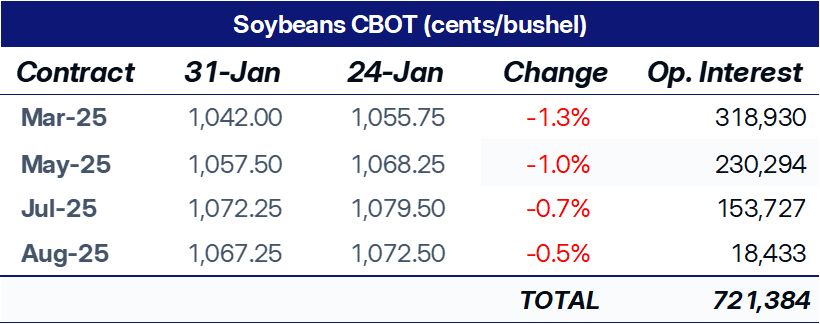
Soybean prices in Chicago fluctuated last week and ended the period in decline, with the March contract closing on Friday (the 31st) at 1042 cents per bushel, a decline of 1.3% for the period.
The market continued to monitor the progress of the South American crop and the geopolitical tensions between the US and other countries, such as Colombia, neighboring Mexico and Canada, and China.
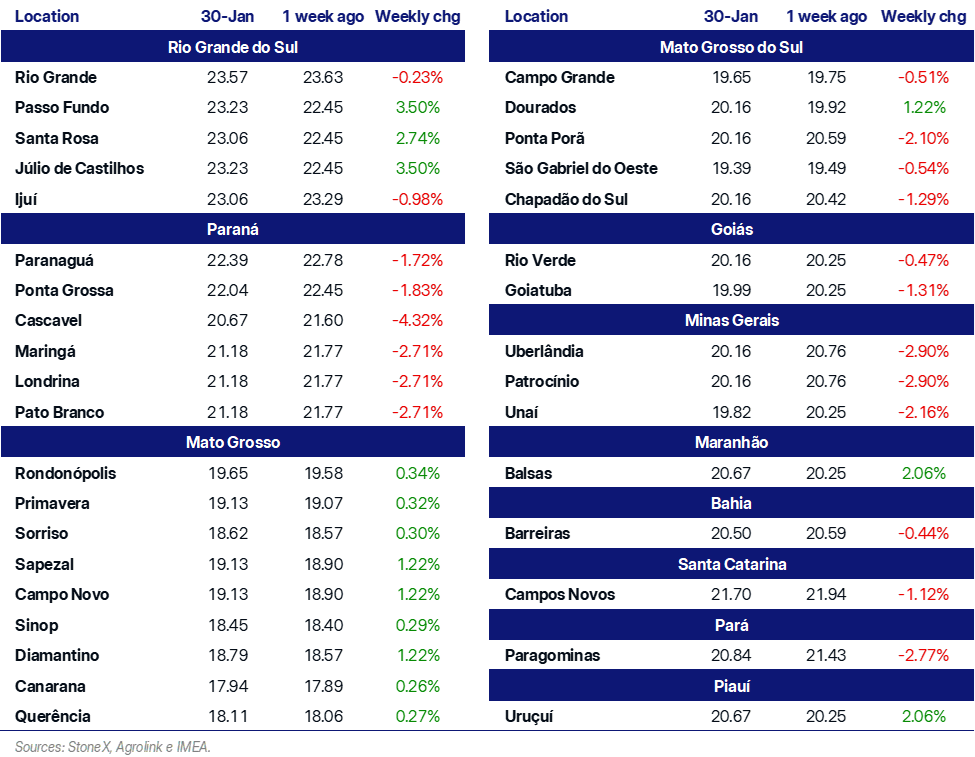
In Brazil, last week saw more widespread rains in the soybean-producing regions, a situation that alleviated concerns over the drier areas, which had been suffering from a lack of precipitation since the end of December. Notably, in Rio Grande do Sul, where the soybean cycle is later and lower humidity has already affected productive potential, the state received more rains last week; however, additional precipitation is needed to ensure plant development. On the other hand, although rains were recorded across almost the entire country, the volumes were lighter in the Central-West regions, which were experiencing field delays due to excess moisture. The soybean harvest is still behind compared to last year, but significant progress was made last week, with the national average reaching 9.7% on Friday (the 31st), according to a StoneX survey. Even so, it is noteworthy that the harvest in Mato Grosso is at 17.8%, compared to 33.1% at the same period a year ago. For the next two weeks, rains are expected throughout the country, but generally in lighter volumes, with heavier precipitation concentrated from the northern half of Mato Grosso upward. In any case, expectations for the soybean harvest are very positive in several states, such as Goiás, Mato Grosso, and Minas Gerais. See more in the StoneX Crop Estimate, which was just updated this Monday (the 03rd).
In Argentina, rains were also recorded last week, but the volumes remained lighter. The Buenos Aires Stock Exchange indicated that soybean planting in the country has been completed, with the percentage of fields with adequate/excellent water conditions increasing by only 3 percentage points to 58% of the crops, while 42% still face regular/dry conditions. Regarding crop conditions, there was a decrease in the percentage of good/excellent ratings from 22% to 20%, with an increase in the normal rating from 50% to 52%, while the share of crops in poor condition remained stable at 28%. Over the next 14 days, rains are expected in the country, but primarily concentrated from February 10 onwards. February precipitation is crucial to ensure good production in the country, which has already experienced some negative revisions in productivity.
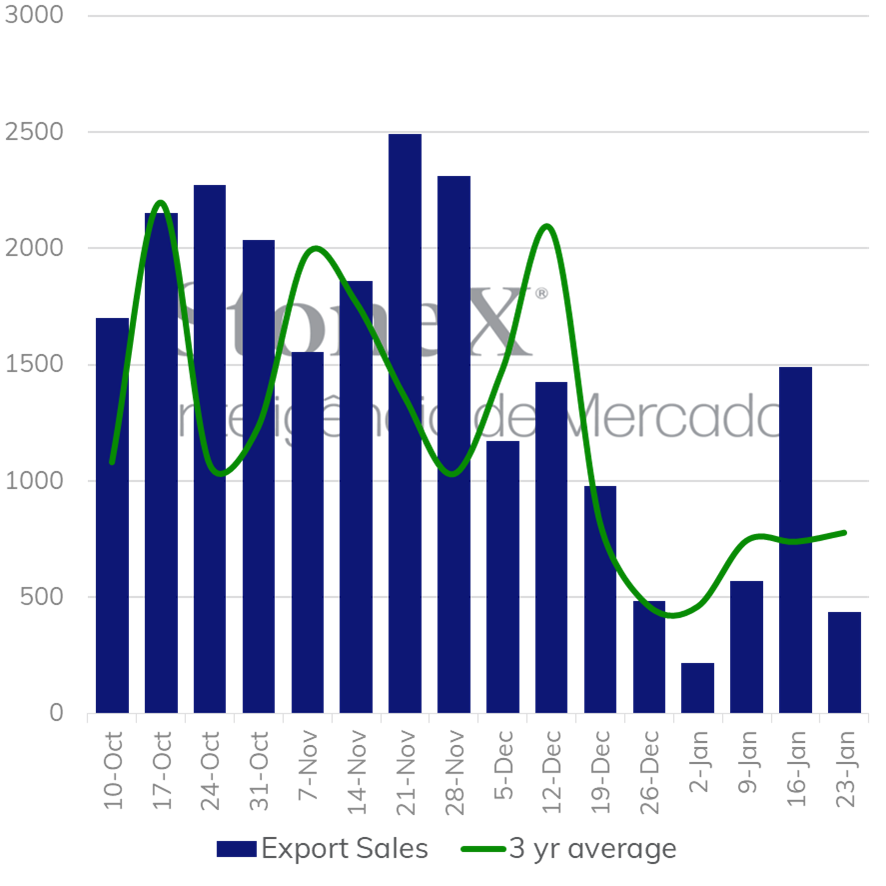
In the US, export sales for the 24/25 crop, in the week ending on 23/01, reached 438 thousand tonnes, a volume below the lower bound of estimates, which ranged from 450 thousand to 1.7 million tonnes. Cumulatively, 42.7 million tonnes were traded. Even with this weekly drop in trades, the cumulative figure is still on pace to reach the shipment level estimated by the USDA at 49.7 million tonnes.
With the harvest advancing in Brazil and Brazilian soybean already more competitive than its US counterpart, US trading should remain in focus, especially given the geopolitical tensions. The Trump administration imposed tariffs of 25% on products imported from Canada and Mexico, and 10% on products imported from China, effective from last Saturday (the 01st). There are still many uncertainties regarding these tariffs, but the affected countries have already confirmed that they will retaliate. In the case of China, if US soy is taxed, as happened during Trump’s first term, the Brazilian product could become even more competitive.
Also regarding the tariffs of the new US administration, over the previous weekend there was a dispute with Colombia after the country refused the landing of US military aircraft carrying immigrants. As a result, there were threats of tariffs and retaliations, which raised concerns about US soybean meal exports to Colombia. However, the two governments reached an agreement and the potential tariffs did not come into effect.
Additionally, US incentives for biofuels also remain on the radar. Even amid uncertainties, the announcement of a 25% tariff on imports from Canada could be beneficial for the US soybean oil market, as it would tend to undermine the competitiveness of Canadian canola oil.
This week, the progress of the South American harvest should continue to be closely monitored, along with the issue of tariffs imposed by the US and possible retaliations by the affected countries.