- Bearish factors
- Global 24/25 production exceeds consumption, according to the USDA;
- US supply and demand balance remains unstrained;
- Concerns about the pace of global demand;
- Record production estimate for the Brazilian 24/25 crop;
- Rainfall in Argentina;
- Doubts about subsidies for biofuels in the US.
- Bullish factors
- New incentive measures adopted by the Chinese government;
- Short covering by funds;
- Reduction in US production for 24/25;
- Loss of potential in the Argentine crop.
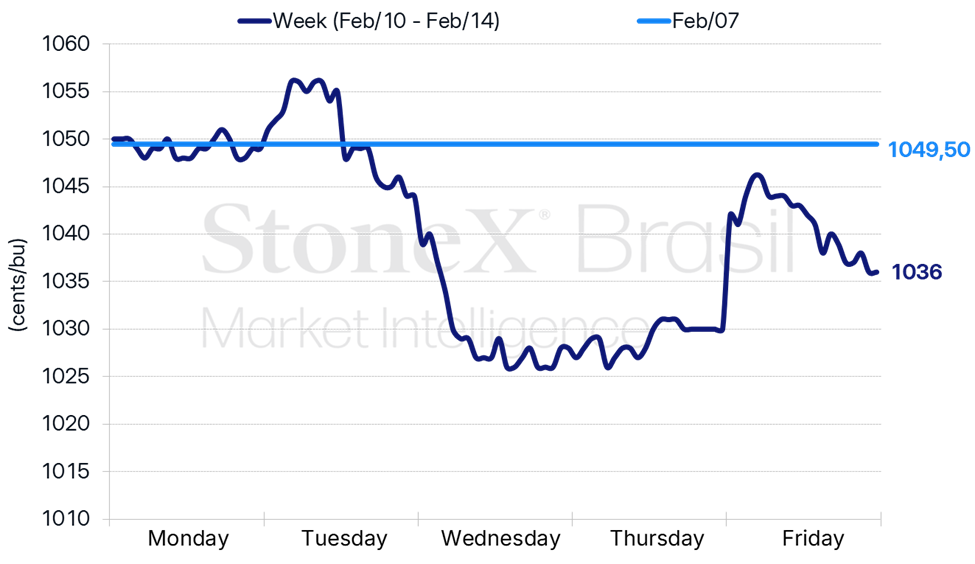
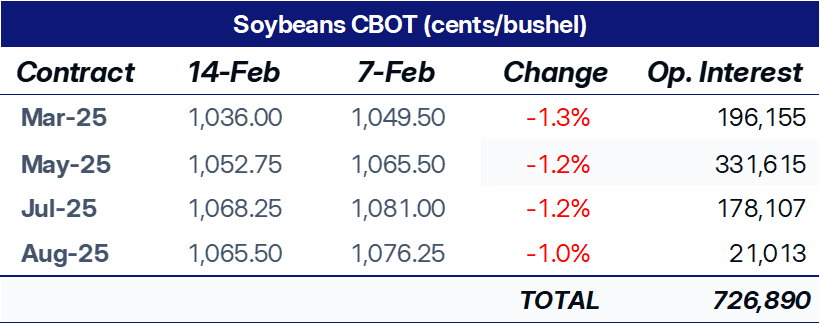
Last week, soybean prices in Chicago ended in negative territory, with the March contract closing Friday (the 14th) at 1036 cents per bushel, a drop of 1.3% over the period.
The persistence of positive prospects for the Brazilian 24/25 soybean crop, while the estimated losses for Argentina are not very large, continued to limit more sustained gains for the oilseed. At the same time, the market is monitoring the relationship between China and the US, which, at least for now, has not directly impacted the soybean market.
The USDA’s monthly update maintained its estimate for Brazilian production at 169 million tonnes while reducing Argentina’s figure from 52 to 49 million tonnes. There was also a downward revision for Paraguay, whose estimate dropped from 11.2 to 10.7 million tonnes. Even with these cuts, it is noteworthy that the global production estimated for the 24/25 cycle still exceeds consumption expectations by more than 14 million tonnes, a situation that maintains a more comfortable scenario for the oilseed. No changes were made to the Chinese balance.
Conab also updated its monthly crop estimate, which now stands at 166 million tonnes—a marginal decrease from the 166.3 million tonnes reported in January. The company highlighted losses in productive potential in Rio Grande do Sul and parts of Mato Grosso do Sul, but emphasized that conditions in most states remain very positive.
As previously noted, other private estimates continue to bet on a record Brazilian crop, such as StoneX’s latest figure of 170.9 million tonnes.
In Argentina, the Rosario Stock Exchange lowered its estimate for the country’s soybean crop to 47.5 million tonnes, falling below the 50 million expected at the start of the cycle. Argentina suffered from a lack of rainfall and high temperatures that damaged some fields during key developmental stages. The Buenos Aires Stock Exchange continues to maintain its crop figure at 49.6 million tonnes, with over 60% of the soybeans in normal/excellent growing conditions, even after the recent heat wave. Nevertheless, the percentage of fields in poor condition increased from 32% to 36% over one week, with the country’s weather continuing to be closely monitored. Over the next 15 days, forecasts indicate good rainfall in Argentina, with the highest volumes expected in the last week of February.
In Brazil, rainfall is also expected over the next two weeks, with the highest volumes likely to be concentrated in the South, in Mato Grosso, parts of Goiás and MATOPIBA, as well as across the North region. The harvest is ongoing, having advanced by just over 10 percentage points last week, reaching 26.9% compared to 32.3% at the same time last year.
Regarding demand, Brazilian soybean exports are weak at the start of the year, which is usual, with official preliminary data showing just over 1 million tonnes in January and 348 thousand tonnes in the first week of February (up to the 7th). In any case, lineup data indicate that shipments should gain considerable momentum in February, highlighting that Brazilian soybeans for China remain more competitive than those from the US.
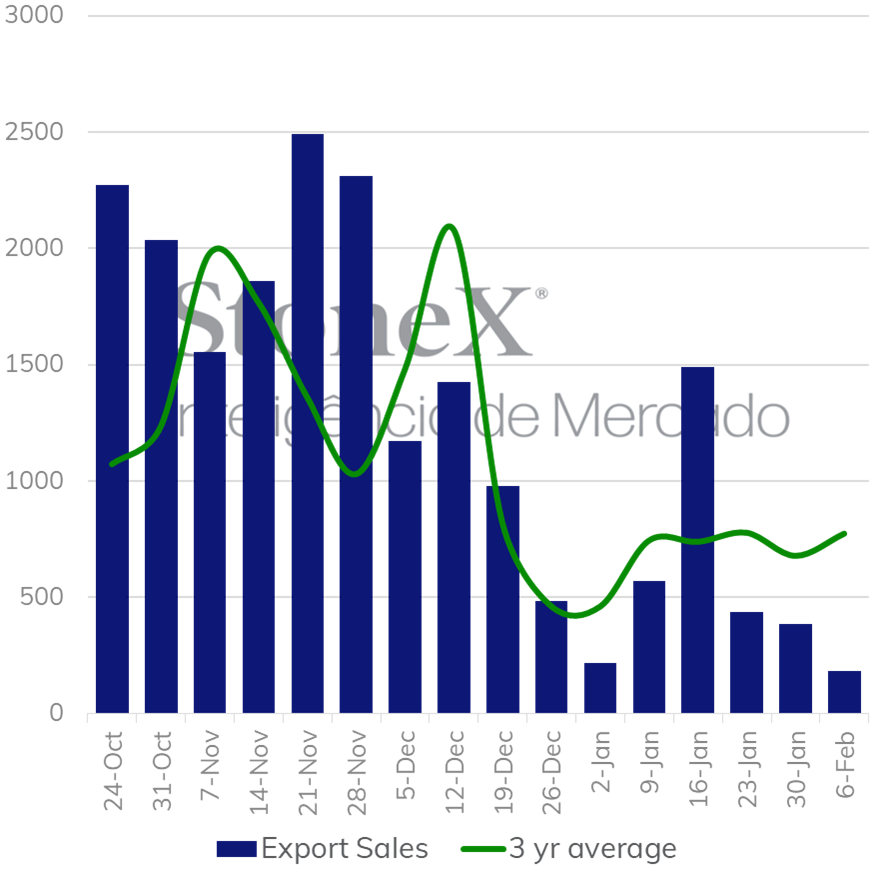
In this context, US export sales of the 24/25 soybean crop for the week ending on 06/02 reached only 185.5 thousand tonnes, against estimates ranging from 300 to 800 thousand. Cumulatively, 43.2 million tonnes have already been traded, a level that remains above what is necessary to reach the US annual export estimate of 49.67 million tonnes by the end of August. Even so, the cumulative figure for China is about 1 million tonnes below that recorded in the same period last year, while other regions purchased 5.6 million tonnes more on an annual basis.
In the coming days, South American weather is expected to remain on the radar, along with possible measures by the Trump administration, in a shorter week due to the President’s Day holiday this Monday (the 17th).