- Bearish factors
- Global production for 24/25 exceeds consumption, according to the USDA;
- Supply-demand balance still not tight in the US;
- Concerns about the pace of global demand;
- Estimate of record production for the Brazilian 24/25 crop;
- Improvement in crop conditions in Argentina;
- Concerns over possible Chinese retaliation to Trump’s tariffs.
- Bullish factors
- New incentive measures adopted by the Chinese government;
- Hot and dry weather in parts of South America;
- Estimate of a decline in planted area for the US 25/26 crop;
- Loss of potential in the Argentine crop;
- StoneX cuts Brazilian crop forecast to below 170 million tonnes.
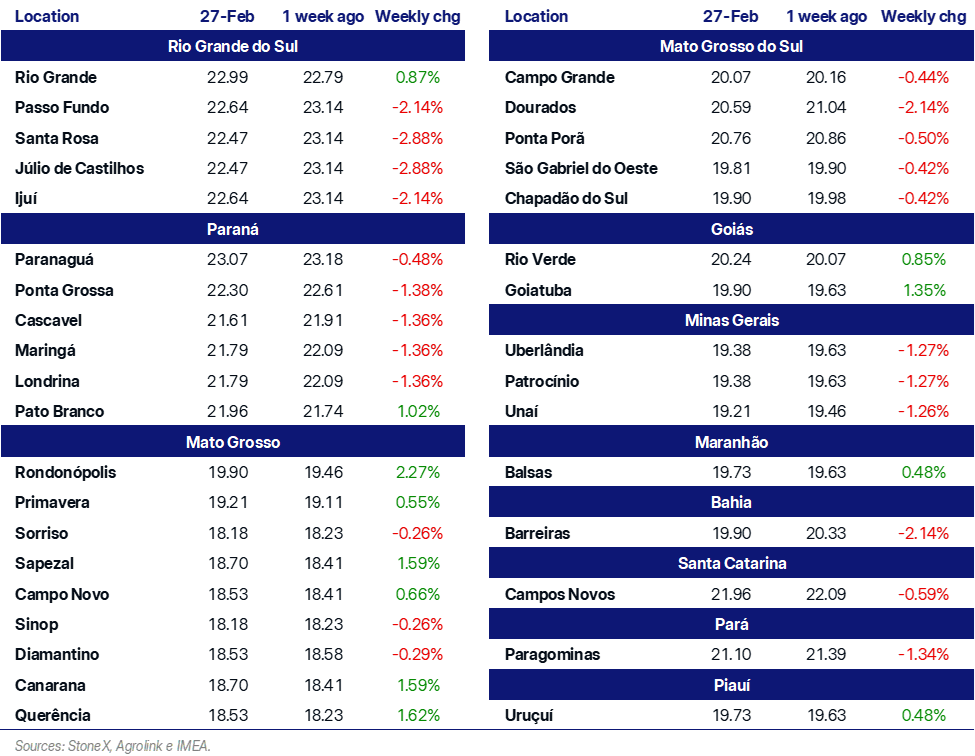
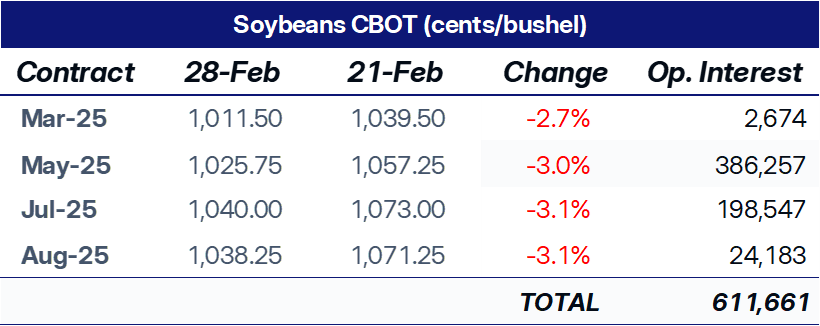
The soybean quotes in Chicago ended the last week of February in decline, with the May contract expiring on Friday (the 28th) at 1025.75 cents per bushel—a 3% drop over the period. In addition to the progress of the South American crop, the data from the USDA Agricultural Forum and concerns over possible retaliation to the tariffs announced/implemented by the Trump administration stand out.
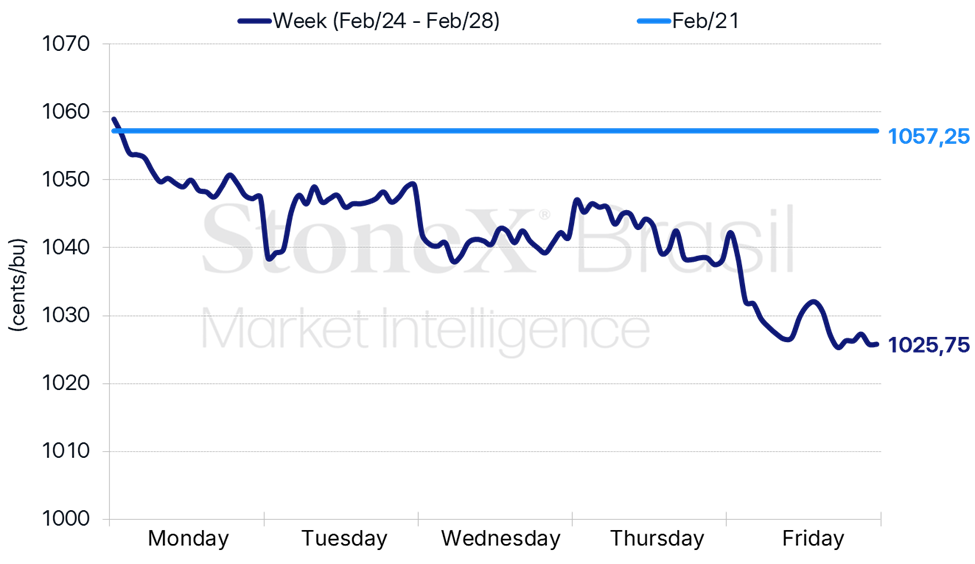
In Brazil, the soybean harvest surpassed 50% last Friday (the 28th), according to StoneX, slightly above the level recorded at the same time last year. Overall, the outlook for the Brazilian crop remains positive, indicating a record harvest; however, StoneX lowered its estimate from 170.9 to 168.3 million tonnes due to new productivity cuts in Rio Grande do Sul, Paraná, and Mato Grosso do Sul. Notably, there was a further reduction of more than 4 million tonnes in the Rio Grande do Sul crop, reflecting the dry weather at the start of the year. Although other states such as Mato Grosso, Goiás, São Paulo, and Minas Gerais recorded productivity gains, they were not enough to offset the losses in the South. Follow the complete figures here.
In Argentina, the Buenos Aires Stock Exchange continues to maintain its estimate at 49.6 million tonnes, highlighting the recent improvement in weather, especially in the central region. On the other hand, in the northern part of the country’s agricultural region, the weather remains drier with elevated temperatures. Thus, the improvement in crop conditions was modest, with the percentage of normal/excellent rising by only 1 percentage point to 67%, while the percentage of crops with adequate/optimal water conditions advanced by only 2 percentage points, reaching 69%.
In Argentina, the Buenos Aires Stock Exchange continues to maintain its estimate at 49.6 million tonnes, highlighting the recent improvement in weather, especially in the central region. On the other hand, in the northern part of the country’s agricultural region, the weather remains drier with elevated temperatures. Thus, the improvement in crop conditions was modest, with the percentage of normal/excellent rising by only 1 percentage point to 67%, while the percentage of crops with adequate/optimal water conditions advanced by only 2 percentage points, reaching 69%.
As mentioned in the previous report, the USDA held its annual Agricultural Forum, which provided the first figures for the US 25/26 crop. Although producer surveys were not considered—with the numbers based on fundamentals and projection models—there was a cut in the US planted area for the 24/25 cycle, down to 34 million hectares (compared to 35.2 million last year), due to lower prices compared to corn. Productivity within the historical trend would reach 3.53 tonnesper hectare, resulting in production of 118.9 million tonnes, virtually stable compared to the 2024 harvest. On the demand side, the Forum expects an increase in exports and domestic consumption, with estimates that the total use of the oilseed would rise by 2.7 million tonnesto 121.1 million. With production remaining virtually stable, ending stocks would tend to fall, estimated at 8.7 million tonnes with a stock-to-use ratio of 7.2%. Even so, this initial projected balance does not indicate a restrictive situation in the US, and it does not bring major changes to the global balance. Moreover, the export and crushing estimates were considered somewhat optimistic.
In any case, it is early, and much will still change regarding the 25/26 crop, noting that the first US planted area figure—based on information gathered from producers—will be released at the end of March in the planting intentions report.
Regarding the US, export sales for the 24/25 crop in the week ending on 20/02 reached 410.9 thousand tonnes, with a cumulative total of 44.1 million tonnes, above last year. Sales to China remain below last year’s levels, but other destinations are more than compensating. Check the complete figures here.
Soy prices were also pressured by the issue of tariffs announced by the US, which are set to take effect tomorrow (the 04th), affecting Mexico, Canada, and China. Trump indicated that he might raise tariffs on Chinese products to 20%, a situation that is expected to result in retaliation from China, potentially impacting US agricultural and food products.
This week, the market is expected to follow the unfolding of geopolitical tensions, as well as the progress of the South American crop, with forecasts of very high temperatures in Rio Grande do Sul and Argentina.