Bearish factors
- Record area and production estimate in Brazil;
- US export sales below the same period of the previous cycle;
- Shipment disruption in the Gulf region after hurricane Ida;
- Concern about the coronavirus delta variant might affect demand.
Bullish factors
- Possibility of a new La Niña;
- Higher than expected crushing in the US in August;
- US balance sheet situation still indicating restricted stocks.
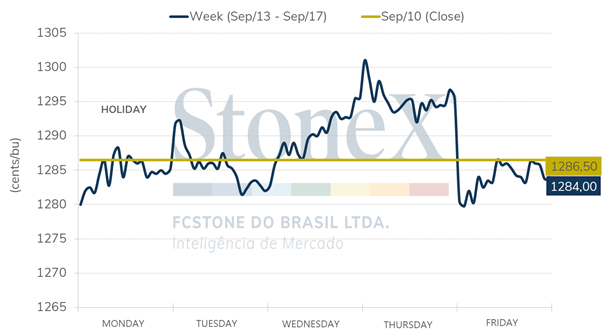
Soybean quotes on the CBOT started last week with little variation and closed Monday (13) slightly lower. By-products continued to be monitored by the market, with soybean oil falling more than meal, although the US and even the global balance sheet seem to indicate meal oversupply.
The USDA announced the sale of another 132,000 tonnes of soybean to unknown destinations, noting that commitments are considerably below those registered in the same period of the previous year.
Export inspections during the week ended September 09 were only 105,000 tonnes, with no shipments from New Orleans (NOLA), whose terminals were affected by hurricane Ida. Although still at the beginning of the 2021/22 crop, accumulated exports are only 136,000 tonnes, compared to over 2 million one year ago.
Later in the day, the USDA crop progress report kept the good/excellent percentage of US crops at 57%, in line with market expectations. Even with stability there were changes among states, which ended up being compensated. For example, conditions in Illinois declined by 4 points, while there was a 6-point advance in Ohio.
Weekly Intraday - November/21 (CME)
Source: CME. Design: StoneX.
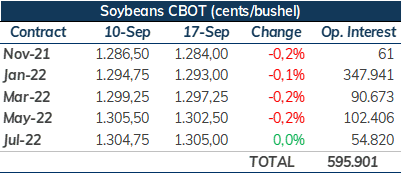
Source: CME. Design: StoneX.
On Tuesday (14), soybean ended close to stability again after starting the day sharply higher under the influence of soybean oil. Concerns about the advance of the coronavirus delta variant and how this situation could affect demand weighed on the bearish side.
Still, the global and the US balance is not comfortable. Even with the US harvesting a good crop, Brazil needs to be able to continue increasing its production. The USDA estimates that 144 million tonnes will be produced in the Brazilian 2021/22 cycle, but the market is looking at the weather and the possibility of a new La Niña, which could result in a drier pattern in the south of the country. However, it is still too early and the coming weeks and months will be closely monitored.
Soybean prices ended Wednesday (15) higher after being pressured by US export sales cancellations. Those cancellations led to rumors that China was buying Brazilian soybean instead of the United States product.
On the other hand, US soybean crushing data in August from the National Association of Oilseed Processors (NOPA) came above expectations, reaching 4.32 million tonnes, a situation that places the processing progress in line with the USDA estimate for the 2020/21 crop year. The quarterly position of US stocks on September 1 will be disclosed later this month, which are equivalent to the ending stocks of the 2020/21 cycle, also showing information about the reality of demand (domestic and external) for the country’s soybean.
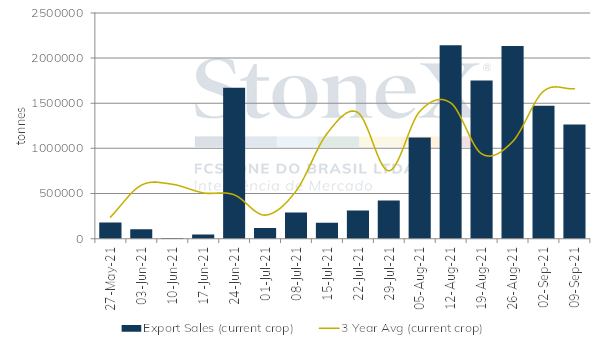
Thursday (16) posted another positive ending, with US export sales in the week ended September 9 reaching 1.26 million tonnes, close to the ceiling of estimates, which ranged from 600,000 to 1.4 million tonnes. Even so, in accumulated terms, sales are about 10 million tonnes below those recorded in the same period of 2020, with China accounting for 8 million tonnes of this difference.
Weekly US export sales - 2021/22
Source: USDA. Design: StoneX.
In addition, the market was waiting for the announcement from the US Environmental Protection Agency (EPA) with a bearish bias regarding the Renewable Volume Obligation (RVO). This weighed on soybean oil prices, as well as net cancellations revealed in the weekly export sales data.
On Friday (17), soybean closed with a decline amid rumors that the EPA would make an announcement regarding mandatory blending volumes. Soybean oil’s drop influenced meal and the grain, with the complex ending in the negative field.
Concerns about Gulf export disruptions after hurricane Ida damage also weighed over prices, at a time when the best export period for the US is approaching.
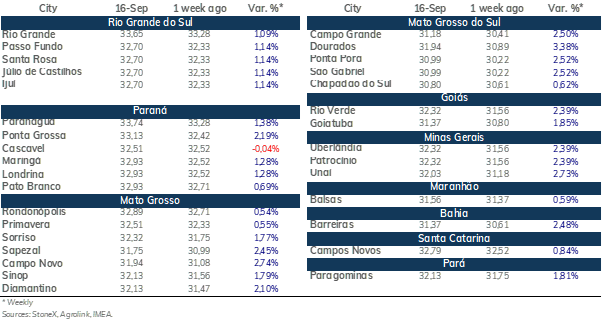
SPOT PRICES (USD/60kg-bag)