fatores baixistas
- Record area and production estimate in Brazil;
- US export sales below the same period of the previous cycle;
- Even lower shipment in the Gulf region after hurricane Ida;
- Progress in US harvest.
fatores altistas
- Possibility of a new La Niña;
- Higher than expected crushing in the US in August;
- US balance still indicating restricted stocks;
- Crushing margin in recovery in China.
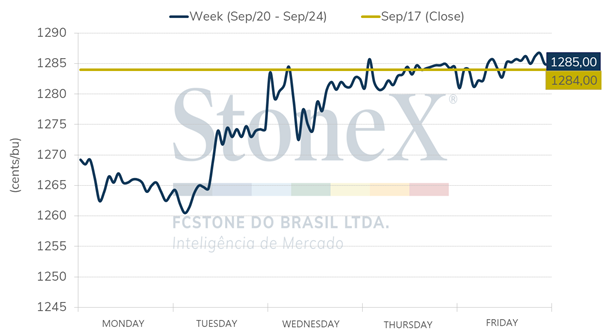
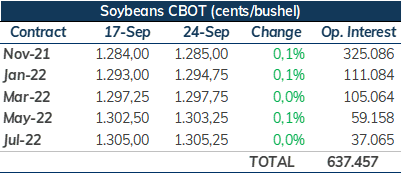
Soybean quotes in Chicago started last week with a significant drop, on a day when risk aversion took over financial markets amid the Evergrande crisis in China, which raised doubts about the performance of the Asian country’s economy. In addition, there was a decline in the oil share, with agents selling off their positions on the vegetable oil.
US export inspections for the week ended 09/16 reached 275,000 tonnes, much below the volume seen in the same period last year: 1.4 million tonnes. The Gulf region still has an export capacity well below the usual level after hurricane Ida. It should be noted that shipments from the country for the 2021/22 crop early this cycle are about 3.2 million tonnes below that recorded in the same period of the 2020/21 crop.
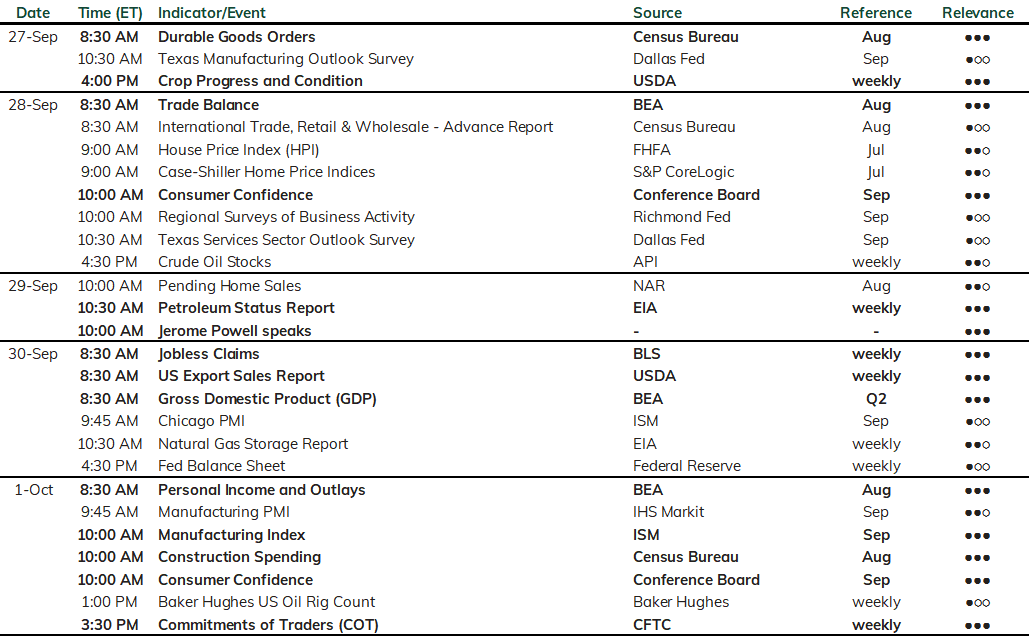
Late in the afternoon, the US crop progress report, released by the USDA, showed an increase in good/excellent conditions by 1 point, reaching 58%, with emphasis on the surprising advance of 14 points in Illinois. It is not the first time in this cycle that the state conditions vary considerably from one week to another, raising some suspicion in the market.
In any case, the improvement of US crops’ conditions weighed over prices on Tuesday. However, low level of the November contract attracted buyers, in addition to rumors that China bought US soybeans for shipping in November. With this, the day closed in the positive field.
Even so, it is important to point out that US sales to China need to gain strength in the coming weeks, as US exports peak in the fourth quarter of the year. If the trading rate continues to be weaker, prospects of selling around 35 million tonnes to China in the 2021/22 cycle may not be achieved, with impacts on the USDA exports estimate for the crop-year.
On Wednesday, soybean continued the move higher, with the oil share rising after its decline to the lowest level in two months.
Even so, the market remained divided between the prospects that China should increase purchases of US soybean in the coming weeks and months and the possibility of reduced mandatory biofuel blending levels in the US. In the case of this last point, the market considers that a review of US mandates should affect ethanol more than renewable biodiesel/diesel.
On Thursday, soybean prices fluctuated between stability and a slight increase. The market continued to follow the US harvest, weak exports, and rumors about the change in the country’s compulsory biofuel blending rate.
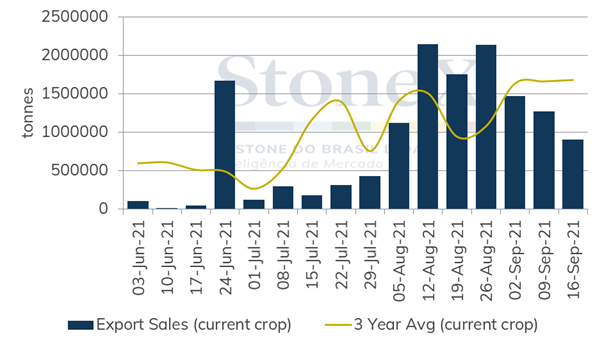
US export sales totaled 902,900 tonnes for the week ended 09/16, within the estimates that ranged from 500,000 to 1.1 million tonnes. However, these sales volumes are lower than the same period of the previous cycle: in accumulated terms, sales are 12.3 million tonnes behind those recorded by the same period in 2020. China accounts for 8.3 million of this difference.
On Friday, soybean ended slightly higher once again, led by the oil share. It should be noted that the possible announcement of US biofuel mandates was postponed.
In China, there were rumors/reports about power cuts at crushers amid an energy crisis in the face of high mineral coal prices. However, they were only for small plants, and since the country has considerable idle capacity, larger plants could increase crushing. In any case, this is a point to keep on the radar.