BEARISH FACTORS
- Estimated record area and production in Brazil;
- Slow pace of US export sales;
- Still low shipment from the Gulf region after hurricane Ida;
- Progressing US harvest with good prospects for production.
fatores altistas
- Possibility of a new La Niña;
- US balance suggests tight stocks;
- Crushing margin recovery in China;
- Progress of vaccination against Covid-19.
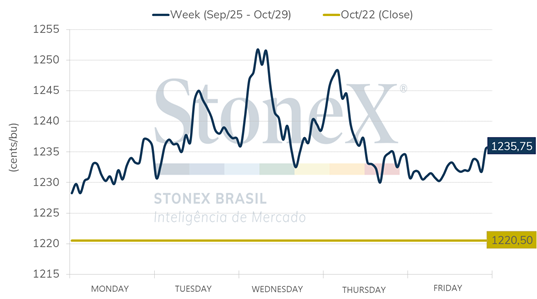
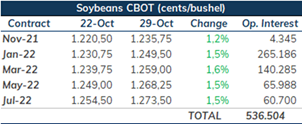
On Monday, soybean prices in Chicago showed strong gains, driven by the oil market. As in the previous week, CBOT soybean oil appreciated as a result of delays in palm oil harvesting, strong demand for crude oil and canola oil shortage. With this, the CBOT soybean contract maturing in November/21 rose by 16.60 cents/bushel, closing the main session at 1,237.25 cents/bu.
Also on Monday, the US Department of Agriculture (USDA) released export inspection data for the week ended October 21. According to the report, weekly physical shipments totaled 2.104 million tonnes, below the values recorded in the previous week (-14.1%) and in the same period last year (-27.2%). Also on the first day of the week, the USDA released the US crop progress report. As of October 24, 73% of the soybean area had already been harvested, compared to 60% in the previous week and 82% in the same period last year.
From Tuesday, soybean values on the CBOT started to trade sideways, with this trend extending until the end of the following session. In both sessions, the nearby future contract (November/21) presented small gains of 0.60 cents/bu on Tuesday and 1.2 cents/bu on Wednesday), closing the latter at 1,239.25 cents/bu.
The lack of a clear direction occurred due to the absence of significant new indicators. Even secondary news or well-known fundamentals, which could have influenced prices, ended up having no impact, because the alternation between bullish and bearish factors ended up nullifying any movement. On the bullish side, we can highlight the 2.0% rise of the corn futures curve on Wednesday, as well as the strong gains of soybean meal on the same day, both on the CBOT. On the bearish side, gains were limited by the progressing US harvest, planting in Brazil and the decline in the soybean oil market.
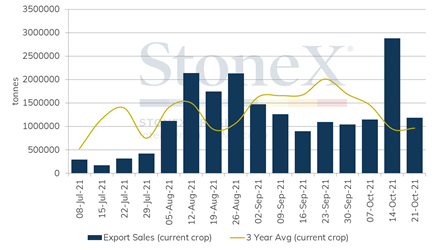
On Thursday (28), future prices in Chicago retreated again, with the November/21 contract closing at 1,233.60/bu. Something that helped soybean futures lower was the drop in export sales volume, referring to the week ended October 21. According to the USDA, 2021/22 soybean sales totaled 1.183 million tonnes, a weekly drop of 59% and 22% lower than the four-week average. It should be noted that China was responsible for buying 1.08 million tons in the week, about 39% below the volume of commitments recorded by the Asian giant last year. In total for 2021/22 and considering all destinations, commitments amount to 65% of those registered last year.
Finally, on Friday, the soybean futures market in Chicago closed the week in the positive field, sustained by corn futures and the oil share. In addition, the USDA reported flash sales of 352,000 tonnes of soybean. On the CBOT, the nearby November/21 contract was quoted at 1,235.60/bu at the main session’s close.