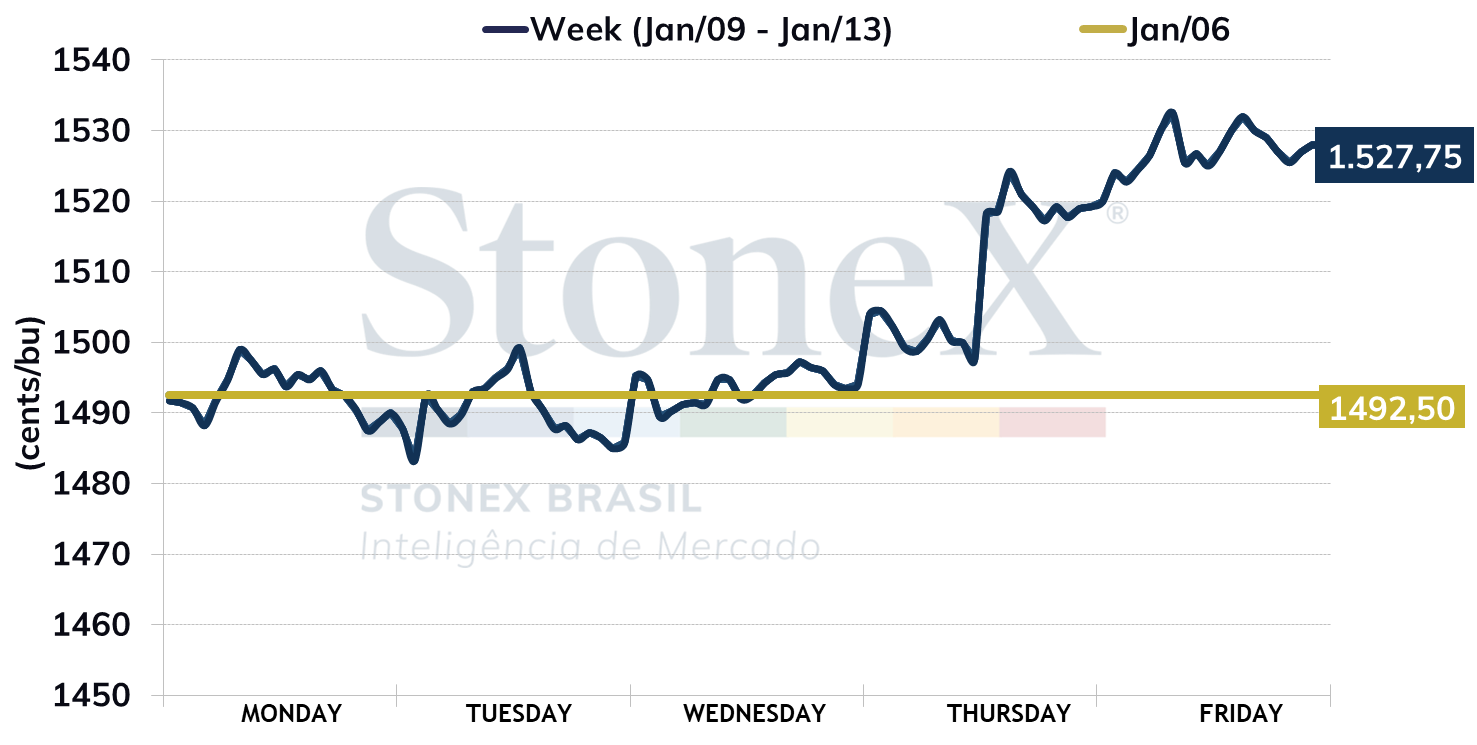
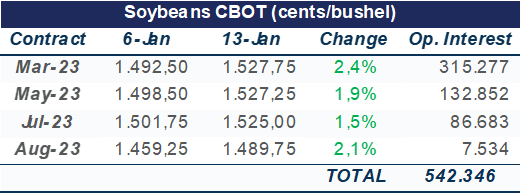
Last week, soybean prices rallied in Chicago, with the March contract ending Friday (13) at 1527.75 cents per bushel. In addition to concerns about the South American crop, the release of the USDA report stands out.
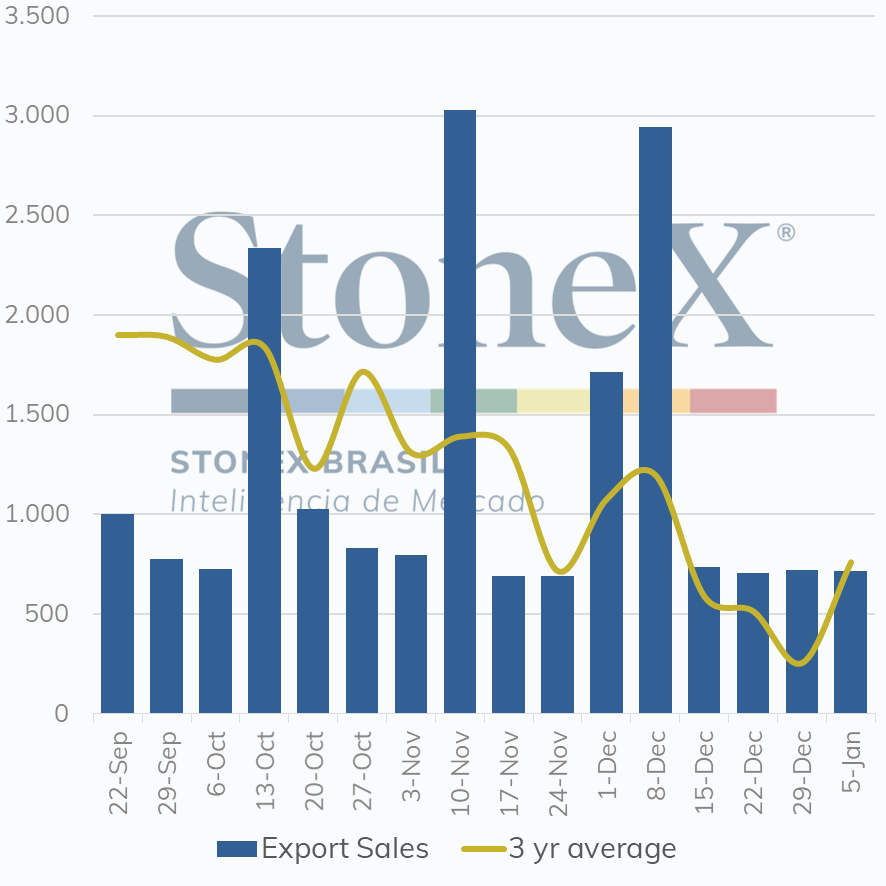
The US Department of Agriculture released its monthly supply and demand report, always awaited, but with special emphasis on the review of the US crop, which takes place in January. There was a cut of almost 2 million tonnes in the country's production, from 118.27 million to 116.38 million tonnes. This decline was motivated by a small reduction in the harvested area, but mainly by the fall in average productivity, from 3.38 to 3.33 tonnes per hectare. Even so, it is noteworthy that the estimated final stocks fell marginally, staying at 5.72 tonnes per hectare, since there were cuts on the demand side, especially the expected exports, which went from 55.66 to 54.16 million tonnes.
For the South American crop, the USDA increased Brazilian production by 1 million tonnes, reaching 153 million. It should be noted that, with this adjustment, the Department was well in line with the revised data from CONAB. Also on Thursday, CONAB updated its crop survey, reducing Brazilian production from 153.48 to 152.71 million tonnes, in the face of a small cut in national average productivity due to the lack of rainfall in areas of southern Brazil.
In the case of Argentina, the USDA decreased soybean production by 4 million tonnes, staying at 45.5 million tonnes, a situation that should directly impact the country’s grain shipments, which already tend to be low, with the focus being on exporting meal and oil. Even with this cut, the USDA number is still considerably higher than that of Argentine exchanges, which also made revisions in their estimates. The Rosario Exchange brought the most aggressive adjustment, with a reduction of 12 million tonnes in 2022/23 soybean production in the country, which would be at 37 million tonnes. The Buenos Aires Exchange also made a significant cut of 7 million tonnes, with the expected production reaching 41 million tonnes. In addition to the adverse impacts of lack of rainfall in the country, the Buenos Aires Exchange made a cut of 500,000 hectares in planted area, going to 16.2 million, as a result of the losses recorded due to very high temperatures and the end of the planting window in center regions of the country’s agricultural area.
This smaller Argentine production, although there are still doubts about what the size of the crop will be, begins to raise concern about the global soybean supply and demand balance, highlighting that there is already a more significant movement of imports of Brazilian soybeans by Argentina. With this, Chinese demand should still be at the center of attention.
Weekly intraday—March/23 (CME)
Source: CME. Design: StoneX.