Bearish drivers
-
Estimated global production for 2022/23 above consumption;
-
Combating inflation may lead to a recession;
-
Possibility of an absolute production record in Brazil;
-
Signs of economic slowdown in China;
-
Agricultural Forum shows production growth for 2023/24 in the US.
Bullish drivers
-
Relaxation of anti-Covid measures in China;
-
Considerable crop losses in Argentina due to the climate;
-
US balance estimated at the Agricultural Forum does not indicate loose stocks;
-
Possibility of an increase in mandatory biodiesel blending in Brazil, starting in April 2023.
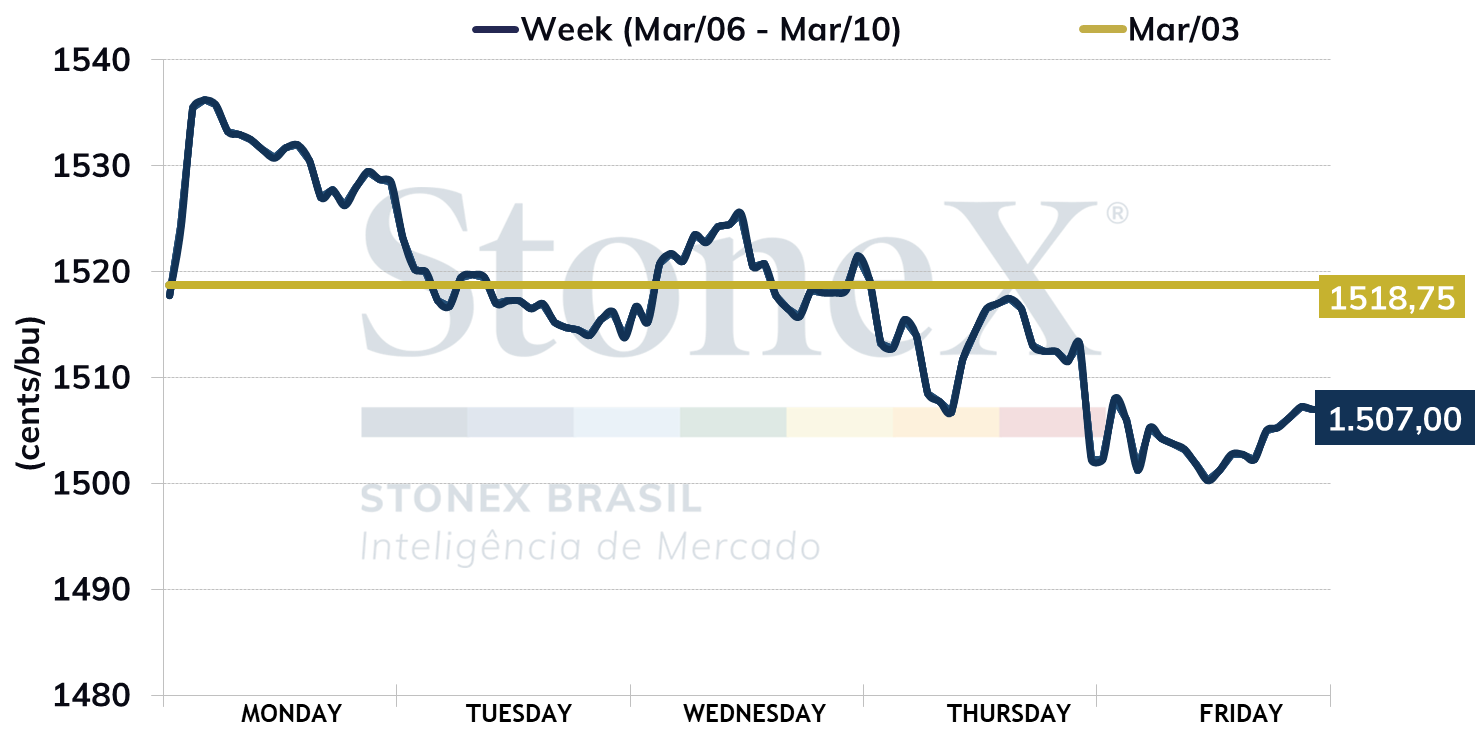
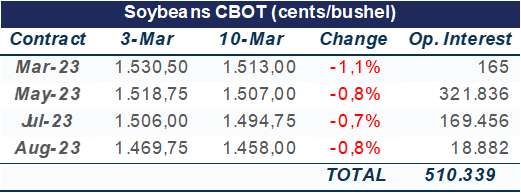
Last week, soybean prices in Chicago fell, with the May/23 contract ending Friday (10) at 1507 cts/bu. Despite significant crop losses in Argentina, soybean was influenced by other grains, in addition to demand concerns.
The market continues to be focused on the South American crop, monitoring mainly the size of the Argentine production since the smaller internal supply tends to result in an increase in imports to meet soybean crushing.
As such, expectations for the USDA report were high since the Department still had a higher number for Argentine production compared to private estimates.
It should be noted that the USDA report lowered the estimate for Argentina to 33 million tonnes, a volume lower than the market's average expectations, which were around 36.5 million, but still within the expected range, with a floor of 32 million tonnes.
With this significant cut in the country's production, the USDA further reduced expected exports, which went from 4.2 to 3.4 million tonnes. On the other hand, the increase in imports was only 1 million tonnes, reaching 7.25 million, a much more conservative volume in relation to other estimates that bet on the country's external purchases surpassing 10 million tonnes.
Weekly intraday - May/23 (CME)
Source: CME. Design: StoneX.
For Brazil, the USDA maintained the 2022/23 production at 153 million tonnes and promoted a slight increase in the number of exports, from 92 to 92.7 million.
In the case of China, the estimate for imports remained at 96 million tonnes, but domestic consumption fell by 2 million, which were directed to ending stocks. If the country reaches the estimated stock of 34.28 million tonnes, it would be the highest volume ever recorded, and this adjustment somewhat surprised the market.
Still regarding China, despite the stability in the import estimate, concerns about the country's economy continue, and domestic crushing margins remain under pressure, often falling to the negative side, a situation that is closely monitored as it may impact the country's soybean external demand.
In any case, when considering US exports, Chinese appetite for soybean 2022/23 is higher, with US export sales to the country being 3 million tonnes above what was registered in the same period last year. On the other hand, US accumulated export sales (to all destinations) are at 48.7 million tonnes, against 52.37 million in the same period in 2022, with purchases from other destinations, except China, being weaker. In the week ended March 2, the country's net soybean sales were negative at 23,200 tonnes.
Nevertheless, the USDA raised its estimate for US 2022/23 soybean exports, from 54.16 to 54.84 million tonnes, still about 4 million below what was registered in the 2021/22 cycle. Furthermore, shipments are ahead of a year ago. In the week ended March, 542,200 tonnes of soybeans were inspected at US ports, bringing the accumulated total to 42.7 million tonnes, compared to 41.5 million at the same time in 2022.
This increase in the US soybean export estimate for the 2022/23 season resulted in an expected drop in the country's ending stocks to 5.72 million tonnes, with a stocks-to-use ratio of 4.83%.
Turning back to South America, Conab also updated its crop numbers for Brazil, reducing the 2022/23 soybean production to 151.4 million tonnes, due to losses in Rio Grande do Sul.
Nevertheless, the Brazilian crop is on track to consolidate a production above 150 million tonnes, with the soybean harvest having reached 53.7% of the total area last Friday (10), according to StoneX's monitoring.