Bearish drivers
- Estimated global production for 2022/23 above consumption, according to USDA;
-
Combating inflation may lead to a recession;
-
Possibility of an absolute production record in Brazil;
-
Signs of economic slowdown in China and ASF outbreak;
-
Agricultural Forum shows production growth for 2023/24 in the US.
Bullish drivers
- Relaxation of anti-Covid measures in China;
-
Considerable crop losses in Argentina due to the climate;
-
US balance estimated at the Agricultural Forum does not indicate loose stocks;
-
Increase in mandatory biodiesel blending in Brazil, starting in April 2023.
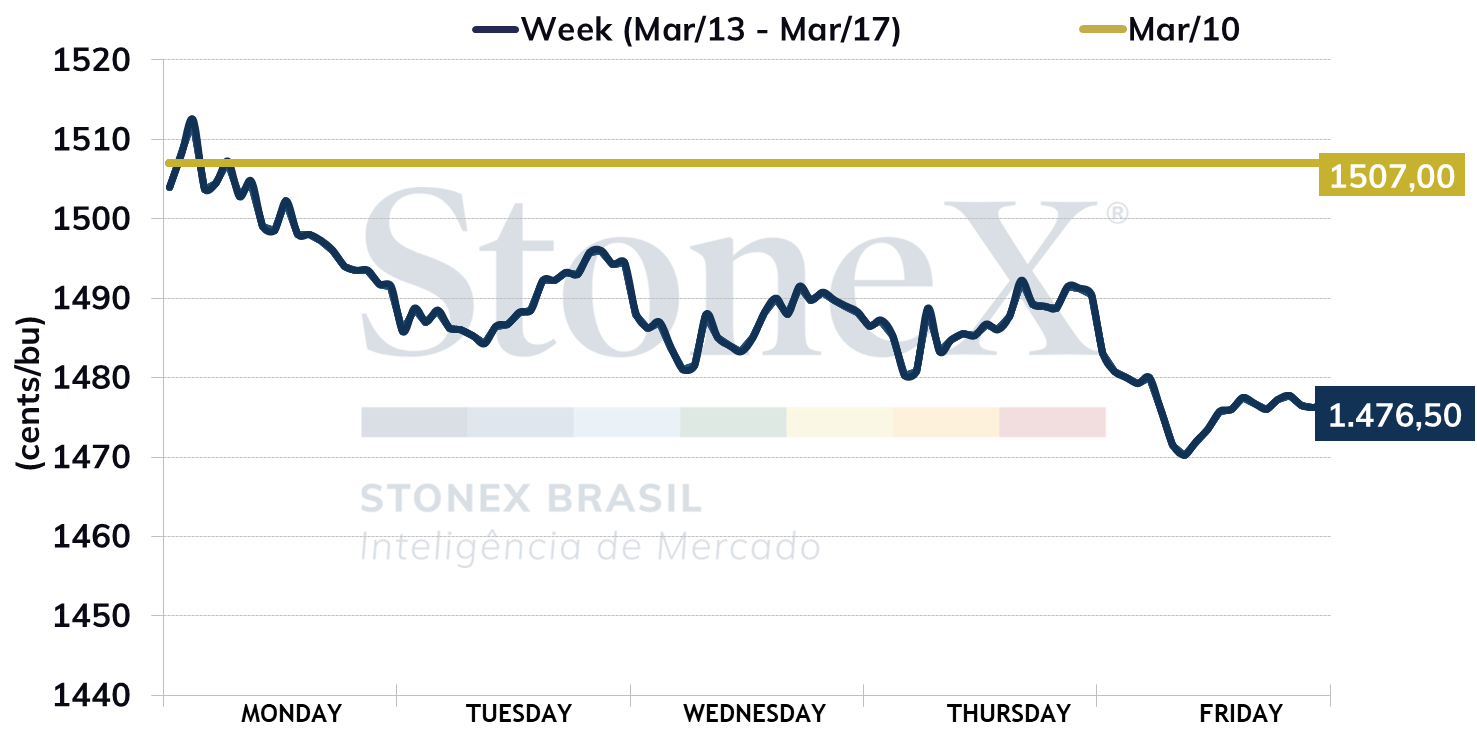
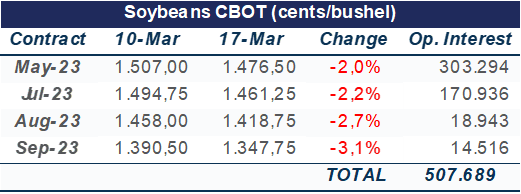
Soybean quotes in Chicago dropped last week amid a more negative macroeconomic context after the collapse of US banks. May/23 ended Friday (17) at 1476.50 cents/bushel.
Even so, the global soybean balance is moving towards a tighter situation due to further reductions in Argentine crop estimates for 2022/23. The Buenos Aires exchange (BCBA) reduced its production number from 29 to 25 million tonnes, a significant decrease compared to the initial estimate of 48 million. This reduction was due to the lack of rain in the central agricultural area, early frosts in February, and high temperatures during critical phases of crop development, according to the BCBA report.
Considering that this production at 25 million tonnes is 8 million below the USDA figure, this difference would already lead world soybean consumption to exceed production in the 2022/23 cycle, resulting in a decline in ending stocks.
As such, even a record crop in Brazil above 150 million tonnes, it may not be enough to guarantee a slack in the global supply and demand balance. It is necessary to monitor what will happen on the demand side in the coming months, especially in relation to China.
A point of attention is the occurrence of more considerable outbreaks of African swine fever in the country, which are being reported recently. The current outbreaks are expected to end up reducing the Chinese pig herd further later this year, with culling of animals, including sows, to control the contagion. Although the current outbreaks are not considered as serious as those of 2018 and 2019, there are already unofficial estimates in the market that pork production could be reduced by around 10%.
Weekly intraday - May/23 (CME)
Source: CME. Design: StoneX.
In any case, at least for the time being, Chinese demand for soybean imports, and also corn, is stronger than in the same period last year. Chinese soybean imports in January and February 2023 (added together) reached 16.2 million tonnes, surpassing the volume registered in the first two months of 2022.
It should be noted that most of this volume originated in the US, which accounted for just over 10 million tonnes of the total, an increase of 15.4% compared to the previous year. The share of Brazilian soybean declined, with 2.24 million tonnes being received by China in the period. It should be remembered that Brazil's crop this year is behind schedule, with the harvest reaching 61.7% of the total last Friday (17), according to StoneX, against 70.6% at the same time in 2022.
Therefore, in the next few months, Brazilian soybean exports will return to world prominence, with prospects for growth in 2023, following the record harvest.
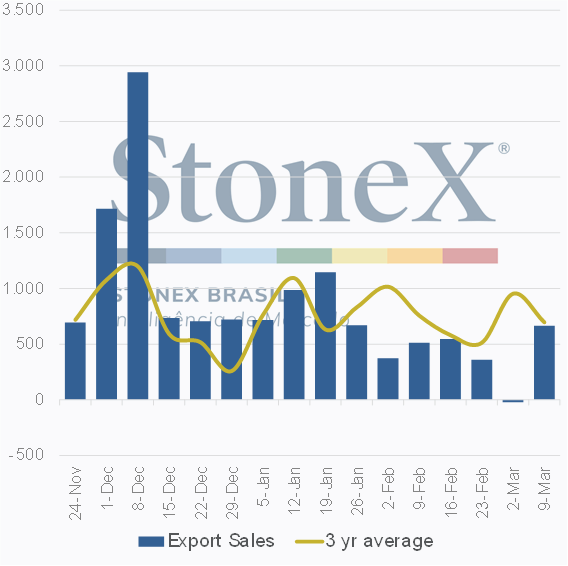
Still on the demand side, in the week ending March 09, net export sales from the US reached 665,000 tonnes, a volume at the ceiling of expectations, which ranged from 50,000 to 700,000. In accumulated terms, 49.3 million tonnes were traded, against 53.3 million last year. Shipments are now at 42.8 million tonnes, a volume slightly above that registered a year ago. In any case, it is worth remembering that, even with the positive review in the last USDA report, 2022/23 exports are estimated at 54.8 million tonnes, a volume that is almost 4 million below that registered in the 2021/22 cycle, at 58.7 million tonnes.
In the case of the US, the trend is for traded volumes to be low in the coming months, but the pace of sales and shipments is always closely monitored to find out whether USDA estimates will be reached.
US weekly export sales (000 tonnes)
Source: USDA. Design: StoneX.