- World production estimated above consumption in 2023/24, according to the USDA.
- Record of more abundant rains in Brazil's soybean areas and good expectations for the coming weeks;
- Although some damages are irreversible if good rainfall volumes are confirmed, later planted areas may show improvement;
- Full crop potential in Argentina;
- Concerns about the pace of global demand;
- Weak accumulated export sales from the US.
- Heated American domestic consumption;
- StoneX cuts soybean production for 2023/24, which is no longer a record;
- Production cuts by CONAB and USDA.
- The Argentine situation still favors holding soybean as insurance;
- Brazilian exports above 100 million tonnes in 2023.
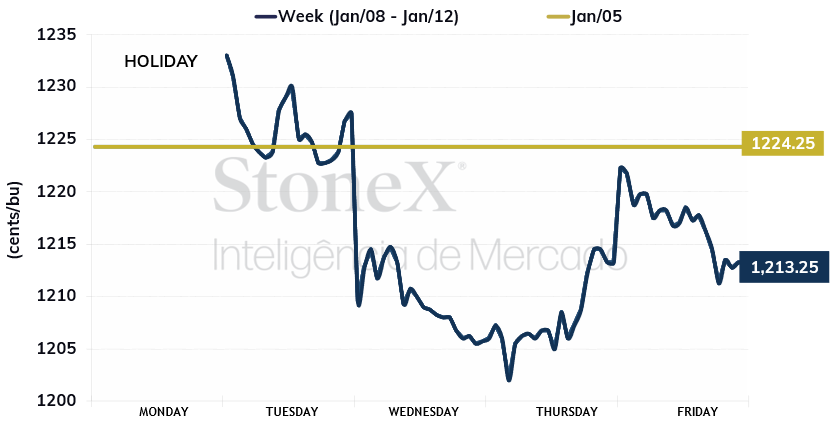
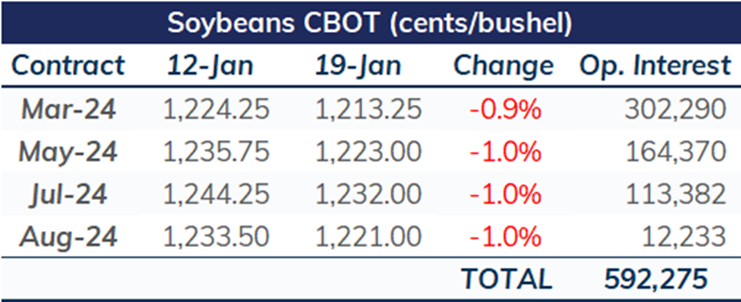
In the shorter week marked by the celebration of Martin Luther King Jr. Day on Monday (15), soybean futures contracts ended the period in the negative field in Chicago. The March 2024 contract ended Friday (19) quoted at 1,213.25 cents/bu, a drop of 0.9% for the week. In addition to all the discussion about soybean production, especially in South America, the demand is also the subject of debate, mainly for soybeans from the US. Compared to demand for the US oilseed, the variable that has been receiving most of the attention is exports. The country has been experiencing lower-than-expected soybean sales and shipments, which constrain grain quotes. The low levels in the Panama Canal continue to hinder the arrival of American products in Asian markets and contribute to a pace of shipments and business that is less heated than expected.
US export inspections: Despite bringing a better figure in the weekly comparison and a significant upward revision for January 4, soybean export inspections could not generate greater optimism among market participants. According to USDA data, 1.26 million tonnes were loaded in the week ended January 11, up from 1.04 million tonnes shipped in the previous week – in the previous report, the Department had indicated that 674.75 thousand tonnes had been exported that week – but below the 2.2 million in the same week of 2022. This positions the accumulated shipments in the US 23/24 crop at 6.85 million tonnes behind the registered in the same period of 22/23.
US crushing: In the last week, on January 16, NOPA released its monthly soybean grinding data. The Association reported that its members crushed 5.32 million tonnes of soybean in December, above the recorded in November (5.1 million), the observed (4.8 million tonnes) and the average estimates (5.26 million). The soybean oil stocks were also surprising. NOPA reported that the US had 616.9 tmt in stocks in December, a number higher than the previous month (550.7 tmt) and the average estimates (585.6 tmt). Nonetheless, the stocks in December 2023 were below the recorded amount in 2022 (812.4 tmt).
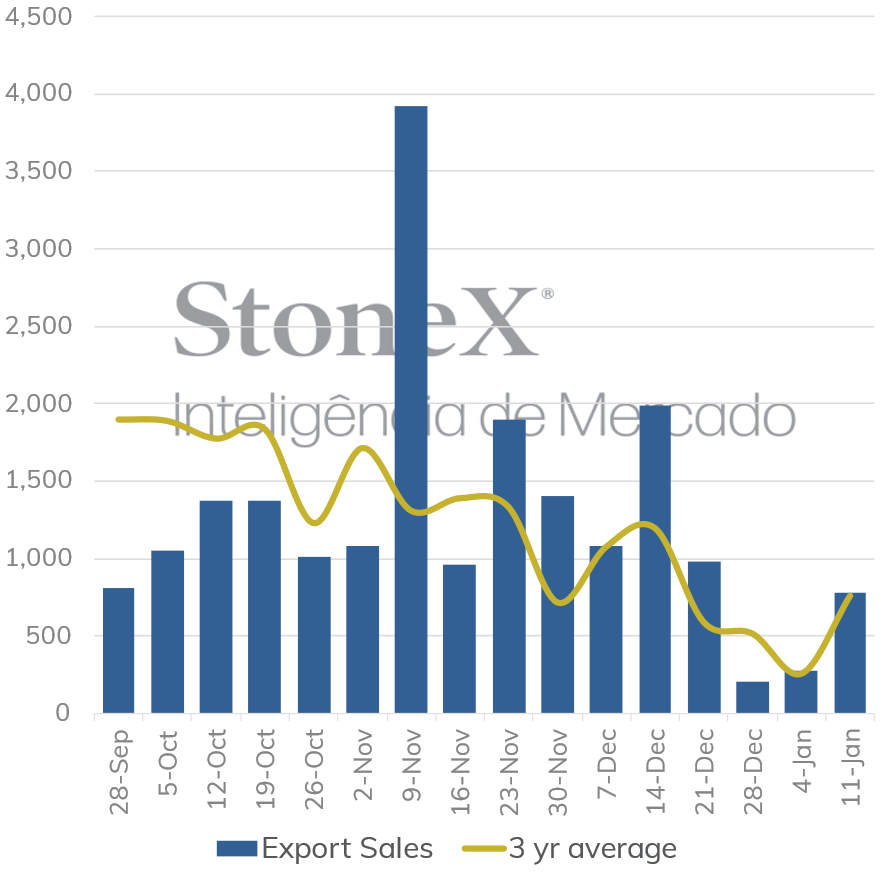
US export sales: The USDA export sales report also did not give the market any major reasons to get excited. The Department reported that the US recorded 781.3 thousand tonnes of net sales in the week ended on Jan 11, compared to 280.4 thousand in the previous week, a significant increase, but below the 986.2 thousand tonnes sold in the equivalent week of 2023 and within the market's range of expectations, which ranged from 400 thousand to 900 thousand tonnes. In the accumulated, the 23/24 crop sales totaled 37.4 million tonnes, against 45.3 million in the same period of 22/23.
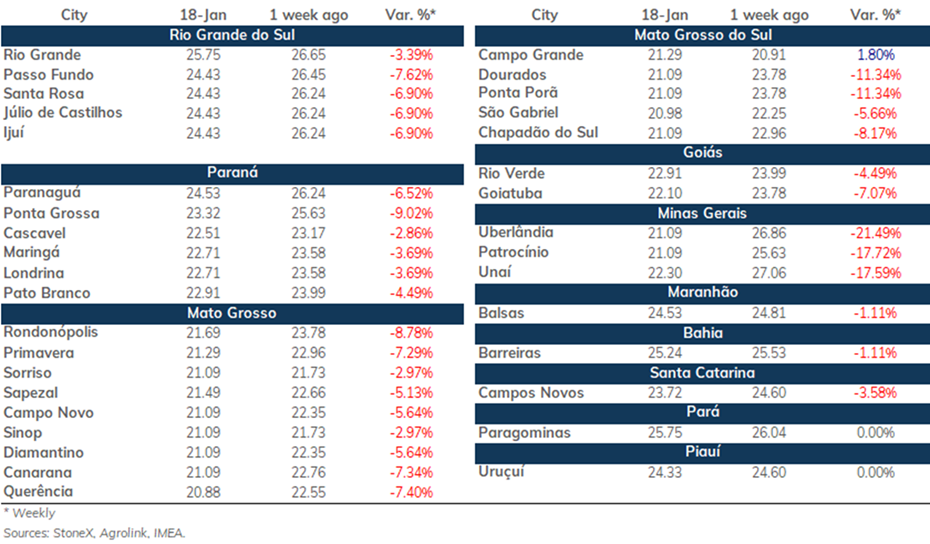
Brazilian crop: The debate about production in South America continues to be one of the main drivers of soybean prices. Although several private consultancies and institutions have reduced their estimates for the Brazilian crop throughout the month, as some of the damage to earlier planted crops is irreversible, the high volume of rain over the past two weeks may have benefited the areas planted later. Furthermore, good amounts of rain are expected in the next two weeks, and if confirmed, later planted areas may show improvement. According to StoneX's follow-up, the oilseed harvest reached 5.1%, compared to 2.3% in the same period last year.
Crop in Argentina: on the one hand, the loss of productive potential of the Brazilian crop is a subject of discussions and differing opinions; on the other hand, it can be said that the idea of the recovery of the Argentine crop is unanimous. Last week, the Buenos Aires Grain Exchange (BCBA) indicated a hike in crops classified as good/excellent condition, reaching 55%, four p.p. higher than the previous week and 51 p.p. higher than the same period last year, strengthening the idea of a robust Argentine crop. The BCBA estimates our neighbors' soybean crop for the 23/24 season at 50 million tonnes, compared to 21 million tonnes last year. Nonetheless, the Argentine supply is not free from uncertainties. Although the country is expected to produce nearly 30 million tonnes more than in 2023, it is unknown what the grain supply will be in the international market, as a rebuilding of soybean stocks in the country is expected, a movement that may also be boosted if the producer decides to hold onto the product as a way to protect themselves from inflation.
Chinese demand: China has shown signs of lower grain demand, contributing to the recent fall in soybean prices. The largest pig production companies in the Asian giant indicate that they are about to reduce the herd size in the coming months, which could pressure the country's demand for imported grains, including soybeans.
Chinese imports: China imported 9.8 million tonnes of corn in December, a hike of 24% versus November but a fall of 2.8% compared to December 2022. Thus, the country imported 99.4 million tonnes in 2023, 10 million more than in 2022. Of the total imported by the Asian giant in the last year, Brazil was responsible for 70.4% (70 million tonnes), being China's main trading partner in the soybean market. The US took second place, with a share of 24.3% (24.2 million tonnes).