- Bearish factors
- Global 24/25 supply exceeds consumption, according to USDA;
- Concerns over the pace of global demand;
- Record production forecast for Brazil's 24/25 harvest;
- Strong initial harvest results in Argentina;
- China increases retaliatory tariffs against the U.S.
- Bullish factors
- New stimulus measures adopted by the Chinese government;
- Expected reduction in U.S. planted area for the 25/26 season;
- Reduced yield potential for Argentina's crop;
- Possible increase in U.S. biodiesel and renewable diesel mandates;
- Potential relaxation/postponement of Chinese vessel taxes at U.S. ports;
- Easing of trade tensions following statements by U.S. officials.
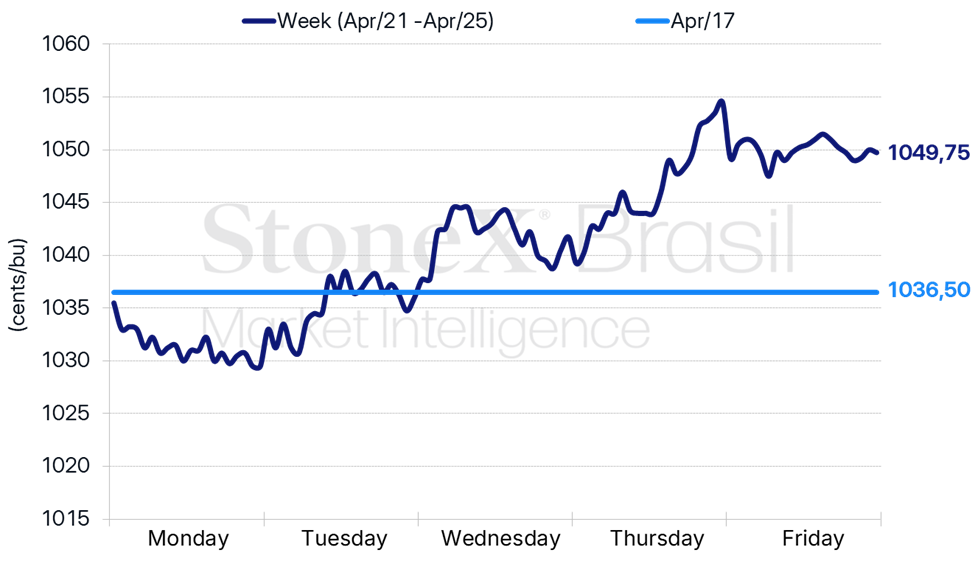
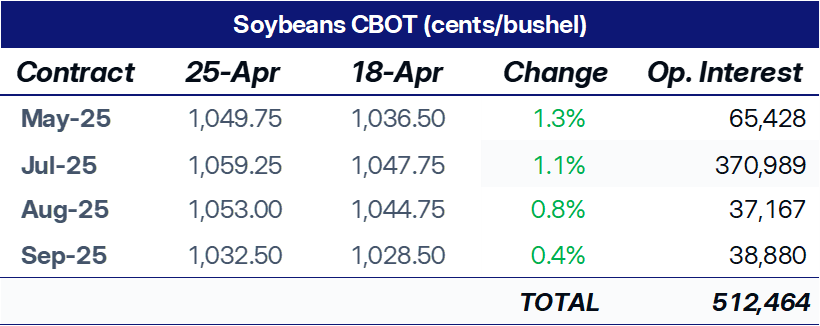
Chicago soybean futures rose last week, with the May contract closing Friday (25) at 1,049.75 cents per bushel, up 1.3% on the week.
The main driver of gains was rumors regarding U.S.-China tariff issues. U.S. Treasury Secretary Scott Bessent stated that high tariffs between the U.S. and China are unsustainable. Additionally, Donald Trump signaled he has no intention of firing Fed Chair Jerome Powell after his criticisms of the central bank head.
In this scenario, risk aversion declined, favoring commodities, but nothing concrete has emerged on a tariff agreement with China. Trump and other U.S. officials claimed that tariff talks were in progress, which China denied, stating that “the U.S. should stop creating confusion.”
Nonetheless, there are reports of a list of over 100 product categories being considered for exemptions by China, although no official statement has been made. For now, some imports of U.S.-made pharmaceuticals have reportedly been exempted by China.
U.S. export sales data for the week ending 04/17 showed commitments of 277,000 tonnes, limited by purchases from other destinations, while China made almost no bookings of U.S. soybeans. Year-to-date, U.S. 24/25 soybean sales to China are 1.5 million tonnes below last year's pace, while other destinations have purchased over 7 million tonnes more than a year ago.
On the other hand, expectations for higher U.S. biodiesel and renewable diesel mandates continued to buoy the soybean market, with speculative funds increasing long positions. This could trigger a wave of selling if the mandate increases fail to meet expected volumes.
In South America, Argentina's harvest reached 14.5% complete, according to the Buenos Aires Grain Exchange, a weekly increase of 9.6 percentage points. However, it remains 11 points behind last year, reflecting excessive rainfall weeks ago that hampered fieldwork. Some central and southern regions report yields up to 4 tonnes per hectare. Crop conditions improved, with the good/excellent rating rising from 37% to 43%. The Buenos Aires Grain Exchange maintains its soybean production estimate at 48.6 million tonnes.
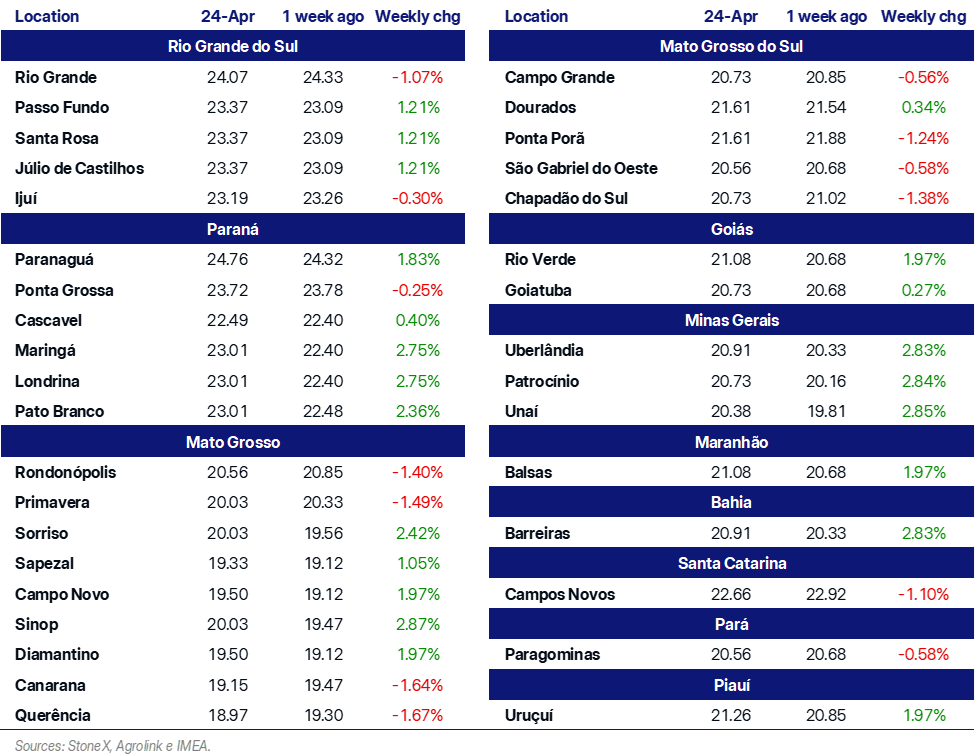
In Brazil, port premiums remain stronger than last year at this time but more competitive than U.S. levels. Immediately after harvest, it's the peak export season for soybeans, with sales and shipments very active, likely to be further boosted by increased Chinese demand amid the tariff dispute. As of April 17, Brazil had shipped 9.4 million tonnes of soybeans in the month, with an update due Monday (28) afternoon.
Producer sales in Brazil have gained momentum post-harvest, as expected, driven by higher supply and infrastructure constraints such as storage shortages. As of April 22, 56.1% of the 24/25 soybean crop was sold, according to StoneX, above levels at the same point in the two previous seasons. In other years, negotiations were more advanced at this stage under higher price conditions.
This week, the market will remain focused on the U.S.-China relationship, with any developments likely to move prices. Additionally, the U.S. crop progress has gained importance, with planting reaching 8% by Sunday (20), above the five-year average of 5% and last year's 7%. Heavy rains are forecast for the Midwest and Delta regions this week, potentially slowing planting.