- Bearish factors
- World production in 25/26 still surpassing consumption, according to the USDA;
- Concerns about the pace of global demand;
- Estimate of record production for the Brazilian 24/25 crop;
- Good crop results in Argentina, with an upward revision of the crop;
- Accelerated sowing in the USA;
- Avian influenza outbreaks in Brazil.
- Bullish factors
- Estimate of decline in area in the 25/26 crop in the US;
- Possible increase in the biodiesel and renewable diesel mandate in the US;
- Possible relaxation/postponement of the taxation of Chinese ships in US ports;
- Retreat in tariffs charged between the USA and China;
- Excessive rainfall in Argentina.
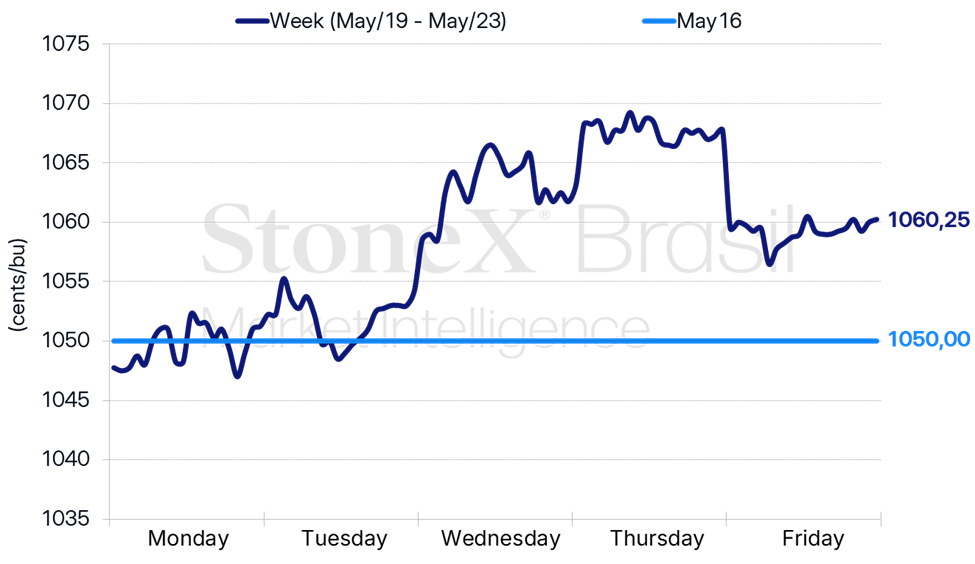
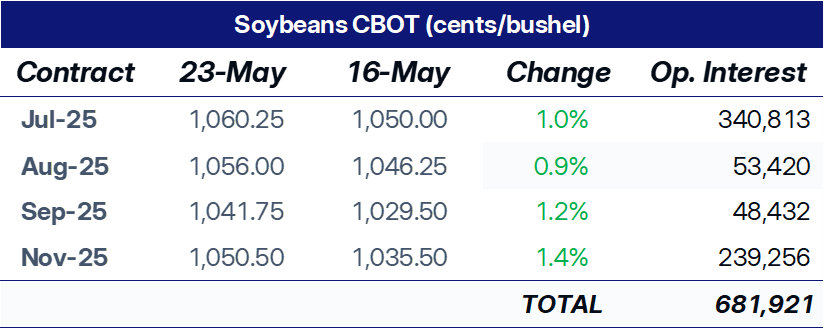
Last week, soybean quotes in Chicago posted gains, with funds acting on the buying side, following climate and biofuel issues in the US. On the Friday's session (23), there was profit-taking, but the weekly increase was still 1%, with the expiry for July closing at 1060.25 cents/bushel.
In the US, discussions about extending the validity period of 45Z credits, which would go from December 2027 to December 2031, continued to be on the agenda with the expectation that the proposal will be voted on by the end of the month. In addition to the continuity of the credit per gallon produced of biofuels in the country, the expectation is that the use of local raw materials will benefit, while imported raw materials would not be covered by the credit. Previously, imported raw materials, with lower levels of greenhouse gas emissions, such as beef tallow and used cooking oil (UCO), had the benefit, receiving a higher credit than soybean oil, for example. In this way, a "blockade" of imported raw materials would tend to benefit the use of soybean oil, with these prospects being monitored by the grain market, remembering that the USA has invested heavily in the renewable diesel segment recently, demanding an increase in soybean crushing capacity in the country.
On the other hand, the definition of biofuel mandates for the years 2026 and 2027 (RVOs) is still awaited, with rumors that the targets sent by the Environmental Protection Agency (EPA) for approval would be below previous expectations.
Regarding the weather, the main factor that influenced the market and gave support to soybean prices was the occurrence of excessive rains in part of Argentina, with the record of floods. The weather event brought speculations about possible crop losses, highlighting that the most affected region was the northwest of Buenos Aires, leading to a slowdown of the harvest in the area, which is more delayed than in the same period last year. Rumors suggest that losses could range between 500 thousand and 2 mmt, but the Buenos Aires exchange emphasized that potential damages are still being assessed, maintaining its estimate for the country's 24/25 soybean production at 50 mmt. The national harvest reached 74.3% of the total, with a weekly advance of 9.4 p.p.
It is noteworthy that, even if a loss of 2 mmt is confirmed, the result of the Argentine crop would still be favorable, not altering the global balance between soybean supply and demand, which remains more relaxed. Since the beginning of the harvest, the yields have remained quite favorable, which prompted positive revisions in the crop outlook, after the estimated losses due to the drier weather at the beginning of the year.
Regarding domestic soybean consumption in Argentina, crushing in April increased compared to what was reported in March, although it remained below the same month in 2024. Even so, in the cumulative total since January, soybean crushing in Argentina is almost one million tonnes above last year, reaching 12.2 MMT.
In Brazil, ABIOVE also released crushing data for March, when 4.67 mmt of oilseeds were processed, an increase of 29.7% compared to March, but a decrease of 6.8% compared to the same month in 2024. In the first three months of 2025, 11.65 mmt were crushed, an increase of 1.3% compared to the previous year.
Brazilian exports up to Friday (16) reached 7.8 mmt, with the total and May expected to be around 15 million, as has been recorded in recent months. It should be noted that Brazilian soybean remains more competitive than the North American, which is usual for this time of year, regardless of tariff issues. With this, Chinese purchases of soybean from the US remain low, with the latest weekly exports sales data from the country standing at 307.9 thousand tonnes, without Chinese participation, with other destinations sustaining the purchases of American soybean. In the accumulated, US export sales maintain a pace more than sufficient to reach the USDA export estimate for the 24/25 cycle, at 50.35 mmt.
In the US, the weather is also in the spotlight, with the occurrence of beneficial rains in the Midwest of the country. With this, there are expectations that the crop condition data, which will begin to be released soon, will be quite favorable. The sowing continues accelerated, having reached 66% of the total on 05/18, according to the USDA, above last year, at 50%, and the five-year average, at 53%.
This week, attention should remain focused on the progress of the North American crop and possible updates regarding measures in the biofuels sector in the country. In Brazil, demand is on the radar, with heated exports and the occurrence of avian flu outbreaks, which may impact feed consumption.
The Ministry of Agriculture reported to the WOAH (World Organisation for Animal Health) that the eradication policy was completed at the commercial farm in Montenegro, in the Porto Alegro region, with no new outbreaks of the disease identified during the investigation. Other 12 investigations of suspected avian flu remain ongoing, according to an update from the Ministry on Monday morning (26th), 6 fewer than reported late Sunday afternoon.