- Bearish factors
- World production in 25/26 still surpassing consumption, according to the USDA;
- Concerns about the pace of global demand;
- Estimate of record production for the Brazilian 24/25 crop;
- Buenos Aires exchange revises Argentine crop estimate upwards;
- Accelerated sowing in the USA;
- Avian influenza outbreaks in Brazil.
- Bullish factors
- Estimate of decline in area in the 25/26 crop in the US;
- EPA announces an increase in the biodiesel and renewable diesel mandate in the US;
- Possible relaxation/postponement of the taxation of Chinese ships in US ports;
- Progress in negotiations between China and the US;
- Worsening crop conditions in the US.
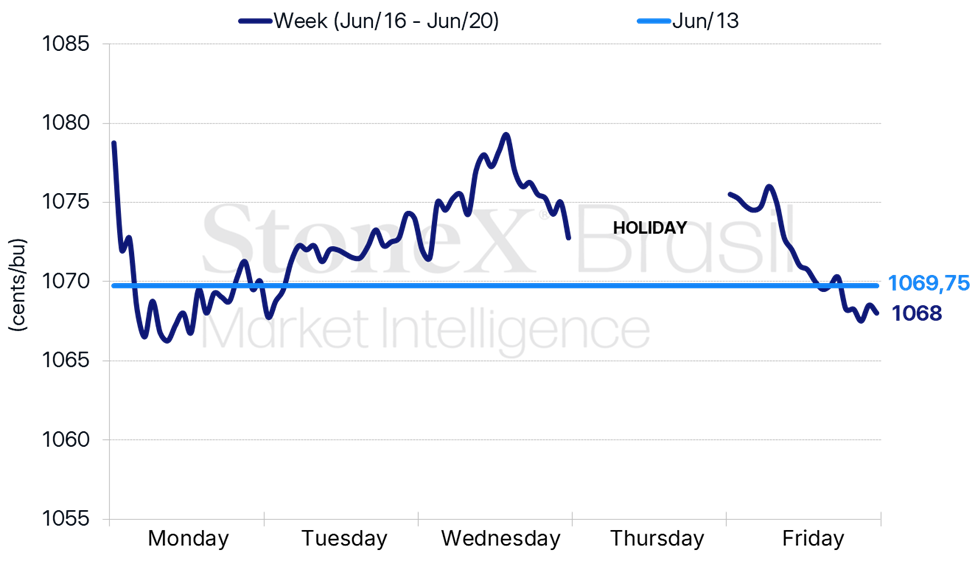
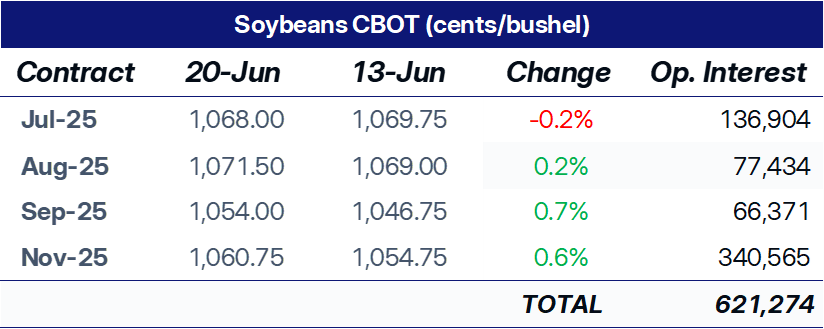
Soybean quotes in Chicago remained at a slightly higher level last week and ended the period practically stable, after position adjustments by funds on Friday (the 20th), even with optimism regarding biofuels in the US. The July contract closed on Friday, after holidays in Brazil and the USA, at 1068 cents per bushel, a small drop of 0.2% in the period.
The prospects of an increase in biofuel mandates slightly above expectations in the US, in addition to the favoring of domestic feedstocks, continued to offer support to soybean prices, as well as to soybean oil. On the other hand, it should be noted that the proposal sent by the Environmental Protection Agency (EPA) may still undergo modifications, with the market monitoring possible changes. Another point of attention is the extension of the 45Z tax credit, which is also highly anticipated by the market. It was reported that the US senators proposed a renewal until 2031, but with a 20% reduction in the value of the credit for biofuels produced with imported raw materials, and not with the exclusion of these inputs (with the exception of those from Canada and Mexico). With the option for a reduction of credits for imported raw materials and not an exclusion, at times it may still be advantageous to source from outside the country, which would tend to hinder the recovery of local soybean oil use.
While soybean oil has been driven by favorable prospects for biofuels, meal is under more pressure. China announced a 2.5% reduction in its herd of breeding sows, as the market would be over-supplied. Moreover, the country's government seeks to reduce the share of soybean meal in feed, given the enormous dependence on external soybeans.
The Chinese soybean imports is a determining factor for global demand, highlighting that the country sources most of the oilseed from Brazil, a situation that has been reinforced in recent years amid tensions with the US. With the record 24/25 crop in Brazil, China is likely to take advantage to buy the maximum amount of Brazilian soybean, becoming less dependent on the US, when the country's new crop enters the market, starting in September. In addition, there is always the concern of some intensification of the tariff war between the two countries. As of 06/13, Brazil's exports of soybean reached nearly 7 mmt, bringing the total since January to 58.5 million tonnes.
In the US, export sales in the week ended 06/12 reached 539.5 thousand tonnes, with the accumulated for the 24/25 crop year rising to 49.1 mmt. The total shipments for the cycle estimated by the USDA are at 50.35 mmt. As the crop year ends in late August, attention to possible cancellations should increase, as they are a relatively common occurrence during this period.
On the supply side, the North American crop is finishing sowing, having reached 93% of the total on Sunday, 06/15. In the period of one week, there was a slight deterioration in the conditions of the crops in the USA, with the G/E percentage dropping from 68% to 66%, which may also have contributed to the price increase, but it is noteworthy that the result remains above the five-year average for the period, at 65%. In addition, the most critical period for the development of crops is the month of August, when most of the grain filling takes place.
In Argentina, the 24/25 crop harvest reached 96.5% according to the Buenos Aires Exchange, with a national average yield remaining quite positive and surpassing the initial estimates, even with the climate issues of drought at the beginning of the year and excessive rainfall in May. In light of this scenario, the institution maintains its estimate at 50.3 mmt.
This week, in addition to the progress of the US crop, geopolitical issues should be on the radar, with the escalation of the conflict between Iran and Israel in the Middle East. Although the two countries are not among the main producers and/or consumers of soybean in the world, the situation may have logistical impacts, on costs, as well as an increase in risk aversion.