- Bearish factors
- World production in 25/26 still surpassing consumption, according to the USDA;
- Concerns about the pace of global demand;
- Record production estimate for the Brazilian crop 24/25;
- Argentina ends crop 24/25 above 50 mmt;
- Good crop conditions in the U.S ;
- Favorable weather in the USA.
- Bullish factors
- Decrease in area in the US 25/26 crop;
- EPA announces increased mandate for biodiesel and renewable diesel in the US;
- Approval of the 45Z credit in the US, which should foster soybean oil;
- Progress in negotiations between China and the US;
- Increase of the biodiesel-diesel blend in Brazil.
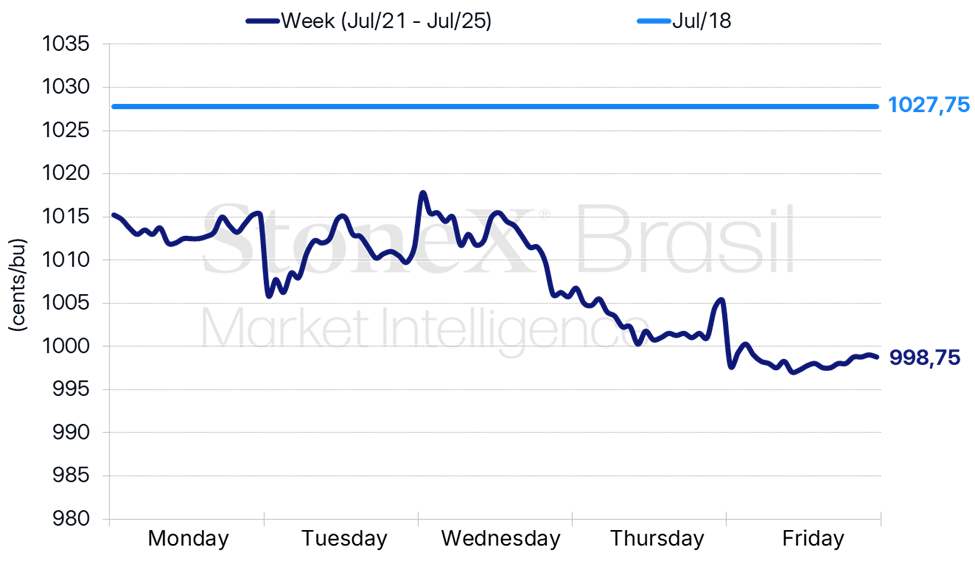
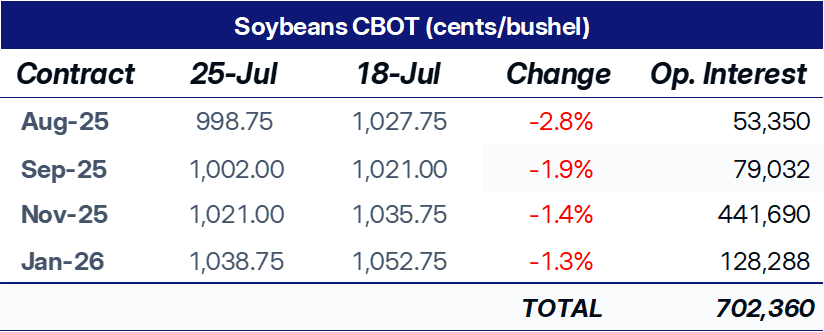
Soybean quotes posted a drop in Chicago last week, with the nearest contract, August, closing on Friday (the 25th) below USD 10.00, at 998.75 cents per bushel, a 2.8% decrease for the period.
The prospects of a full crop in the US continue to weigh on prices, even with the positive outlook for biofuels in the country, with the forecast of a considerable increase in mandates next year. Furthermore, the market is monitoring geopolitical tensions and tariff issues around the world, but without direct impacts on the soybean sector, at least for now, with concerns more related to risk aversion that ultimately hinders the pursuit of commodities.
In the week ending 07/20, the G/E percentage of 25/26 US crops fell from 70% to 68%, while the market was expecting an increase of 1 p.p. The main states responsible for this drop were Illinois, Indiana, and Missouri. In any case, even with the unexpected drop, the level of 68% is still 6 p.p. above the five-year average and is the eighth best result for the period since 1986. Furthermore, if the G/E percentage remains above 66% at the beginning of August, the probability of above-average productivity increases significantly, with the correlation between these two variables becoming relevant.
On the demand side, as highlighted, U.S. domestic consumption of soybean is expected to remain strong to meet the growing expected need for soybean oil for biofuels. However, the combination of a favorable supply with concerns on the exports side may overshadow the increase in crushing. Moreover, the issue of an imbalance between the demand for biofuels and food remains on the radar, as the high integration of the renewable fuels segment may end up hindering access to refined soybean oil, necessary for the food industry and human consumption.
Regarding meal, an increase in soybean crushing tends to direct larger volumes of the protein by-product to the external market, a situation that has also been happening in Brazil in recent years, with the increase in the exported share. Even though the trend is for continued growth in the consumption of soybean meal around the world, with plenty of room for the introduction of animal protein into people's diets, there is no outlier in this demand progress, as has been occurring with biofuel programs. In this context, Chinese demand is also on the radar, with the country being the largest importer of the oilseed, but with its consumption advancing more slowly. Chinese authorities reaffirmed the intention to continue reducing the use of meal per animal, in addition to making cuts in the size of the pig herd in the coming years, which would be facing a situation of oversupply.
In Brazil, soybean exports in the week ended 07/18 reached 3.1 mmt, bringing the month's total to 7.4 mmt. Since the beginning of January, 72.4 mmt have already been shipped.
In Argentina, President Javier Milei announced the reduction of retenciones (tariffs on exports) on the country’s agricultural products. In the case of soybean grain, the rate will be reduced from 33% to 26%. The percentages charged on the meal and oil fell from 31% to 24.5%, noting that the country focuses its shipments on derivatives.
Still regarding Argentina, it was reported that China rejected 300 thousand tonnes of soybean from the country due to suspected fraud, with the product actually being of North American origin. The declared protein level of the product raised suspicions and tests showed that the products did not originate in Argentina. This incident happened in May, when the tariffs between China and the USA were at very high levels and raised the alert for the possibility of new occurrences amid the context of tariff war.
This week, the progress of the US crop should remain on the radar, with the fields entering the key grain filling stage. StoneX will release crop numbers for Brazil on Friday (01/08). Moreover, the implementation of the tariffs on Brazil is being monitored, as well as the trading attempts.