- Bearish factors
- Global 24/25 production above consumption, according to USDA;
- Concerns about the pace of global demand;
- Forecast for a record Brazilian crop in 24/25;
- Improved crop conditions in Argentina;
- China imposes a 10% tariff on US soybeans;
- China imposes tariffs on Canadian canola and derivatives.
- Bullish factors
- New stimulus measures by the Chinese government;
- Rio Grande do Sul crop severely impacted by weather;
- Estimated area decline for the 25/26 US crop;
- Loss of potential in the Argentine crop;
- StoneX lowers Brazilian crop forecast to below 170 million tonnes.
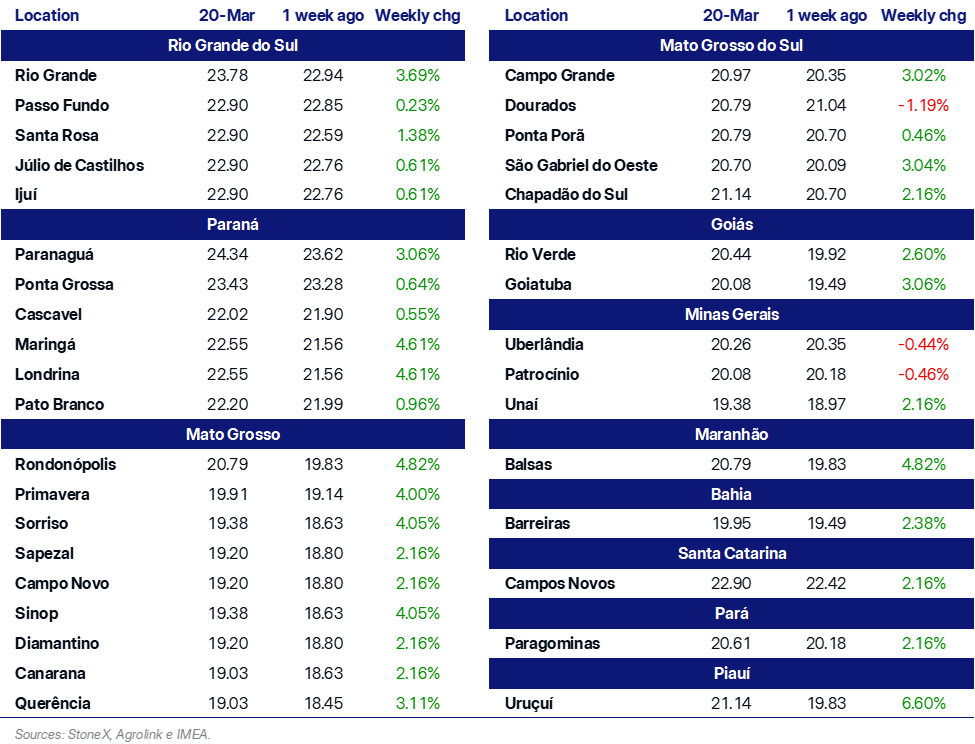
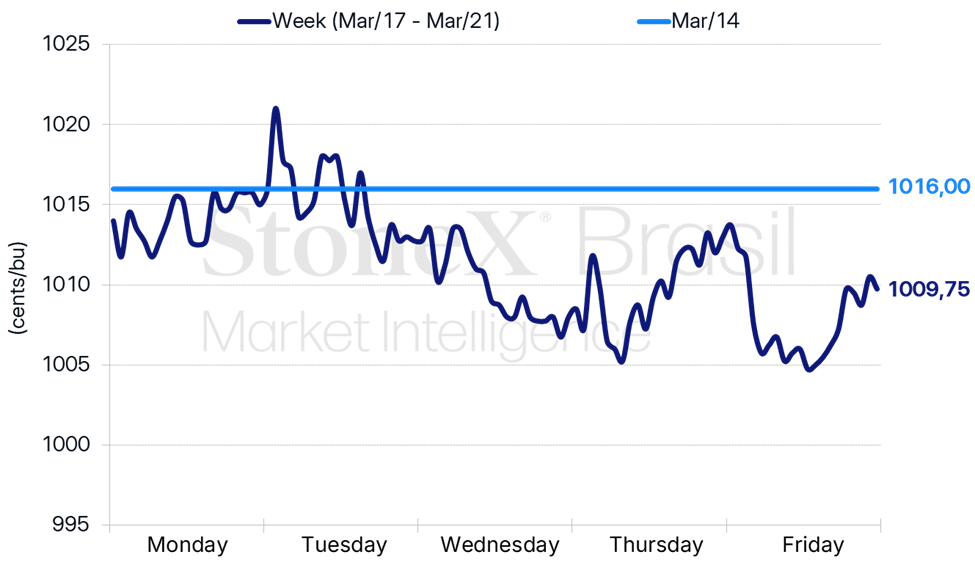
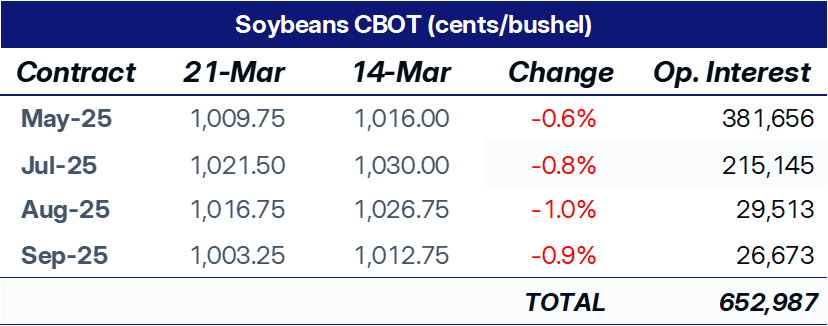
Soybean prices in Chicago remained above USD 10.00 per bushel last week, but with a downward trend. The May contract ended Friday (March 21) at 1009.75 cents per bushel, down 0.6% for the week. The market continues to monitor the South American crop, as well as demand trends, with stronger basis levels in Brazil.
As of last Friday (March 21), Brazil’s soybean harvest had reached 75.3% of the total, according to StoneX. Many states are close to completing their harvest, while Rio Grande do Sul is just beginning, as its crop cycle is later. In any case, with the harvest advanced, the crop forecast is less likely to face major revisions, with the record output being confirmed. The latest StoneX figure stands at 168.3 million tonnes.
In Argentina, the Buenos Aires Grain Exchange reduced the 24/25 soybean crop estimate by 1 million tonnes to 48.6 million, due to dry conditions and high temperatures, especially in February. Northern regions received less rainfall compared to others when precipitation returned. Although some regions with better rainfall show good conditions, they won’t be enough to offset the northern losses, prompting the production cut. Overall crop conditions have improved, with the poor/fair rating dropping 6 percentage points in one week, to 27%.
Despite weather issues in South America, the output is still expected to be very strong, contributing to a lackluster international price outlook. Attention now shifts to the size of the US crop, which begins planting in April. Expectations point to a decrease in planted area, with the USDA Agricultural Outlook Forum forecasting 34 million hectares. Even so, this area, combined with trendline yields, would result in a crop similar to last year's, not tightening the country’s supply and demand balance. Next week, focus will turn to the US planting intentions report, which is based on farmer surveys and provides a more accurate projection.
On the demand side, US soybean crush data for February, released by the National Oilseed Processors Association (NOPA), added pressure to prices. NOPA, which accounts for around 95% of US soybean processors, reported a crush of 4.84 million tonnes—below last year and market expectations (just over 5 million tonnes). Although this period is seasonally weaker for crushing, larger-than-expected drops in Illinois and Iowa were seen, with margins turning negative.
Regarding exports, US sales for the week ending March 13 totaled 352.6 thousand tonnes, bringing total sales for the 24/25 season to 45.4 million tonnes. Sales to China were 1.3 million tonnes below last year, while sales to other destinations were 6.7 million tonnes ahead—putting total commitments above the 49.7 million tonnes forecast for the season. In the coming months, volumes will remain in focus amid China’s tariff on US soybeans.
Currently, China is focusing its soybean purchases on Brazil—a usual trend during the Brazilian harvest due to increased availability. This helps explain the strong premiums at Brazilian ports, even amid abundant supply. While international prices in Chicago remain under pressure, premiums in Brazil have strengthened in recent weeks, hurting Brazil’s competitiveness in Asia. At times, US soybeans have been nearly as cost-effective as Brazilian ones—an unusual scenario for this time of year. Nevertheless, Brazilian exports are expected to remain hot, with ship lineup data indicating March shipments could total around 15 million tonnes.
This week, demand should remain in focus—especially premium trends in Brazil—while no major surprises are expected on the supply side. As mentioned, the US planting intentions report will only be released next week, and StoneX will update its 24/25 Brazil crop estimate on April 1.