Bitcoin’s Yuuge Upgrades, Parasitic L2s, and World Liberty

Executive Summary
- Market trading color: Bitcoin breaking out, ETF inflows exceeding $20B, supply imbalance on exchange persisting, and increased interest in BTC basis trade
- Theme of the week – Trump’s DeFi ($WLFI), Uniswap’s L2, and Bitcoin Amsterdam coupled with Bitmaps, Liquid Staked Bitcoin, and Bitcoin Core upgrade
- Sector commentary: Bitcoin challenges highs near $69K, Ethereum ETF optimism, Solana rises, and altcoins face selling pressure
Market Trading Color (Nolan Aibel)
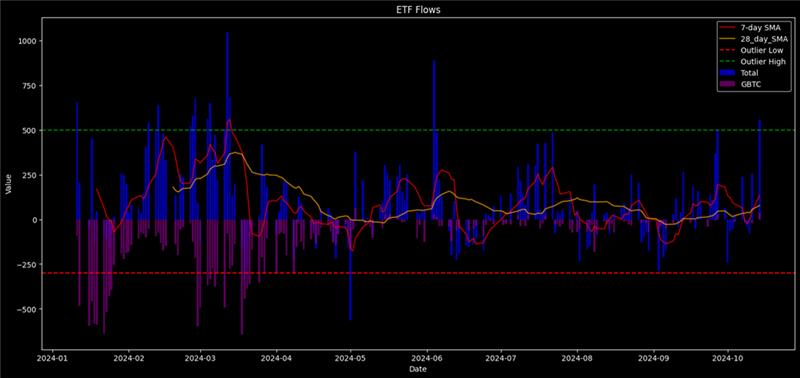
What a week it has been for Bitcoin and the digital asset market. Bitcoin has risen 10% over the past seven days, reaching levels not seen since early July. Contributing to this positive price action has been ETF inflows. BTC spot products saw an additional $456.9 million in inflows yesterday, bringing the four-day total to $1.6 billion. Only eight of more than 560 ETF launches in 2024 have reached such numbers within a year, let alone in just four days. This massive week of inflows has pushed Bitcoin ETFs above $20 billion in total net flows for the first time. By comparison, it took gold ETFs roughly five years to reach this milestone.
The last three instances of daily inflows exceeding $500 million—including this past Monday—occurred on September 27th, June 4th, and July 22nd. While the sample size is small, these high-inflow days have previously marked local tops, as seen below. However, this time might be different with the election approaching and the momentum Bitcoin is gaining as Trump’s lead in the polls widens, according to Polymarket. Interestingly, nearly $2 billion has been wagered on the election through Polymarket (use case). Despite the uncertainty surrounding short-term price movements, the outflows of BTC from exchanges into ETFs have correlated with ongoing supply-demand imbalances. The percentage of BTC held on exchanges is now at a six-year low, just above 15%.
Source: CryptoCond
As prices continue to rise, so does CME open interest, which hit an all-time high of $12.2 billion as of this morning. Over the past seven days, open interest has grown by more than 32,000 BTC, a level of growth last seen when BlackRock's spot ETF filing was launched. Just a year ago, CME surpassed Binance as the leader in BTC futures open interest. Today, CME outpaces Binance by approximately 35%.
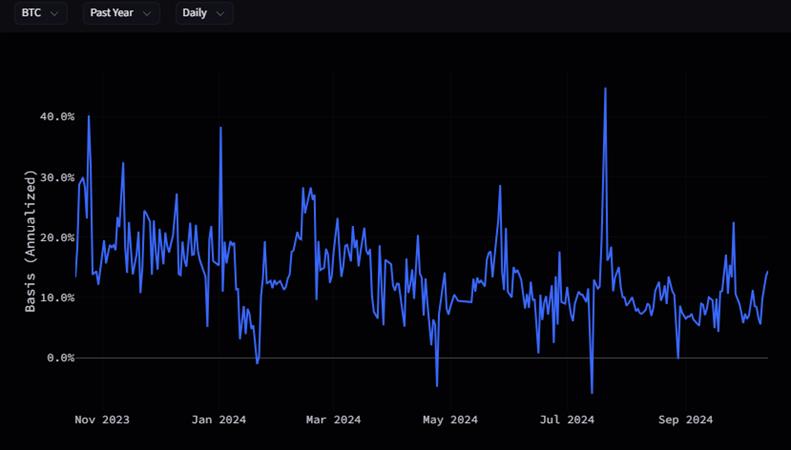
As activity on CME has increased and volatility has risen, many traders are revisiting the basis trade between spot and futures. This trade is currently yielding around 12.2% to end of the month (next week), 9.5% to November and 9% to December. We’d be happy to explore the dynamics of this trade further for anyone interested.
Source: TheTie
Trump’s DeFi Protocol and Aave Partnership
One of the most attention-grabbing announcements this week is the launch of Donald Trump’s DeFi protocol, World Liberty Financial (WLFI). The ICO went live on the 15th of October at 12:40 UTC, selling over 344 million tokens in the first hour to nearly 3,000 unique wallets. Despite website outages during the launch, the sale managed to attract a significant amount of attention, with a blockchain wallet linked to the token holding nearly $4 million worth of ether (ETH), $1.2 million in tether (USDT), and around $250,000 in USD Coin (USDC).
The project aims to raise $300 million, with a fully diluted valuation (FDV) of $1.5 billion. However, the Trump team has sold only about $12 million worth of $WLFI tokens on the first couple of days of the presale, representing just 4% of their $300 million goal, as the website crashed. Notably, 7% of the WLFI supply, estimated to be worth $105 million, will be allocated to the Aave DAO as part of a strategic partnership, allowing Aave to benefit from increased liquidity and attention in the DeFi sector. Currently, WLFI has approximately 2,900 unique holders and will serve as a governance token, enabling users to participate in DeFi activities such as borrowing, lending, and liquidity pooling.
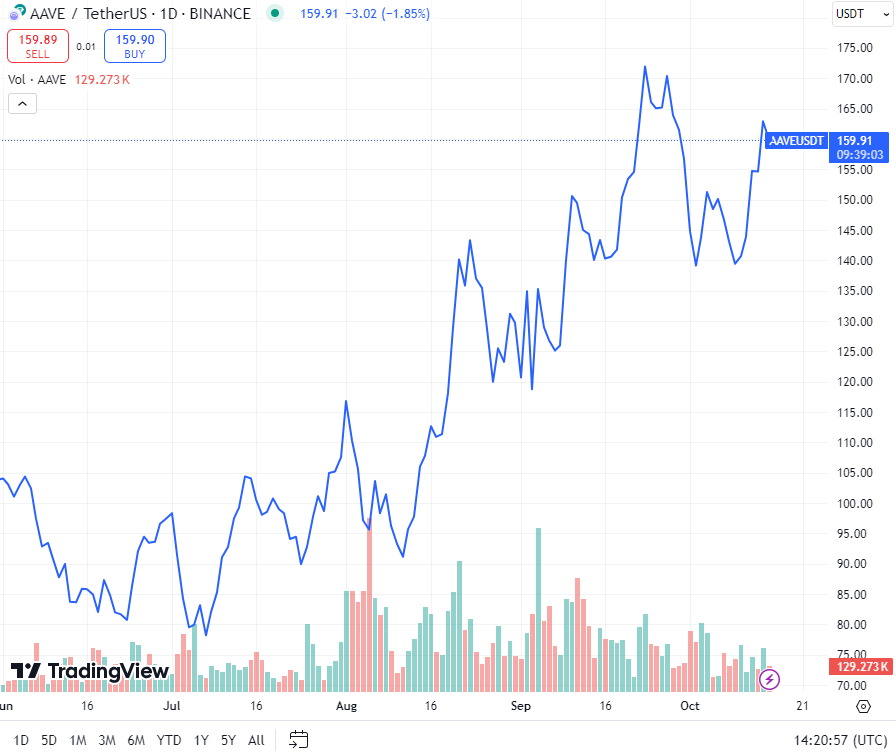
While the success of this project remains to be seen, $AAVE has surged 16.73% over the past month, delivering a YTD return of 48.42%, showing strong performance as the DeFi space heats up.
Source: TradingView.com
Uniswap’s Unichain: Transforming Fee Distribution and MEV Capture
Uniswap is making headlines with the upcoming launch of Unichain, a Layer 2 blockchain built within the Optimism Superchain. Unichain will transform the economics of DeFi by capturing fees previously directed to Ethereum validators, MEV bots, and Layer 2 sequencers.
Here’s a breakdown of the changes Unichain will bring:
- Settlement Fees: Instead of paying $368 million in fees to Ethereum validators, Uniswap Labs and UNI token holders will now capture these fees through staking.
- Maximum Extractable Value (MEV): Uniswap will also capture the $100 million in MEV, with the option to share this value with token holders.
- Redistribution: Unichain is expected to redistribute $468 million annually to UNI token holders and liquidity providers.
Uniswap has historically generated $1.3 billion in trading fees over the past year, with 100% of those fees going to LPs, Ethereum validators, and others. With Unichain, UNI token holders and LPs can now stake and capture a portion of these fees, fundamentally changing how value is distributed within the ecosystem.
Uniswap Economics Across Blockchains
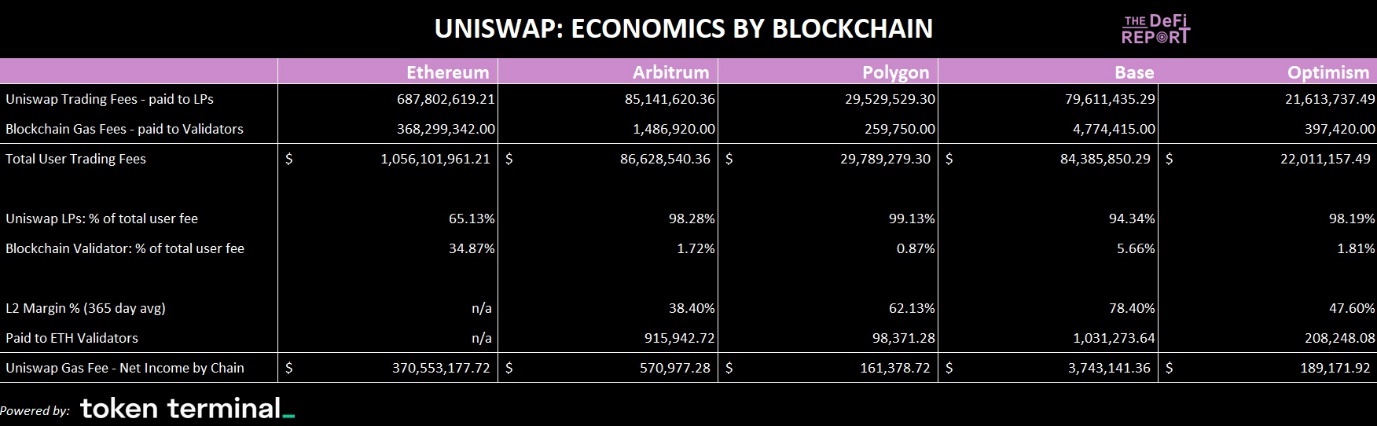
The following table illustrates Uniswap’s economic performance across five blockchains: Ethereum, Arbitrum, Polygon, Base, and Optimism. The total trading fees across these chains reveal how Uniswap continues to dominate the decentralized exchange (DEX) landscape:
- Ethereum: $1.056 billion in user trading fees, with $687 million paid to LPs and $368 million paid to validators.
- Arbitrum: $86.6 million in user trading fees, with 98.28% going to LPs and only 1.72% to validators.
- Base: $84.3 million in user trading fees, with $3.7 million in gas fees contributing to validators.
Source: x.com/JustDeault – Michael Nadeau
L2s and Ethereum: Parasitic Relationship?
We continue to write about the growing criticism around the L2 model being parasitic to Ethereum’s long-term sustainability. As illustrated in the Ethereum Supply chart, the EIP-4844 upgrade aimed to address Ethereum’s Layer 2 data availability, but Layer 2 scaling has inadvertently reduced Ethereum’s burn rate and fee capture.
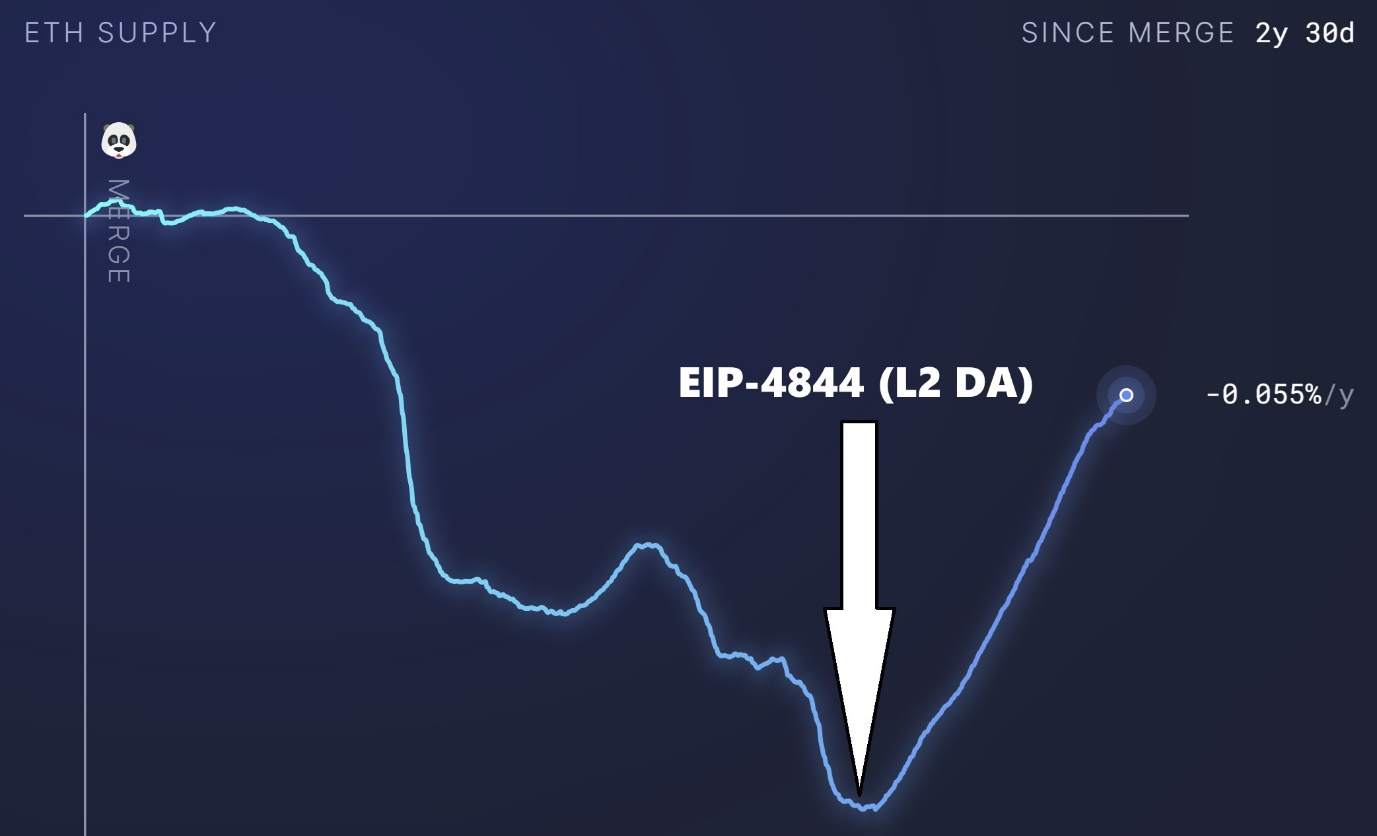
Source: ultrasound.money
L2s like Unichain retain most fees, with only a small fraction flowing back to the Ethereum base layer. As the second chart demonstrates, for every dollar paid to Ethereum, Optimism retains up to $300 in transaction profits. This has led some to call L2s extractive to Ethereum’s ecosystem and demand a shift in Ethereum economics back to Ethereum.
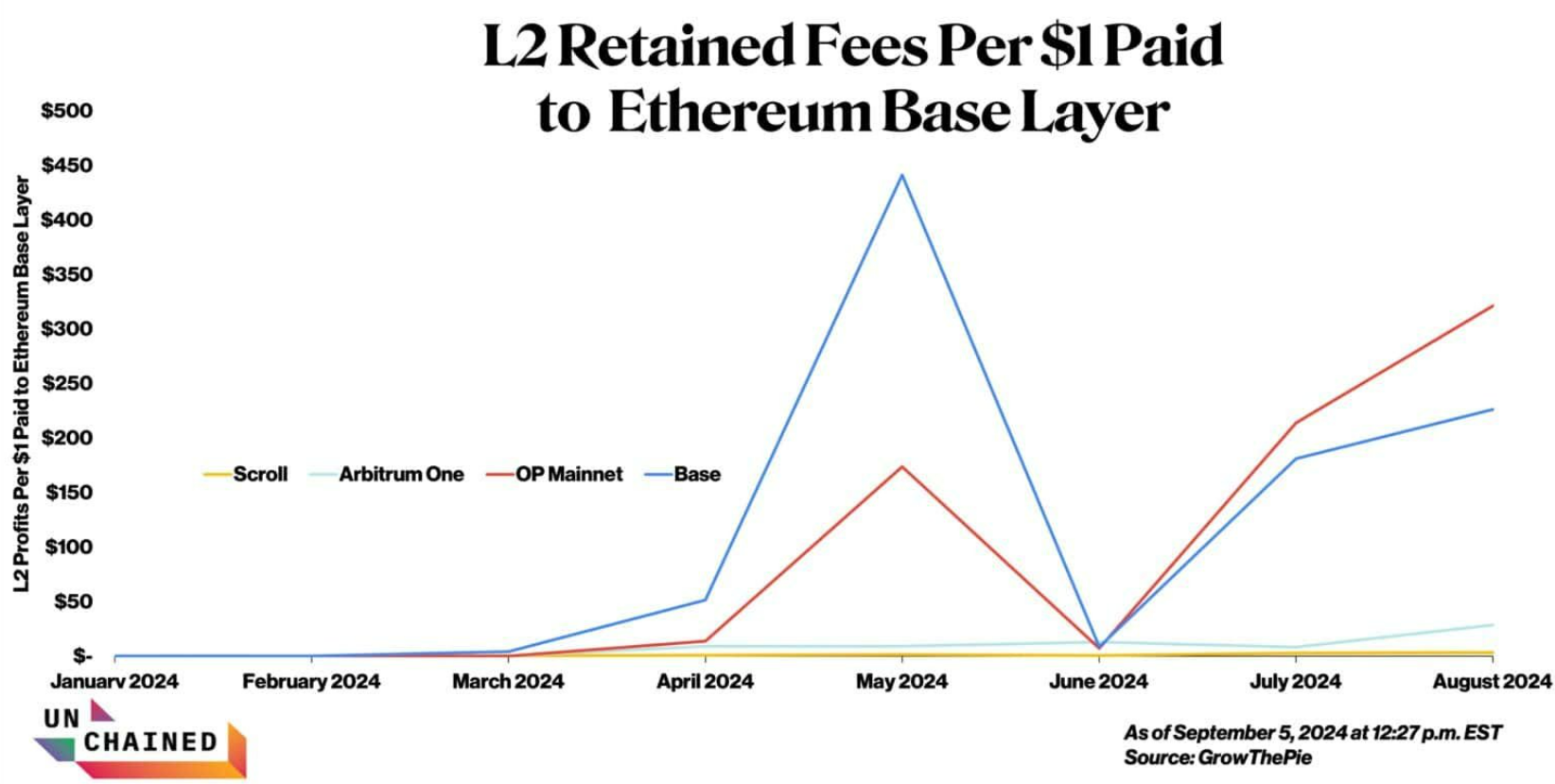
Source: GrowThePie
Key Insights from Bitcoin Amsterdam
Last week, our team attended the Bitcoin Amsterdam Conference, where speakers emphasized growing institutional interest in Bitcoin as a long-term store of value, likening it to gold and its potential as a global reserve asset. The conference also explored critical advancements in the Bitcoin ecosystem, including infrastructural improvements like proof of reserves, financialization of hashrate, and scaling solutions such as the Lightning Network, while innovations like Bitmaps and Liquid Staked Bitcoin (LBTC) are expanding Bitcoin’s utility within decentralized finance.
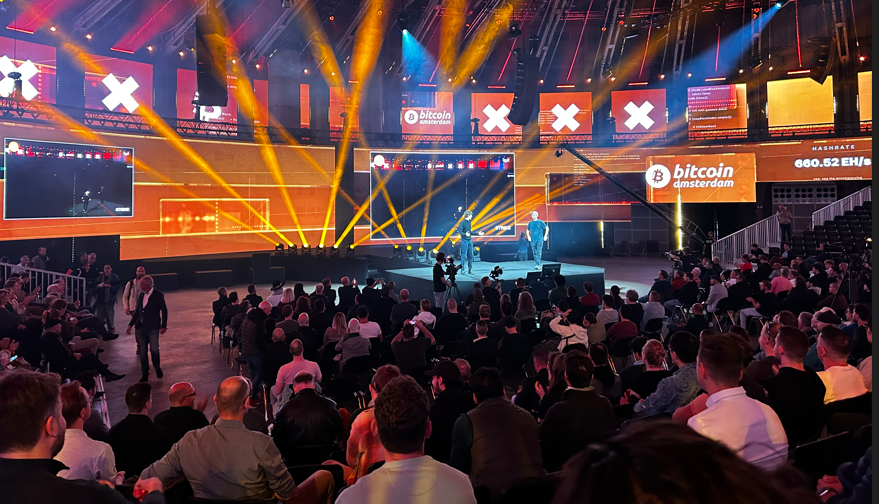
Key Takeaways from the Bitcoin Amsterdam Conference
- Bitcoin as a Hedge Against Inflation: With Bitcoin’s fixed supply of 21 million, its deflationary nature contrasts sharply with fiat currencies like the euro, which loses approximately 20% of its purchasing power every five years. This fixed supply positions Bitcoin as a potential competitor to traditional reserve assets like gold. As institutional interest grows, on-chain data reveals that 75% of Bitcoin’s supply remains dormant for over a year, signaling strong long-term holder confidence. Over the next 5-10 years, Bitcoin could emerge as a global reserve asset alongside the U.S. dollar and gold.
- Proof of Reserves and On-Chain Transparency: An estimated 15% of Bitcoin’s total supply has been lost or stolen due to security issues and hacks. The rise of Proof of Reserves is becoming a crucial verification tool to ensure solvency for institutions and exchanges in the Bitcoin ecosystem. As of 2023, new blockchain-based verification tools are helping mitigate risks, providing greater transparency, and fostering trust within the financial industry.
- Hashrate as a Financial Asset: Bitcoin's hashrate recently hit an all-time high, surpassing 450 EH/s. The financialization of hashrate is enabling miners and investors to manage risks via hashrate derivatives, much like commodities in traditional markets. This move allows miners to hedge against Bitcoin price fluctuations and network difficulty. With the mining industry generating over $6 billion in revenue this year, these financial products are expected to add liquidity and sophistication to the sector, enhancing profitability.
- Global Adoption and Hyperbitcoinization: Hyperbitcoinization, the process by which Bitcoin becomes a dominant global financial system, is already underway. By 2050, Bitcoin's influence will be so significant that those who do not adopt it may be disadvantaged. Bitcoin's purchasing power is expected to rise continually, impacting personal savings, employer-employee relationships, and national economies. Institutions increasingly use Bitcoin as a hedge against hyperinflation and currency devaluation, with El Salvador's adoption of Bitcoin showing a 12% rise in remittance flows since 2021.
- Institutional Participation and Bitcoin ETFs: The growing presence of Bitcoin ETFs is set to accelerate institutional adoption. The U.S. leads globally in Bitcoin ETF assets under management, exceeding $50 billion. Bitcoin ETFs allow pension funds, trusts, and other traditional investors easy access to Bitcoin. This trend is expected to continue in 2025, with new regulatory frameworks implemented across Europe and Asia to enable broader retail and institutional participation.
- Scaling Bitcoin for the Future: Scaling Bitcoin for a global audience by 2050 requires innovative solutions such as the Lightning Network, which currently has over 16,000 active nodes and more than 5,200 BTC locked. The Lightning Network allows faster, low-cost transactions, which is crucial for Bitcoin’s role in supporting financial inclusion worldwide. Rollups and zero-knowledge proofs are also being explored to enhance scalability and improve the user experience, enabling billions to use Bitcoin efficiently in the coming decades.
- Bitcoin’s Role in National Economies: As inflation continues to rise globally, Bitcoin is emerging as a tool for national economic sovereignty. For example, countries like Argentina have faced inflation rates of over 277.1% since 1997, driving individuals to use Bitcoin as a store of value. With more governments exploring Bitcoin's potential, Bitcoin could be critical in reducing dependency on fiat currencies. For instance, the “Bitcoin in Bundestag” initiative in Germany aims to educate policymakers about Bitcoin's potential to harness renewable energy for mining and promote economic freedom.
Bitcoin Ecosystem Developments
Bitcoin Core v28 Upgrade
Alongside the exciting insights from the conference, it's important to highlight the ongoing improvements to Bitcoin’s technical infrastructure. The Bitcoin Core v28 upgrade introduces key enhancements that strengthen the network’s performance, privacy, and usability. Below is a condensed overview of the most significant updates:
- Improved Block Validation & Syncing: Optimizations in block validation are designed to speed up node synchronization, improving overall network efficiency.
- P2P Network Stability: Enhanced peer-to-peer (P2P) networking ensures more reliable node connections, supporting decentralization and network resilience.
- Taproot & Schnorr Enhancements: Further optimizations in Taproot and Schnorr signatures improve Bitcoin’s scalability, flexibility, and privacy.
- Privacy Upgrades: Greater support for privacy-focused techniques like CoinJoin and improved integration with Tor and I2P networks for anonymous transaction routing.
- Efficient Wallet Management: Descriptor wallets are gaining more flexibility, allowing users to manage complex wallet setups easily. This includes improved support for multi-wallet functionality and easier key management.
- Disk Usage and Resource Efficiency: Improvements in pruned node functionality and resource efficiency make running a Bitcoin node on low-resource devices easier, lowering the participation barrier.
- Security and Bug Fixes: Critical bug fixes and security patches ensure Bitcoin’s robustness against vulnerabilities, reinforcing its long-term stability and decentralization.
LBTC: Liquid Staked Bitcoin
Another significant development in the Bitcoin space is the rise of LBTC (Liquid Staked Bitcoin), a protocol that enables Bitcoin holders to stake their BTC and mint liquid staking derivatives. These derivatives can be deployed within Babylon’s DeFi ecosystem and are already used across platforms such as ZeroLend and Pendle.
Key Statistics:
- Over 8,000 BTC have already been staked via the LBTC protocol, representing 0.04% of Bitcoin’s total supply.
- LBTC has surpassed legacy-wrapped Bitcoin products such as tBTC, which has only 3.7k BTC staked. In less than two months, LBTC has over 2x the supply of tBTC, showcasing its rapid adoption within the DeFi ecosystem.
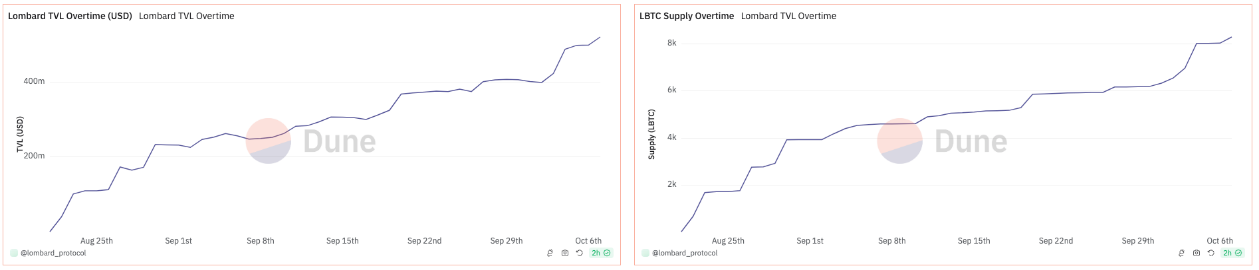
Source: Dune Analytics @lombard_protocol
Significance:
- Yield Opportunities: LBTC allows Bitcoin holders to earn yield while maintaining liquidity, offering more utility than traditional BTC holdings.
- DeFi Integration: LBTC’s integration across multiple DeFi platforms highlights Bitcoin’s increasing role within decentralized finance as users seek new ways to generate returns on their assets.
Bitmaps and BRC-721 Tokens
Another development within the Bitcoin ecosystem is the rise of Bitmaps, a new form of decentralized ownership on the Bitcoin blockchain facilitated by the BRC-721 protocol. While initially overshadowed by the prominence of NFTs on other chains like Ethereum, Bitmaps represent a unique approach to digital ownership directly tied to Bitcoin.
Bitmaps allow users to claim ownership of specific Bitcoin blocks by inscribing them with Ordinals, turning them into unique, tradable digital assets. This system functions like virtual real estate, where each claimed block represents a plot in a decentralized metaverse. The concept of Bitmaps enhances Bitcoin’s utility by blending blockchain technology with the idea of digital property ownership, like the NFT movement but within the context of Bitcoin’s history and blockchain.
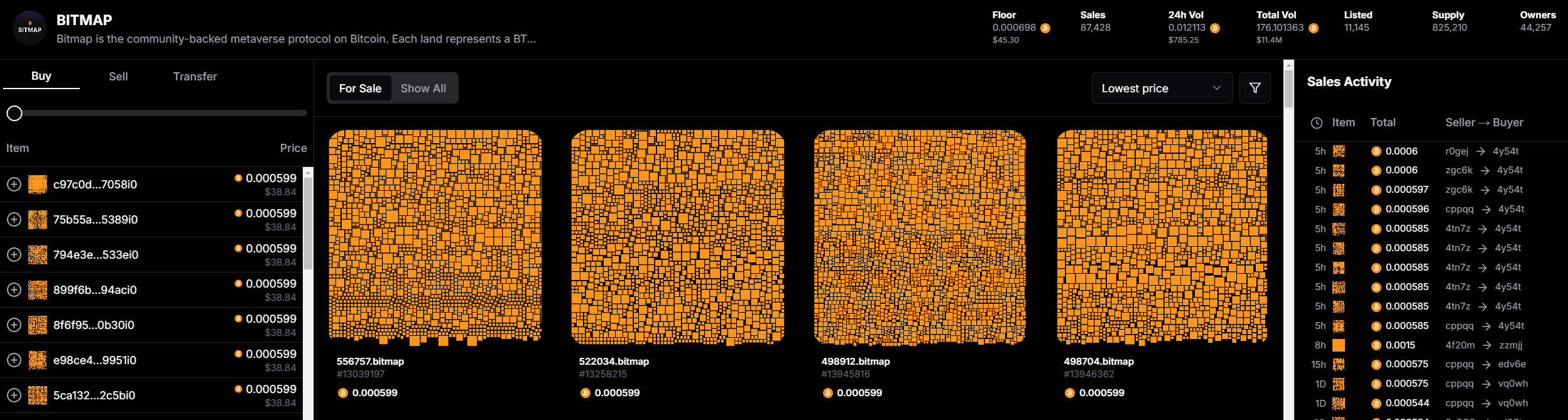
Each Bitcoin block inscribed as a Bitmap is unique and non-reclaimable, introducing a layer of scarcity that has driven speculative interest. The current floor price for a Bitmap is approximately 0.0000698 BTC ($45.29 USD), with over 176 BTC in total volume traded and 44,257 unique owners.
- Decentralization & Scarcity: Each Bitcoin block inscribed as a Bitmap is unique and non-reclaimable, introducing a layer of scarcity that could drive speculative interest. Early blocks, in particular, have seen rising demand as collectors seek to own a piece of Bitcoin’s historic timeline.
- Potential Use Cases: While still early in its development, Bitmaps hold potential for integration into dApps, metaverse environments, and community-driven projects. Owners of specific blocks could form collaborative ventures, turning Bitmaps into hubs for decentralized virtual projects.
Source: ordinalswallet.com
Sector Commentary
- Layer One / Altcoins
- Bitcoin ($BTC): Bitcoin Jumps to Just Shy of $68K Before Quick Plunge Lower (link)
- Bitcoin ($BTC): BTC price focus shifts to $69K as Bitcoin challenges 8-month downtrend (link)
- Bitcoin ($BTC): This Chart Indicates Bitcoin May Be Headed for Record Highs Above $73K (link)
- Bitcoin ($BTC): Cash-Margined Bitcoin Futures are More Popular Than Ever as Open Interest Reaches New Highs (link)
- Bitcoin ($BTC): Standard Chartered says bitcoin could revisit its all-time high before the US election (link)
- Ethereum ($ETH): Bitwise: Why This ETF Expert Is Bullish on Ethereum and Says Washington’s Crypto Stance Is Misunderstood (link)
- Ethereum ($ETH): Split Capital: $ETH: A Saturday Tragedy (link)
- Solana ($SOL): Why is Solana (SOL) price up today? (link)
- Altcoins: CoinDesk 20 Performance Update: ICP Drops 3.5% as Index Inches Lower From Monday (link)
- Altcoins: Altcoin Selling Pressure Looms as $500M in Token Unlocks Scheduled This Week (link)
- DeFi / Stablecoins
- Why the $172B Stablecoin Market Could Send Crypto Prices Higher (link)
- Tether Explores Lending to Commodity Traders: Report (link)
- Ripple Names Exchange Partners for Stablecoin RLUSD, Awaits NYDFS Approval (link)
- Trump-Touted Crypto Website Crashes as Token Sale Goes Live, With Just 1.7% of Target Sold (link)
- Web3 / AI / NFTs
- RWA / Tokenization / Metaverse / Gaming
- Digital Infrastructure: Capital Markets / Exchanges / DAOs / Mining
- Crypto market matured ‘dramatically’ in 2024: Coinbase (link)
- CME's Bitcoin Friday Futures Are Ideal for News Traders: CF Benchmarks (link)
- Fidelity Plans First Fund That May Use Blockchain (link)
- ‘Political shift’ drives $407M inflows to crypto products — CoinShares (link)
- Coinbase Escalates SEC Fight Over the Agency's Inside Chatter on ETH (link)
- Samara Asset Group Plans up to $32.8M Bond to Expand Bitcoin Holdings (link)
- Arca: “That’s Our Two Satoshis” - Breakdown of Republicans' and Democrats' Views on Crypto Issues (link)
- JPMorgan bullish on crypto into 2025, considering a Trump win and other factors (link)
- Metaplanet Bitcoin Treasury Reaches $56 Million With Latest BTC Buy (link)
- Crypto ETF takes from the Permissionless stage (link)
- Bitcoin Price Bounces as Spot ETFs Pull in $556 Million (link)
- Liquidity and Options Pave the Way for Bitcoin ETF Market Expansion (link)
- Monochrome’s First Spot Ether ETF to Go Live on Tuesday (link)
- Ex-Valkyrie Founder’s Canary Capital Group Files for First Litecoin ETF (link)
- Blockstream Raises $210M in Convertible Note Financing Round (link)
- Bitcoin Mining Profitability Fell in September, Jefferies Says (link)
- Crypto Custodian Copper Appoints Former SEC Advisor Amar Kuchinad as New Global CEO (link)