From Niche to Necessity: Bitcoin in a Modern Portfolio

Executive Summary
- Market trading color: Bitcoin rebounds on economic data and Trump’s crypto policy, fueling altcoin gains and renewed optimism
- Theme of the week – Bitcoin’s decentralized scarcity, low correlation, and ETF evolution drive enhanced returns and diversification
- Links of the week: Analysts project bullish Bitcoin, potential dips, and significant crypto ETF growth
Market Trading Color (Nolan Aibel)
What a mid-week turnaround for the digital asset market. This week began with Bitcoin sinking below $90,000 for the first time since November, as risk markets felt the lingering effects of hotter-than-expected jobs data. Fast forward three days, and Bitcoin has rallied 10%, climbing back above $99,000. Bitcoin and the crypto market in general have benefited from a flurry of favorable economic data. First, Tuesday’s PPI showed cooler-than-expected readings, followed by Wednesday’s CPI, which came in line with or even slightly better than expectations. Coupled with a wave of Trump/crypto-related headlines, this marked a complete 180-degree shift from the doom and gloom seen on Monday.
These headlines include:
- Trump’s SEC to overhaul crypto policy, potentially freeze existing enforcement cases
- Trump to issue executive order addressing crypto-accounting SEC rule SAB 121 on day one
This rollercoaster week was unkind to leveraged traders, as over $2 billion in liquidations were recorded—a near-even split between shorts and longs. Monday’s selloff saw funding rates reset completely, dropping below 7% annualized for BTC across exchanges. While rates have ticked up slightly from the lows, sitting above 10% now, they remain in a healthy range. This helps in indicating that the most recent leg higher was largely driven by spot trading. The Coinbase Premium Index even flipped positive after spending a week in the negative.
ETF results reflected this reversal in the Coinbase Premium Index, with $755 million worth of BTC inflows recorded yesterday after five straight days of outflows. ETH ETFs followed suit with $59 million in inflows. Options flow this week has been dominated by the $120K Call and the $90K Put. Total notional on the $120K Call has surpassed $10 billion, while the $90K Put has over $550 million wagered. BTC implied volatility has remained relatively stable at around 69v.
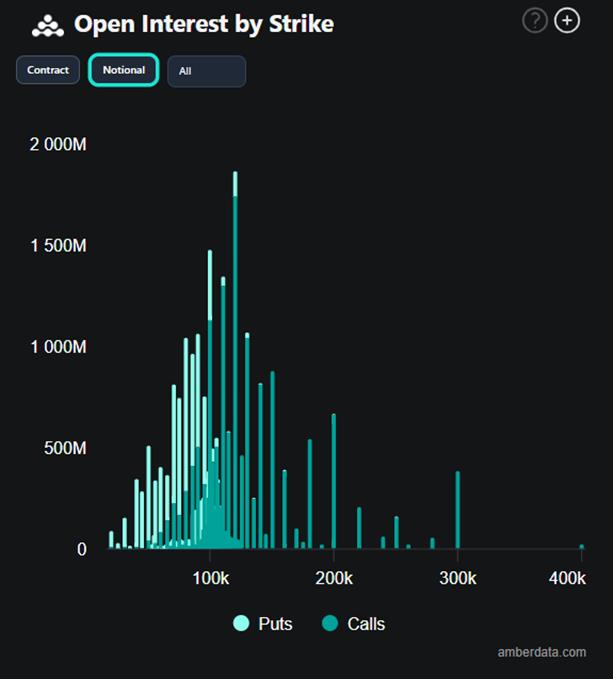
Source: Deribit
Aside from BTC and ETH, the real winners this week were perhaps XRP and SOL. Both have benefited from spot ETF speculation and strategic reserve rumors—the latter being news we remain skeptical about for now. Baby steps: BTC will be first. Retail investors have also embraced XRP, sending it up over 50% this week and pushing its market cap toward $200 billion. The top gainers of the week were largely older, retail-oriented coins, including ALGO, HBAR, and XLM. Memecoins have cooled off for the time being, with AI-related tokens attracting much of the exited liquidity. New leaders in the AI token sector include VIRTUALS, ai16z, AIXBT, and ARC.
Why Bitcoin Should Be Part of a Portfolio
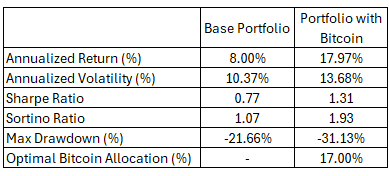
Bitcoin’s historical performance shows it can enhance returns, reduce overall volatility, and provide diversification benefits when included in a traditional portfolio. After examining nearly a decade of data, Bitcoin has maintained a low correlation with major asset classes such as equities, bonds, and commodities. Our analysis shows that reallocating 17% of a base portfolio (which originally earned 8% annualized with a 0.77 Sharpe ratio from 2016 to 2025) to Bitcoin boosted returns to 18% and raised the Sharpe ratio to 1.31, highlighting Bitcoin’s impact on risk-adjusted performance. Moreover, VanEck and Galaxy Digital studies confirm that even modest allocations of 3–6% can meaningfully increase Sharpe ratios while having minimal effect on drawdowns. As institutional products and futures markets have grown—along with Bitcoin ETFs—opportunities to incorporate Bitcoin into portfolios have multiplied, offering convenience and regulated structures for investors seeking higher risk-adjusted returns.
Bitcoin tied to Traditional Assets
Bitcoin’s historical performance demonstrates low correlation with major asset classes such as equities, bonds, and commodities. This attribute positions Bitcoin as a potential portfolio diversifier. Galaxy Digital highlighted this weak relationship in one of their reports. Our analysis further reveals an average correlation range of ±0.16 with traditional macro assets, suggesting that Bitcoin’s price movements are largely independent of broader financial markets.
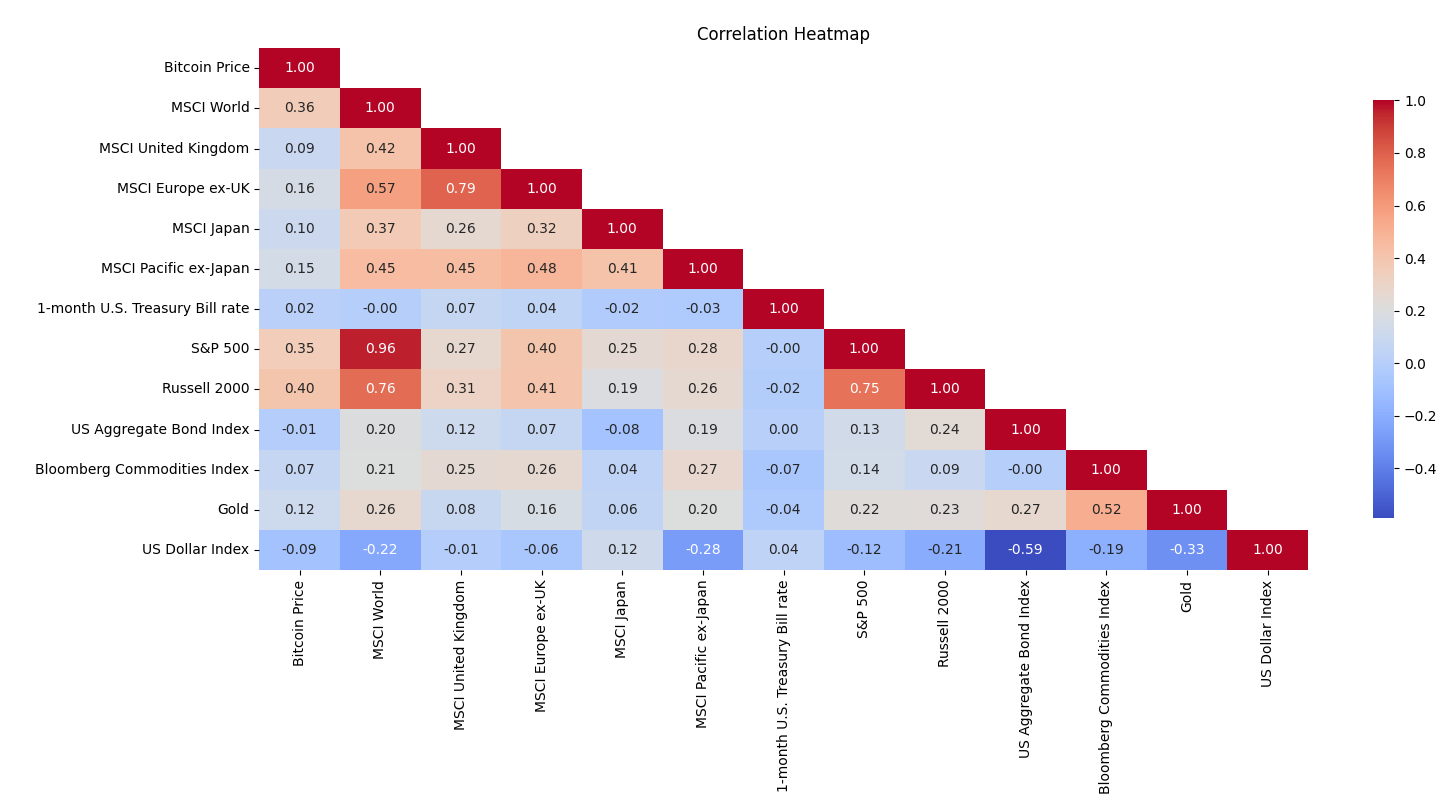
Source: Bloomberg, StoneX Digital
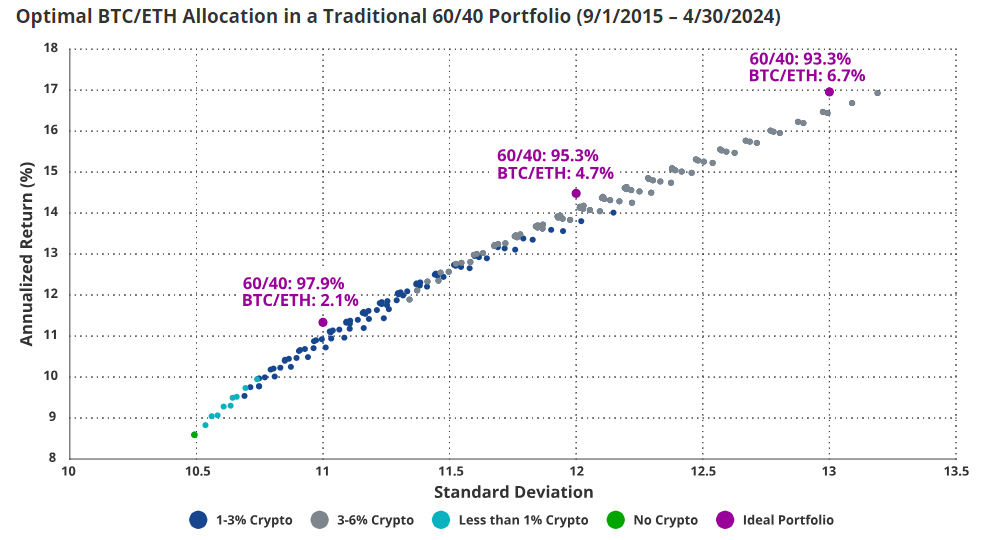
Similarly, VanEck’s comprehensive study further substantiates Bitcoin's role in enhancing portfolio performance. Their analysis, spanning September 1, 2015, to April 30, 2024, evaluated the integration of Bitcoin and Ethereum into a traditional 60/40 equity-bond portfolio. The findings revealed that a modest cryptocurrency allocation of 6%—split evenly between Bitcoin (3%) and Ethereum (3%)—provided the highest return per unit of risk (Sharpe ratio) with minimal impact on drawdowns. Portfolios with this allocation demonstrated a nearly doubled Sharpe ratio compared to a traditional 60/40 portfolio, while maximum drawdown increased only marginally.
Source: VanEck Research as of 5/28/2024
For investors with higher risk tolerance, allocating up to 20% to cryptocurrencies further enhanced risk-adjusted returns, with Bitcoin and Ethereum optimally weighted at approximately 70/30. This weighting yielded the best Sharpe ratio in a crypto-only portfolio, underscoring the complementary nature of these two assets.
VanEck’s study also identified that including cryptocurrencies in traditional portfolios shifted the efficient frontier upwards, providing superior risk-return profiles at various volatility levels. Interestingly, the Sharpe ratio plateaued around 22% volatility, suggesting diminishing returns for portfolios taking on excessive risk. By building on reports from Galaxy Digital, VanEck, and others, our analysis demonstrates how Bitcoin’s inclusion in a portfolio increases returns and decreases volatility.
Our Take
Since 2016, Bitcoin has transitioned from a niche digital experiment to a recognized asset class embraced by mainstream institutions, global investors, and regulators. This transformation, driven by the introduction of institutional products and futures markets, has led to enhanced portfolio performance when incorporating Bitcoin. Using data from January 2016 to January 2025, a Base portfolio (55% S&P 500, 35% U.S. Aggregate Bonds, 10% Commodities) delivered an annualized return of 8% with a Sharpe ratio of 0.77. By optimizing for the Sharpe ratio, reallocating to 17% Bitcoin, 28% S&P 500, 53% bonds, and 2% commodities, the annualized return increased to 18% with the Sharpe ratio rising to 1.31.
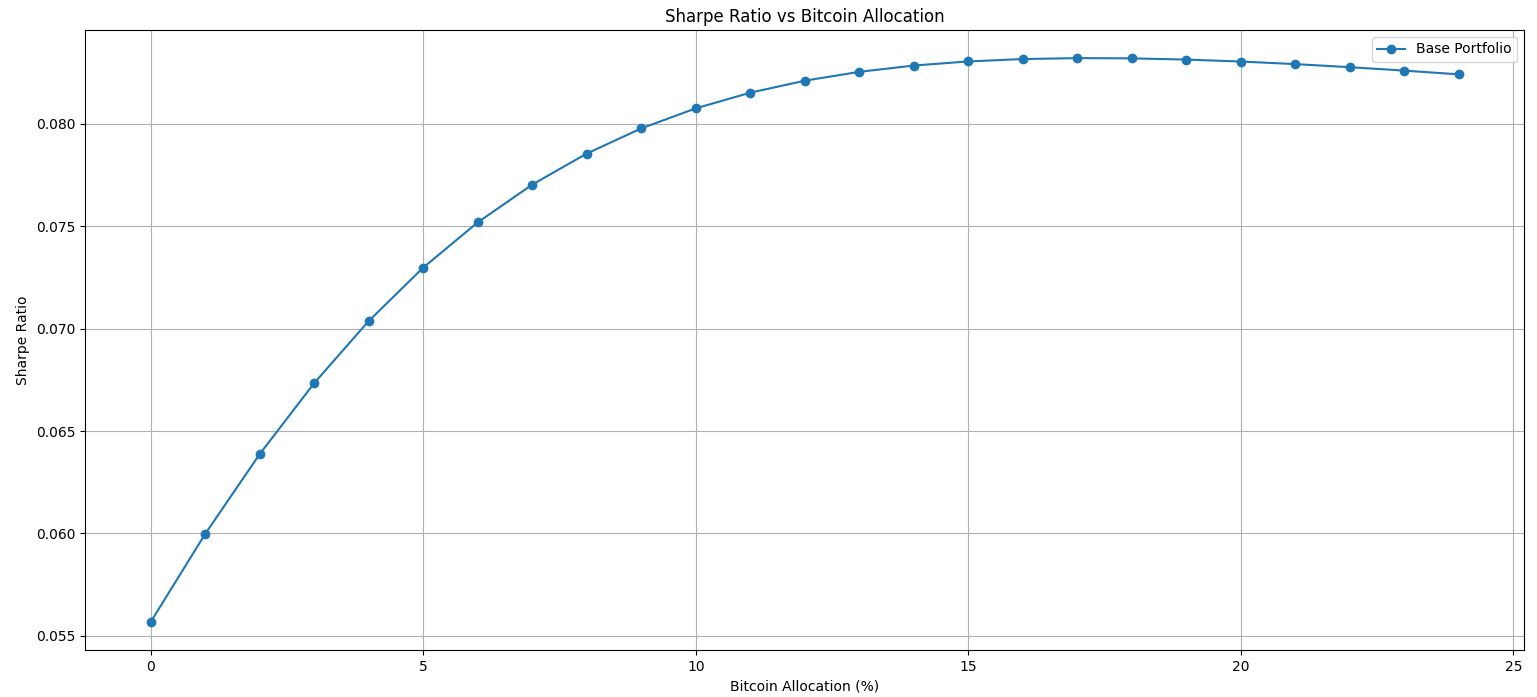
Source: StoneX Digital
While these enhancements come with higher volatility and drawdowns, the data shows that, when managed strategically, Bitcoin can improve risk-adjusted returns. Moreover, the emergence of Bitcoin-related financial instruments—like ETFs—has broadened how investors can incorporate Bitcoin into their portfolios.
Although Bitcoin ETFs are relatively new and have limited historical data, a one-year post ETF launch comparison suggests that their inclusion may offer similar benefits to holding Bitcoin directly. Since the start of the Bitcoin ETFs, a portfolio incorporating the IBIT ETF, like the one discussed above, achieved an annualized return of 26.4% and a Sharpe ratio of 1.87, closely mirroring the portfolio holding Bitcoin directly at 25.9% and 1.92, respectively. Volatility levels and drawdowns were also close across both options. While this early data indicates that ETF-based exposure to Bitcoin can deliver comparable risk-adjusted returns to owning the asset itself, it remains important to track these vehicles over a longer time horizon and the nuisances that come with a market that is open 24/7. As Bitcoin ETFs mature, factors like management fees, liquidity, and regulatory influences could differentiate their performance further from direct Bitcoin holdings.

Source: StoneX Digital, Bloomberg Data
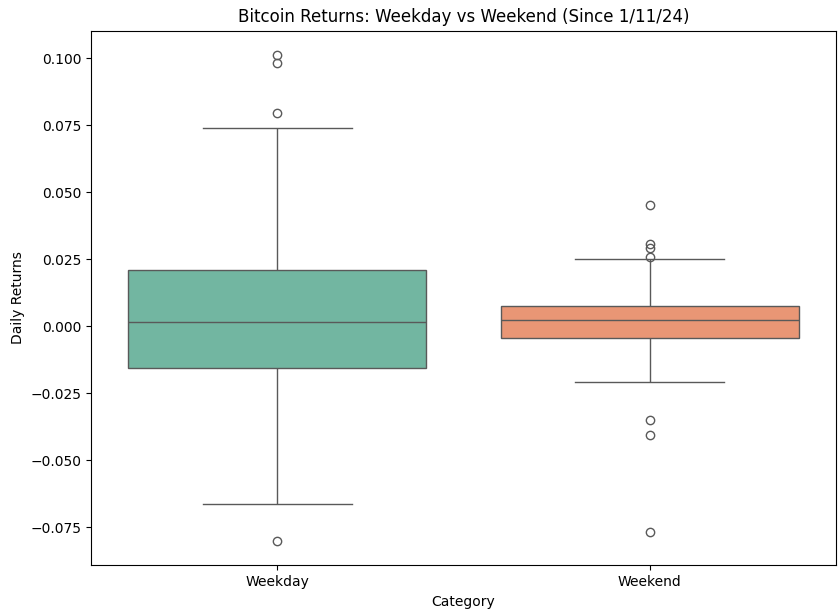
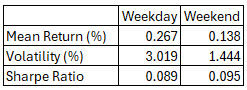
The data highlights key differences in Bitcoin’s performance between weekdays and weekends. Weekdays show higher average daily returns (0.267%), but also greater volatility (3.019%) compared to weekends, which have lower returns (0.138%) and reduced volatility (1.444%). Despite the calmer weekend trading environment, the Sharpe Ratio slightly favors weekends (0.095 vs. 0.089), indicating marginally better risk-adjusted returns.
Source: StoneX Digital
Trading spot Bitcoin directly often provides greater market flexibility and immediacy than a Bitcoin ETF. Unlike the traditional trading hours of regulated exchanges where ETFs are listed, spot Bitcoin can be bought or sold at any time, day or night, seven days a week. This around-the-clock availability helps traders quickly respond to breaking news or sudden price swings, potentially capitalizing on opportunities that occur outside of standard trading sessions. Furthermore, trading actual Bitcoin eliminates the need for intermediary management fees and custodial layers associated with ETFs, allowing investors to maintain full control over their private keys and digital assets. Regardless of an individual’s fundamental views on Bitcoin, a growing body of research demonstrates that allocating even a small portion to Bitcoin can enhance the risk-adjusted returns and diversification of a traditional portfolio. By applying a strategic asset allocation framework—where various approaches might include consistent rebalancing, target-weight positioning, or dynamic allocation—investors can not only reap the benefits of direct, flexible Bitcoin exposure but also improve the resilience and performance potential of their overall investment strategy.
A Refresher: What is Bitcoin?
Bitcoin is a decentralized digital currency and the first successful implementation of blockchain technology. Created in 2009 by an anonymous figure or group known as Satoshi Nakamoto, Bitcoin was envisioned as a response to the 2008 financial crisis, aiming to provide a transparent, censorship-resistant, and trustless financial system. At its core, Bitcoin operates on a peer-to-peer network where transactions are validated and recorded on a distributed ledger, known as the blockchain. This ledger ensures transparency and immutability, eliminating the need for intermediaries such as banks or payment processors.
Unlike traditional fiat currencies issued by central authorities, Bitcoin is governed by code, with a fixed supply cap of 21 million coins. This scarcity is enforced through its mining process, where participants compete to validate transactions and secure the network in exchange for new Bitcoin issuance, known as block rewards. Over time, these rewards diminish through a programmed event called the halving, which occurs approximately every four years. This mechanism mimics the extraction process of precious metals, establishing Bitcoin as a deflationary asset.
Bitcoin, a New Asset Class
Beyond its role as a digital currency, Bitcoin has evolved into a store of value, often compared to gold due to its scarcity, durability, and independence from centralized control. It is widely used for international remittances, wealth preservation in inflationary economies, and a growing tool in investment portfolios.
Bitcoin’s decentralized nature ensures that no single authority can alter its monetary policy, contrasting sharply with the centralized control of fiat systems. Moreover, its digital format enables seamless transferability across borders, an advantage over gold’s physical constraints. When compared to energy, Bitcoin stands out as a non-consumable asset—it stores and transfers value without physical depletion, offering a unique position in the asset class spectrum.
Rotta et al. (2022) classify Bitcoin as a digital commodity, highlighting its independence from liabilities upon issuance. Unlike traditional money, which creates a corresponding liability, Bitcoin’s value is intrinsic, rooted in its network’s security and utility. This liability-free structure enhances its durability and ability to retain value over time. Its applications range from international transactions and speculation to wealth preservation, underscoring its unique role in the digital economy.
Links of the Week
- StoneX Digital Top 10 Links of the Week
- Bitcoin ($BTC): Bitcoin technical indicator predicts BTC price cycle top in summer 2025 (link)
- Bitcoin ($BTC): Bitcoin Bull Tom Lee Sees BTC Reaching as High as $250K by Year-End (link)
- Bitcoin ($BTC): Standard Chartered warns bitcoin risks 10% retracement if $90,000 support breaks (link)
- Ethereum ($ETH): Ethereum price rebound will take time, even if ETH data looks bullish (link)
- Michael Saylor posts Bitcoin tracker for the 10th consecutive week (link)
- JPMorgan says XRP, Solana ETFs could bring in $13.6 billion in first year, if approved (link)
- Options Tied to BlackRock's Bitcoin ETF Surge to Nearly 50% of Deribit's BTC Open Interest in Two Months (link)
- Spot Bitcoin ETFs Exceeded Expectations in 2024, but Just Wait for 2025 (link)
- Departing SEC Chair Gary Gensler Slams Crypto Again—But Says Bitcoin Is Different (link)
- Bitcoin reserves interest gains momentum across 5 continents (link)