Bitcoin as a Treasury Asset: The Next Frontier for Corporate Strategy

Executive Summary
- Market trading color: The crypto market overcomes a rocky start to the week, ETH beta sees heavy bid, and ETFs are a train that won't slow down
- Theme of the week – Bitcoin in Treasuries, Quantum computing with blockchains, and ‘Jupuary’ approval on Solana
- Links of the week: Bitcoin vs quantum computing, CoinDesk’s Most Influential, Memecoins, and Stablecoins
Market Trading Color (Nolan Aibel)
What a bounce back it has been in the latter half of the week for the overall crypto market. It was a week that started with over $2B of longs seeing liquidation on Monday and Tuesday. We’ve noticed a recent pattern in weekend weakness spilling over to Monday’s trading session. This time was no different however as Bitcoin and Ethereum slid a modest ~4% on the 24-hour frames, alts were bleeding as many fell nearly 20%+ over the two-day span. This reset funding completely across the board with most tokens seeing a normal 10% annualized across exchange. Funding rates could currently be seen ticking higher on a select number of alts including $DOGE, $BNB, and $ADA, all of which are seeing an annualized rate >37%.
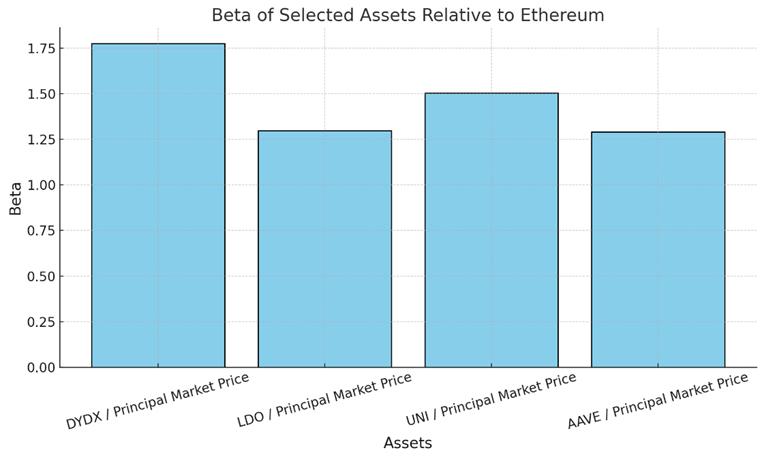
It seemed like all the market needed was an inflation print that came in line with consensus for digital assets to resume higher. With that behind us, Bitcoin easily broke through $100,000 and seems on path to test new highs here shortly. The level to flip is $102,000 with the majority of shorts built up there. Support could be seen below near $99,500. Ethereum has eyes set on a break back above $4,000 with no real resistance ahead. Ethereum beta has seen a large run up with $AVVE +42%, $dYdX +23% and $UNI +17% showing strength during and post the early week selloff to be amongst the weekly gainers in the top 100.
Source: CoinMetrics, StoneX Digital
Despite upwards or downwards price action, one thing that hasn’t wavered has been ETF inflows. Bitcoin spot ETFs have posted 9 straight days of inflows above $200M. These 9 days have seen over $4.2B of total inflows. In the same 9-day span, Ethereum spot ETFs have seen daily inflows >$80 and a total of $1.7B. All the inflows have culminated with BlackRock releasing a report recommending 1-2% exposure to Bitcoin ETFs. This is the first time they’ve referenced a specific percentage.
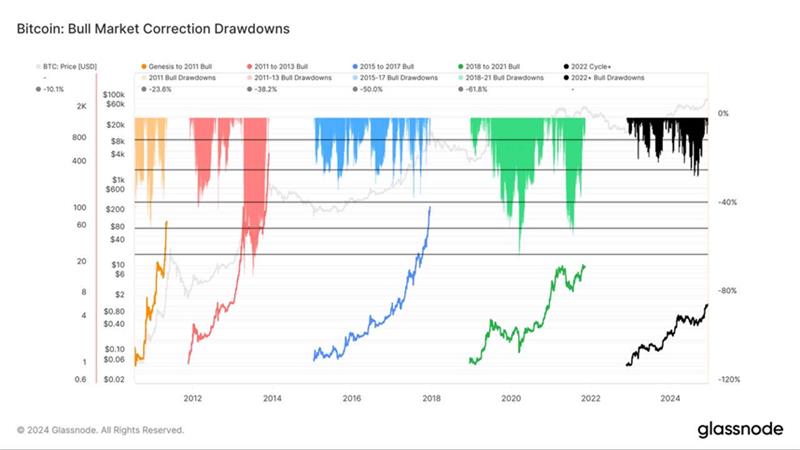
The presence of these ETFs has provided a nice level of stabilization for BTC as compared to past cycles. The average drawdown seen on this cycle has been -7.68%. Previous cycles have seen -16.24% average drawn downs. The max drawn down seen this cycle has been -26.25%, lower than that of previous cycles (Glassnode).
Source: Glassnode
Bitcoin and Treasury Management Trends
Recent shareholder proposals at Amazon advocate for the inclusion of Bitcoin in its $70 billion treasury. Hypothetically, if Amazon allocated 10% of its cash and marketable securities ($7 billion) to Bitcoin at a price of $100,000 per BTC, it could acquire approximately 70,000 Bitcoins. Such a transaction could significantly affect market dynamics by reducing available over-the-counter supply and creating upward pressure on prices due to Bitcoin's fixed supply.
Source: Coinglass
Corporations have increasingly demonstrated interest in Bitcoin as a treasury asset. MicroStrategy holds over 423,000 BTC, representing a market value of $41 billion and an enterprise value multiple of 1.63x its cost basis. Other firms, such as Tesla and Block, have smaller holdings, but their investments reflect a broader institutional trend. Tesla’s Bitcoin holdings, for instance, total approximately 9,700 BTC, valued at nearly $954 million, shows the asset's potential role in treasury diversification.
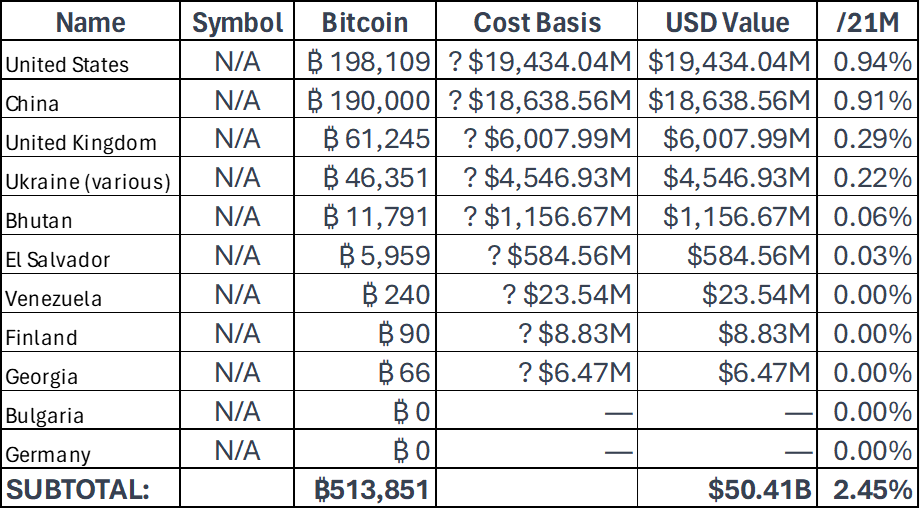
Government holdings of Bitcoin present a more nuanced picture. The United States government reportedly holds 198,000 BTC, valued at approximately $19.4 billion. However, a significant portion of these holdings, including approximately 94,000 BTC related to the Bitfinex hack, is expected to be redistributed rather than retained by the government. This reflects the reality that much of the U.S. government’s Bitcoin holdings are the result of confiscations rather than strategic accumulation. Conversely, countries like El Salvador and Bhutan have taken deliberate steps to integrate Bitcoin into their fiscal strategies, with El Salvador notably adopting Bitcoin as legal tender and mining operations being explored in other nations.
Source: bitcointreasuries.net, StoneX Digital
While political discussions about sovereign Bitcoin holdings as a strategic reserve persist, such moves remain a low-probability outcome in the near term. However, the potential for sovereign accumulation—whether through mining or direct purchases—represents a key driver of long-term demand. It is a trend worth monitoring as Bitcoin continues to gain traction as a hedge against macroeconomic instability and a tool for diversification.
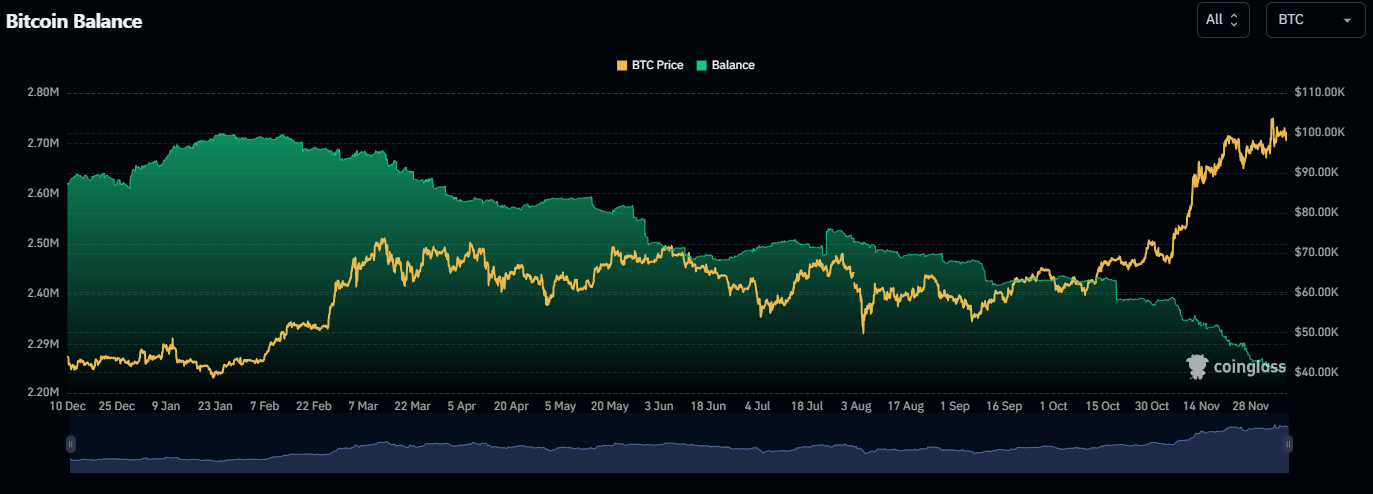
Current exchange balances for Bitcoin are near historic lows, reflecting reduced liquidity on centralized platforms. This scarcity, combined with increased institutional and sovereign interest, underlines Bitcoin’s evolving role in global financial markets. The presence of Bitcoin in ETFs and funds, such as the Grayscale Bitcoin Trust and iShares Bitcoin Trust, further demonstrates its growing accessibility for traditional investors, with over 1.2 million BTC now held across these vehicles. These dynamics collectively highlight Bitcoin's potential to reshape treasury management at both corporate and sovereign levels.
Google’s Willow Quantum Processor and Its Impact on Crypto
Google's new quantum processor, Willow, has achieved a major milestone, solving in five minutes a problem that would take supercomputers 10 septillion years. With 105 qubits and advanced error-correction capabilities, Willow demonstrates exponential error reduction as more qubits are added, paving the way for larger and more reliable quantum systems.

Source: Google Quantum AI
For the blockchain industry, concerns about quantum computing's ability to break cryptographic systems like Bitcoin's elliptic curve encryption persist. However, current estimates suggest it would take a quantum computer with 13 million qubits to pose a threat to Bitcoin. Willow’s 105 qubits are far from that threshold, ensuring blockchain security remains intact for the foreseeable future.
Willow’s breakthrough highlights the growing importance of post-quantum cryptography to secure blockchain systems. Developers, including Ethereum co-founder Vitalik Buterin, have proposed strategies like hard forks to mitigate future risks. Solutions like quantum-resistant cryptography are being actively researched to secure blockchains against long-term risks. Simultaneously, quantum computing could enhance blockchain scalability and efficiency, optimizing tasks like transaction validation, smart contract execution, and on-chain data analysis.
Google’s roadmap for quantum computing envisions scaling logical qubits and achieving practical computations in fields like cryptography, energy, and materials science. These developments offer the blockchain community both opportunities and challenges. On the one hand, the eventual maturation of quantum technologies could bolster blockchain networks with more sophisticated optimization tools. On the other, the race to develop quantum-resistant cryptographic standards must intensify to future-proof decentralized systems.
Jupiter DAO Approves $860M Jupuary Airdrop with Revised Governance
Jupiter DAO, which oversees governance for the Solana-based decentralized exchange Jupiter, recently passed a revised $860 million “Jupuary” airdrop proposal. The vote, which initially failed to gain community approval, was refloated with significant changes to address prior concerns. The approved plan allocates $860 million worth of JUP tokens annually over two years and introduces measures to refine distribution and strengthen the token’s fundamentals.
The revised proposal incorporates additional eligibility checks to mitigate the risk of token allocations to “mercenary” airdrop farmers—users who engage with protocols solely to capture rewards. Instead, the new framework prioritizes long-term community building by focusing on users with meaningful engagement, including factors such as token holdings, participation in governance, and consistent usage patterns. Bots are explicitly excluded under the updated guidelines, which aim to foster a more sustainable and loyal user base.
Snapshot data for eligibility was captured in November, with a link for users to verify their status expected later this month. The actual token distribution is scheduled for January, aligning with the DAO’s annual “Jupuary” initiative, which rewards users based on their interactions with the protocol in the preceding year.
Governance challenges within DAOs, including low participation and difficulties achieving consensus, have persisted since their inception. Jupiter DAO's initial vote was emblematic of these issues, securing only 58% approval—short of the required threshold. However, the revised proposal garnered significant community support, with approval increasing to 87%. This highlights the DAO’s ability to adapt and respond to stakeholder concerns, a critical function in decentralized governance.
Participation in DAOs remains an ongoing issue across the sector, with many projects struggling to align incentives for active engagement and long-term commitment. Jupiter DAO’s approach, which emphasizes meaningful contributions over superficial interactions, represents a case study in improving governance practices. The allocation of incentives to promote holding, buying, and voting throughout the year further aligns token distribution with the protocol’s broader objectives.
Noteworthy Links of the Week
-
- Bitcoin ($BTC): Bitcoin is crashing, but options markets are calling for $111K BTC price by February (link)
- Bitcoin ($BTC): Bitcoin's Quantum Safeguards: Decoding the Future by @Bit_Thinker (link)
- Bitcoin ($BTC): Microsoft BTC-related shareholder proposal rejected (link)
- Bitcoin ($BTC): Former Trump campaign chairman says, “To those celebrating $100K #Bitcoin, you are going to be celebrating much higher.” (link)
- MicroStrategy $MSTR will likely enter the Nasdaq 100 $QQQ this month — Bloomberg (link)
- CoinDesk's Most Influential 2024 (link)
- Altcoins: Memecoins are the Convergence of Social Media and Financial Markets – TabbFORUM – by Maria Adamjee (link)
- Stablecoins: Another Crypto Revolution Is Here – and It’s Unlike Any From the Past by Yueqi Yang (link)
- RLUSD, Ripple's stablecoin, gains approval from New York's Dept. of Financial Services (link)
- ‘Normie degens’ go all in on sports fan crypto tokens for the rewards (link)