High Fully Diluted Valuations (FDV) and Low Float Criticism

Executive Summary
- Market trading color: Recent political headway, ETH price action on shift in sentiment, ETH supply/demand dynamic moving forward
- Theme of the week – Token unlocks, and market cycles drive concerns over "low float" and "high FDV" in crypto
- Sector commentary: Bitcoin and Ether surge on ETF optimism; Ethereum and altcoins show mixed developments and regulatory challenges
Market Trading Color (Nolan Aibel)
There has been a lot that has happened over the past week. To recap the major events:
- The first domino to drop came exactly a week ago when the senate voted to disapprove of the SEC’s Staff Accounting Bulletin No 121 (SAB 121) which prevents regulated financial institutions from custody digital assets.
- It’s hard to not think that the SAB 121 vote created a significant political sea-change. Perhaps the realization that tens of millions of US voters have exposure to digital assets is leading to a softening of the SEC (and the Democrats tied to the anti-crypto stance) and causing them to pivot from making this a bi-partisan issue this election cycle.
- On the back of this vote, sentiment surrounding the upcoming decision for an $ETH ETF seemingly flipped on Tuesday. As we’ve discussed in these notes for the past month or two, the odds of spot $ETH approval had been below 25%. Bloomberg analysts Eric Balchunas and James Seyffart tweeted they are increasing their odds of approval to 75% after hearing the SEC could be engaging with ETF providers and exchanges to potentially pave the way for an approval.
- FDIC Chairman Marty Gruenberg announced he will step down after an independent investigation concluded there was a toxic work culture under his administration. Gruenberg was widely on the record as being anti-crypto.
- In accordance with all the above, we’ve seen exchanges and ETF providers updating their 19b-4 filings on an accelerated basis. Among those are Blackrock, Bitwise, Grayscale, VanEck, WisdomTree, and ProShares.
- Lastly, the House passed the Financial Innovations and Technology for the 21st Century (FIT21) Act by a margin of 279-136. 71 house democrats voted in favor of the bill. This will create a regulatory framework that sets guidelines for digital assets in the 21st century & promotes innovation. This is a breath of fresh air after having to deal with the conflicting viewpoints of the SEC and CFTC these past couple years. The bill will now move on to the Senate for approval.
All of the above events have led to a much-needed bounce back week for $ETH as we await the first spot $ETH ETF decision coming today on VanEck’s proposed $ETHV. The second largest digital asset by market cap is up a staggering 31% over the past week. Significantly outperforming $BTC +5.27% and the broader market. This price action now has the ETHBTC ratio screening 0.05629 and up 4.33% YTD. Now shining a much more positive light than a week ago when we noted the ratio was down 16.06% YTD. Approval for a spot ETF could exacerbate this outperformance. That starts with the supply / demand imbalance that could be instore for asset, an even more significant one than $BTC.
Source: Glassnode
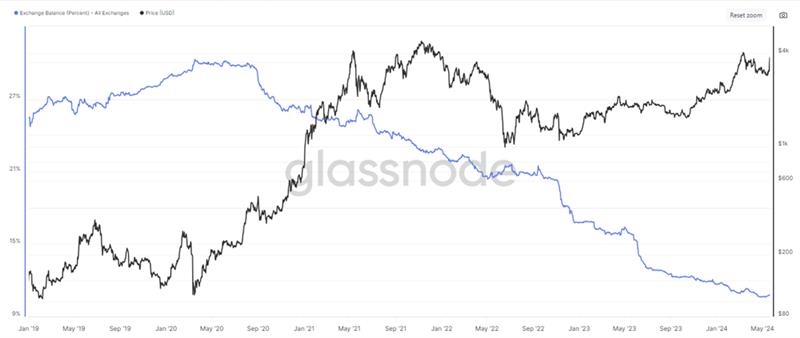
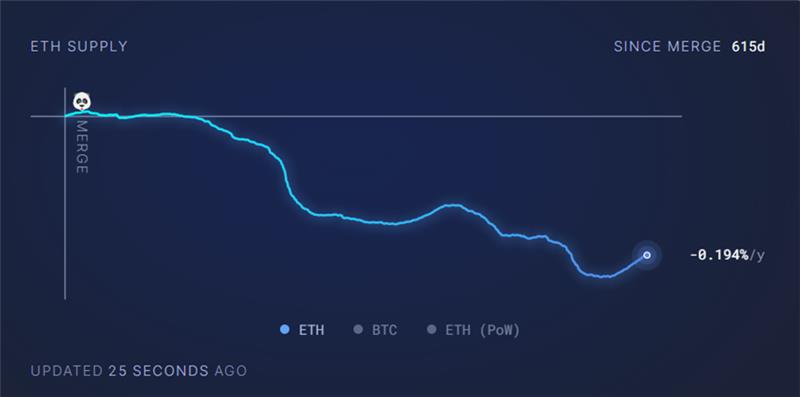
Shown above, only 10.8% of ETH, is currently held on exchanges. Compare this to $BTC who’s supply is around a full percentage point higher. That’s 12M ETH or $45B that is available on exchange currently. To put this in perspective, $BTC ETFs currently hold $60B of $BTC already. In addition, you have 26.8% of Ethereum's total supply off market and staked, unlikely to be brought to market. Couple this with the usual deflationary nature of $ETH and the available supply could quickly be consumed if demand is there for these spot ETF products. While that is bullish data, there has been a recent shift on the deflationary aspect mentioned above that is not so bullish. While ETH has been deflationary overall since the Merge, burning 395,415 ETH at a rate of -0.194%/y, over the past 30 days, this supply change screens around +0.511%. This is due to more activity moving off ETH mainnet and to L2s. More activity on L2s leads to a reduction in transaction fees as it is much cheaper to transact on these L2s. This means less ETH is being burned and in turn a move back to an inflationary environment. These dynamics could be magnified if there is less ETH being transacted with in day-to-day activity as chunks of ETH would be held in ETFs.
Source: UltraSound.money
High Fully Diluted Valuations (FDV) and Low Float Criticism
The crypto community is increasingly critical of tokens launching with high Fully Diluted Valuations (FDV) and low float, often seeing these as unsustainable or "down only." There is a widespread sentiment on platforms like Crypto Twitter against such launches, blaming various parties including VCs and market makers.
Definitions of Key Terms:
- Low Float: Refers to the small proportion of a cryptocurrency's total supply available for market trading.
- High Fully Diluted Valuation: The valuation of a cryptocurrency assuming all possible tokens are in circulation.
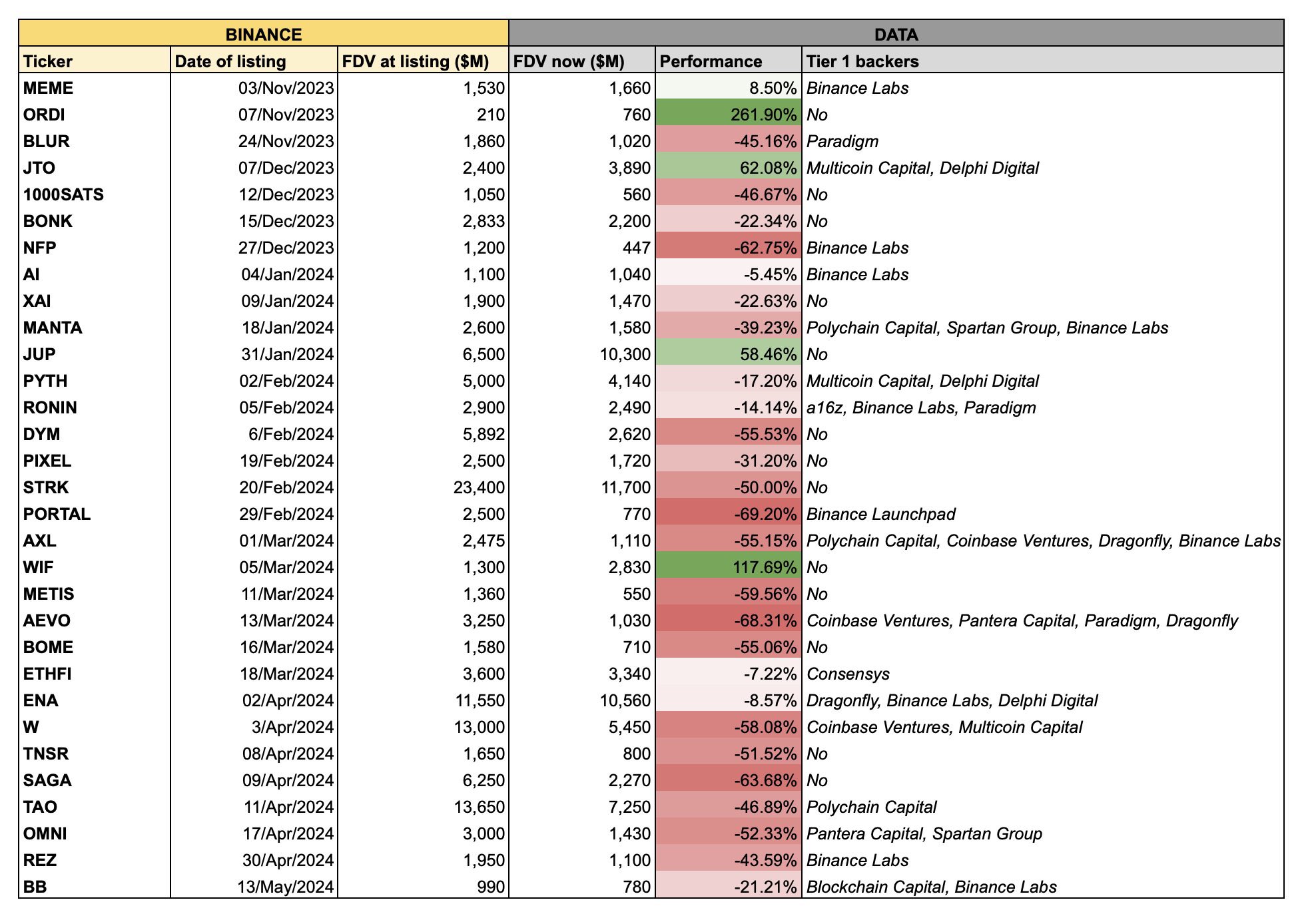
Underperformance of Low Float High FDV Tokens: Many tokens listed on Binance with low float and high FDV have recently seen significant price declines. This trend raises concerns about the sustainability and valuation of such tokens.
Source: Binance Labs, Dragonfly Capital
Haseeb, a managing partner at Dragonfly Capital, highlighted three ideas circulating on crypto Twitter (CT) about why low float/high FDV tokens were underperforming:
- VCs/KOLs Dumping: The expectation is that tokens with shorter lockups should dump faster. However, data shows tokens were fine until mid-April; top-tier VCs with 1-year cliffs couldn't have been dumped since they’re still locked.
- VCs and KOLs dumping tokens early can't fully explain the downturn as most top-tier VCs are still locked due to 1-year cliffs, and even projects with reputable VCs experienced declines simultaneously.
- Retail Rage Quitting: The theory suggests retail moved to meme coins. Data indicates meme coin volume spiked before the downturn of these tokens, and meme coins represent a minority of trading volume.
- The data does not support the theory that retail investors moved to memecoins after the downturn in low float high FDV tokens; memecoin trading peaked in March while the basket of tokens declined in April, and memecoins only represent a small fraction of overall trading volume. Additionally, capital-intensive projects have always had significant insider allocations, contradicting the idea that only recent tokens are heavily influenced by VC involvement.
- Too Little Supply for Price Discovery: The current low float isn't historically unusual (13% circulating supply at launch is typical). However, the lack of a strong correlation between float size and price performance undermines this theory.
- Data shows the average float for tokens at TGE in this cycle is 13%, similar to past cycles and comparable to the 12.8% median float of equity IPOs in 2023. If a low float hindered price discovery, tokens with the lowest floats should perform worse, yet all tokens are down, indicating no strong correlation between float size and price performance.
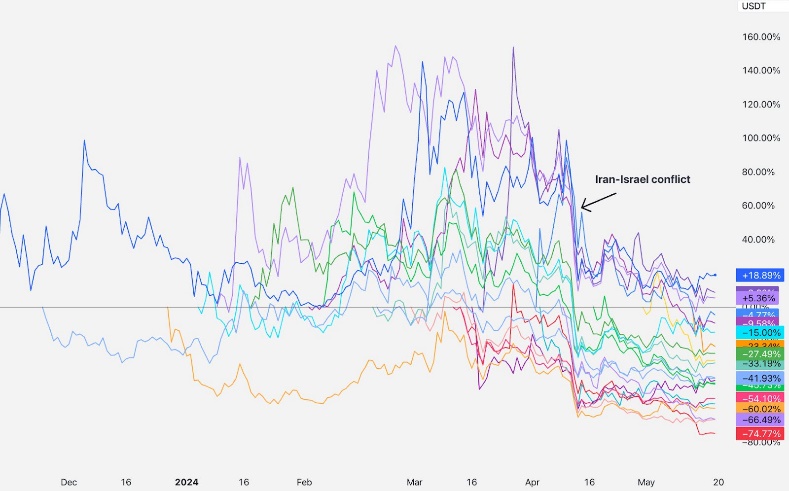
The market downturn in April was linked to geopolitical tensions. For the first couple of months, these tokens mostly traded about flat from their listings until mid-April. Suddenly, Iran and Israel started threatening WW3, and markets tanked. Bitcoin recovered, but these coins didn’t. The general aversion to "risky new coins" persisted even as Bitcoin recovered, implying market repricing rather than fundamental structural issues.
Source: X @hosseeb
Evolution of Tokens
The purpose of tokens has evolved from incentivizing early users to a customer acquisition tool and now to an investor acquisition mechanism. This shift reflects broader market trends and regulatory pressures affecting how tokens are perceived and utilized. Retail participation in the crypto market is significantly down from its all-time highs, while institutional involvement has recovered more robustly. Data from Coinbase's earnings shows a stark difference between retail and institutional trading volumes, highlighting the shift in market dynamics.
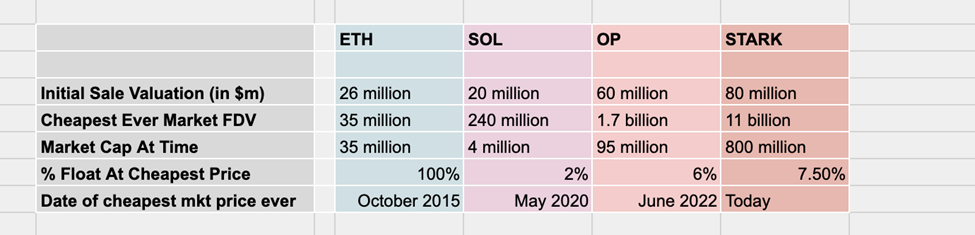
In recent years, most of the upside for new tokens has been captured privately, with price discovery occurring off-market before the tokens are available to the public. Cobie’s Substack highlights that private market dynamics often inflate the price discovery process. While ICOs had their problems, including many non-viable projects that wasted investor funds, they also had significant successes like Ethereum, which raised $16 million and provided early investors with enormous returns. Regulatory crackdowns on ICOs have pushed token issuers to seek private funding from VCs, leading to competitive seed rounds with valuations reaching hundreds of millions.
Source: Cobie’s Substack
High FDVs are driven by natural market demand but can become detached from the reality of the asset, especially when price discovery happens in a private, often inflated market. This results in tokens being launched with valuations that the public market cannot sustain, as seen with projects like Axie Infinity and FileCoin. Tokens like Ethereum and Solana had initial sales at relatively low valuations but provided much higher returns in their private rounds compared to public markets. The issue lies not with low float alone, as evidenced by Bitcoin’s early low float period, but with the private market dynamics that push valuations beyond sustainable levels, leaving many tokens trading significantly below their private market valuations.
Solutions Discussed
Regulatory challenges, particularly from entities like the SEC, significantly influence how tokens are launched and distributed. Due to regulatory constraints, projects are often forced to raise funds from venture capitalists rather than through community driven ICOs. VCs take on substantial early-stage risk, and their involvement is often necessary under the current regulatory framework.
There is an ongoing debate about whether tokens should be more widely distributed among the community to promote decentralization and equitable ownership. The concept of participatory networks is gaining traction, where networks are bootstrapped through participant involvement rather than traditional capital expenditure. This model leverages the resources and enthusiasm of community members to build and sustain networks more efficiently.
Proposed solutions include:
- ICOs: Deemed impractical and often illegal in the United States
- 100% immediate unlocks: Not feasible under current regulations
- Bookrunners: Adds layers of complexity
- Lower listing prices: This might cause initial trading mispricing’s which will be arbitraged by the first movers
- Fair launches: Largely unsuccessful
- Larger airdrops: Potentially useful but would have to find a balance between incentives and adoption
Generally speaking, venture capitalists prefer to see gradual and steady price growth over time, as large early valuations can reflect increased market potential but may mislead if they don't translate into sustained value. In contrast, the free market's response to mispricings is that they will correct themselves over time. The market will naturally adjust expectations and pricing, leading to more realistic valuations for future token launches.
More Unlocks to Come
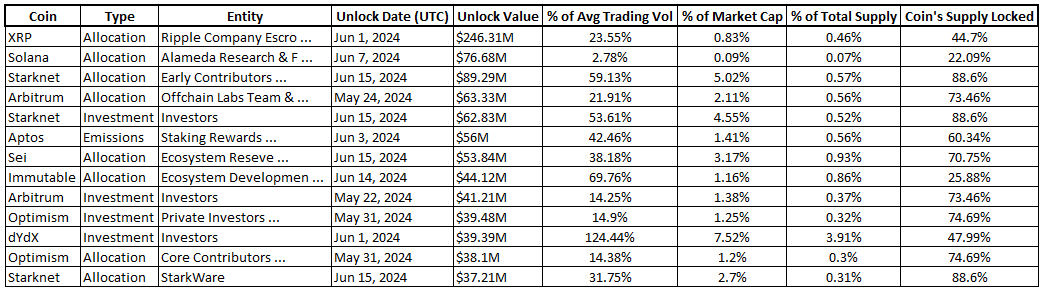
In May 2024, about $3 billion worth of vested crypto tokens were scheduled to be unlocked. Projects like Sui and Pyth Network are expected to unlock over $1 billion in crypto tokens allocated to various crypto holders, such as early investors.
Source: TheTie
Token unlocks and CoinMarketCap data from Binance estimate that about $155 billion in tokens will be unlocked from 2024 to 2030. Over the next week, there will be $466 million in cliff unlocks, with $80 million unlocked linearly per day, according to token.unlocks. Coins with large unlocks scheduled in the future may continue to press down price action, creating additional market volatility. We have emphasized the opportunities token unlocks create in previous reports, like our Avalanche Deep Dive, demonstrating a drawback on price at token release. Until there is a systematic change in how tokens are launched and valued, the market will likely continue to experience cycles of concern and debate over "low float" and "high FDV."
Sector Commentary
- Layer One / Altcoins
- Bitcoin ($BTC): Bitcoin Hits $71K as Ether ETF Hopes Build (link)
- Bitcoin ($BTC): Bitcoin Surges Over $71K as Ether ETF Hopes Lead to $260M in Short Liquidations (link)
- Bitcoin ($BTC): Standard Chartered says bitcoin expected to hit fresh all-time high by weekend (link)
- Bitcoin ($BTC): Bitcoin derivatives hint at potential rally above $73K — New all-time highs next (link)
- Ethereum ($ETH): Ether Surges 17%, Polymarket Approval Chances Rocket as ETF Makes Regulatory Progress (link)
- Ethereum ($ETH): Ether ETF Hopes Drive Futures Open Interest to Record $14B (link)
- Ethereum ($ETH): Over $280 million in short liquidations as ether rallies on renewed ETF optimism (link)
- Ethereum ($ETH): Standard Chartered expects ether ETF approval this week, reiterates year-end target of $8,000 (link)
- Ethereum ($ETH): Second Ethereum Foundation Researcher Acknowledges Advisory Deal Paid in EIGEN (link)
- Solana ($SOL): Solana-Based Wallet Phantom Buys Web3 Specialist Bitski (link)
- Altcoins: MOG, PEPE Rocket as Traders Search for Ether Beta BetsSurge (link)
- Altcoins: Ether ETF Speculation Could Weigh on SOL, Wider Altcoin Market (link)
- DeFi
- Uniswap Labs Urges SEC to Drop Pending Enforcement Action in Wells Response (link)
- Crypto Derivatives DEX Aevo's Token Jumps 10% as Binance Labs Discloses Investment (link)
- Crypto Sleuth Ogle Proposes Security-Centric 'Glue' Blockchain (link)
- Hex Trust Issues First Native Stablecoin on Layer-1 Blockchain Flare (link)
- ZkSync planning on token generation this week with airdrop in middle of June: Sources (link)
- AI / NFTs / Web3
- Protocol Village: Livepeer Announces 'AI Subnet' Launch (link)
- Ethereum-Based Twitter Rival Farcaster Raises $150 Million (link)
- Pantera Capital Conference Call: The Integration of AI and Web3 Technologies (link)
- Yuga Labs will 'no longer touch' CryptoPunks amid new collection backlash (link)
- Op-Ed: The history of NFTs you didn’t know you needed: A review of ‘Token Supremacy’ (link)
- RWA / Tokenization / Metaverse / Gaming
- Gala Games Hacker Returns $23M in ETH; Founder Proposes 'Buy and Burn' (link)
- Real-word asset tokens can stabilize DeFi — Market observers (link)
- Diamonds Standard Co. uses precious gems to back payment network (link)
- KlimaDAO Japan to launch carbon credit marketplace with Progmat (link)
- Navigating NFT games: Spotting the gems in a crowded market (link)
- Digital Infrastructure: Capital Markets / Exchanges / DAOs / Mining
- Crypto firms target custody market as institutional adoption grows (link)
- Do users really care about decentralization? Industry figures clash (link)
- SEC's lack of internal coordination suggests Ethereum ETF pivot 'entirely political,' source says (link)
- Ether ETFs Filing Process Sees Abrupt Progress, Though Approval Not Guaranteed: Sources (link)
- Fidelity Drops Staking Plans in Updated Ether ETF Filing (link)
- Could staked ETH be classified as a security? Galaxy researcher weighs in (link)
- The big thing for Ethereum ETFs was getting over the ‘mountain of possible approval’ says expert (link)
- Hong Kong spot ether ETFs recorded no net flows Monday as US approval anticipation grows (link)
- Grayscale Ethereum Trust discount narrows to 10% as odds of spot ETH ETF approvals are raised (link)
- Grayscale CEO Michael Sonnenshein departs company (link)
- Spot bitcoin ETFs report sixth consecutive day of net inflows (link)
- Public Bitcoin miners secured $2B in financing ahead of halving (link)
- MicroStrategy 500% yearly gains beat Bitcoin, Tesla stock — Is MSTR the best short-term bet? (link)
- Crypto exchanges exit Hong Kong license race ahead of May deadline (link)
- Do potential spot Ethereum ETF approvals signal a shift in US crypto policy? (link)
- Democrat House Leadership Says Crypto Bill Vote Won't Be Whipped (link)
- NYAG says Genesis settlement to pay back creditors up to $2B (link)
- Anti-crypto FDIC chair Martin Gruenberg to step down (link)
- Op-Ed: The Biden Administration Is Easing Up on Crypto (a Vibes Analysis) (link)