From Congestion to Clarity: Solana Transactions and SocialFi Growth

Executive Summary
- Market trading color: BTC price action in relation to leverage built up, long-term holder activity, and Solana underperformance
- Theme of the week – Gain insights into the underlying causes of transaction failures on the Solana blockchain and explore the emerging landscape of SocialFi, alongside an overview of notable projects
- Sector commentary: Bitcoin faces volatility, Ethereum eyes growth, Solana grapples with fees, DeFi explores innovations, and crypto infrastructure expands
Market Trading Color (Nolan Aibel)
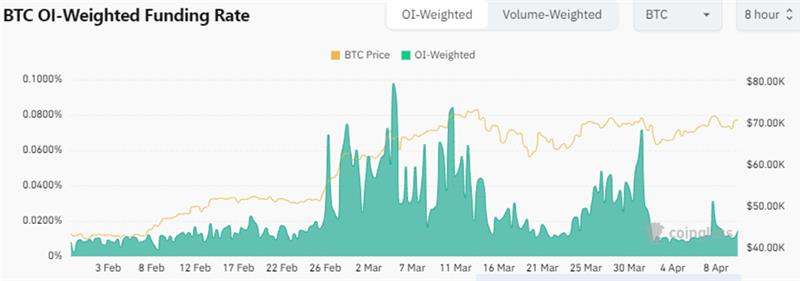
It has been another volatile week for Bitcoin as the asset has seen prices as low as $66,300 and as high as $72,300. Over the past twenty-four hours alone, $BTC +1.24% has fully erased a dip below $68,000 that was seen as a result of a hot CPI print. This continued volatility has led to a decent number of liquidations over the past week with over $1.1B in total liquidations, $655M coming from longs and $456M from shorts. While this may seem like a lot, to put things into perspective, on March 4th alone, we saw over $1.1B in liquidations. This could be viewed positively as the price of Bitcoin is trying to test the $71,000 mark with significantly less leverage built up, normally the sign of a healthy market.
Source: Coinglass
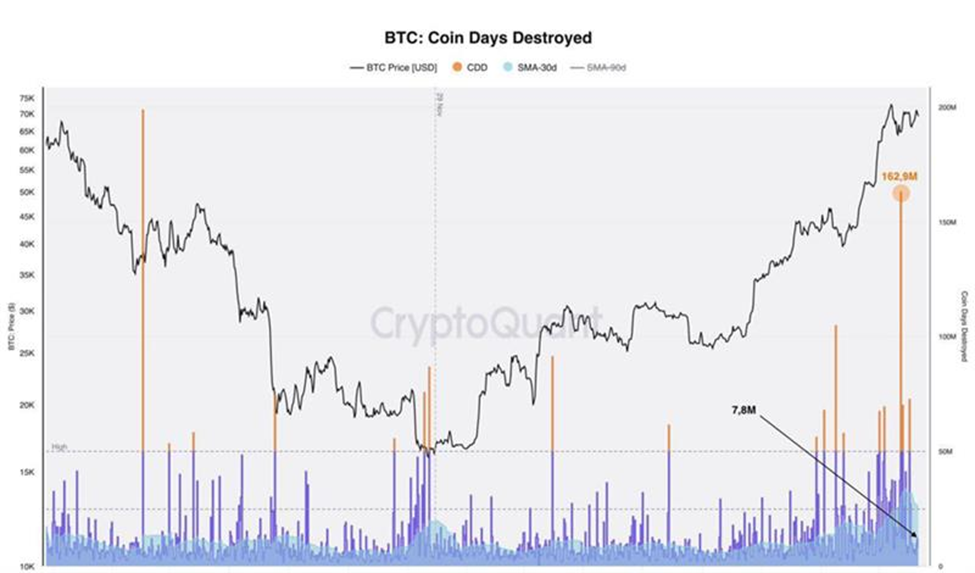
A metric suppressing Bitcoin from having that breakout has been long term holders selling and realizing profit. As of yesterday, 73% of the total circulating supply was in the hands of long-term holders. This is down from 80% at the beginning of 2024. In the same time frame, short term holders have increased their holdings from 20% to 26%. The good news is this selling has slowed as coin days destroyed, which measure the value of an asset spent and the time that asset stayed dormant, has reduced from 162M to 7.8M. A high CDD indicates that assets that have been dormant for a significant amount of time are re-entering the market. A low CDD suggests that the assets making up the trading volume are the usual assets.
Source: CryptoQuant
While both majors $BTC and $ETH are up nearly 6% on a weekly lookback, $SOL has fallen 8%. This has occurred due to the network experiencing significant congestion that we explore below. With these issues expected to be patched April 15th, the token could be in position to bounce back and regain momentum.
Solana Transactions Failing
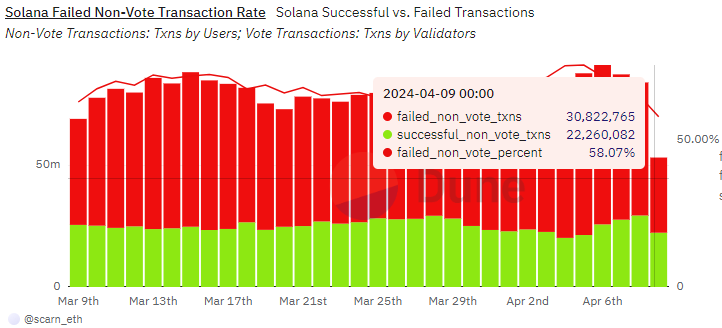
Solana has seen a surge in activity since early 2024, marked by a notable increase in new tokens appearing on Solana DEXs. However, despite improvements, the blockchain faces challenges, with recent transactions failing due to poorly implemented logic that throttles connections and hampers Solana's capacity to handle heightened network activity. Matt Sorg, a tech leader at the Solana Foundation, likened Solana's architecture to the internet's infrastructure, where individual validators directly process transactions without a mempool, akin to IP endpoints and servers. Sorg emphasized that Solana forwards transactions straight to block leaders, bypassing any waiting in a staging model or mempool before inclusion in the chain. Nevertheless, an influx of spam transactions could overwhelm this setup, potentially causing dropped transactions. These dropped transactions are what we are seeing today due to Solana's upgrade to QUIC, which empowers its networking layer for block leaders to manage connections more efficiently during peaks in demand by either cutting some connections or applying rate limits based on criteria. Right now, 58% of all non-voting transactions, are failing due to congestion.
Source: Dune Analytics @scarn_eth
To better understand, we walk through an example we found on Twitter/X. Each block leader has X connections it can talk to. Now during times of high activity - the block leaders start receiving requests for 10-100X the number of connections. This is when block leaders can choose to drop certain connections. However, instead of connections getting dropped on a set criterion (like drop all with fees lower than x), currently these connections would get dropped randomly. Essentially, to win, you must spam more than the others. And because there are multiple bots who would spam the network with connection requests, it becomes harder and harder for regular users to establish a connection and land their transactions. Teams like Jump and Solana are working to ship fixes to the networking layer. These patches are being rolled out as we speak however there are no guarantees as to how efficient the current fixes will be in preventing the next congestion problem on Solana.
The end result may very likely make Solana better much like CryptoKitties did on Ethereum back in 2017. When Axiom Zen launched CryptoKitties in 2017, it started as an experimental blockchain-based game but quickly became a viral sensation, causing congestion on the Ethereum network due to high transaction volumes. This led to collaboration among Ethereum developers, including MetaMask, Infura, and Grid+, to address the immediate challenges and work on scaling solutions. Short-term optimizations were made, such as adding indicators for users and implementing transaction resubmission options, while long-term strategies like sidechains were considered to alleviate network strain. Even in this state it is in today, Solana is averaging 700+ "true transactions per second," which is about 6x the daily average of all L2's plus the L1 combined (numbers from Solana.FM). Solana's set of challenges will be different, but the network will get through it just as Ethereum did years ago. experience highlighted the importance of user experience, education, and ongoing collaboration in navigating challenges and evolving blockchain technology.
Going into the Presidential Election
As we enter a presidential election, discussions about social media platforms influencing election outcomes and concerns about communication censorship will once again dominate mainstream media. We believe that this topic will attract attention and renew interest in SocialFi, which could offer an alternative solution to address some of these challenges.
What is SocialFi?
SocialFi represents the fusion of social media and decentralized finance (DeFi), offering a Web3 approach to managing and owning social media platforms and their content. At its core, SocialFi aims to empower content creators, influencers, and participants by providing better control over data, freedom of speech, and the ability to monetize social media engagement using cryptocurrencies and nonfungible tokens (NFTs).
One of the key data points about SocialFi is its focus on decentralized autonomous organizations (DAOs) structured to prevent centralized censorship decisions, a prevalent issue in traditional social media platforms. By leveraging blockchain technology, SocialFi platforms ensure transparency and censorship-resistant content curation processes.
Key differentiation points of SocialFi include:
- Monetization: SocialFi introduces social tokens or in-app utility tokens that enable creators to manage their own economies. Examples of token economies could include fair incentives across stakeholders and allow users to engage with content based on token ownership, thereby creating new monetization models or a model that values tokens based on social clout, enabling direct engagement and interactions between users and influencers.
- Censorship and freedom of speech: SocialFi platforms rely on decentralized curation through on-chain data labeling, empowering individual nodes to choose content based on community guidelines rather than centralized authority. This approach strikes a balance between free expression and preventing harmful content dissemination.
- Digital ownership and identity: SocialFi leverages NFTs, particularly profile picture (PFP) NFTs, to establish digital identity and proof of ownership. These NFTs serve as profile pictures and grant access to exclusive communities, offering creators new ways to distribute and monetize their work.
Despite promising innovations, SocialFi faces challenges in scalability and sustainable economic models. Scalable infrastructure and robust economic models are crucial for SocialFi's long-term success, requiring stress testing and adaptation to market dynamics.
With a market capitalization of $6.1 billion and a 24-hour trading volume of $252 million as per CoinGecko, we explore three prominent SocialFi platforms that have been in news feeds recently.
Popular SocialFi Platforms
Dream Machine Token (DMT)
DMT, or dream machine token, aims to address the inefficiency of Play-to-Earn, a model where users earn tokens by playing, which has fallen out of favor over the past of years, by emphasizing a sustainable tokenomics model. With 601k tokens in circulation out of a total supply of 1 million, DMT currently has a market cap of $55 million. The project aims to combine gaming and gambling into a cohesive token economy that benefits token holders who stake. By burning a third of tokens spent in-game and distributing two-thirds to stakers, DMT creates a deflationary mechanism like Ethereum. The project's layer 3 architecture on Arbitrum enables efficient on-chain gaming due to low transaction costs. With games like Milady Tekken and Sakura Park Pinball already live and poker in final testing, DMT wants to be a one stop shop for anyone’s gaming experience. Stakers enjoy privileges such as whitelist access, token rewards, and potential involvement in token sales.
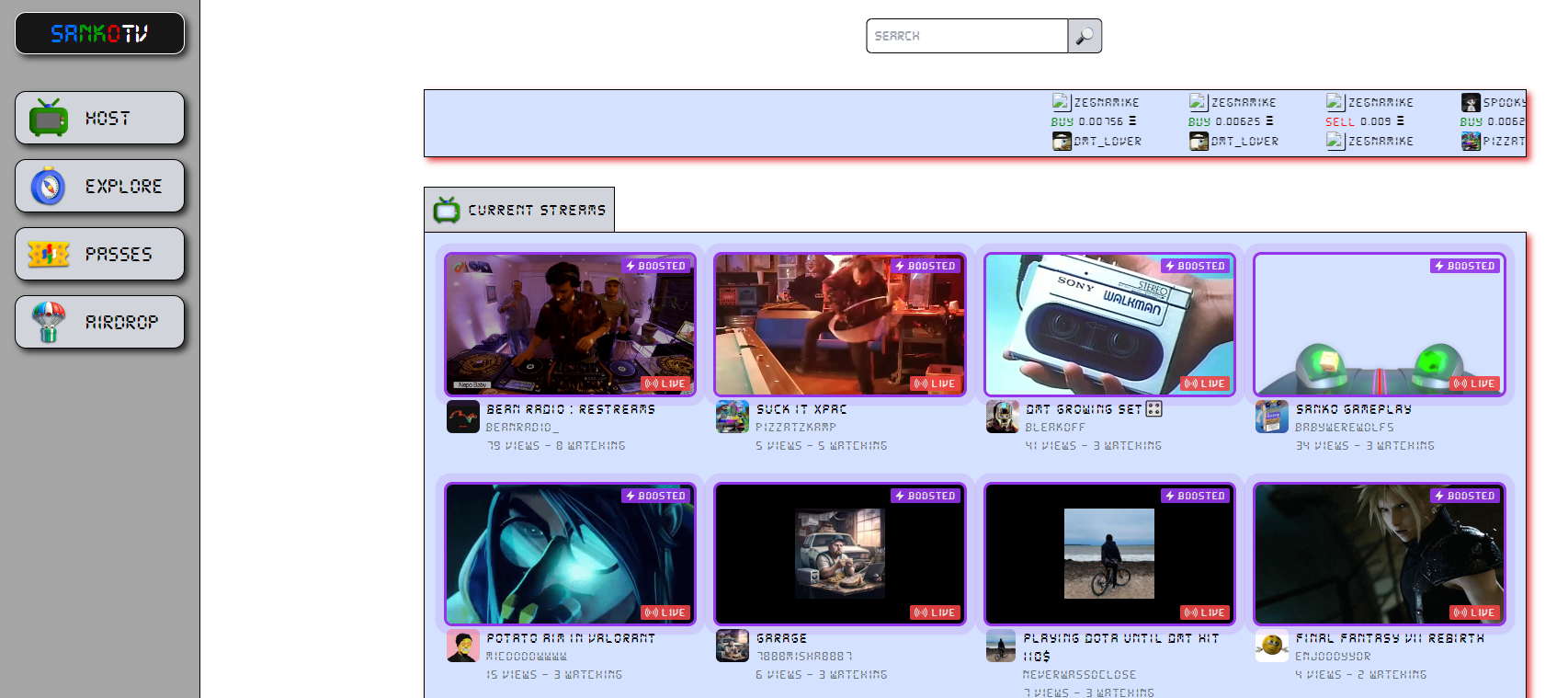
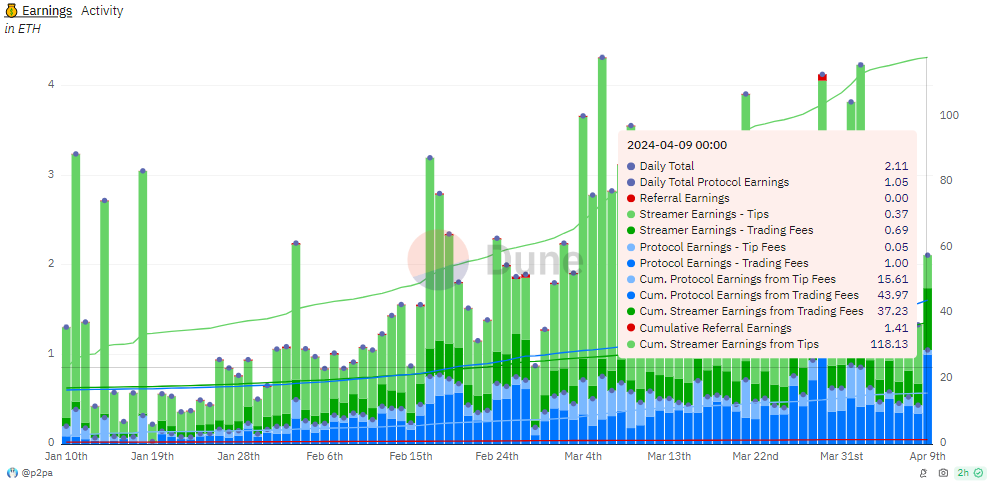
In addition to the games, Dream Machine Token has Sanko TV, which looks like an early version of Twitch.tv with the same premise.
Source: Sanko.tv
While the competition for streaming platforms have been fierce with the likes of Meta and Google trying to take market share from Twitch, statistics around Sanko TV have seen growth since the start of this year:
- Peaked at 4,349 DAU
- Averaging about 400 DAU over the past three days
- While Sanko.tv has done well, DMT Play has seen a dramatic reduction in play and unique users. Play dropped from a high of 199 unique users in May 2023, to 6 on April 9th, 2024
Source: Dune Analytics @p2pa
Farcaster
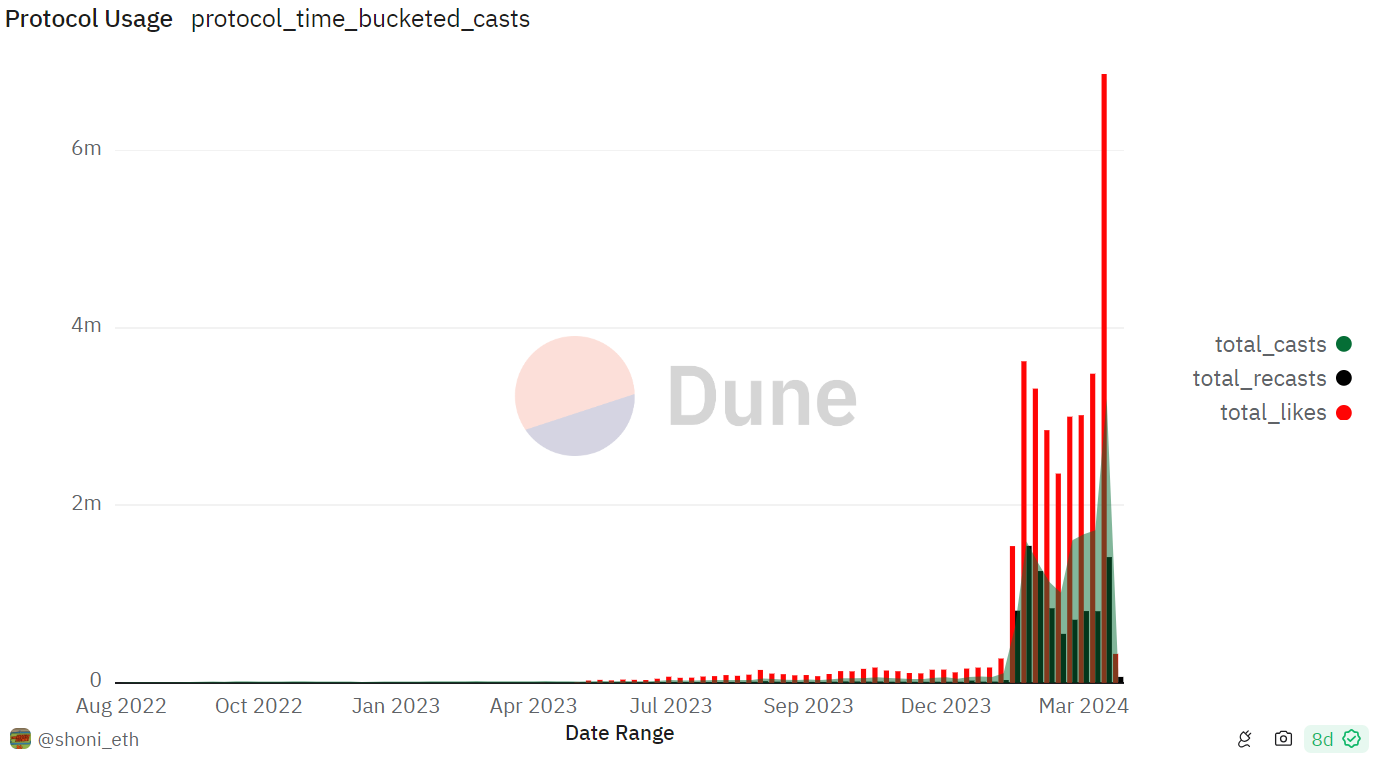
Farcaster is a social media protocol established in 2020 by former Coinbase executives Dan Romero and Varun Srinivasan. It operates on Optimism, an Ethereum layer 2 network, providing a ecosystem where users can access various integrated apps for social media activities at low transaction fees thanks to blobs.
One of the most popular apps on Farcaster is Warpcast, akin to Twitter/X, allowing users to create posts called "casts," follow others, and engage by liking or sharing ("recasting") posts. Notably, Farcaster focuses on curbing bot activity by requiring a $5 sign-up fee and limiting the number of casts users can post through storage units, which are purchased for $5 each and provide specific post and reaction quotas over a year.
A unique feature introduced on January 26, Frames, enhances user experiences within Farcaster apps. Frames enable a range of actions such as NFT minting, gaming, art browsing, newsletter subscriptions, and online purchases, all accessible without leaving the app. Frames operate through Farcaster's EdDSA authorization system, helping protect against crypto hacks.
A significant update on March 6, 2024, saw Farcaster introducing support for Solana addresses, expanding the platform's capabilities for developers to integrate Solana wallet functionalities into Frames. In less than 24 hours of launching this support, over 9,328 unique Farcaster IDs were verified through Solana addresses.
Source: Dune Analytics @shoni_eth
Friend.tech
Friend.tech entered the scene in August, 2023 rapidly accruing over 100,000 users and $25 million in total value within its first few weeks, according to DefiLlama.
The unique platform, which is still technically in beta, allows individuals to buy and sell “keys” to private chatrooms that are linked to specific X accounts. These keys grant access to exclusive content and conversations with various people and influencers on X. Essentially, Friend.tech billed itself as “the marketplace for your friends” – a portal to pay for personalized access to the conversations and communities of prominent figures on X.
For the pseudonymous founders of Friend.tech, a big concern is sustainability. One of the co-founders known as Racer told Decrypt that the initial launch was intended for load testing only, and the fact that the platform went viral came as a surprise. There has been a mad dash to try to scale the platform’s infrastructure and fix issues as they come up over the last two weeks.
Still others have likened the fast-growing platform to a Ponzi scheme, pointing to the fact that if you buy (and other people also buy) into a particular user’s keys, the value of those keys goes up. By linking appreciation in value of keys so directly and exclusively to the number of people investing in those keys, the thinking goes, eventually the entire system will come crashing down, leading to a rush to sell keys. Others have suggested the platform could fail because it lacks a compelling reason for users to stick around over the long term.
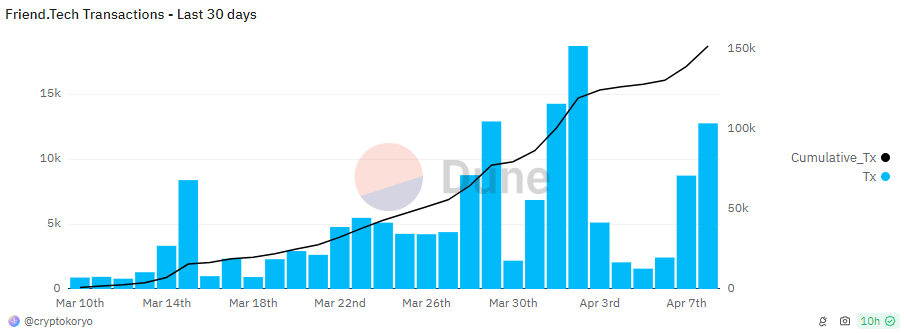
Daily transactions on Friend.tech have since plummeted nearly 99% from a mid-September peak of more than 500,000 per day down to around 20k per day, with a recent resurgence in interest over the past 30 days.
 Source: Dune Analytics @cryptokoryo
Source: CoinGecko, Coinmarketcap, Decrypt
Sector Commentary
- Layer One / Altcoins
- Bitcoin ($BTC): Bitcoin Buckles Below $69K as Crypto Bulls Endure $175M Liquidations (link)
- Bitcoin ($BTC): Bitcoin spot volumes confirm crypto markets’ ‘euphoric’ phase — Glassnode (link)
- Bitcoin ($BTC): Bitcoin Could Slump Around Reward Halving Time, Arthur Hayes Says (link)
- Bitcoin ($BTC): We're seeing new money come into Bitcoin – TD Securities (link)
- Bitcoin ($BTC): Bitcoin's halving won't see a 600% return this year — so adjust your strategy (link)
- Ethereum ($ETH): VanEck predicts Ethereum Layer 2 tokens will reach $1 trillion valuation by 2030 (link)
- Ethereum ($ETH): JPMorgan says Ethereum could avoid 'security' label amid decreasing Lido share (link)
- Solana ($SOL): Solana’s cheap fees are turning out to be a curse — for now (link)
- Solana ($SOL): FTX Offloads Giant Solana Pile in Sale Drawing Galaxy, Pantera (link)
- DeFi
- Decentral Park Research: A Deep Dive into the Jupiter Perpetual Exchange Product (link)
- EigenLayer and EigenDA Launch on Ethereum Mainnet (link)
- Ripple to Issue USD-backed Stablecoin Bringing More Utility and Liquidity to XRP Ledger (link)
- Coinbase is working with Lightspark to integrate the Bitcoin Lightning Network for all its customers (link)
- AI / NFTs / Web3
- RWA / Tokenization / Metaverse / Gaming
- Digital Infrastructure: Capital Markets / Exchanges / DAOs / Mining
- Miners keep adding to BTC stockpiles in homestretch before halving (link)
- Bitcoin needs to hold above $80,000 to keep mining profitable post-halving (link)
- With spot ether ETF fate uncertain, issuers seek leveraged ETH futures funds (link)
- Stablecoins Are Seeing Adoption as a Cross-Border Settlement Mechanism: Bernstein (link)
- DWS launches physical Bitcoin ETC in Germany (link)
- HashKey’s Crypto Exchange Goes Live After Winning License in Bermuda (link)
- Genesis GBTC Redemption Wallets are now on Arkham (link)
- MicroStrategy Should Continue to Rally as Bitcoin Halving Nears: Benchmark (link)
- Do Kwon May Be Extradited to US After Montenegrin Top Court Acts (link)
- The DOJ's eye-catching BTC transactions probably tidied up old business (link)
- Crypto Market Maker GSR Receives Singapore Crypto License (link)
- Key Congressman McHenry Is Bullish U.S. Stablecoin Law Will Pass This Year (link)
- DeFi Trader Eisenberg 'Wasn't Borrowing, He Was Stealing,' Prosecutor Says in Opening Argument (link)