Executive Summary
- Market trading color: Bitcoin bullish with healthy spot flow, ETFs driving significant inflows
- Theme of the week –Chainlink and Data Oracles: We explain what blockchain oracles are, recent developments in the space, price action with metrics for comparison, and how data oracles play into themes like artificial intelligence and real world assets
- Sector commentary: Ethereum ETF filings, Solana rallying, gaming and token exploits
Market Trading Color
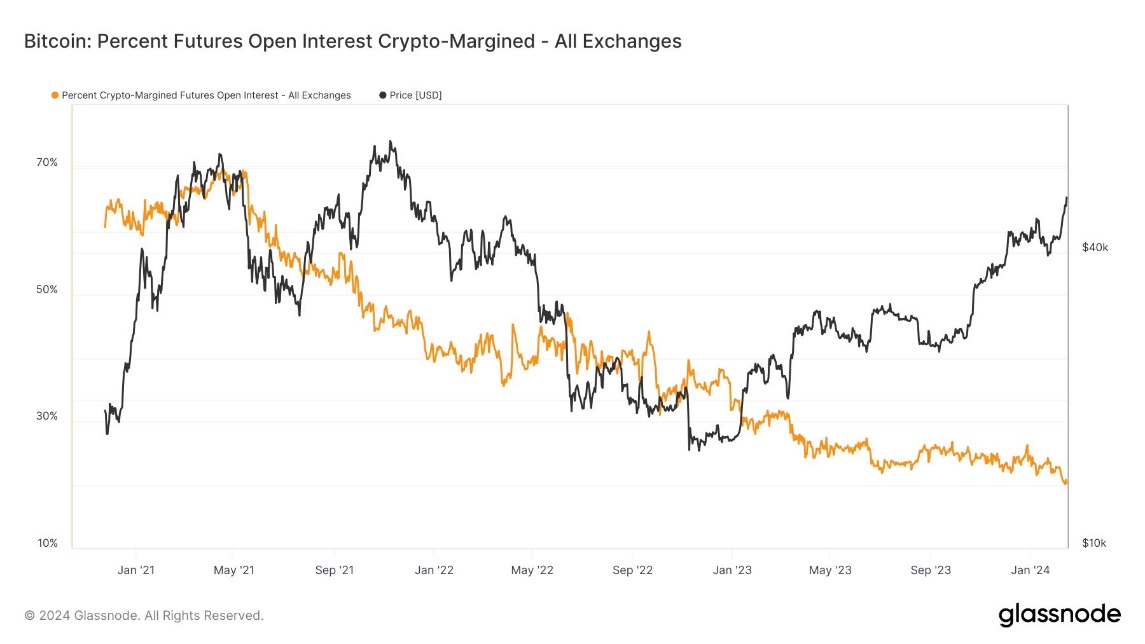
Bitcoin continues to run, up another 1.5% over the past 24 hours, bringing its weekly total to 17.13%. Its dominance now sits at 54.04%, with this ratio up 2.54% over the same weekly timeframe. Compared to the 2020-21 bull market that was driven by intense amounts of leverage, sustained and healthy $BTC spot flow has driven this rally.
Source: Glassnode
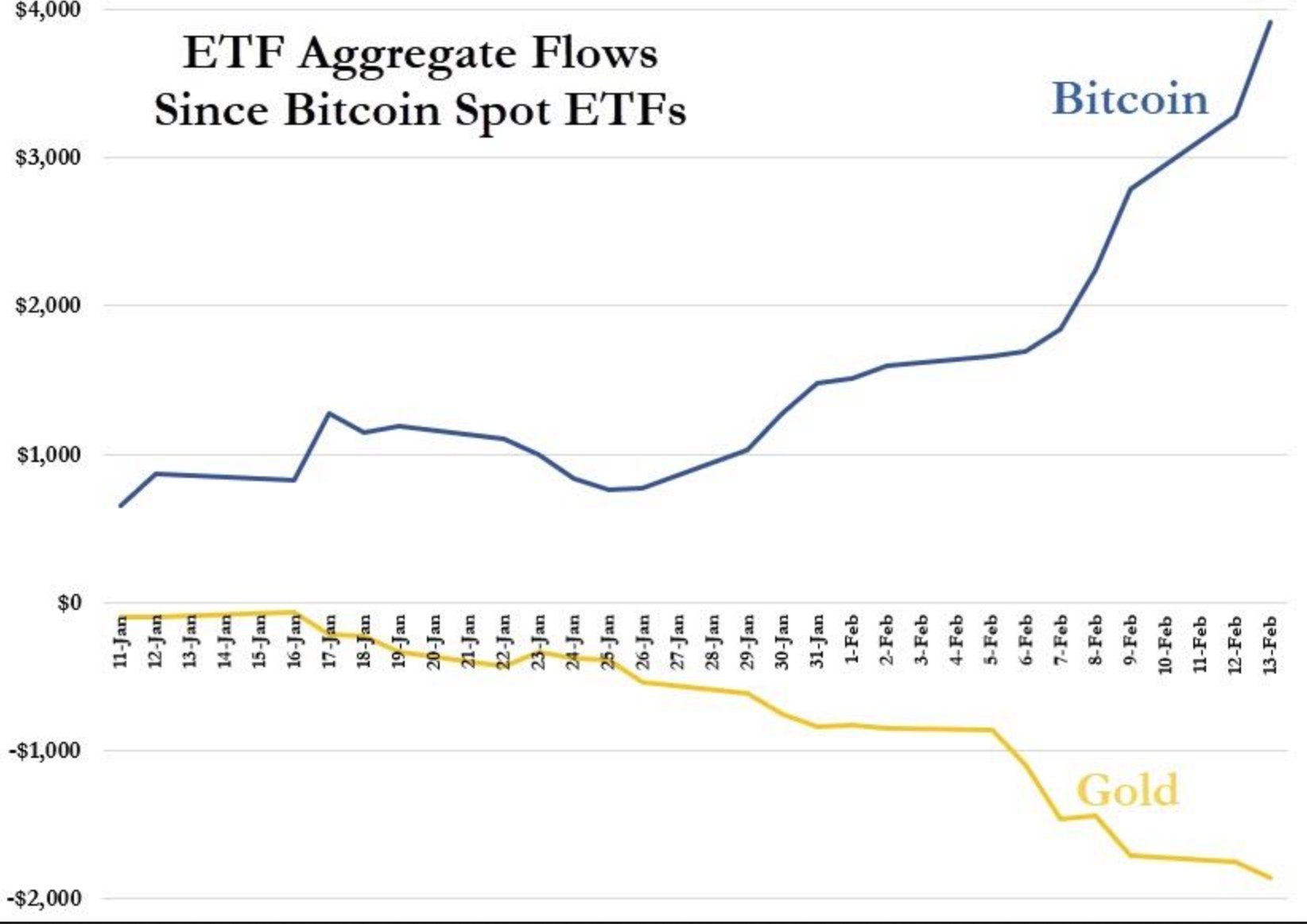
This spot buying is largely associated with the new $BTC spot ETFs. The last 7-day cumulative inflow into these ETFs was 53,607 BTC, $2.59B. The equivalent value of $BTC mined in the same time frame was 6,300 $BTC. That means the last 7 days $BTC spot ETFs saw 8.5x the amount of $BTC mined (and this is before halving). Since January 11, the 10 ETFs have seen aggregated inflows of $3.89B. The 14 leading gold ETFs have seen outflows of $2.4B so far in 2024. We are not saying people have been exiting Gold ETFs and migrating straight to the $BTC ETFs, we just find the decoupling interesting.
Source: Cointelegraph
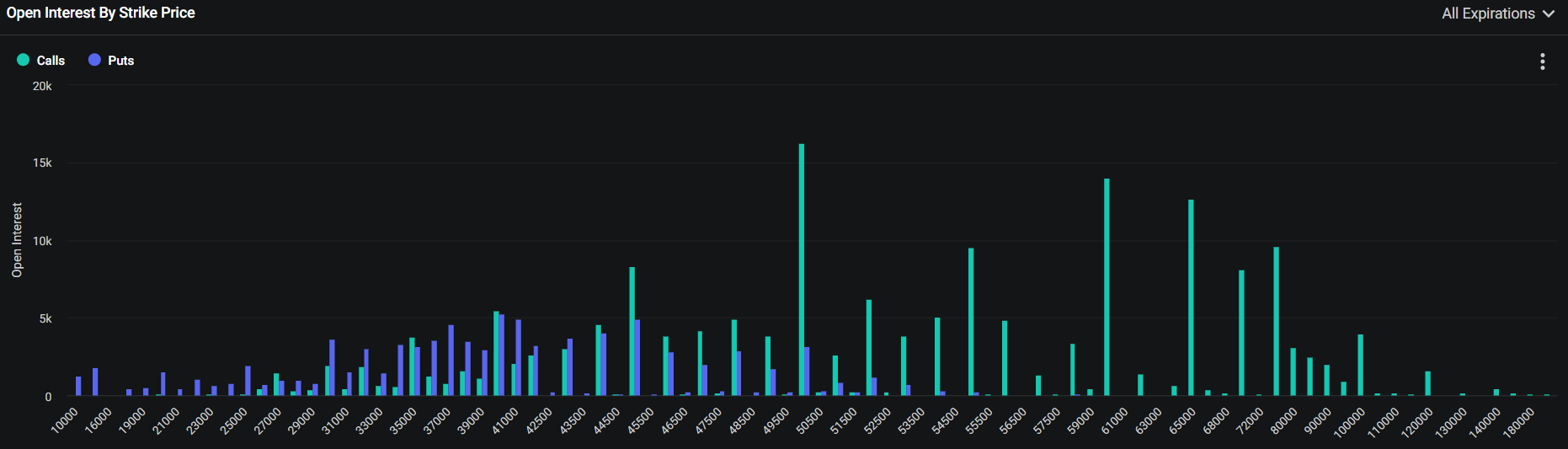
$BTC call options for all expiries from April through December show a notable concentration at strikes above 60k. This week alone, $10M was spent on premiums for 60-80k strikes expiring April-December. On upcoming expiries, the largest volume of $BTC options are March 29 60k calls.
Source: Deribit
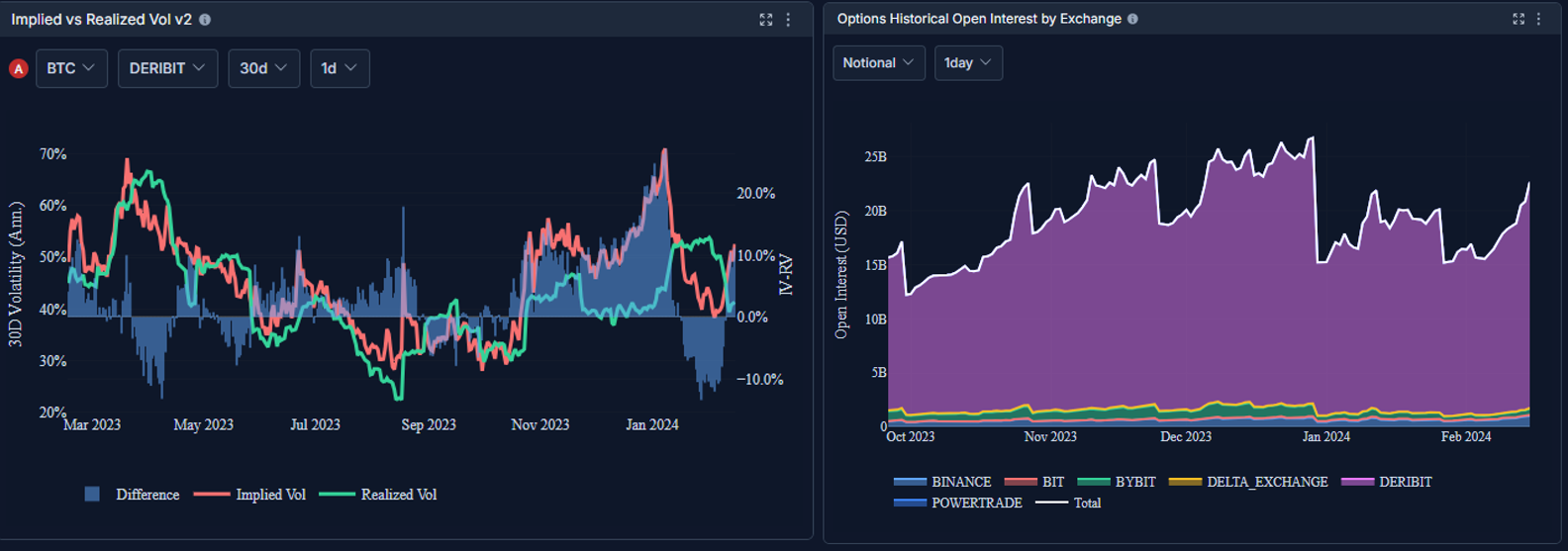
We have also noticed implied vol has picked up with this increased call buying. Due to this, implied has flipped back above realized. Open interest is starting to pick up as a result.
Source: TheTie
What are Blockchain Oracles?
Oracle networks serve as the crucial interface bridging data between on-chain and off-chain environments, as well as facilitating interactions between different blockchain networks. They play a pivotal role in providing cryptographically verified data to chains, executing computations that chains cannot perform independently, and linking various public and private blockchain ecosystems.
With a track record of processing trillions of dollars in transaction value and generating a significant amount of cryptographic truth, blockchain oracles bridge blockchains and the external world, allowing smart contracts to interact with off-chain data and systems. This capability is essential because smart contracts cannot access or verify information outside their network. Oracles extend the functionality of smart contracts by enabling them to execute actions based on real-world events, such as price movements, temperature changes, or the outcome of a sports event. Below is a graphic of how Chainlink ($LINK) aggregates data from different exchanges to be used in smart contracts.
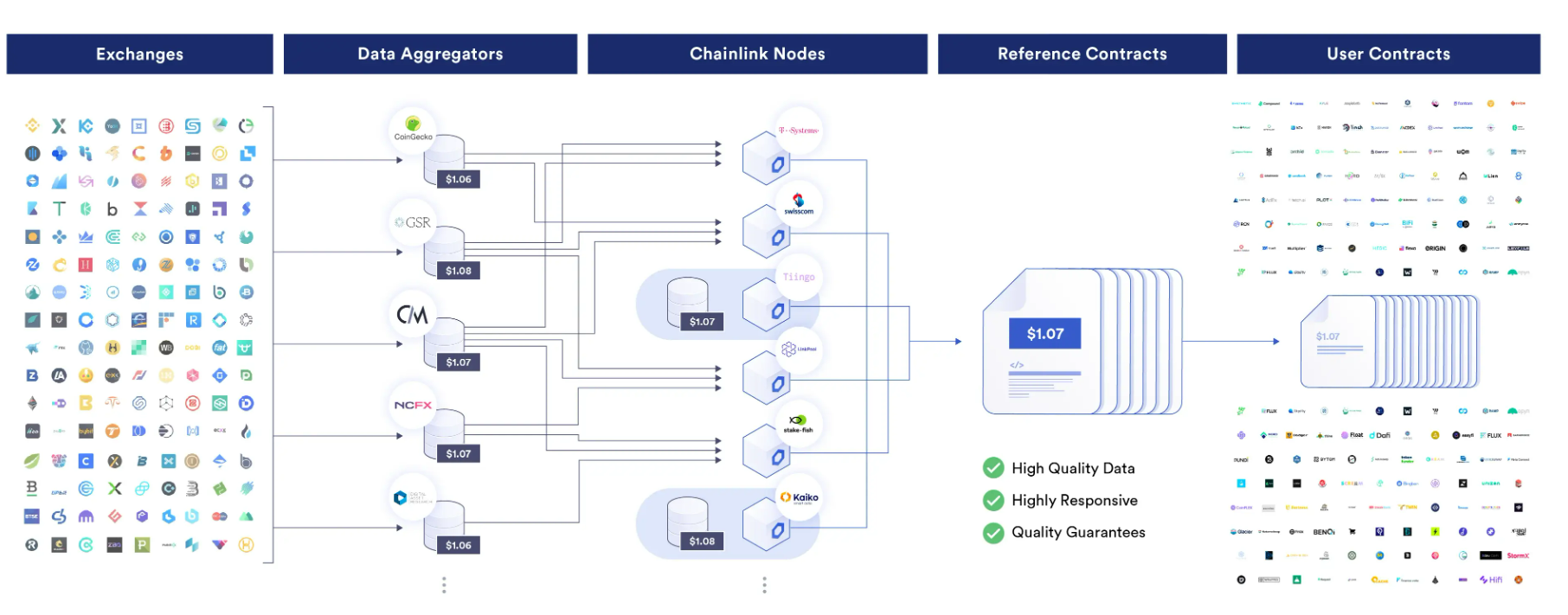
Source: Chainlink
Chainlink's Market Presence and Strategic Developments
In January, Chainlink, the leading decentralized computing platform, saw significant developments and partnerships that underscore its pivotal role in the crypto ecosystem. Co-founder Sergey Nazarov outlined Chainlink's ambitious 2024 outlook, emphasizing its mission to establish a global internet of contracts and unlock tokenized real-world assets (RWAs). Amid the broader crypto industry's excitement over U.S. regulators' approval of spot bitcoin ETFs, Nazarov highlighted how this milestone could accelerate the participation of large financial institutions in crypto markets, bridging the gap between traditional finance (TradFi) and decentralized finance (DeFi) with an emphasis on cross-chain interoperability protocol (CCIP).
CCIP is an open blockchain interoperability standard designed to facilitate seamless communication and data exchange between various blockchain networks. It serves as an abstraction layer and cross-chain messaging protocol, allowing existing infrastructure to connect to blockchains and enabling smart contracts to send and receive arbitrary data and conduct token transfers across public and private blockchains. CCIP eliminates the need for developers to write custom code for chain-specific integrations, as they only need to integrate the CCIP Router onchain to begin building secure cross-chain applications. Powered by Chainlink decentralized oracle networks (DONs), CCIP ensures time-tested security and reliability, with customizable rate limits on transaction flows and support from a Risk Management Network for continuous monitoring and verification of cross-chain operations. CCIP also offers advantages such as liquidity aggregation, fast integration, reliable transaction execution, future-proof technology, and development by industry experts in cryptography and computer science.
Other recent developments for Chainlink include:
- June 7, 2023: Swift partners with major financial institutions like DTCC, ANZ, BNP Paribas, and more to test connecting with blockchain networks. Chainlink provides connectivity across public and private blockchains for these experiments, aiming to enhance efficiencies and reduce costs in capital markets.
- September 14, 2023: ANZ one of Australia’s “Big Four” banks, completes a transaction using its A$DC stablecoin and Chainlink's CCIP, showcasing cross-chain funds transfer capabilities. Chainlink's role in fostering blockchain interoperability addresses concerns about integrating banks with the crypto sector.
- December 12, 2023: Matter Labs' zkSync joins Chainlink SCALE, enhancing access to oracle data for its Ethereum layer-2 scaling solution. Chainlink's Price Feeds on zkSync Era reduce costs, empowering developers for scalable, secure applications.
- January 16, 2024: Chainlink partnered with Circle to streamline USDC stablecoin transfers across various chains like Ethereum, Arbitrum, and Avalanche using CCIP.
- January 25, 2024: Chainlink's serverless web3 development platform, Chainlink Functions, now available on Arbitrum One mainnet, facilitates web2-connected dApps, enhancing Arbitrum's transactions while bridging web2 and web3 technologies for mass adoption.
- February 7, 2024: Chainlink's PYUSD Price Feed secures PayPal's stablecoin on Ethereum, facilitating onchain payments and accelerating tokenized real-world asset adoption, supported by Chainlink's secure and reliable decentralized price data.
These partnerships, alongside ones such as integrations with projects like Base, Morpho Labs, and Thales, extend Chainlink's reach and capabilities, from enabling cross-chain capabilities to providing essential data feeds and automation tools, positioning it as a cornerstone infrastructure provider for the burgeoning web3 landscape.
Oracle Landscape
Oracle networks are crucial for securing the value within hybrid smart contracts by providing accurate real-world data, thus preventing potential loss of user funds due to faulty logic or manipulated data inputs. In decentralized money market protocols like Aave and Compound, price oracles ensure the issuance and liquidation of overcollateralized loans based on reliable data. Total Value Secured (TVS) represents the aggregate TVL across various DeFi applications that rely on trustworthy oracle networks to protect user funds, highlighting the critical role of oracles in safeguarding TVL in different ecosystems.
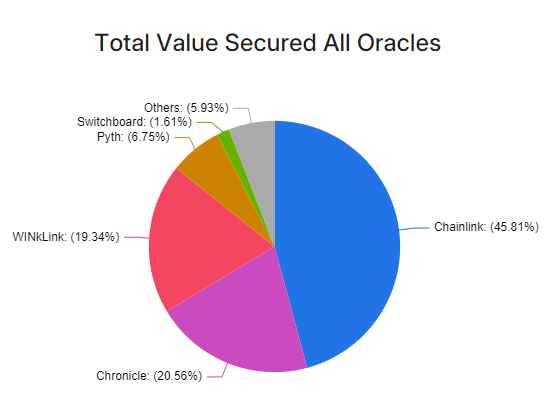
Source: Defillama
Below are the next largest data oracles by TVS:
Chronicle Protocol: Chronicle Protocol, an Oracle service developed by MakerDAO's Oracle Core Unit, provides a transparent, scalable, and cost-effective solution for bridging verifiable data securely onto and between blockchains. Currently supporting MakerDAO's total user deposits of $5.2B, Chronicle stands as the second-largest Oracle based on total value secured, offering end-to-end verifiable data architecture that is blockchain-agnostic and easily integrated through a public dashboard. With a focus on creating a decentralized interface, Chronicle addresses the necessity for blockchains to interact effectively with AI systems, envisioning a symbiotic relationship where blockchain data serves as a reliable source of truth for AI while blockchain smart contracts provide the foundation for securing, transacting, and managing global value.
WINkLink: Winklink ($WIN), supported by the WIN coin, introduces trustworthy real-world data onto the TRON ($TRX) blockchain, serving as the initial decentralized oracle service in the cryptocurrency exchange realm. Its primary goal is to cater to the expanding market of decentralized applications (dApps) within the TRON ecosystem, offering secure and provable random numbers to enhance user experiences in payment systems, events, and DeFi through the Winklink Verifiable Random Function.
Pyth Network: Pyth ($PYTH), a decentralized oracle built on the Solana blockchain, has made significant strides in recent times. On November 20, 2023, Pyth Network launched its permissionless mainnet, marking a major milestone. The network is designed to incentivize creators and owners of valuable market data to contribute directly to on-chain applications, positioning Pyth as a leader in financial data sourcing.
On February 7, 2024, Pyth Network announced the second phase of its token airdrop program for 167 dApps that use the oracle network. The airdrop distributed 100 million PYTH governance tokens, worth around $47 million, to these dApps. This news has positively impacted the market, with the price of $PYTH increasing 17.39% from $0.46 to $0.54 as of the time of writing.
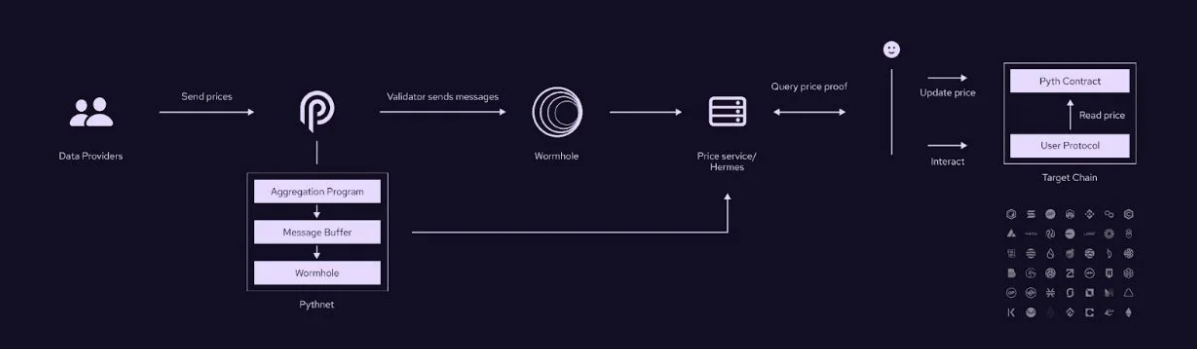
Source: Solana.com
Pyth Network was the first Permissioned Environment (SPE) on Solana’s stack. It uses the Solana Virtual Machine to connect to external data sources, serving as a crucial aggregator for real-world smart contract execution. Pyth’s requirements for rapid data processing and minimal latency (400 ms) are met by Solana’s high-throughput infrastructure.
Relative Metrics
Having examined the top oracles by TVS measured by DeFiLlama, we now shift our focus to some of the leaders in the oracle landscape based on market capitalization. By exploring market capitalization, we gain insight into the perceived value and market position of these oracle projects within the broader cryptocurrency ecosystem.
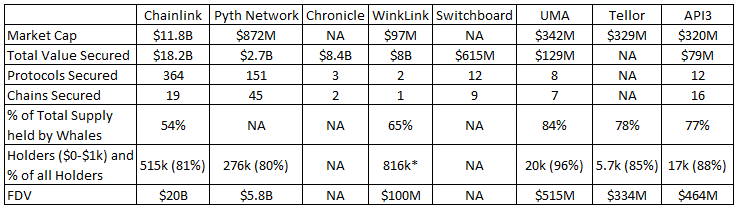
Source: Defillama, Messari, Tronscan, Dune Analytics @cctdaniel
Chainlink's leadership defines the Oracle market landscape with an $11.8B market cap and $18.2B in TVS, underscoring its expansive reach across 364 protocols and 19 chains. Pyth Network, with a $872M cap and $2.7B TVS, alongside 151 protocols spanning over 45 chains, indicate its focus on interoperability and demand for its services. Chronicle, without a publicly traded token, shows a high TVS of $8.4B, with 67% of that coming from MakerDAO. Whale holdings suggest potential price sway across a variety of smaller market cap tokens. This is common in a variety of projects, but token release schedules should be investigated further to help anticipate unlocks and sell side pressure.
About other decentralized oracles:
- UMA ($UMA): founded in 2018 by ex-Goldman Sachs traders, seeks to democratize global markets through an open-source protocol for trustless financial contracts. Their optimistic oracle system, inspired by Vitalik Buterin's concepts since 2014, introduces human intelligence into data resolution for Web3 projects needing non-codable data. UMA's system involves three actors: the contract requester, data provider, and disputant, with disputes resolved by tokenholder votes within 48 hours. Token holders engage through Ethereum-based wallets connected to the UMA voting Dapp, with rewards compounding on successful votes. UMA's audited smart contracts cater to decentralized app developers.
- Tellor ($TRB): is a decentralized oracle protocol for blockchain infrastructure, updating off-chain data for on-chain smart contracts. Data reporters compete for TRB incentives to provide valuable information for various DeFi applications. Unique to Tellor is its permissionless reporter system, allowing anyone globally to participate. The oracle operates by incentivizing accurate data submissions while penalizing inaccuracies through disputes and slashing mechanisms. Founded in 2019 by Brenda Loya, Nick Fett, and Michael Zemrose, Tellor addresses Ethereum's oracle problem, leveraging its native token, Tributes (TRB), to align stakeholders and secure the network through a governance contract and dispute resolution.
- API3 ($API3): API3 aims to address the challenge of accessing reliable data for smart contracts by creating decentralized versions of APIs that can be built, managed, and monetized at scale. The project was launched in response to the limitations of current oracle solutions, which act as middleware between APIs and smart contracts, leading to increased costs and centralization. API3's approach involves enabling API providers to operate their own nodes, bypassing the need for traditional oracles. The project's token went live in December 2020. What sets API3 apart is its focus on improving data transparency and reducing transaction fees using its lightweight middleware called Airnode, which can be deployed quickly and easily.
Price Action and Narratives of Oracles
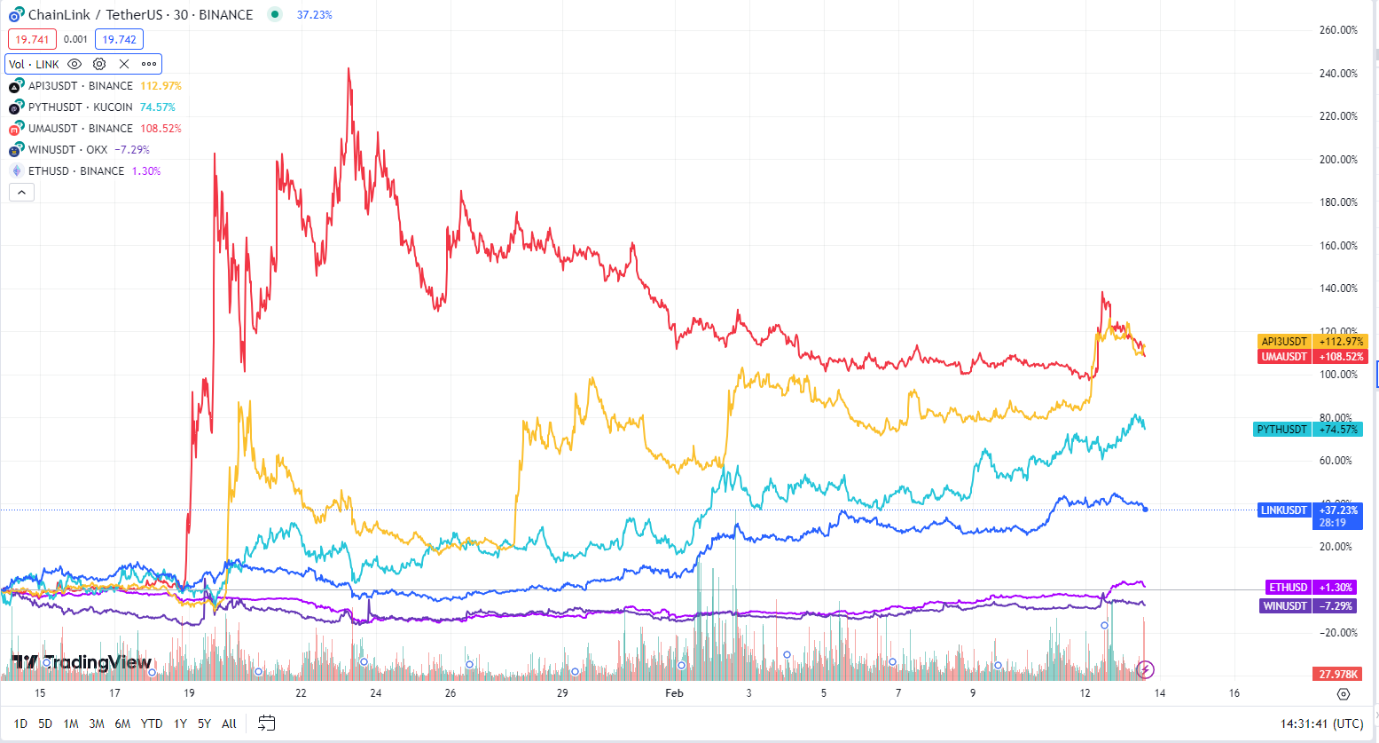
Source: TradingView
Since mid-January, Chainlink has demonstrated a +43.88% increase, showcasing market optimism. UMA's +122.93% surge, with a significant event on January 18th regarding the Oval protocol, suggests a strong response to potential new DeFi revenue potential. API3's +116.35% increase correlates with the January 19th announcement about negative funding rates and a market-making loan, influencing the price positively. Pyth Network, too, reflects a +120.62% gain alongside heightened adoption and staking activities since January 13th, indicating increased investor confidence. In the same timeframe, Ethereum (ETH) exhibited a relatively stable performance, with a slight increase of 1.30%.
Narratives play a significant role in driving price action in the cryptocurrency market, often influencing investor sentiment and market behavior. Chainlink, with its versatile oracle network and wide-ranging applications across various blockchain ecosystems, has the potential to intersect with numerous narratives within the crypto space. Whether it's providing critical data feeds for DeFi protocols, enabling secure cross-chain interoperability, facilitating real-world asset tokenization, or supporting emerging trends like NFTs and decentralized autonomous organizations (DAOs), Chainlink's technology and other data oracles can touch virtually every aspect of the blockchain industry.
Artificial Intelligence (AI)
The convergence of blockchain technology and artificial intelligence (AI) requires a robust interface that ensures security, reliability, and compatibility with both blockchain and AI technologies. As smart contracts and blockchain networks become the cornerstone of global value storage, transfer, and management, they require interfaces capable of integrating AI technologies seamlessly. The Chainlink network stands as the leader, providing the necessary infrastructure to facilitate this intersection by meeting the security requirements of blockchains, enabling interactions with AI technologies, and advancing the integration of verifiable applications into the blockchain ecosystem.
Chainlink co-founder Sergey Nazarov emphasized the critical role played by oracle networks at the convergence of blockchains and AI. Acting as the interface between on-chain and off-chain environments, as well as among different blockchain networks, Chainlink’s oracle networks provide essential services such as cryptographically verifiable data, computation, and cross-chain capabilities, ensuring the integrity of a chain’s deterministic environment. Nazarov highlighted the necessity for blockchains to have a “verifiable, secure, decentralized interface” to interact effectively with AI systems. He envisions a symbiotic relationship between blockchains and AI, where AI relies on blockchain data as a reliable source of truth, while blockchain smart contracts serve as the foundation for securing, transacting, and managing global value, leveraging AI's advanced computational capabilities.
Real World Assets
Chainlink offers a suite of services vital for the creation and security of RWAs. Its Data Feeds ensure reliable onchain data about tokenized assets, while Functions provide a serverless web3 development platform integrating offchain data, enriching assets beyond price data. Automation enables programmability, driving transparency and adoption, while CCIP facilitates seamless transactions between institutions and blockchains, fostering liquidity and unlocking new RWA use cases.
Proof of Reserve (PoR) leverages oracles to verify collateralization of onchain assets, enhancing confidence in stablecoins by ensuring transparency and maintaining a 1:1 peg. Together, these services create a golden record, serving as an immutable source of truth, bridging traditional finance and web3. Euroclear and Swift, among others, have collaborated with Chainlink, demonstrating CCIP's potential, unlocking new RWA use cases projected to drive the space to $10 trillion by 2030.
Everything needs Data
First published on May 17, 2019, and then updated November 18, 2022, Chainlink has posted 77+ Smart Contract Use Cases Enabled by Chainlink, found here. This list includes decentralized finance, external payments, onchain finance, NFTs and gaming, enterprise systems, supply chain, and more. Our published 2024 outlook weekly highlights the importance of data and the critical role it plays in shaping the future ecosystems.
Source: Chainlink, DeFiLlama, CoinMarketCap, Solana Foundation
Sector Commentary
- Layer One / Altcoins
- Bitcoin ($BTC); Ethereum ($ETH): Bitcoin Tops $50K as Spot ETF Inflows Accelerate; ETH Rallies Amid Franklin Templeton's Filing (link)
- Bitcoin ($BTC): Bitcoin ETF First Month Is in the Books: How It Went and What Comes Next (link)
- Bitcoin ($BTC): VanEck Monthly Bitcoin ChainCheck (link)
- Bitcoin ($BTC): Bitcoin call options concentrate at strike prices above $50,000 ahead of February end-of-month expiry (link)
- Ethereum ($ETH): Franklin Templeton Joins Ethereum ETF Race (link)
- Ethereum ($ETH): Ether options open interest on CME on track to hit fresh all-time high (link)
- Ethereum ($ETH): Op-Ed: Ethereum Has Gatekeepers (for Good Reason) (link)
- Solana ($SOL): Solana (SOL) price rallies 19% in a week — Is $120 the next stop? (link)
- Chainlink ($LINK): Chainlink (LINK) hits 1-year price high above $20 — Here’s what to expect next (link)
- Aptos ($APT): Aptos implements passwordless passkey authentication for transactions (link)
- DeFi
- NFTs / Web3
- Metaverse / Gaming
- Embarking on a new frontier: What’s next for the Metaverse in the gaming sphere (link)
- Why the Metaverse Is About to Make a Comeback (link)
- London-Based Wine Platform Curated Ventures into the Metaverse (link)
- Crypto gaming platform PlayDapp loses $290 million worth of tokens in two exploits: Elliptic (link)
- Digital Infrastructure: Capital Markets / Exchanges / DAOs / Mining
- StoneX Expands Crypto-Trading Team With Former Cowen Staff (link)
- Michael Saylor Believes Demand for Bitcoin Products Is 10x the Supply (link)
- Bitcoin 'Stronger’ Ahead of Halving: Grayscale (link)
- How Bitcoin ETFs could impact the average investment portfolio (link)
- Crypto greed index hits highest level since Bitcoin’s $69K ATH (link)
- Ripple acquires Standard Custody & Trust, its second custody provider (link)
- In inflation-torn Argentina, locals use ‘crypto caves’ — and avoid Bitcoin (link)
- Op-Ed: The FTX Hack: The Unsolved SIM Swap Mystery (link)
- Op-Ed: Crypto Has an Unrealized Opportunity in Asia (link)
- Op-Ed: Did President Biden Just Endorse Bitcoin? (link)
- Binance founder Changpeng Zhao’s sentencing postponed to April (link)
- US Treasury will outline fears about use of crypto in illicit finance at upcoming hearing (link)