On Thursday (15), the Brazilian Federal Superior Court (STF) unanimously approved an agreement reached between the Federal Government and the States regarding the ICMS tax on fuels and other products. The negotiations maintained the essentiality of diesel, natural gas and cooking gas, therefore agreeing to an ICMS limit between 17% and 18% for these categories, - as determined by Bill 18/2022, sanctioned in June.
In the case of gasoline, its essentiality will be subject to further debate. The determination leaves open the perspectives for 2023 in the fuel sector, in particular, demand for Otto Cycle fuels. Added to this, federal taxes on gasoline and ethanol have been zero since the middle of the year, and the return of these rates next year is another big question mark.
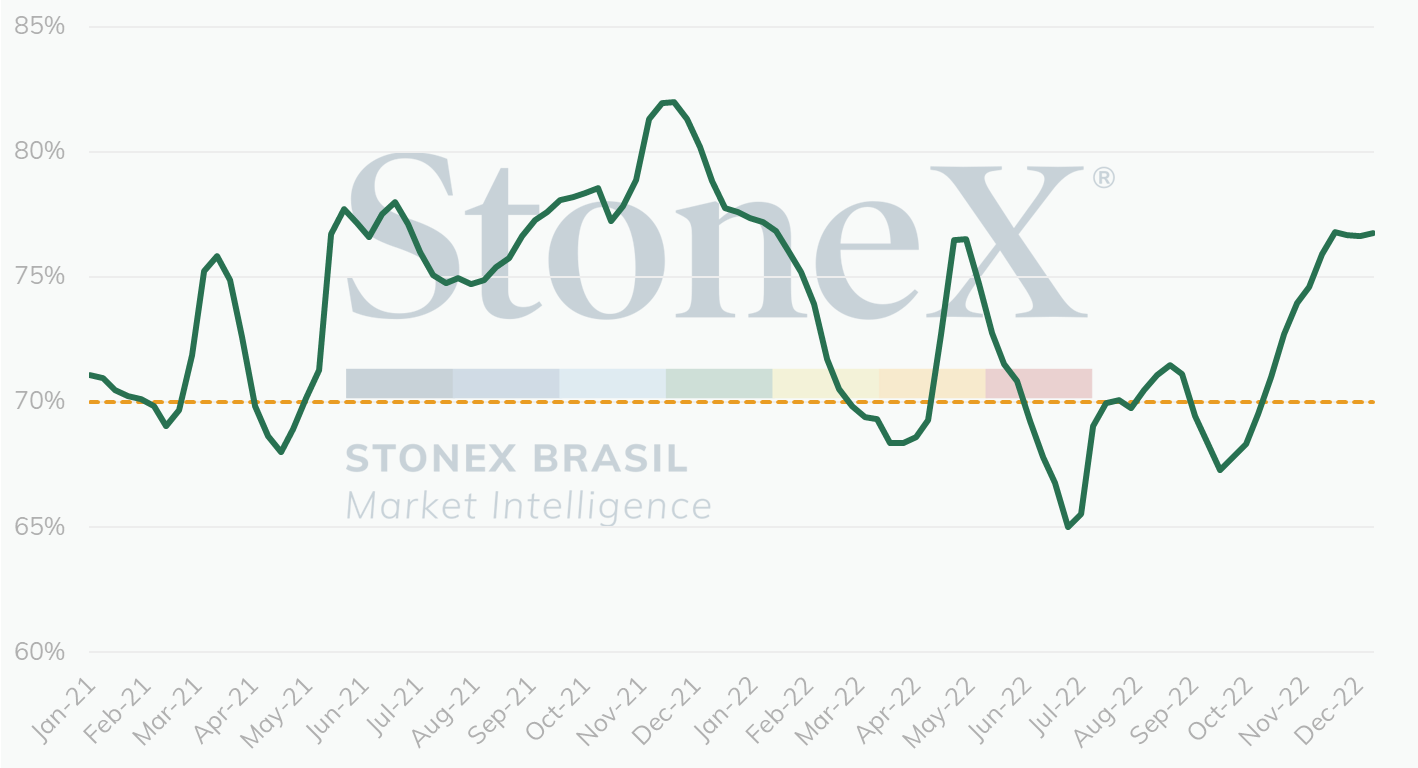
The fact is that the tax relief promoted in the fuel sector benefited gasoline in terms of competitiveness with ethanol at pumps. This is because the tax burden on gasoline used to be almost BRL 0.70/liter higher in relation to ethanol, whose added taxes (PIS/Pasep and Cofins) were BRL 0.13/liter. In the state of São Paulo, the average price of gasoline at gas stations fell by BRL 1.85/liter (-26.5%) between the beginning of July and the end of August, as a result of the tax cut, but also due to the adjustments made by Petrobras at the time. In contrast, although it followed the movement, hydrous lost BRL 0.89/liter (-19.6%) in the same period. The parity in SP, which operated at around 65% in June, returned to over 70% at the end of August.
Parity between hydrous ethanol and gasoline in São Paulo (%)
Source: ANP. Design: StoneX.
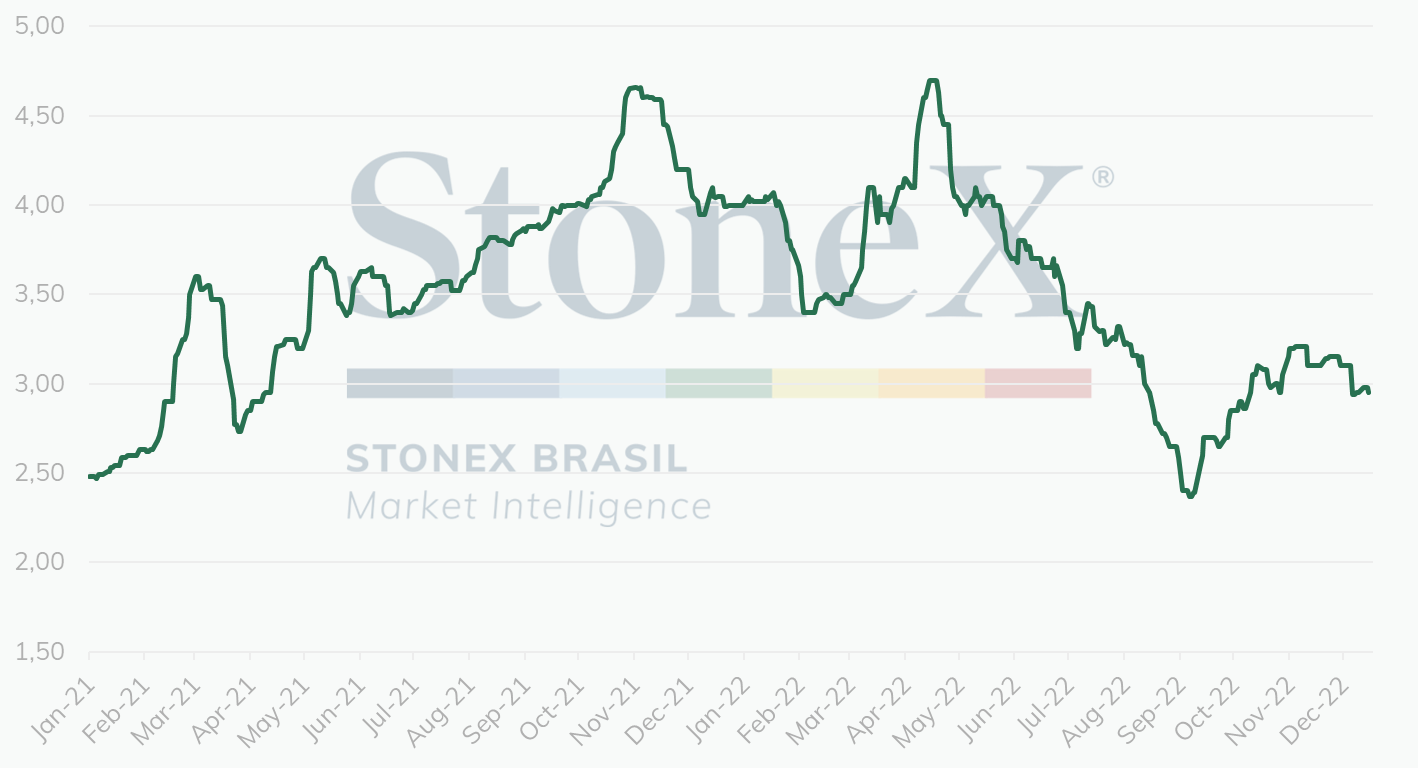
For most of 2021, ethanol remained at a disadvantage compared to gasoline at the pumps, especially in the second half, when there was a crop failure in the Center-South's sugarcane crop. As a result, demand for ethanol weakened, which was one of the reasons why prices dropped at the end of the year. On the other hand, the strong increases in gasoline prices by Petrobras encouraged new increases in ethanol until mid-April 2022, when hydrous at Ribeirão Preto plants reached BRL 4.70/liter.
With the start of the 2022/23 sugar crop (Oct-Sept), ethanol sales grew, causing a significant drop in prices, which were intensified by the tax exemption and readjustments by Petrobras. In September, hydrous regained parity again and its consumption was stimulated, but the low stocks at the plants were enough for quotes to rise again, already operating close to BRL 3.00/liter, 24.5% more expensive compared to what was traded at the beginning of September.
Price of hydrous ethanol at the plants* (BRL/liter)
*Ex-mill based in Ribeirão Preto (SP), with taxes. Source and design: StoneX.
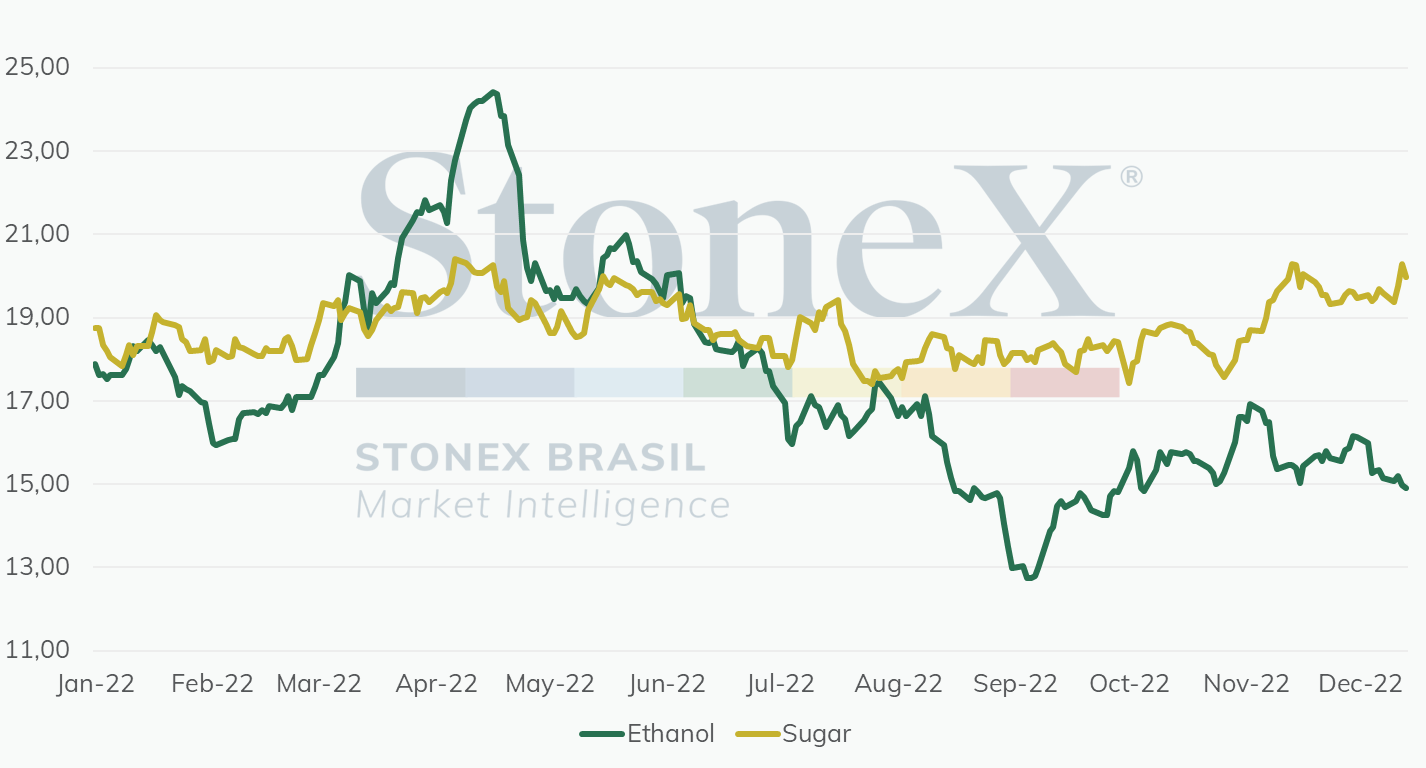
The sugarcane crop in Brazil's Center-South region has increasingly directed more feedstock to sugar production, as its advantage over ethanol has remained, with the NY#11 contract keeping at high levels. The dollar price also remained above BRL 5.00 in recent months, encouraging sugar exports. At the moment, hydrous in raw sugar equivalent is quoted around 14.90 c/lb, more than 500 points cheaper in relation to the #11 March/23 contract. Even compared to May/23 and July/23, export sugar has a positive premium of 388 and 310 points, respectively, maintaining a large advantage.
Parity between NY#11 and hydrous ethanol* (cents/lb)
*At mills based in Ribeirão Preto (SP). Sources: ICE/NY & StoneX. Design: StoneX.
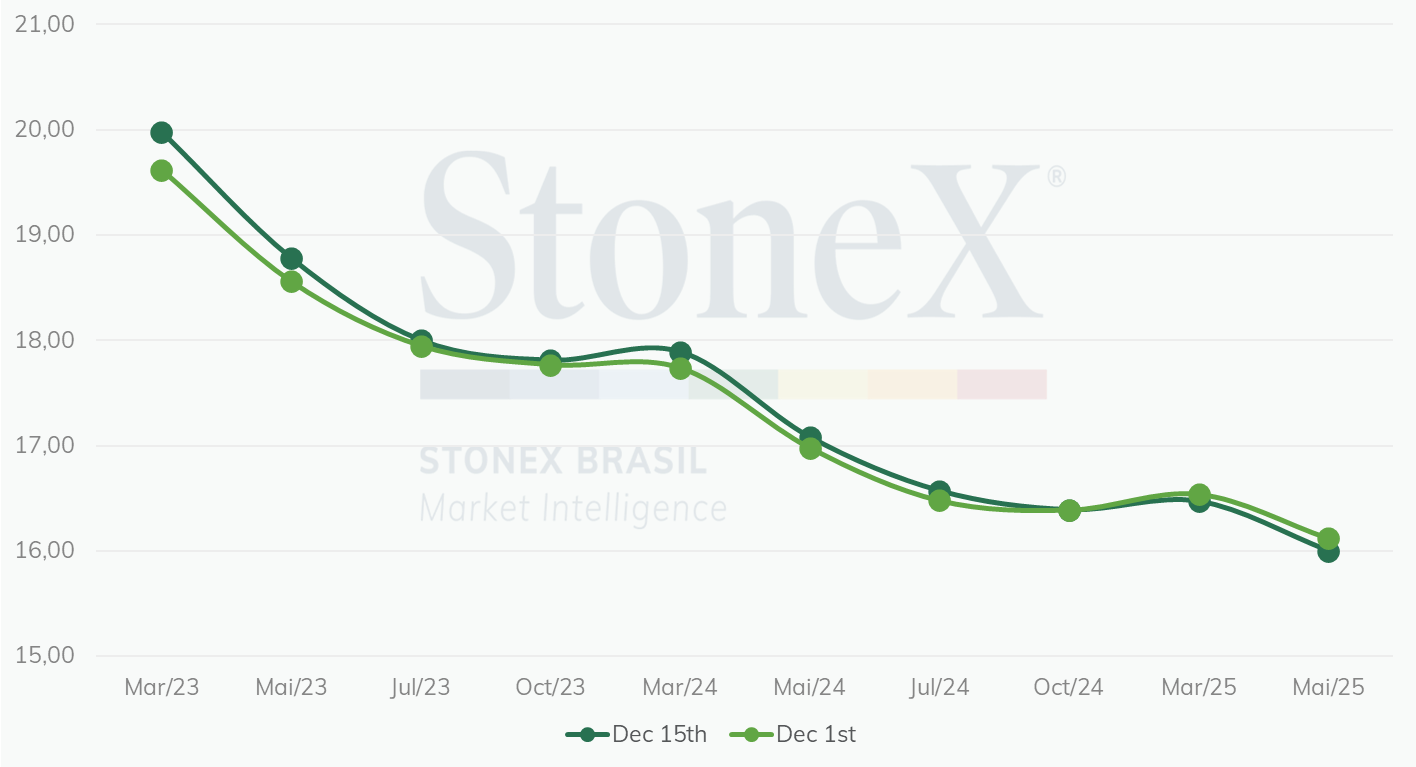
In this sense, hydrous has a long way to go to regain competitiveness with sugar and therefore have its production encouraged at mills. This scenario should already be better reflected in the sugar-directed mix for the 2023/24 season (Apr-Mar), which may be even higher than the closing of the current cycle. The NY#11 futures curve has become increasingly inverted, as the market is faced with tight short-term stocks, but a possible massive entry of Brazilian cargo for export in the second quarter of 2023.
NY#11 forward curve (US¢/lb)
Source: ICE. Design: StoneX.
With the Center-South inter-crop period, there is support for ethanol prices to remain at current levels, especially if mills continue with the mixes even with less cane available. Therefore, depending on carryover stocks and starting prices in the next crop, if this drop in sugar actually materializes, it is possible that ethanol will recover a part of this competitiveness. However, it is worth noting that the behavior of the futures curve for ethanol in the B3 is also inverted, which may represent a market expectation of lower prices in the coming months.
As previously explained, the return of taxes on fuels may favor ethanol consumption. If the previous federal rates return, the parity between ethanol and gasoline would already go back to around 69.6% in São Paulo (calculated with the current prices published by the National Agency of Petroleum, Gas and Biofuels, the ANP), which would encourage demand for hydrous, since it would leave the current parity of 76.7%. With a supposed return of ICMS taxes in São Paulo to the rates prior to the Government changes, this ratio would fall even further to 68.8%, and could be one of the escape valves for mills to raise prices, with potential higher consumption.
What is worth mentioning is that taxes impact direct sales to consumers, not necessarily changing the net price at the mill – which will benefit or be harmed according to changes in demand. If ethanol consumption grows in an extreme scenario of complete tax return on gasoline, which would make it more expensive for consumers by almost BRL 1.00/liter, it could be the basis for an increase in prices at processors, since their stocks are low at the moment and at least until the beginning of the next crop, in April 2023.
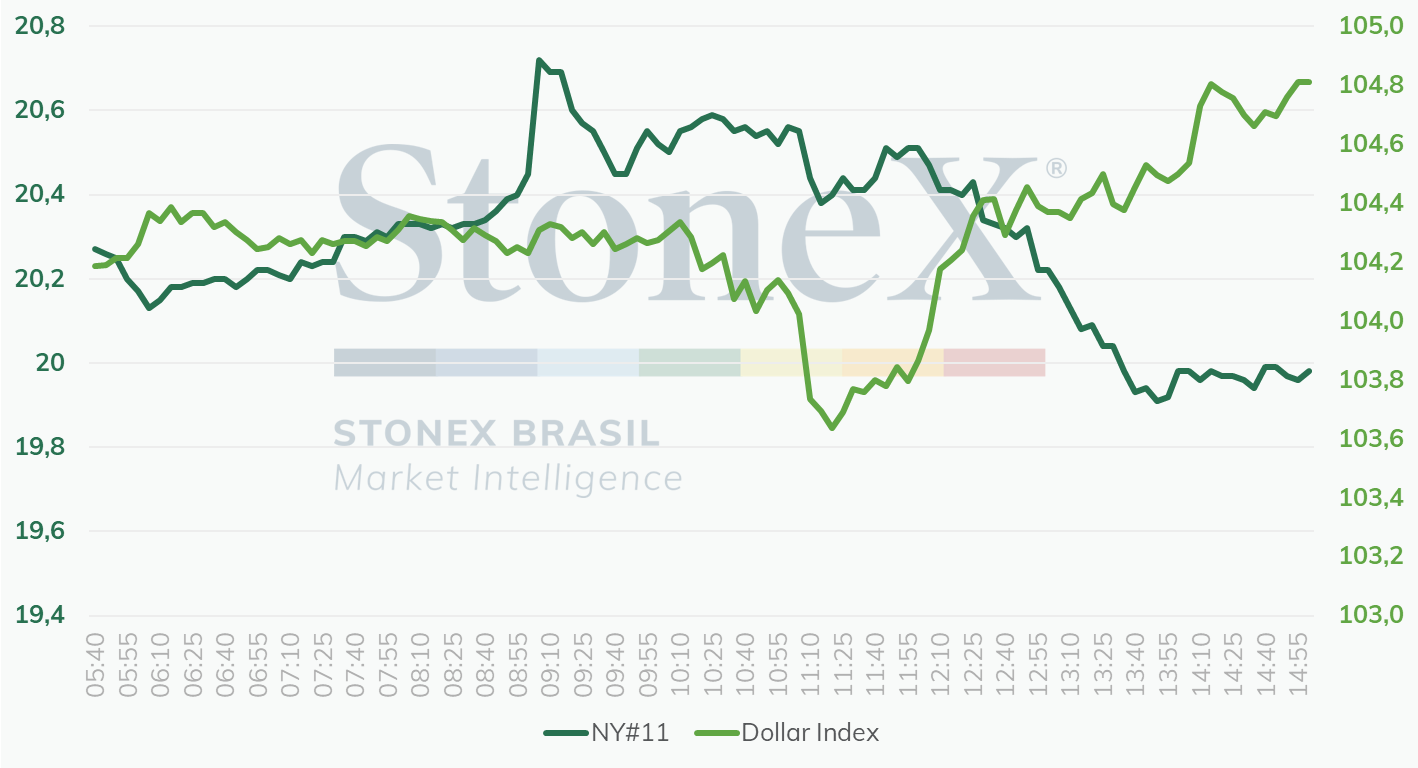
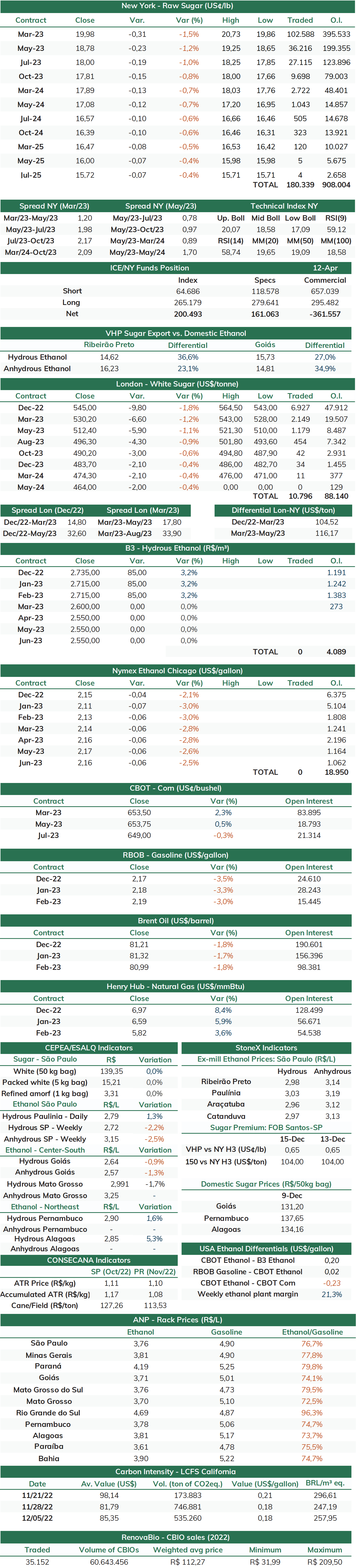
Thursday's trading session was extremely volatile, starting the day with an increase that reached 20.73 c/lb (+2.2%) for raw sugar, oscillating to a daily low of 19.87 c/lb (-2%) and finally closing the day at 19.98 c/lb (-1.5%). It is worth mentioning that this behavior for sugar is probably associated with the action of speculators, who caused the spread between the March and May contracts to reach unusually high levels during Thursday's session. For white sugar in London, the trend was similar, ending the day at USD 545/t (-1.8%), which means that the London-New York differential remains at around USD 104/t.
In terms of fundamentals, the news of a possible revision in the gasoline taxation policy should not yet affect prices, since the distance between sugar and ethanol is still large, as discussed. In addition, the Indian government seems to be considering releasing more cargoes for export in January of next year, which could ease inventories in the medium term.
On the other hand, the day's operations may have been a reflection of the macroeconomic scenario, against a day of greater risk aversion (contrary to the week), which is evident in the movement of the Dollar Index (DXY). In the morning, the DXY went into a strong rally, which coincided with the reversal of the sugar trend in New York (see the chart below), representing some market players' movement of withdrawing positions of riskier assets, such as are commodities.
Mar/23-NY#11 (cents/lb) and Dollar Index (points)
Source: Reuters. Design: StoneX.
indicators