In the last three months, from December 23 to the beginning of March 24, the trading price of decarbonization credits (CBIOs) - which are equivalent to the removal of 1 m³ of CO2 from the atmosphere as a result of biofuel use - has followed a slightly downward trend, trading at an average of BRL 108.7 per certificate - the average price of CBIOs in 2023 was BRL 113.5. Considering the last few weeks, the price has been under even more pressure, testing trading values below BRL 100 at the end of February/24, even as the final period for proof of the 2023 acquisition targets approaches, on 03/31/2024.
Average daily price of CBIOs (BRL/CBIO)
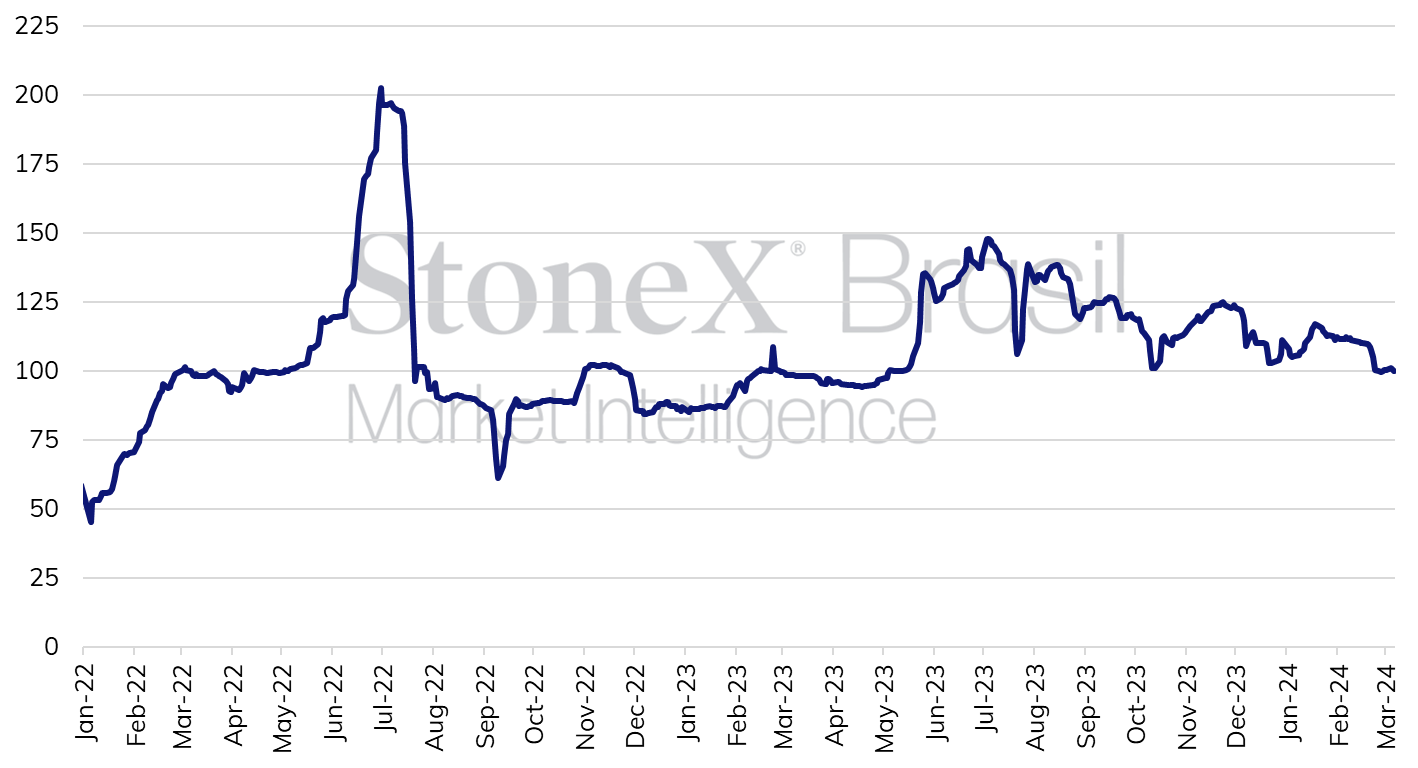
The trajectory of decarbonization credits has been highly volatile in recent years, a situation that tends to occur mainly in periods close to the date of distributors' purchase targets verification, as they are obliged to purchase CBIOs in quantities compatible with their fossil fuel sales.
Mills, on the other hand, which issue CBIOs backed by biofuel sales receipts (such as ethanol, biodiesel and biomethane) have no obligation on the issuance side, which has led many agents to complain of an imbalance in the market created by the Renovabio program.
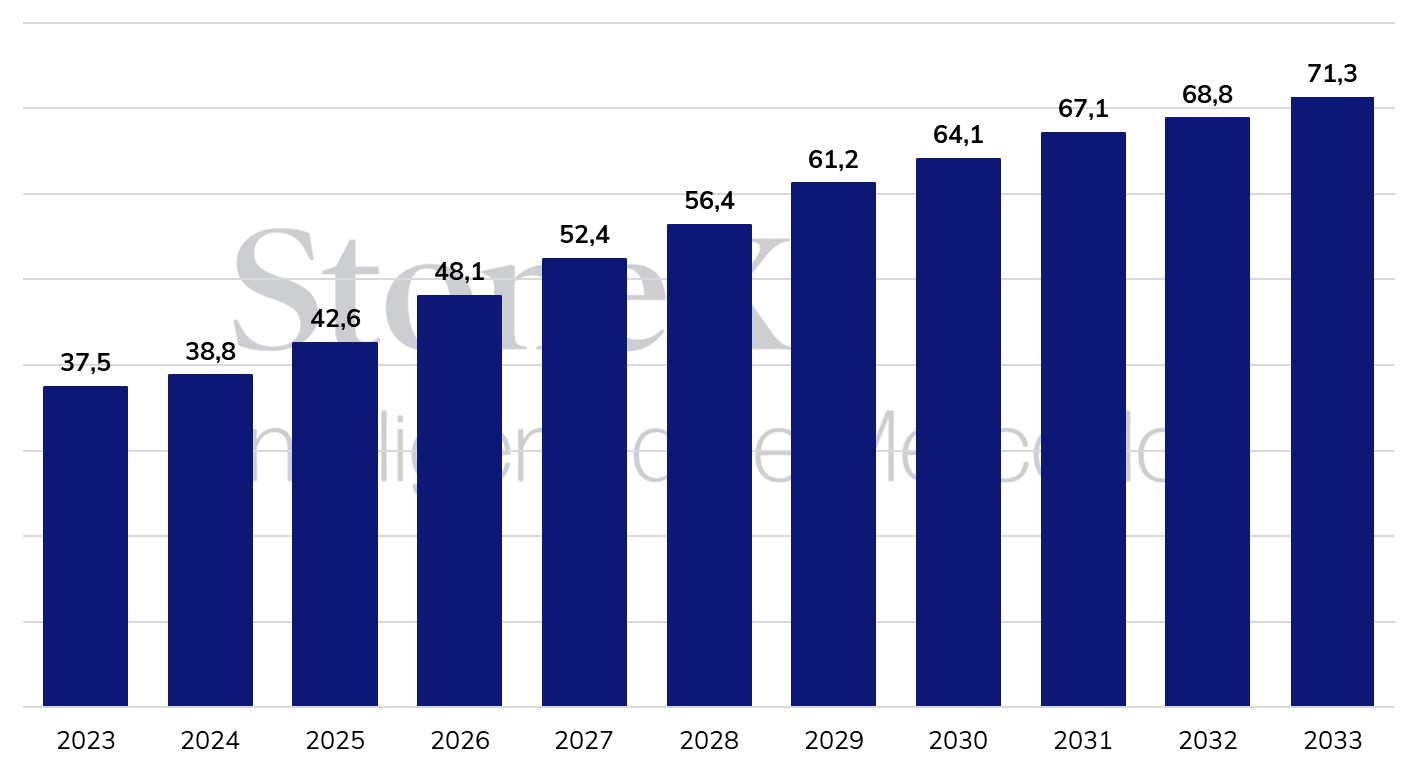
Considering the fundamentals of the market for these bonds, there are two main components. On the supply side, the sale of biofuels - the main one being ethanol, which has accounted for most of the CBIOs issued since the start of the program - is the main determinant of the amount of these bonds available on the market. On the demand side, the acquisition targets set annually by the National Energy Policy Council (CNPE) define the size of the demand, established at first as a total amount and then divided up individually for each distributor, defining their individual acquisition targets.
Annual CBIO acquisition targets (millions of CBIOs)
Currently, considering the record production of the 2023/24 (Apr-Mar) sugar-ethanol crop in the Center-South, which, including the distillation of corn ethanol, produced a total of 32.48 million m³ of ethanol, an annual increase of 15.5%, the growth in biofuel availability has encouraged mill sales, which in turn has increased the amount of ballast available for the issuance of decarbonization credits.
Ethanol sales by mills in the Center-South (million m³)
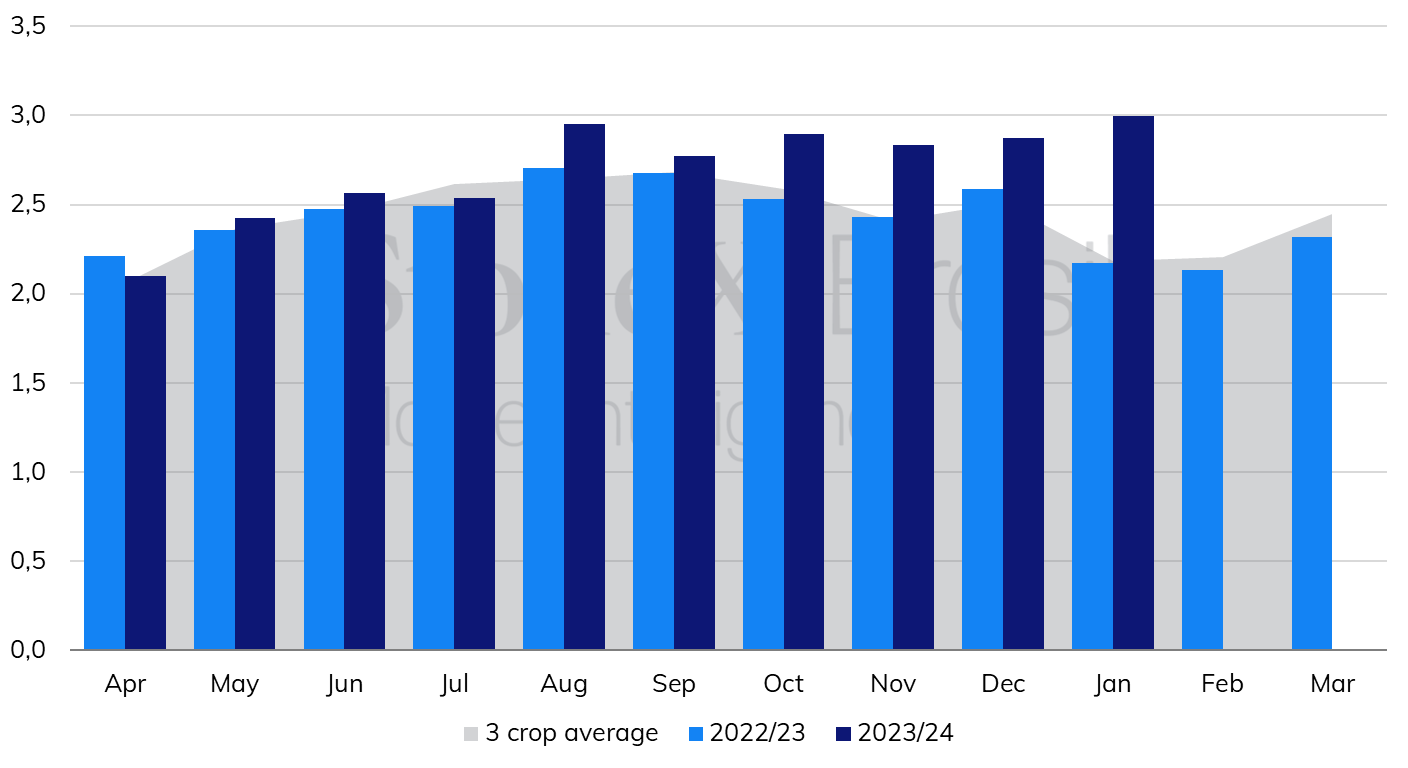
Source: UNICA. Design: StoneX.
On the demand side, the scenario has also somewhat contributed to the sideways trend seen in the decarbonization credits market in recent months. It is worth remembering that, traditionally, the targets for distributors to purchase CBIOs must be met by the end of December each year, at the end of the calendar year. However, in mid-2022, due to growing concerns about the rising price of fossil fuels such as gasoline and diesel, the deadline for attesting to CBIO acquisition targets was changed, causing a sharp drop in prices in July/22 and a huge increase in uncertainty in the market.
With the change in July/22, the deadline for proof of the 2022 targets was extended to September 2023 and the deadline for 2023 targets was postponed to March 31, 2024. Only from 2024 onwards will the deadline for proving targets return to the end of the calendar year, at 12/31/2024 for the year 2024, meaning that there are two concurrent deadlines for proving targets in the current year.
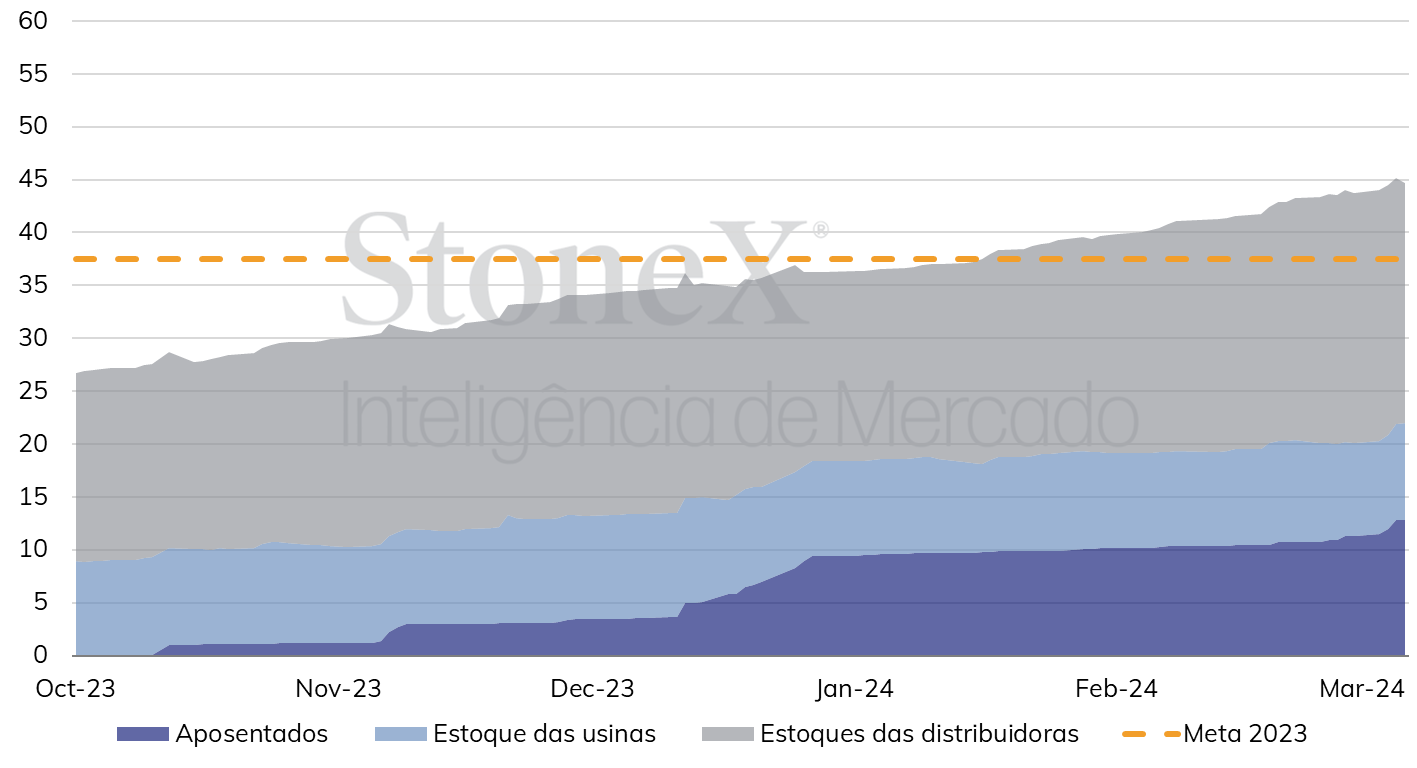
Analyzing the current market dynamics, we can see that from the beginning of October/23 to the beginning of March/24, a total of 12.83 million CBIOs were retired, with distributors still having a total of 22.68 million CBIOs available, a figure that, added to the total of retired securities, represents 94% of the target set for 2023, of 37.8 million CBIOs. When added to the mills' stocks, the figure represents almost 120% of the target.
Stocks, retired CBIOs and acquisition target for 2023 (million CBIOs)

Source: B3. Design: StoneX.
In this sense, it is clear that the CBIO market already has the credits needed to meet the 2023 target, which will be met at the end of this month. Despite this, it is worth noting that the verification period usually leads to a rise in prices, which may be driven by demand from smaller distributors who have not yet acquired the necessary securities.
With regard to the 2024 target, it has so far been set at 38.8 million CBIOs, an increase of 3.5% compared to 2023, but it is likely to see an increase in ethanol sales in the Brazilian Center-South, contributing to the greater availability of certificates. In addition, the increase in the biodiesel blend rate, announced in December 2023 and which took place in March this year - with the ethanol blend rate rising from 12% to 14% - should also contribute to a greater availability of CBIOs in the market, reassuring players that the target will be met.
- Weekly recap
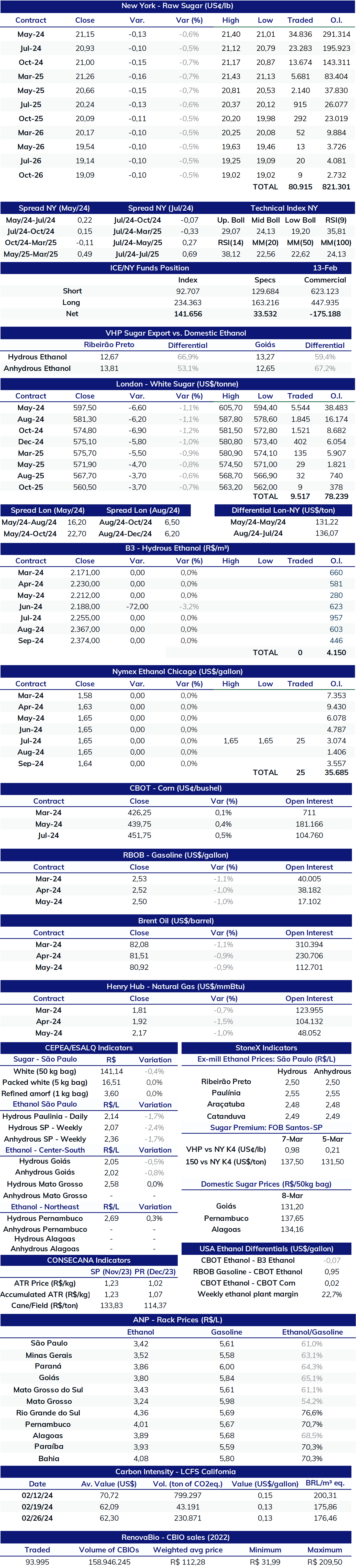
On Friday (08), the May/24 NY#11 contract was quoted at US¢21.15/lb, a weekly rise of 0.23%. After the March/24 expiration, prices found a strong bearish argument, as deliveries against the tape were high, materializing the high sugar supply for exports from Brazil's Center-South). However, the lower volume of rainfall in the region between November and February may have a more significant impact on sugarcane productivity in 2024/25 (Apr-Mar), and some companies announced new estimates throughout the week with more pessimistic figures for crushing and sugar production in the region.
- North-Northeast crop monitoring
According to Brazil's Ministry of Agriculture and Livestock (MAPA), the North-Northeast region produced 3.09 million tonnes of sugar in the current crop year, corresponding to 52.9 MMT of cane crushed. The figures for 2023/24 are still higher than for 2022/23, mainly because the previous cycle started late and lasted longer.
- Sugar exports hit record high in February
Last Wednesday (06), the MDIC published Brazil's trade balance data for the month of February. Sugar exports in the period reached 3.02 million tonnes - 2.57 MMT of raw sugar and 0.44 MMT of white sugar. The volume is very close to that recorded in January (which was 3.2 MMT), reflecting Brazil's high supply of the product at the start of the year, due to the large stocks inherited from 2023 - when shipments fell short of Brazil's production potential. In February, the result was an all-time record for the month and the first quarter of 2024 should be an absolute record for the entire historical series.
- India reaches 25.5 million tonnes of sugar produced in 2023/24
Last Monday (04), the ISMA published its monitoring of the 2023/24 (Oct-Sept) crop in India up to the end of February. The Indian season has already produced 25.54 million tonnes of sugar, just 0.9% behind 2022/23. In total, 49 units have already finished the current cycle, compared to 65 in the same period of the previous season. In 2023/24, the number of mills operating at the end of February was 466, which is 19 more than last year. The current harvest cycle in Maharashtra has performed better than initially expected and the ban on ethanol production from B-molasses and cane juice allowed for higher production volumes in January and February in the state.
- Sugar production in China slows down in February
Last week, the China Sugar Association (CSA) released the country's sugar production figures for February. In the 2023/24 crop (Oct-Sept), the total produced by Chinese factories reached 7.95 million tonnes, an annual increase of just 0.44% from the previous year. In the month, production was 2.09 MMT, a significant drop of around 580,000 tonnes compared to January. All of China's northern beet-producing units have already closed for the season, contributing to the slower pace of production in February - in addition to the excessive rainfall for the start of the year in sugarcane-growing regions and low temperatures. Against this backdrop, China's Ministry of Agriculture slightly revised its estimate for 2023/24 from 10.0 MMT to 9.95 MMT.
- Hydrous ethanol falls at the mills
The hydrous ethanol indicator based on Ribeirão Preto (SP) mills fell by around BRL 0.10/liter, quoted at BRL 2.50/liter on Friday (08). In January and until mid-February, the pace of purchases by distributors grew significantly, in response to the extremely attractive level of parity between biofuel and gasoline, which was below 60% in São Paulo at the turn of the year. On the other hand, after the Carnival holiday, the number of deals dropped significantly, giving little bargaining power to the mills, which are still holding record volumes of stocks in the Center-South - therefore contributing to the devaluation of prices.