After a significant increase in Otto Cycle sales during 2022, reaching a new record in national consumption with a level of 53.9 million m³, the year 2023 seems to follow a trend of renewing this high, but with data until the month of May indicating a consumption much more focused on gasoline than on hydrous.
Gasoline demand has been growing since 2021, when ethanol prices registered an increase due to the 2021/22 crop failure, which limited supply in the states of the Brazilian Center-South.
In 2022, even with a more favorable scenario for production, ethanol ended up struggling in the second half of the year, as a result of tax changes (exemption from federal taxes and reduction of the ICMS rate) that sought to lower fuel prices for the final consumer. This measure applied a federal exemption of BRL 0.69/liter on gasoline and only BRL 0.24/liter on ethanol.
With these legislative measures, accompanied by a sequence of falling crude oil prices in the international market during the second half of 2022, which reduced the prices of gasoline A sold from refineries to distributors, consumption of the fossil derivative was highly favored, a factor that was reflected in demand growth.
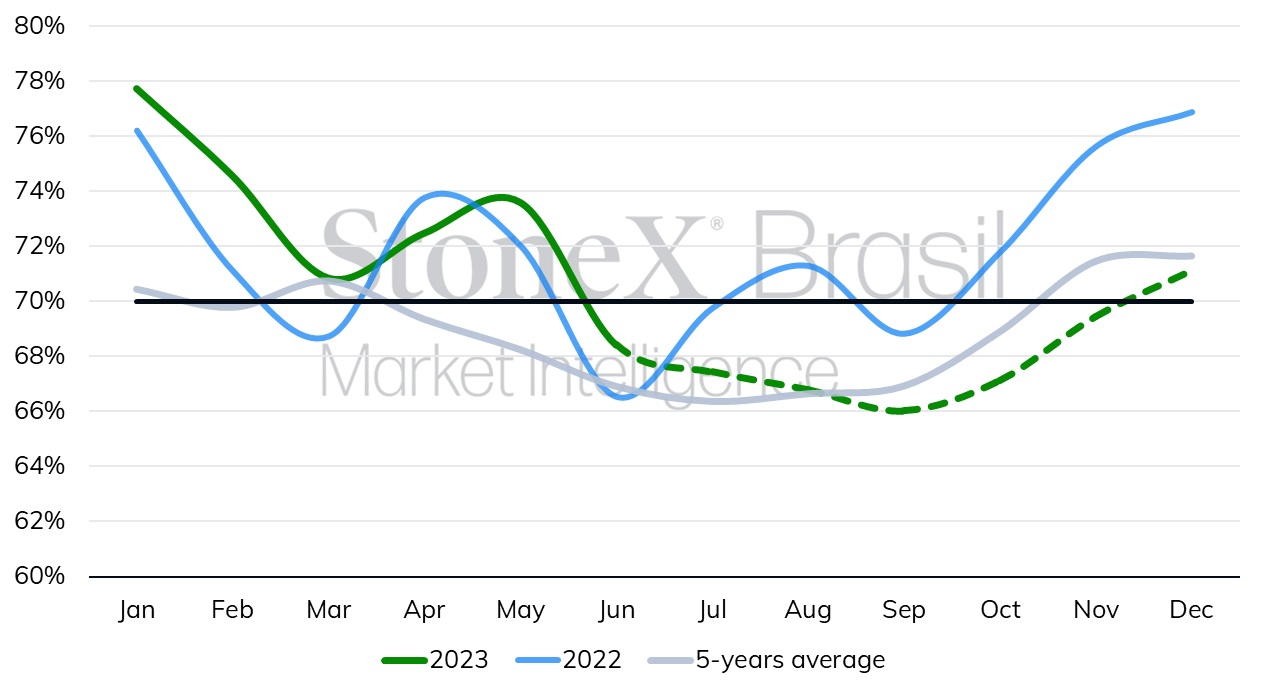
Competition between fuels was compromised because, while the measures lowered gasoline prices, they also removed tax incentives previously established for hydrous ethanol, a less polluting fuel than its counterpart fossil fuel. Parity went from 66.5% in June 2022 to 69.7% in July 2022 and 71.3% in August 2022, the peak months for sugarcane harvesting and strong supply of the biofuel, which seasonally has an average parity of 66%.
Consequently, with an average parity of 73.8% in the first five months of 2023, gasoline demand totaled 4.14 million m³, 16.2% more than the same period last year, thereby representing the highest gasoline demand ever recorded for the period. However, for hydrous ethanol, it is worth noting that consumption is 10.6% below the same period in 2022, as a result of discouraged consumption.
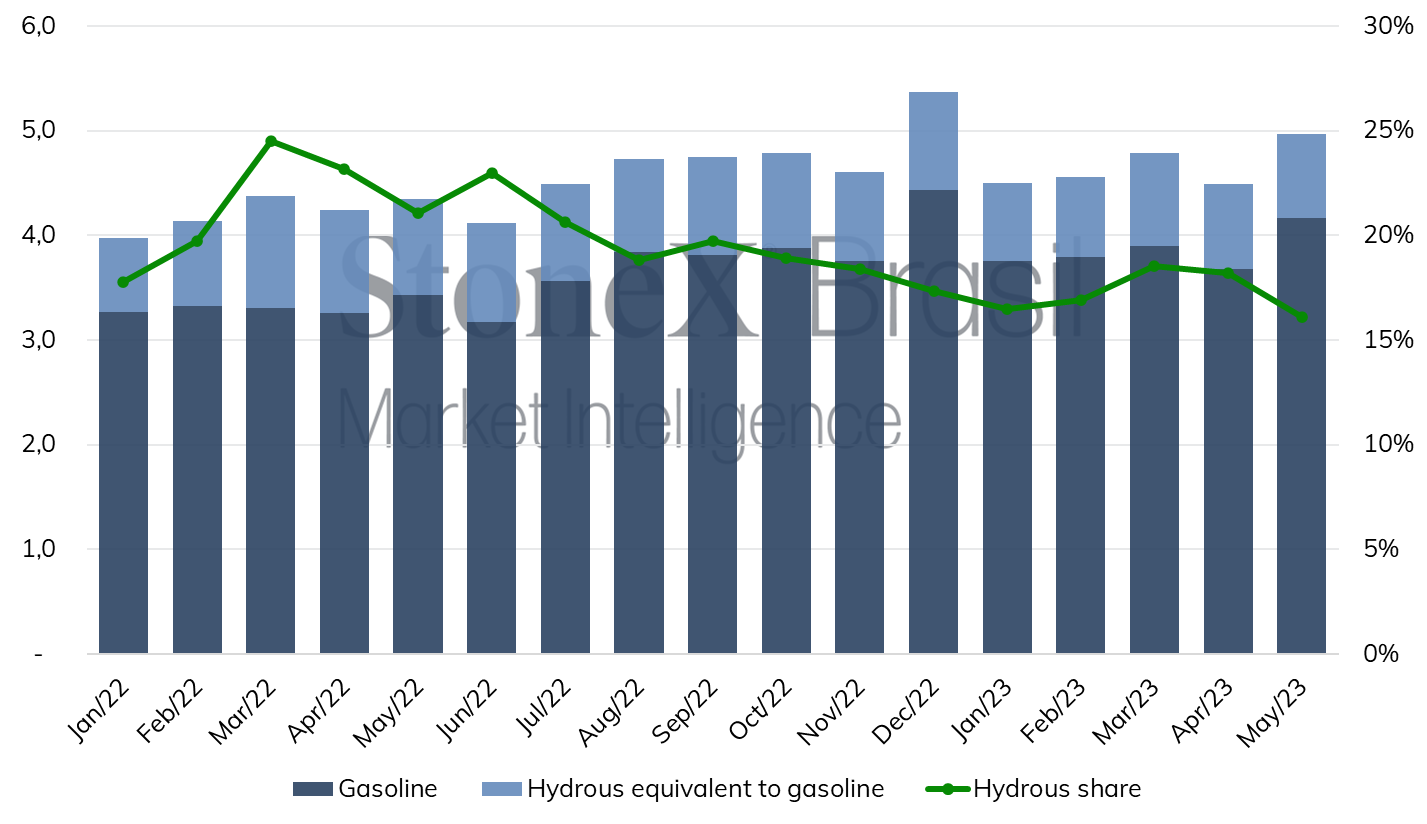
Despite this, even with the lower ethanol consumption, Otto Cycle sales have set a record, standing 10.6% above the same period of the previous year YTD until May 2023, representing the value for the period in the entire historical series. Therefore, it is evident that there is a growth in demand for light vehicle fuels, as a result of the growth in mobility levels since the end of restrictions related to the COVID-19 pandemic, in addition to the effects of the healthier economic scenario, increasing demand for transportation.
Regarding the recent scenario of ethanol prices, it is marked by a clear drop, as a result of growing supply, due to the progress of the 2023/24 sugarcane crop (Apr-Mar), which has registered significant production gains, thereby increasing ethanol production. In addition, with the drop in gasoline A prices promoted by Petrobras recently, mills needed to reduce prices to compete at the pumps.
In addition to this seasonal price movement by the mills, in 2023, federal taxes were resumed. At the beginning of March, the federal government determined the partial return of tax collection. However, unlike the action taken in 2022, the competitive differential between fuels was maintained, with hydrous having risen by BRL 0.02/liter and gasoline C by BRL 0.35/liter.
June saw the approval of the single ICMS collection rate for gasoline, which unified the collection of the state tax at BRK 1.22/liter. In July, federal taxes resumed full collection, and ICMS on hydrous products in the state of São Paulo had an increase, which went from 9.57% to 12%. After these updates, in June, the parity between fuels reached levels below 70%, a scenario that had not occurred since October 2022. Until the end of the first half of July, parity remained at levels that favor demand for hydrous (67.9%).
For the short term, StoneX projections for the state of São Paulo, the main consumer, is a parity below 70% in the main harvest months of the Center-South (Jun - Nov). According to crop estimates, due to the high volume of sugarcane available for harvest, the industry should report considerable crushing until early November. As such, the latest price projection released by StoneX's Market Intelligence team indicates a drop in fuel parity until September, when competitiveness should reach an average of 66%. After September, with a gradual reduction in the volume offered, parity is expected to start registering a gradual growth, reaching 69.4% in November, and 71.7% in December. In the inter-crop period, the first quarter of 2024, average parity is projected at 72.0%.
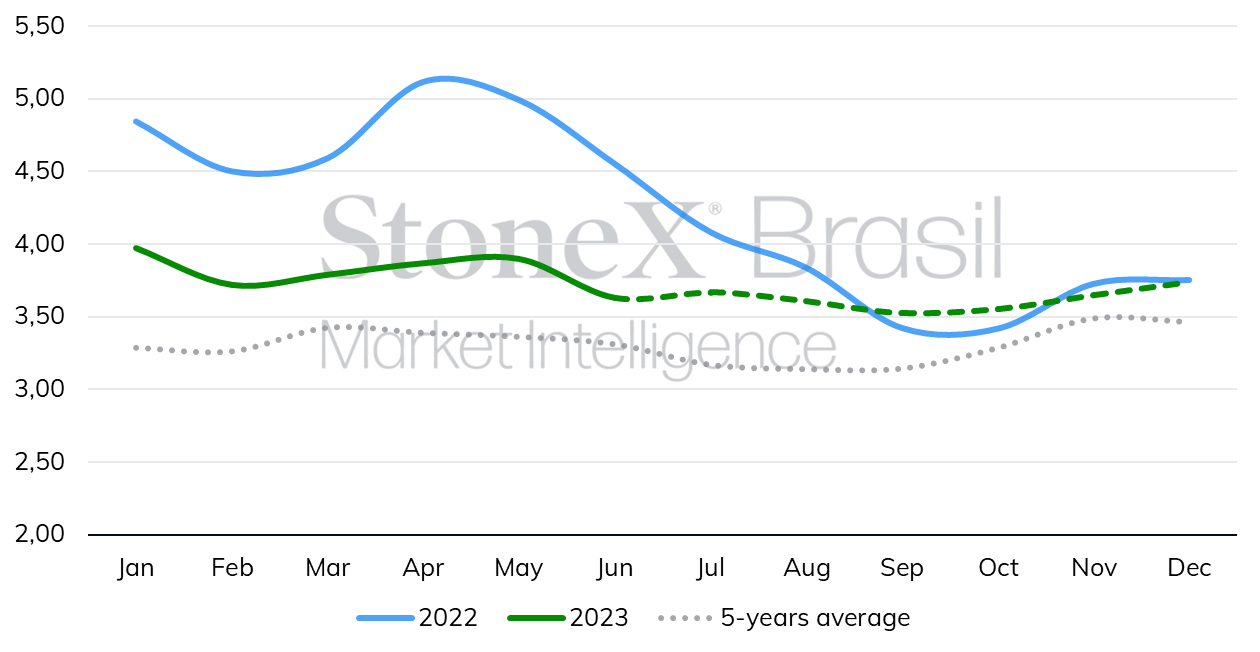
As a result, ethanol sold at gas stations is expected to fall by approximately 5.76% from the last weekly ANP monitoring release, when the average value of the biofuel in São Paulo was BRL 3.74/liter and should be quoted at an average of BRL 3.52/liter.
However, many challenges surround the fuel market: with the end of Petrobras' Import Parity Policy (PPI), gasoline price variations end up being uncertain, making it difficult for mills to see the medium and long term.
So far, the downward adjustments applied by the state-owned company were in line with StoneX's methodology for calculating the PPI, however, the downward adjustments are consistent with the government's objective of lowering prices to the final consumer. On the other hand, the methodology currently points to a negative disparity of BRL 0.28/liter, which means that national gasoline A would have to undergo a positive adjustment of 10.8% to match the international price.
On the side of the mills, the selling price of hydrous ethanol, which according to the São Paulo CEPEA reference for this week was at BRL 2.0965/liter (excluding taxes), is already close to the cost of production. Therefore, in case there is any change in gasoline values that raises the parity above 70% in the coming months, mills may have to sell alcohol below the operating cost. If there is any upward adjustment by Petrobras, in the short term, the mills will have more leeway in their negotiations and parity may be below 65%, which tends to boost demand for the biofuel.
- Weekly summary
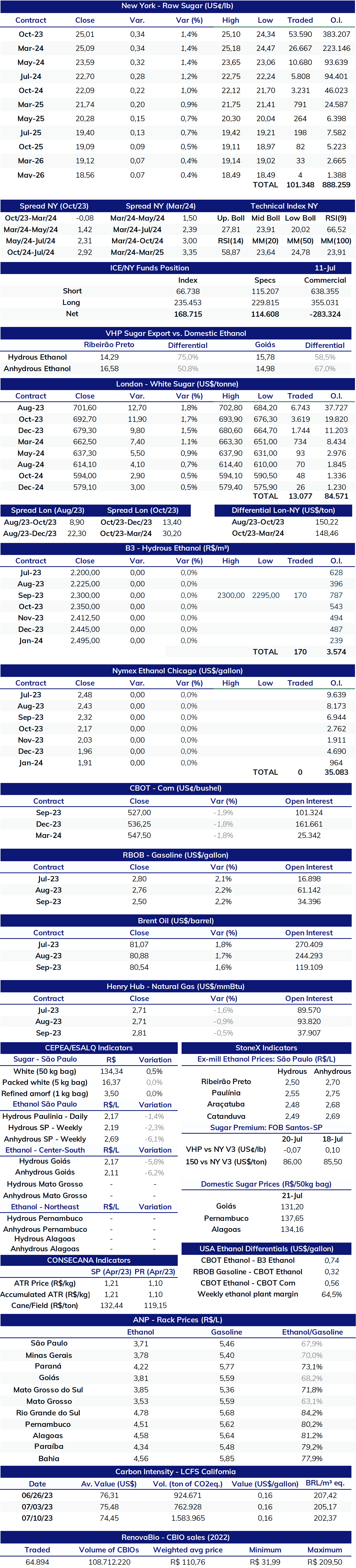
Last week, the prices of raw and white sugar contracts had a bullish behavior in response to the weather uncertainties presented by El Niño, as well as the continued action of speculative agents in the market. In New York, the most active contract for raw sugar (SBV23) rose 1.05%, ending the week at 25.01 c/lb. In London, the week saw an appreciation of 4.8% for the most active white sugar contract (SWV23), as a result of concerns about the Indian crop (a major exporter of white sugar), causing the contract to end last Friday (21) at US$ 701.6/t.
In addition to the weather in Asia, which has been the focus of the market for months, the situation in Europe is similar, with many areas in drought, which should damage sugar beet crops in 2023/24. In this sense, white sugar has strong upward pressure at the moment, pulling the raw variety. The white premium reached US$ 150.22/t on Friday, which tends to stimulate demand for raw sugar by refineries around the globe.
- Chinese sugar imports remain low during the month of June
According to China's customs agency, during the month of June 2023, the country imported a total volume of only 40,000 tonnes of sugar, the same amount registered in the previous month and a drop of 71.4% compared to the same period of the previous year. Since the beginning of the current 2022/23 season (Oct-Sept), the country has already registered a 24.7% drop in sugar imports, as a result of an unfavorable import margin, leading to a higher consumption of domestic stocks, despite the 6.2% drop in Chinese sugar production in the current cycle. For more details click here.
- Expectations for Center-South crushing to grow during the first half of July
Over the next week, the Union of Sugarcane and Bioenergy Industries (UNICA) is expected to release its crop monitor data for the first half of July. Despite record rains at the end of the two-week period, StoneX's Market Intelligence estimates the highest crushing volume of the 2023/24 crop (Apr-Mar) in the Center-South so far. In addition, the expectation also points to the highest sugar-directed mix recorded since the 2017/18 season, as well as a significant improvement in the sugar recovery rate, which should lead to a production of 3.3 million tonnes of sugar in the period. For more details click here.
- Sugar production in the United States
Last Monday (17), the United States Department of Agriculture (USDA) pointed to good conditions for most of the country's crops, which consist of both sugar beet and sugarcane plantations. However, the country's stocks-to-demand ratio is expected to fall during the 2023/24 season (Oct-Sept).
- Speculators raise long position in NY again
Last Friday (21), the CFTC released the positions of agents on international exchanges. For sugar, between July 11 and 18, the scenario was a 4% increase in the net long position of speculators, in a period of stability in open interest contracts, but an increase of 1.4%. Given that, in the last three trading sessions, NY#11 was up more than 100 points, it is possible that this speculative movement remained in the week, which will be brought up in the next CFTC report.
- Lineup in Brazilian ports drops on a weekly basis
According to the Williams agency, the total lineup in Brazil last Wednesday (19) was 3.75 million tonnes of sugar, a weekly drop of about 200,000 tonnes, with 100,000 in the port of Santos alone. On the other hand, the volume is 27.5% higher than in the same period last year. Reflecting lower demand in the short term, even under tight global stocks, the combination of lower lineup and falling premiums in Santos may be a bearish factor at the moment, coupled with the growth of supply in the Center-South, in a market on a bullish trajectory in July.
- Crude oil retreats in the international market
Last Friday (21), Brent oil closed the trading session at a daily high of 1.3%, quoted at USD 80.56/barrel. In the monthly comparison, the most active contract of crude oil has accumulated 4.5% appreciation and has been pulled by a scenario of rising derivatives and tight commodity balance prospects for the coming months. As fundamentals, agents have been reflecting geopolitical tensions in Russia, the decrease in Russian oil export rates and expectations of new economic stimuli from China.
- After approaching BRL 150.00 in early July, CBIOs plummet in the week
According to data from Brazil's B3, the average price of decarbonization credits (CBIO) fell sharply by 17.5% on Thursday (20), reaching BRL 114.40. The increase in purchases by distributors in 2023 and the prospects of maintaining the established annual acquisition targets had been bringing CBIOs to high levels, approaching BRL 150.00 earlier this month. However, last week, the political scenario again brought the possibility of the government increasing the blend of anhydrous ethanol in gasoline from 27% to 30% (within the scope of the bill called "Fuel of the Future"), which, in the medium term, could bring lower targets and commitments for gasoline sellers (after all, the product content would decrease at the final end) or it would bring growth in ethanol supply since more anhydrous would need to be produced, two factors that tend to be bearish for CBIO.