
FX Weekly Overview (Brazil Issue)
Dollar expected to reflect Brazil's presidential election, Fed's interest rate decision, US economic data, and PTAX

Leonel Mattos
- Currencies
Quarterly Commodities Outlook is available for free now. Download your report →
Market Intelligence Analyst • BRAZIL PRS

USDBRL and Dollar Index (points)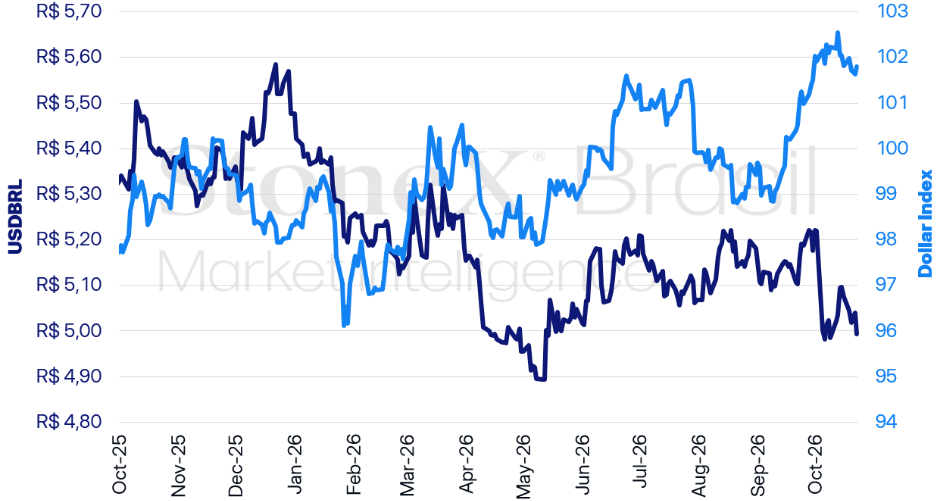
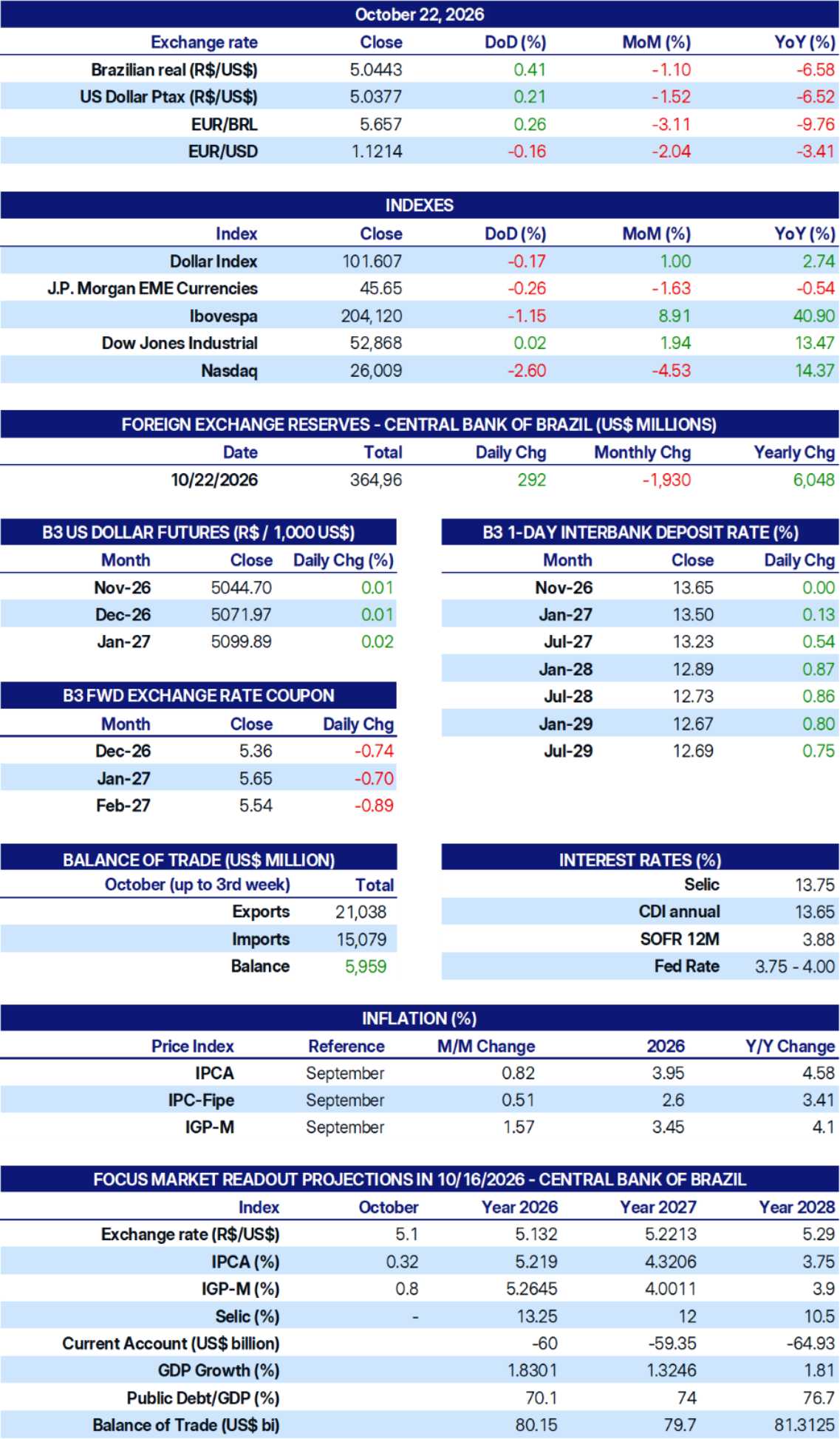
USDBRL variations | Daily: -0.94% | Weekly: -1.60% | Monthly: -3.53% | Annual: -8.84% | Over 12 months: -7.30%
Dollar Index variations | Daily: +0.18% | Weekly: -0.00% | Monthly: +0.30% | Annual: +3.54% | Over 12 months: +2.89%
The currency market is expected to react to the second round of national elections on Sunday (25), aiming to monitor the definition of the next president and adjust expectations for economic policy over the next four years.
Why this matters: Recent reactions from financial market players reveal a preference for Flavio's election, expecting robust fiscal adjustments under his government.
Expectations: Overall, investors remain optimistic about a victory for Senator Flavio Bolsonaro, which has favored maintaining the exchange rate at lower levels since Flavio's surprising lead in the first round.
Latest polls: The latest Datafolha survey showed Flavio and Lula tied with 50% of valid votes each, compared to 51%-49% in favor of Flavio in the previous survey.
Possibility of a turnaround? In recent weeks, President Lula's campaign shifted its communication strategy, focusing on influencers and mass mobilization on social media and messaging apps.
What if Flavio wins? In the event of Flavio's victory, optimism for fiscal adjustments early in his government should gain strength, supporting the performance of national assets.
What if Lula wins? In the event of President Lula's victory, a deterioration of national assets is likely, driven by investor disappointment and the continuation of the current government's expansionary fiscal policy.
Probability of an interest rate hike in the Federal Reserve's October 28 decision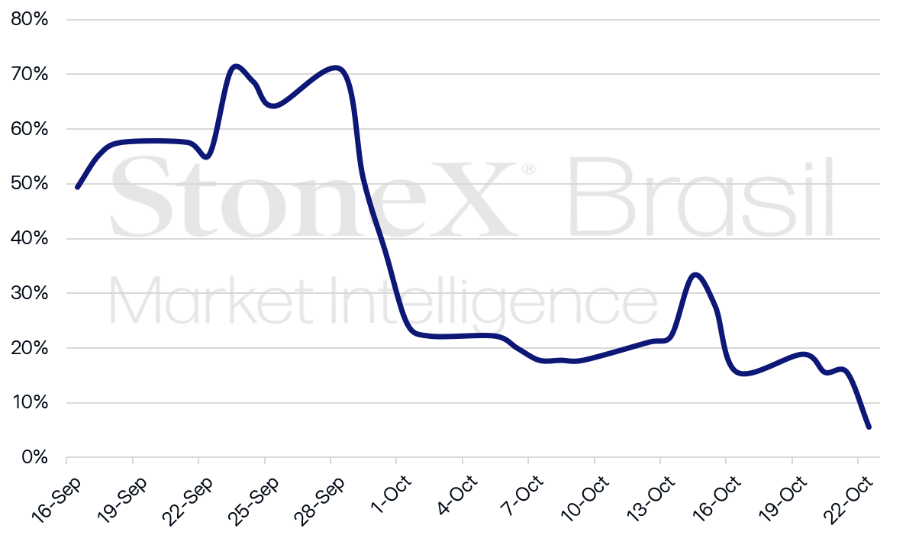
Externally, the currency market is expected to react to the Federal Reserve's Federal Open Market Committee (FOMC) decision, which is expected to keep its benchmark interest rate unchanged in the range of 3.75%-4.00% per year.
Why this matters: The Fed's decision to maintain interest rates tends to reduce the yield on US Treasuries and hinder the attraction of foreign capital to the country, weakening the dollar globally.
Stronger data: Economic data released since the last FOMC interest rate decision on September 16 has reinforced the perception of a risk balance for the US economy leaning more toward inflation.
Contradictory signaling: However, despite this scenario of higher risks for accelerating inflation, there is virtually unanimous consensus among investors that the Fed will opt to keep rates stable.
What will Warsh say? Given the near-consensus on the decision, investors are expected to react to Federal Reserve Chair Kevin Warsh's press conference to adjust expectations for the trajectory of US interest rates.
Additionally, investors are expected to react to the release of the September Personal Consumption Expenditures (PCE) Price Index and the first reading of the US GDP for the third quarter.
Why this matters: The release of strong readings for inflation and GDP in the US tends to increase investor bets on Fed rate hikes in the coming months, which tends to raise the yield on US Treasury bonds (Treasuries) and favor the attraction of foreign capital to the country, strengthening the dollar globally.
Estimates: Following above-expected numbers for September's Consumer Price Index (CPI) and Producer Price Index (PPI), the monthly PCE increase is expected to rise from 0.3% in August to 0.5% in September.
End-of-month PTAX rate – selling (BRL/USD)
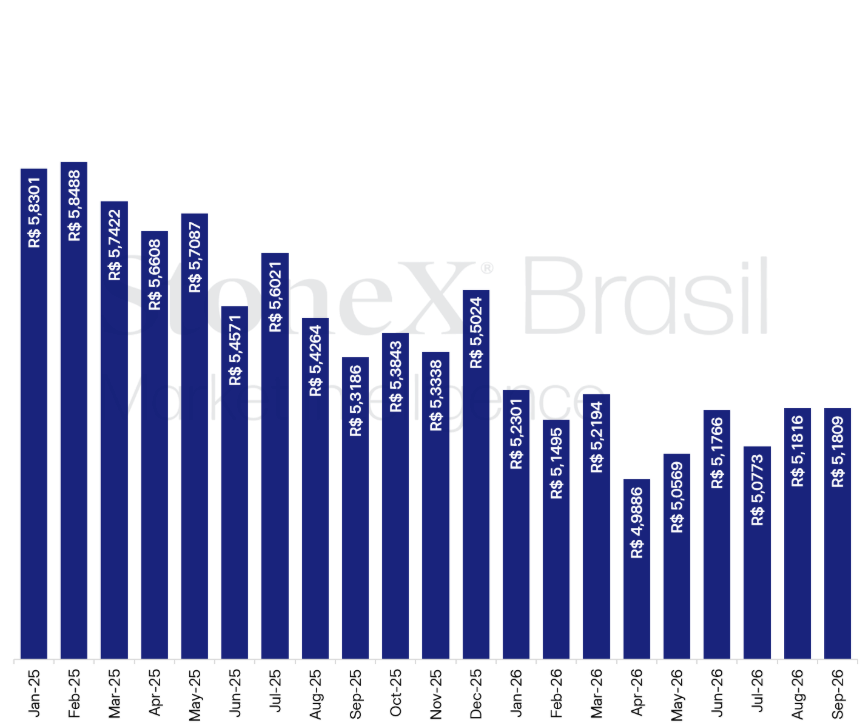
Trading volume and exchange rate volatility are expected to rise on the last trading day of October due to the formation of the end-of-month PTAX rate.
Why this matters: Financial market operators intensify their trades during the formation intervals of the month's last PTAX rate to try to influence its value in a way that benefits their positions, increasing volatility and complicating the reading of real movements on the day.

INDICATORS
The StoneX Group Inc. group of companies provides financial services worldwide through its subsidiaries, including physical commodities, securities, exchange-traded and over-the-counter derivatives, risk management, global payments and foreign exchange products in accordance with applicable law in the jurisdictions where services are provided. References to over-the-counter (“OTC”) products or swaps are made on behalf of StoneX Markets LLC (“SXM”), a member of the National Futures Association (“NFA”) and provisionally registered with the U.S. Commodity Futures Trading Commission (“CFTC”) as a swap dealer. SXM’s products are designed only for individuals or firms who qualify under CFTC rules as an ‘Eligible Contract Participant’ (“ECP”) and who have been accepted as customers of SXM. StoneX Financial Inc. (“SFI”) is a member of FINRA/NFA/SIPC and registered with the MSRB. SFI is registered with the U.S. Securities and Exchange Commission (“SEC”) as a Broker-Dealer and with the CFTC as a Futures Commission Merchant and Commodity Trading Adviser. References to securities trading are made on behalf of the BD Division of SFI and are intended only for an audience of institutional clients as defined by FINRA Rule 4512(c). References to exchange-traded futures and options are made on behalf of the FCM Division of SFI . StoneX is a trading name of StoneX Financial Ltd (“SFL”). SFL is registered in England and Wales, Company No. 5616586. SFL is authorized and regulated by the Financial Conduct Authority [FRN 446717] to provide to professional and eligible customers including: arrangement, execution and, where required, clearing derivative transactions in exchange traded futures and options. SFL is also authorised to engage in the arrangement and execution of transactions in certain OTC products, certain securities trading, precious metals trading and payment services to eligible customers. SFL is authorised & regulated by the Financial Conduct Authority under the Payment Services Regulations 2017 for the provision of payment services. SFL is a category 1 ring-dealing member of the London Metal Exchange. In addition SFL also engages in other physically delivered commodities business and other general business activities which are unregulated and not required to be authorised by the Financial Conduct Authority. StoneX Group Inc. acts as agent for SFL in New York with respect to its payments services business. StoneX APAC Pte. Ltd. acts as agent for SFL in Singapore with respect to its payments services business. ‘StoneX’ is the trade name used by StoneX Group Inc. and all its associated entities and subsidiaries.
Trading swaps and over-the-counter derivatives, exchange-traded derivatives and options and securities involves substantial risk and is not suitable for all investors. Past performance of any futures or option is not indicative of future success. Indicators are not a trading system and are not published as a specific trade recommendation. The information herein is not a recommendation to trade nor investment research or an offer to buy or sell any derivative or security. It does not take into account your particular investment objectives, financial situation or needs and does not create a binding obligation on any of the StoneX group of companies to enter into any transaction with you. You are advised to perform an independent investigation of any transaction to determine whether any transaction is suitable for you. No part of this material may be copied, photocopied or duplicated in any form by any means or redistributed without the prior written consent of StoneX Group Inc.
© 2026 StoneX Group Inc. All Rights Reserved.
Our subscribers have access to comprehensive market analysis from StoneX spanning commodities, equities, currencies and more.
Dollar expected to reflect Brazil's presidential election, Fed's interest rate decision, US economic data, and PTAX

Cheap borrowing in Japan has quietly underpinned leverage across global markets, from U.S. Treasuries to AI stocks. As tech stocks slide and Dollar Yen weakens, the hedging mechanics of the yen carry trade show why the July 2024 unwind still matters.

Brazil's tied presidential runoff has turned Brazilian public debt into the deciding variable for the Brazilian real. Markets link one outcome to fiscal adjustment and a firmer currency, and the other to rising debt and a sharp devaluation.

Our market expertise, advanced platforms, global reach, culture of full transparency and commitment to our clients’ success all set us apart in the financial marketplace.
Reach
With access to 40+ derivatives exchanges, 180+ foreign exchange markets, nearly every global securities marketplace and numerous bi-lateral liquidity venues, StoneX’s digital network and deep relationships can take clients anywhere they want to go.
Transparency
As a publicly traded company meeting the highest standards of regulatory compliance in the markets we serve; our financials and record of accomplishment are matters of public record. StoneX’s commitment to “doing the right thing over the easy thing” sets us apart in the industry and helps us build respect, client trust and new partnerships.
Expertise
From our proprietary Market Intelligence platform, to “boots on the ground” expertise from award-winning traders and professionals, we connect our clients directly to actionable insights they can use to make more informed decisions and achieve their goals in the global markets.