

USD/JPY Q4 2026 Outlook: Hawkish Fed Pricing Clashes With Intervention Risk
The year-end tug-of-war is clear: hawkish Fed pricing supports USD/JPY, while intervention risk limits the upside - read on for the full Q4 outlook!

David Scutt
- Global Macro
Quarterly Commodities Outlook is available for free now. Download your report →

Market Analyst
The Australian dollar delivered a strong performance in Q1, underpinned by RBA tightening and a widening yield advantage over the US. But the outlook for Q2 is becoming more complex.
Geopolitical tensions, elevated oil prices and shifting expectations for both the RBA and Fed are creating conflicting macro signals. While higher yields have supported the Aussie, they are increasingly being driven by inflation risks rather than growth strength—raising questions about how sustainable the rally really is.
With positioning stretched and seasonality pointing to a choppy quarter, AUD/USD may be vulnerable to near-term downside before any sustained bullish breakout can emerge.
The Australian dollar’s strong Q1 performance was largely driven by RBA tightening and a widening yield advantage over the US. But as we move into Q2, those drivers are becoming less straightforward.
Geopolitical tensions, particularly in the Middle East, are complicating the outlook for inflation and growth, while expectations for both the RBA and Fed are shifting. This leaves AUD/USD caught between supportive yield dynamics and growing macro headwinds—setting the stage for a potentially volatile and directionless quarter unless a clear catalyst emerges.
Geopolitics and Oil Risks Complicate the AUD/USD Outlook
The pattern so far has been familiar: the US signals progress on talks that Iran later claims never began. That has driven repeated swings in risk sentiment. Yet it already feels like markets have moved beyond the initial ‘shock and awe’ phase of the cycle. Not that the Australian dollar has taken much notice—it has remained largely rangebound, caught between negative risk-off flows and support from firmer commodities and expectations of further RBA tightening.
That said, the conflict in Iran is clearly complicating the outlook for the RBA. If tensions persist and the Strait of Hormuz remains disrupted, elevated oil prices could weigh on the global economy and add another layer of uncertainty for policymakers. In that scenario, higher energy prices could reinforce expectations for tighter monetary policy—particularly in the US—thereby supporting the US dollar and limiting upside for AUD/USD despite stronger commodities.
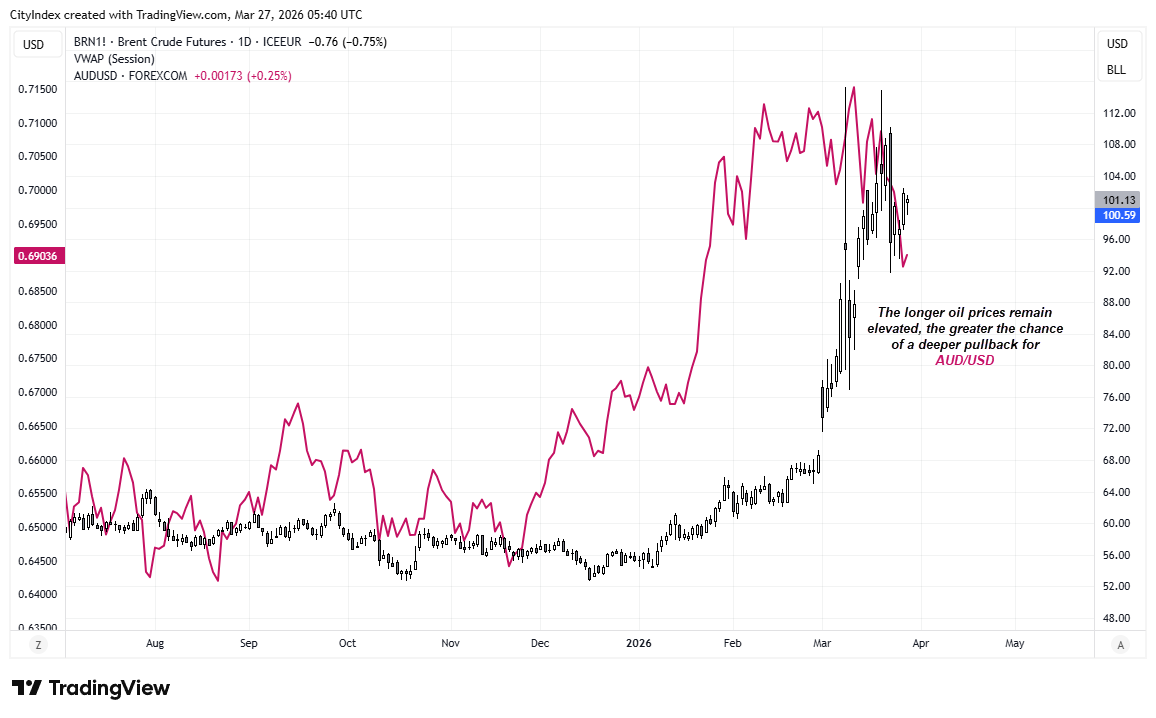
Source: TradingView
A sustained spike in oil prices would also pose downside risks to global growth, particularly in China—Australia’s largest trading partner—which could further weigh on the Australian dollar.
Conversely, any meaningful de-escalation could see oil prices retrace, easing inflation pressures and removing a key pillar of support for the US dollar. That in turn could allow AUD/USD to break higher, especially if RBA hike expectations are repriced.
On balance, the current geopolitical backdrop leans modestly supportive of the US dollar in the near term, increasing the risk of a downside break for AUD/USD before any sustained upside move.
That leaves domestic data and policy expectations as the next key drivers for AUD/USD.
With an unemployment rate at 4.3%, a participation rate of 67% and around 139k jobs added since December, the Australian economy is hardly on its knees. But that doesn’t mean there aren’t pockets of weakness. We’ve seen a steady stream of job-cut headlines from the financial and tech sectors, reflected in the 30.5k decline in full-time employment in February. Whether this broadens across other sectors will likely hinge on the trajectory of global growth, although any slowdown may not fully materialise until later in the year.
Inflation was slightly softer than expected in February, although trimmed mean CPI remained at 3.4%—above the RBA’s 2–3% target for a fourth consecutive month—while headline CPI held at 3.7%. That said, this may prove a temporary reprieve given the lagged impact of higher energy prices linked to Middle East tensions.
While growth has held up better than expected, business and consumer confidence are beginning to soften following the RBA’s recent tightening. The key question is whether this deterioration is enough to temper expectations for further hikes—and what that ultimately means for the Australian dollar.
Takeaway: The data points to a resilient but slowing economy, leaving the RBA caught between sticky inflation and softening growth — keeping the AUD/USD outlook finely balanced, with downside risks building.
RBA–Fed Policy Divergence Set to Widen?
The RBA’s February hike pushed the cash rate above the Fed’s for the first time in six years, and the follow-up move in March extended the yield differential to a nine-year high of around 35bp. The spread now looks set to widen further, although that does not necessarily imply AUD/USD will track it higher.
Assistant Governor Kent warned that persistent inflation—particularly if driven by energy—could force the RBA to tighten further to prevent inflation expectations from becoming unanchored. While rate hikes cannot offset the initial supply shock, they can limit second-round effects. RBA cash rate futures now imply around 66.5bp of tightening by December, equivalent to roughly two to three additional hikes.
However, these are not ‘happy hikes’. Policy is being tightened to anchor inflation expectations while households absorb higher energy costs, which could weigh on growth and sentiment. That dynamic raises the risk of a more bearish AUD outlook despite rising yields.
The Fed is also not in a position to cut rates any time soon, with money markets assigning around a 20–25% probability of a further hike into year-end. That should continue to underpin US yields.
Even so, the RBA’s recent hawkish shift may allow the AU–US rate differential to widen modestly further, although the net impact on AUD/USD is likely to be less straightforward given the drag from weaker growth and risk sentiment.
With macro and policy drivers becoming more conflicted, positioning and technicals may ultimately determine the next move for AUD/USD.
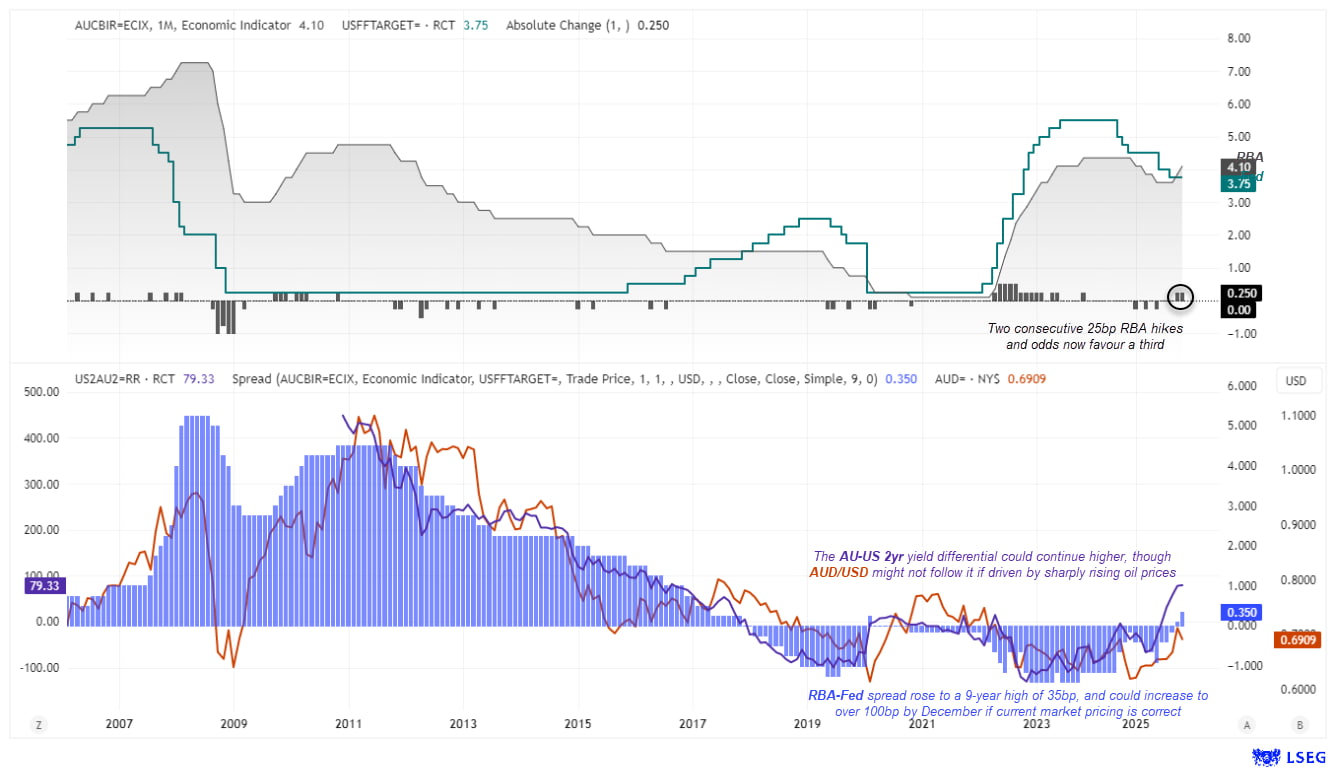
Source: LSEG
Key takeaway: Rising yield differentials may no longer translate into AUD/USD gains, as “unhappy hikes” risk weighing on growth and sentiment.
AUD/USD Technical Outlook: Positioning and Seasonality in Focus
The Australian dollar has rallied over 20% since its April low and is up 7.8% year-to-date. However, the advance has stalled around the 2023 high, with positioning arguably stretched by several metrics. This raises the risk of a pullback for AUD/USD in early Q2, particularly if the US dollar index breaks higher—as I suspect it will.
The main takeaway is that long exposure may be nearing a sentiment extreme, while there is little appetite to bet against AUD/USD. This suggests any pullback could be limited and driven more by a shakeout of longs than fresh shorting. If Middle East tensions ease, it could pave the way for a bullish breakout in the Australian dollar, particularly if RBA hike expectations are repriced higher.
Seasonality patterns also point to a less straightforward Q2.
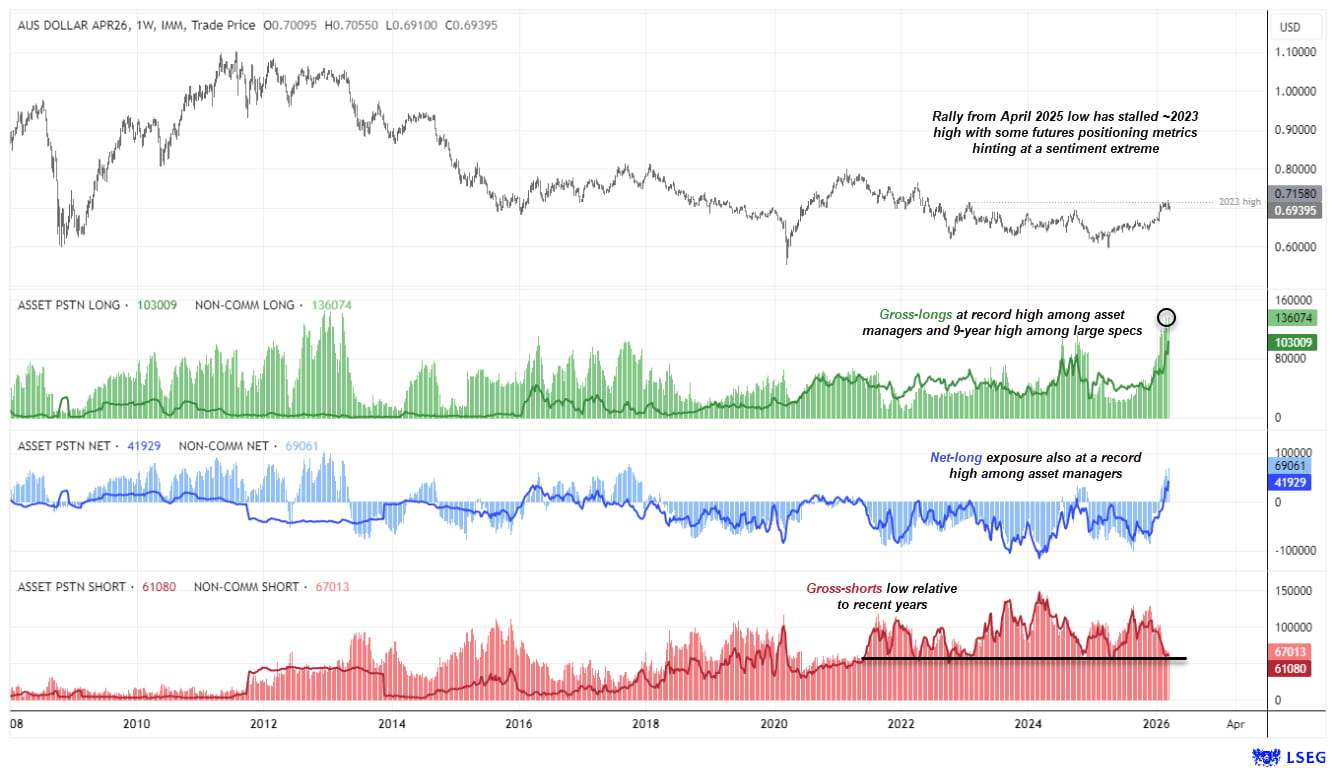
Source: CME, CFTC (COT), LSEG
Seasonality should be taken with a pinch of salt, particularly given the rise in geopolitical risks and their potential impact on economies and central bank policies. Still, it provides a useful benchmark for what a typical month—or a strong or weak period—may look like at this time of year.
Data since 2000 shows that April tends to be the most bullish month of the year, with an average gain of 1.2%. Its median return is slightly lower at 0.9%, suggesting a handful of stronger months have lifted the average. The win rate of 64% is also respectable, while the 3.1% average gain during bullish Aprils is among the strongest of the year. Average losses for April have been around -2.1%.
May, however, tells a different story. It has negative average and median returns, alongside a relatively low win rate of 42.3%. Its average decline of -3.1% during negative months is also among the worst of the year.
June is more mixed. While its average and median returns are softer than April’s, it boasts one of the highest win rates of the year at around 53.9%.
Overall, Q2 tends to be a choppy period for AUD/USD, albeit with a modest bullish bias.
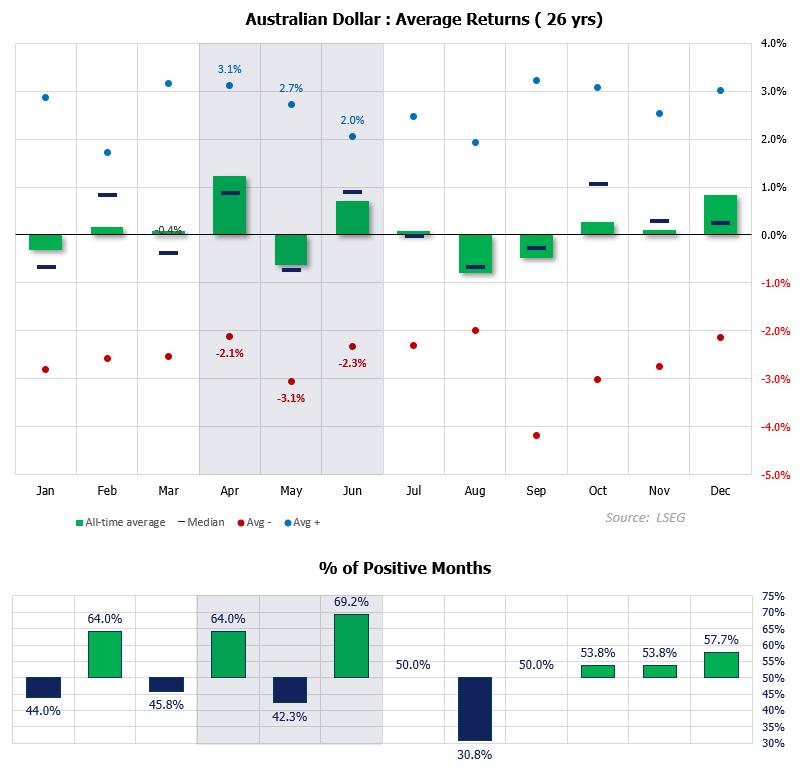
Source: LSEG
Overall, AUD/USD enters Q2 with conflicting drivers. While policy divergence may widen, growth risks and geopolitical uncertainty could limit upside. That leaves the pair vulnerable to near-term downside before any sustained bullish breakout can emerge.
StoneX TV content is created, produced, and distributed solely by StoneX Media Ltd (“StoneX TV”) and is provided for informational and educational purposes only. StoneX TV does not provide investment, financial, legal, or tax advice and does not make any recommendation or endorsement of any investment strategy, transaction, or financial instrument. Nothing in this content constitutes, or should be construed as, investment advice or a recommendation to buy, sell, or hold any financial instrument, including securities, futures, derivatives, digital assets, foreign exchange products, or CFDs. This content does not constitute an offer, invitation, or solicitation to engage in any investment activity. The information presented is general in nature and is not tailored to the financial situation, investment objectives, or risk tolerance of any specific person. You should not rely on this content as a substitute for independent professional advice. Investing and trading in financial instruments involves significant risk of loss and is not suitable for all investors. Past performance is not indicative of future results. Any views or opinions expressed are those of the presenter at the time of publication and are subject to change without notice. Such views may not necessarily reflect those of StoneX Media Ltd or its affiliates. StoneX Media Ltd and its affiliates, including StoneX Group Inc., may from time to time have positions in, or engage in transactions involving, the financial instruments referenced. This content may include general market commentary and opinion. It does not constitute independent investment research and has not been prepared in accordance with legal requirements designed to promote the independence of investment research. StoneX Media Ltd is not authorised or regulated to provide investment services and does not act in a fiduciary capacity. StoneX Media Ltd is incorporated in Ireland and operates in accordance with applicable Irish law. It is a wholly owned subsidiary of StoneX Group Inc. and is a separate legal entity from other subsidiaries within the StoneX Group, which may be regulated in various jurisdictions. StoneX Media Ltd does not act on behalf of, or provide services for, any regulated affiliate. This content is not directed at, and may not be distributed to, any person in any jurisdiction where such distribution would be contrary to local laws or regulations. Supporting documentation for any claims, comparisons, statistics, or technical data may be made available upon reasonable request, where applicable.
Our subscribers have access to comprehensive market analysis from StoneX spanning commodities, equities, currencies and more.
The year-end tug-of-war is clear: hawkish Fed pricing supports USD/JPY, while intervention risk limits the upside - read on for the full Q4 outlook!

GBP/USD has fallen just 0.5% across the third quarter. While the pair booked solid gains in July and August, those were unwound in September with the pair falling over 2% - read on for the full Q4 outlook!


The historically-reliable 4-year halving cycle suggests that Bitcoin’s bear market may soon be coming to an end, if it hasn’t already - read on for the full Q4 forecast!

Our market expertise, advanced platforms, global reach, culture of full transparency and commitment to our clients’ success all set us apart in the financial marketplace.
Reach
With access to 40+ derivatives exchanges, 180+ foreign exchange markets, nearly every global securities marketplace and numerous bi-lateral liquidity venues, StoneX’s digital network and deep relationships can take clients anywhere they want to go.
Transparency
As a publicly traded company meeting the highest standards of regulatory compliance in the markets we serve; our financials and record of accomplishment are matters of public record. StoneX’s commitment to “doing the right thing over the easy thing” sets us apart in the industry and helps us build respect, client trust and new partnerships.
Expertise
From our proprietary Market Intelligence platform, to “boots on the ground” expertise from award-winning traders and professionals, we connect our clients directly to actionable insights they can use to make more informed decisions and achieve their goals in the global markets.