

USD/JPY Q4 2026 Outlook: Hawkish Fed Pricing Clashes With Intervention Risk
The year-end tug-of-war is clear: hawkish Fed pricing supports USD/JPY, while intervention risk limits the upside - read on for the full Q4 outlook!

David Scutt
- Global Macro
Quarterly Commodities Outlook is available for free now. Download your report →

Market Analyst
Gold is heading into the second quarter of 2026 after a large drop in March that had threatened to wipe out the entire Q1 gains. At the time of writing on 27th March, gold was around 15% down on the month but still some 4% higher on the first quarter. The metal peaked just under $5,600 in January before staging a sharp drop later that month. In February, dip-buyers stepped in to lift gold prices to high of almost $5420 by early March, from where we saw a steep sell-off as the Iran conflict started and escalated quite quickly. Crude oil surged above $100, European stocks sold off, while the dollar and bond yields surged. That combination provided a toxic mix for gold, as bets for central bank rate hikes outweighed heightened haven demand. Heading into Q2, confidence was shaken after gold’s one-way price action in preceding quarters. But now it all depends on how the Middle East situation evolves and what it might mean for energy prices, and, in turn, inflation and therefore central bank policy response.
If crude oil falls back in Q2 on signs of de-escalation, then this will likely allow the US dollar to ease back, providing support for gold, indices and bitcoin. But the situation remains far from resolved and anything could still happen. Iran appears less willing to negotiate, looking to use high energy prices as leverage. Until there are concrete steps towards a ceasefire and an end to the conflict, we would take any short-term moves against the recent trend with a pinch of salt. While oil prices remain above $100 per barrel, the risk of inflation revival and central bank tightening means the near-term gold outlook is far from bullish, even if gold is considered the ultimate inflation hedge. That may mean limited downside for gold, as clearly some investors will seek the metal to protect against inflation chipping away at the values of fiat currencies.
Gold’s wobble at the end of January and its drop through much of March means the prior strong bullish trend has weakened. This comes after the metal had enjoyed one of its strongest years on record last year. Fuelled by aggressive central bank buying, a global interest rate cutting cycle and elevated safe-haven demand, the metal surged an eye-watering 65% in 2025, and posted a hat-trick of positive annual returns. Gold was already quite overstretched, so some of the weakness was long overdue anyway. The key question now is whether we will see some further unwinding of those strong moves as we move through the second quarter of 2026 and beyond, or whether dip-buys will once again show up to take advantage of weaker prices.
The macro backdrop is shaping to be different all of a sudden, with the oil shock reviving inflationary worries and threatening to re-start hiking by some central banks.
Investors will be weighing the impact of a potentially strong dollar if the war persists against any further central bank gold buying and haven demand. It is difficult to say which of these forces will ultimately prove the strongest, but we see limited downside for gold - especially if the oil price shock fades quickly.
Apart from haven demand and rate cuts, one of the main reasons why gold has been rising sharply in recent years has been due to aggressive central bank buying. The latest figures from the World Gold Council suggest that central bank buying eased a touch at the start of the year. January saw net purchases of around five tonnes, down from the previous 12-month average of 27. Some of that slowdown may simply reflect volatile prices and the usual holiday lull. Even so, the broader picture hasn’t really changed. With geopolitical tensions still simmering and showing little sign of cooling, the WGC expects central banks to keep adding to their gold reserves well into 2026 and beyond. However, the big risk is that this may not prove to be the case, which could remove one of the strongest sources of support for prices.
Since Russia’s invasion of Ukraine in 2022, central banks—particularly in emerging markets—have stepped up efforts to diversify their reserves. That’s been driven by a mix of sanctions risk, a more fragmented global landscape, and a clear desire to reduce reliance on the US dollar. Importantly, this demand has been steady and, for the most part, not overly sensitive to price moves.
On a country level, Poland was the largest reported buyer last year and has already signalled that there’s more to come. Meanwhile, China’s central bank extended its buying streak into a fifteenth consecutive month in January, reinforcing the same underlying trend.
As things stand, it’s hard to see any meaningful reversal in central bank demand while geopolitical fragmentation remains in place. If anything, that steady accumulation continues to provide a solid foundation for gold outlook, but that alone cannot prevent a short-term correction.
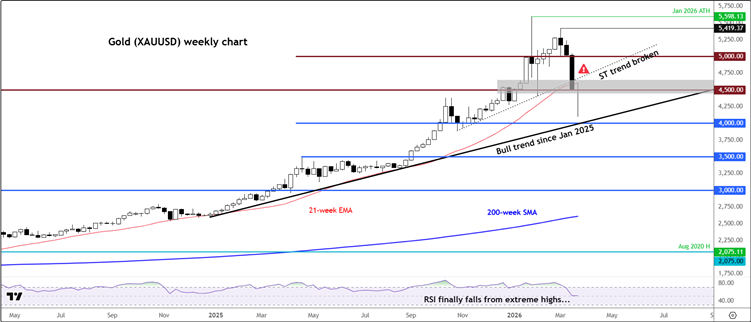
Gold’s long-term trend of higher highs and higher lows remains intact despite the sharp drop seen in March. It’s still far too early to suggest that the precious metal has topped out. However, the breakdown of a few short-term levels, along with selling pressure near the $5,000 level, suggests that gold could be heading into choppier waters in the coming months.
Source: TradingView.com
The prior strong bullish trend is at least on pause until we see a fresh technical signal confirming that the long-term uptrend has resumed. For now, that’s not the case. We’ve broken a short-term trendline, and prices have made a lower low below $4,500. Admittedly, this is just the first lower low we’ve seen, so it doesn’t necessarily signal the start of a new bear trend—but it does warrant caution.
Objectively, we’ve also seen gold break below the 21-day exponential moving average. This hasn’t happened for quite some time. In fact, the last meaningful break below this level was back in May 2023, which led to a period of consolidation before prices moved higher again. Since then, dips below the 21-day EMA have been short-lived, with consistent buying interest around that level. This time, however, we’ve seen a clearer break below it—raising the question of whether conditions are starting to shift.
Meanwhile, the 200-week moving average—the ultimate long-term trend indicator—remains significantly lower, below the $3,000 level. For this moving average to catch up with current prices, we would either need continued weakness in the coming weeks or a prolonged period of consolidation. Both scenarios would allow the longer-term average to align more closely with recent price action.
Ultimately, price action remains the most important tool in determining gold’s trend, as all other indicators are lagging. Until we see a strong bullish candle and clear upside follow-through on the weekly chart, a cautious technical gold outlook remains appropriate.
On the downside, the next major level is $4,000—a psychologically important level. Around $100 above this area, we also have a bullish trendline originating from January 2025. While it hasn’t yet been tested, it remains exposed and could come into play if selling pressure resumes.
Another level to monitor is $4,500, which has acted as a pivot in recent weeks and is where gold was trading at the time of this analysis.
On the upside, $5,000 remains the key resistance level if we see a recovery. Before that, we have the 21-day EMA near $4,600, followed by the backside of the broken short-term trendline around $4,700.
So, in terms of resistance, the key levels to watch are $4,600, $4,700, and then $5,000.
Gold enters Q2 2026 under pressure after a sharp sell-off in March that nearly erased its Q1 gains as the Iran conflict escalated. The surge in oil prices above $100, alongside a stronger dollar and rising bond yields, outweighed safe-haven demand and hurt gold. Looking ahead, the outlook for Q2 hinges largely on how the Middle East situation evolves and its impact on energy prices, inflation, and central bank policy. We maintain a cautious gold outlook and think it is level-to-level market when it comes to trading the metal in the coming weeks.
StoneX TV content is created, produced, and distributed solely by StoneX Media Ltd (“StoneX TV”) and is provided for informational and educational purposes only. StoneX TV does not provide investment, financial, legal, or tax advice and does not make any recommendation or endorsement of any investment strategy, transaction, or financial instrument. Nothing in this content constitutes, or should be construed as, investment advice or a recommendation to buy, sell, or hold any financial instrument, including securities, futures, derivatives, digital assets, foreign exchange products, or CFDs. This content does not constitute an offer, invitation, or solicitation to engage in any investment activity. The information presented is general in nature and is not tailored to the financial situation, investment objectives, or risk tolerance of any specific person. You should not rely on this content as a substitute for independent professional advice. Investing and trading in financial instruments involves significant risk of loss and is not suitable for all investors. Past performance is not indicative of future results. Any views or opinions expressed are those of the presenter at the time of publication and are subject to change without notice. Such views may not necessarily reflect those of StoneX Media Ltd or its affiliates. StoneX Media Ltd and its affiliates, including StoneX Group Inc., may from time to time have positions in, or engage in transactions involving, the financial instruments referenced. This content may include general market commentary and opinion. It does not constitute independent investment research and has not been prepared in accordance with legal requirements designed to promote the independence of investment research. StoneX Media Ltd is not authorised or regulated to provide investment services and does not act in a fiduciary capacity. StoneX Media Ltd is incorporated in Ireland and operates in accordance with applicable Irish law. It is a wholly owned subsidiary of StoneX Group Inc. and is a separate legal entity from other subsidiaries within the StoneX Group, which may be regulated in various jurisdictions. StoneX Media Ltd does not act on behalf of, or provide services for, any regulated affiliate. This content is not directed at, and may not be distributed to, any person in any jurisdiction where such distribution would be contrary to local laws or regulations. Supporting documentation for any claims, comparisons, statistics, or technical data may be made available upon reasonable request, where applicable.
Our subscribers have access to comprehensive market analysis from StoneX spanning commodities, equities, currencies and more.
The year-end tug-of-war is clear: hawkish Fed pricing supports USD/JPY, while intervention risk limits the upside - read on for the full Q4 outlook!

GBP/USD has fallen just 0.5% across the third quarter. While the pair booked solid gains in July and August, those were unwound in September with the pair falling over 2% - read on for the full Q4 outlook!


The historically-reliable 4-year halving cycle suggests that Bitcoin’s bear market may soon be coming to an end, if it hasn’t already - read on for the full Q4 forecast!

Our market expertise, advanced platforms, global reach, culture of full transparency and commitment to our clients’ success all set us apart in the financial marketplace.
Reach
With access to 40+ derivatives exchanges, 180+ foreign exchange markets, nearly every global securities marketplace and numerous bi-lateral liquidity venues, StoneX’s digital network and deep relationships can take clients anywhere they want to go.
Transparency
As a publicly traded company meeting the highest standards of regulatory compliance in the markets we serve; our financials and record of accomplishment are matters of public record. StoneX’s commitment to “doing the right thing over the easy thing” sets us apart in the industry and helps us build respect, client trust and new partnerships.
Expertise
From our proprietary Market Intelligence platform, to “boots on the ground” expertise from award-winning traders and professionals, we connect our clients directly to actionable insights they can use to make more informed decisions and achieve their goals in the global markets.