Gold was heading into the third quarter of 2026 limping. After a large drop in March, the metal edged lower in April and May before taking another plunge in June. That meant the precious metal was on course to end the second quarter down in double digits. The metal peaked just under $5,600 in January and it was now set for its first quarterly drop in 11 quarters, after falling back below the key $5,000 level and later the next psychological level of $4,000 per ounce. The metal was thus down nearly 30% from its all-time high, which meant it was in a technical downtrend. Against this backdrop, the gold outlook for the second half of 2026 was at least mildly bearish at the time of writing on June 26th.
Gold H2 2026 and long term outlook
In the short term, gold remains under pressure as investor demand continues to fade, with growing concerns over the Federal Reserve’s monetary policy outlook weighing on sentiment. Much of this weakness reflects expectations that the Fed will keep interest rates on hold through 2026. However, if policymakers are forced to resume tightening and deliver three or four rate hikes instead, the downside for gold could become much more pronounced.
Persistent outflows from gold-backed exchange-traded funds reinforce this cautious near-term gold outlook. As reflected in ETF outflows, investor appetite for the metal has weakened considerably in recent weeks, leaving central bank buying as the main source of support. That trend looks set to continue, with official sector demand likely to remain a key pillar for gold over the coming quarters.
That said, the longer-term outlook remains constructive. I still believe gold is likely to push to fresh record highs over time, driven by concerns over widening fiscal deficits and the potential return of the de-dollarisation trade. We saw how powerful that theme became last year and into the early part of this year, when emerging-market central banks shifted reserves away from US Treasuries, helping to fuel strong gains in both gold and cryptocurrencies. At the same time, robust investment demand from China should continue to provide an important source of long-term support for the precious metal.
Dollar stays supported post US-Iran deal
The Iran conflict remained the key focus for much of Q2. After crude oil surged above $100 in March, prices remained elevated in April. This helped to provide support for the dollar and bond yields. That combination provided a toxic mix for gold, as bets for central bank rate hikes outweighed heightened haven demand. When the two sides finally agreed on a deal, gold initially popped higher with everything else. But it then resumed lower, as the dollar found renewed support from a hawkish Fed under a new chairman in Kevin Warsh.
Confidence was already shaken after gold’s one-way price action in preceding quarters had come to a halt in March. But the fact that the US dollar stayed supported after the US-Iran deal, this suggests that the coming months could remain unfavourable for gold amid a hawkish Fed, strong dollar and reduced have demand. Thus, the gold outlook for Q3 and beyond will depend more on how the US economy and inflation data will evolve from here than was the case during the height of the Middle East crisis. This makes gold more sensitive to data releases again.
When is gold likely to bottom?
Gold’s recent struggles mean the prior strong bullish trend has weakened, if not broken entirely. A fresh bullish catalyst needs to emerge to encourage the buyers to return. The more recent struggles come after the metal had enjoyed one of its strongest years on record last year. Fuelled by aggressive central bank buying, a global interest rate cutting cycle and elevated safe-haven demand, the metal surged 65% in 2025, before giving back some of those gains this year. Without some of these bullish catalysts, it is difficult to foresee another bullish year for gold. The key question now is whether we will see some further downside follow through as we move through the third quarter of 2026 and beyond, or whether dip-buys will show up to take advantage of weaker prices.
The near term macro backdrop is shaping to be different all of a sudden. The past oil shock has revived inflationary worries while surprising resilience in the US economy has raised expectations that the Fed will re-start hiking rates later this year.
Those expectations are helping to fuel a rally in the dollar. Looking ahead, investors will be weighing the impact of a potentially stronger dollar against any further central bank gold buying. It is difficult to say which of these forces will ultimately prove the strongest, but we see the potential for some further downside for gold - especially if the dollar remains supported - before the metal becomes fundamentally undervalued again.
XAU/USD technical analysis and key levels to watch
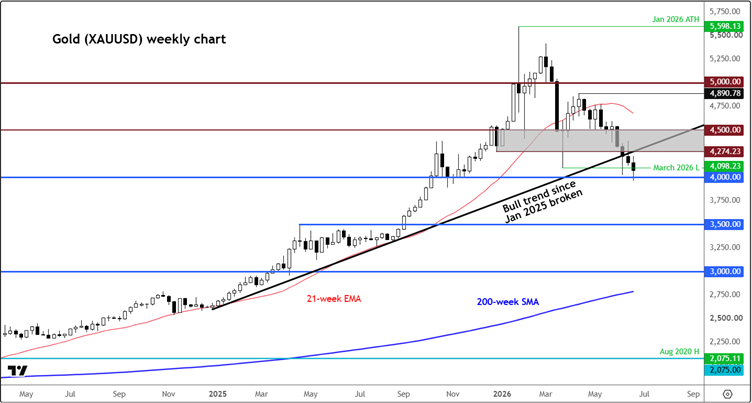
Source: TradingView
Gold has broken its bullish trend that had been in place since January 2025, meaning the technical gold outlook has become a lot gloomier. The breakdown came after several consecutive weeks in which gold finished lower. The metal has also broken through a number of key interim support levels.
Thus, given this recent bearish price action, with a pattern of lower highs and lower lows, the path of least resistance now appears to be to the downside. Selling pressure could accelerate if we see a decisive break below the psychologically important $4,000 level in the coming weeks.
If the $4,000 level gives way, that could pave the way for a decline towards $3,900, $3,800, and beyond, with $3,500 representing the next major downside target.
On the upside, resistance is now seen around $4,275, where the underside of the broken bullish trendline comes into play. Above that, $4,500 is likely to be the next important area of resistance, should we get there.
The most recent high, set in mid-April, comes in at $4,890. If gold breaks above that level, then the bearish outlook would be invalidated, and we could see prices climb back above the $5,000 mark. But we’ll cross that bridge if and when we get there. For the time being, the path of least resistance remains to the downside.