Q4 2025 GBP/USD Forecast
By Fiona Cincotta
Introduction
After impressive gains across the first half of the year, Q3 was a weaker touch for GBP/USD. The pair rallied 9.4% across the first half of the year but then fell by 2.6% during the July-September period. Year-to-date, GBP/USD trades 6.7% higher.
The pound's losses in Q3 have come as the steep selloff in the USD in the first half of the year (-10%) stabilized, with the US dollar index booking gains of 1.6% across Q3. The pound has seen a mixed performance against other major currencies, falling against the euro and the Australian dollar, but rising against the Japanese yen and the Canadian dollar.
GBP/USD started Q3 on the front foot at a 4-year high of 1.3790 before falling to a low of 1.3150. The price trades in the middle of that range at 1.3350 heading into Q4. Domestic challenges for the UK are rising, and the outlook is deteriorating, which will likely weigh on the pound in the final quarter, despite uncertainty surrounding the USD.
UK economic outlook
- Inflation & wage growth
UK inflation was 3.8% YoY in August, which is still 1.8% above the Bank of England's 2% target level. CPI is expected to peak at 4% in September, before easing lower. Service sector inflation remains sticky at 4.7%, as does wage growth at 4.8%. These are not levels consistent with the BoE’s target 2%. The BoE closely monitors wage growth and service sector inflation as key indicators of domestic economic conditions, and has highlighted sticky service sector inflation as an obstacle to cutting rates more aggressively. The OECD raised its forecast for UK inflation to 3.5% in 2025, marking the highest level in the G7, although the BoE consider the spike will be temporary moving back to target 2027.
BoE CPI expectations chart
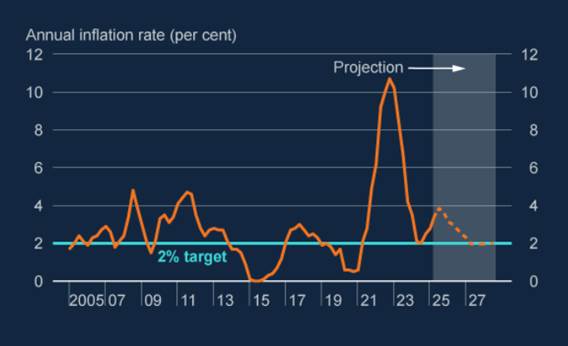
Source: BoE
The labour market is starting to show some signs of weakness. The unemployment rate has ticked higher to 4.7% its highest level in almost four years. Weakness in the labour market has come as firms react to the government’s previous budget, which saw social security costs and the minimum wage rise, making hiring more expensive. The BoE forecast that unemployment could reach 4.9% this year, a level last seen in the pandemic, as the central bank struggles to balance the weakening jobs market against sticky inflation.
Many businesses are on alert for more tax increases in the autumn budget, given the perilous state of public finances. This could further slow the labour market.
- Growth
The UK economy grew 0.3% QoQ in Q2, a slowdown from 0.7% in Q1 as the pull-forward effect of businesses rushing to avoid the impact of Trump tariffs faded. The monthly GDP in July was just 0% and September’s PMI data showed momentum fading.
The Bank of England has said it expects economic growth of 0.25% in the second quarter of this year. Given the weakness that is starting to appear in the labour market, consumption could also take a hit as real disposable income is likely to be squeezed over the coming quarter by elevated inflation. With inflation, sticky firms may be inclined to cut costs, and as hiring becomes increasingly expensive owing to the government’s previous budget, growth is likely to slow. The OECD forecast growth slowing sharply from 1.4% this year to 1% next year, owing to the UK’s tighter fiscal stance.
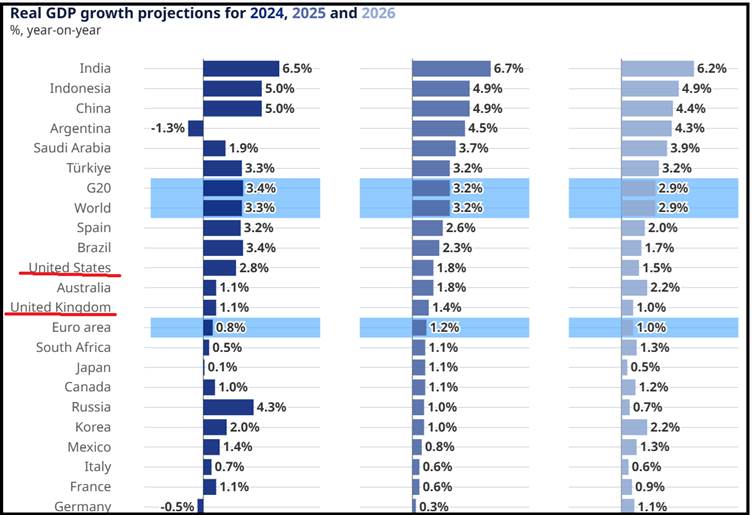
Source: OECD
- Fiscal worries
Attention will be on Rachel Reeves' autumn budget on November 26, which comes as international investors show signs of shunning Gilts, sending borrowing costs sharply higher. The Chancellor is facing a challenging backdrop of weak growth, high inflation, elevated borrowing, and rising borrowing costs, as well as a significant funding gap to fill. Rachel Reeves will need to take action to calm the bond market. However, her options are limited given her need to stick to her fiscal rules and the manifesto pledge not to raise the three main taxes. Spending cuts are also looking unlikely. Meanwhile, smaller tax hikes may not be sufficient, and further taxes on corporations could further slow the UK economy. If the bond market doesn’t think Reeves is doing enough, yields could continue to climb higher.
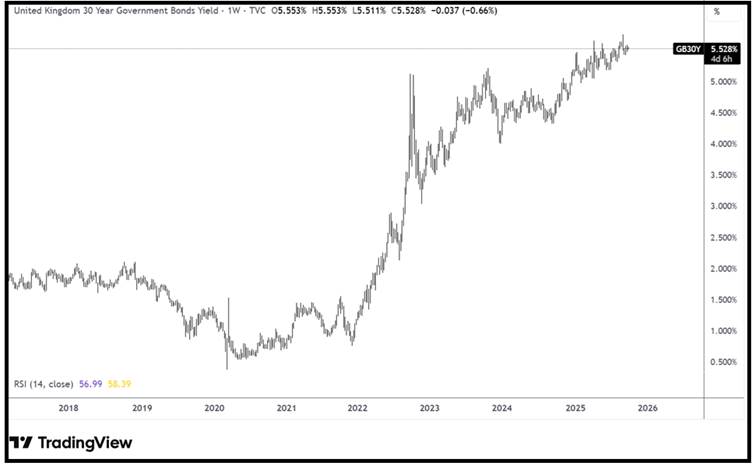
BoE rate cut expectations.
The Bank of England has cut interest rates three times in 2025 and a total of six times since starting its monetary easing cycle in August last year. The central bank reduced rates by 25 basis points in March, June, and August, taking the benchmark rate to its current level of 4%.
Given the macro backdrop of weak growth but still sticky inflation, the BoE could struggle to cut rates again this year. Add into the mix the uncertainty surrounding the Budget, which isn’t until the end of November, and there appears to be little reason for the BoE to cut rates again in 2026. The central bank may need to cut rates next year if the economy weakens sufficiently to lower inflation.
Any benefits for the pound from the BoE keeping interest rates elevated are likely to be limited given concerns over the growth outlook and the fiscal picture. As a result, the pound could struggle.
US economic outlook
The US dollar index has declined by over 10% since the start of this year, falling from a high of 110.18 in January to a multi-year low of 96.2 in September. The double-digit decline was primarily seen in the first half of the year, while USD actually rose 1% in Q3.
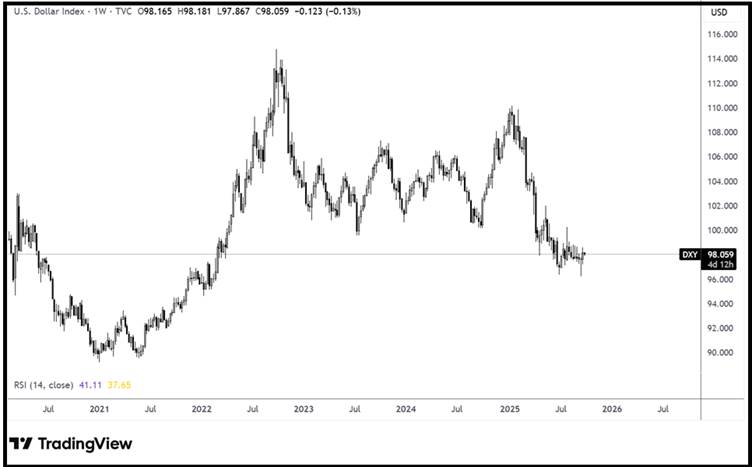
The US dollar stabilized in Q3 after experiencing steep losses during the first part of the year. The US has agreed on trade deals with most major economies, and US economic data showed resilience. However, signs of weakness are starting to appear in the US labour market.
Heading into the final quarter of the year, the market will be watching developments surrounding the jobs market and inflation. US non-farm payrolls have weakened notably in the third quarter, spurring the Federal Reserve to take action and reduce rates even when inflation is sticky. Ongoing weakness in the US labour market could pull USD lower.
Meanwhile, the inflation outlook remains a key focus. Core PCE has ticked higher, away from the target 2% level to 2.9% YoY in August, and could continue to rise as the impact of Trump’s trade tariffs transfers through the economy. The unknown here is the extent to which the tariffs will be inflationary, which could limit the action the Fed can take to support the jobs market.
Federal Reserve rate cut path
The Federal Reserve cut rates for the first time this year in September. The FOMC agreed to cut rates amid a weakening jobs market and despite rising inflation. The Fed’s dot plot pointed to two more 25-basis-point rate cuts this year.
Markets are pricing in two additional rate cuts in Q4, with a 90% implied probability of a 25-basis-point cut in October and a 68% probability of another 25-basis-point cut in December. The question here is whether the market is too optimistic about rate cuts. If inflation continues to rise or the job market steadies, the Fed may be more inclined to cut rates just once this year and consider further cuts next year. This scenario could lift the USD.
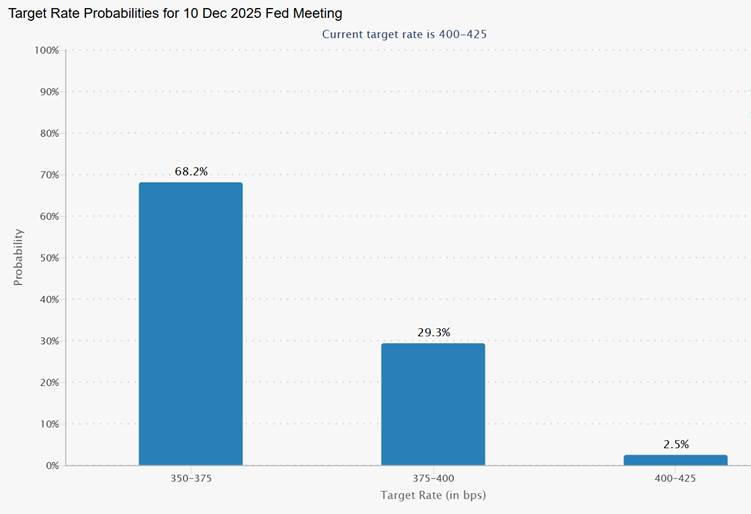
However, if the US jobs market deteriorates further but inflation remains sticky, this presents a more complicated outlook for the Fed. Policymakers could continue to cut rates, particularly given the political pressure coming from the White House. With this in mind, non-farm payroll data and core PCE figures will be more closely watched than usual.
Conclusion
GBP/USD enters Q4 on a fragile note. The pound faces persistent headwinds from sticky inflation, a cooling labour market, and fiscal uncertainty ahead of the November budget, leaving the BoE with little room to maneuver. Meanwhile, the US dollar faces uncertainty in its outlook, balancing weakening jobs data with stubborn inflation and an uncertain Fed rate path.
With both economies facing headwinds, the GBP/USD may struggle to find a clear direction. However, risks appear skewed to the downside for sterling unless UK fiscal credibility is restored and growth momentum improves.
The more bearish scenario for GBP/USD would be if the Chancellor’s Budget spooks the market, while the Federal Reserve cuts the rate just once. This scenario could pull GBP/USD lower towards 1.3150
Meanwhile, if trade tariffs fail to have a meaningful impact on US inflation and the jobs market deteriorates further, the Fed cuts rates more aggressively, which could lift GBP/USD towards 1.37.
GBP/USD outlook - technical analysis (weekly chart)
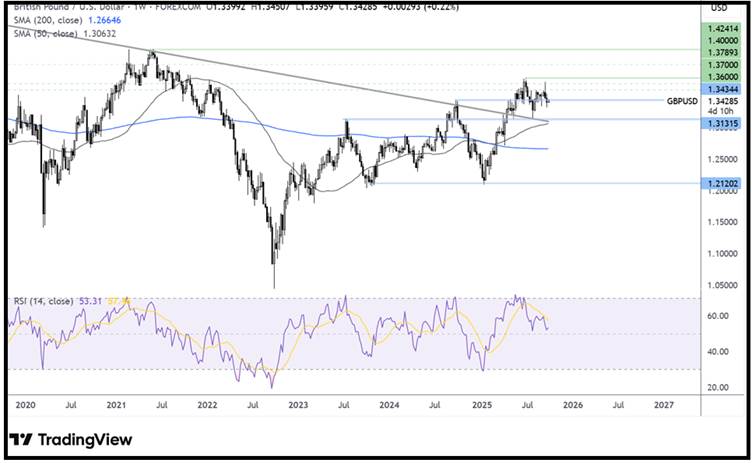
GBP/USD has recovered from the 1.21 low in 2025, rising above the 200 SMA and the falling trendline dating back to 2015, reaching a high of 1.3770. The price has since consolidated around the 1.3450 level as the RSI moves towards neutral.
Buyers will need to rise above 1.37 and 1.3790 to create a higher high and extend gains towards 1.40 and 1.4220, the 2021 high.
Support can be seen at 1.3450 and 1.3150, where the falling trendline and the 50 SMA converge. A break below here exposes the 200 SMA at 1.2660.