

USD/JPY Q4 2026 Outlook: Hawkish Fed Pricing Clashes With Intervention Risk
The year-end tug-of-war is clear: hawkish Fed pricing supports USD/JPY, while intervention risk limits the upside - read on for the full Q4 outlook!

David Scutt
- Global Macro
Quarterly Commodities Outlook is available for free now. Download your report →

Market Analyst
As 2026 continues to unfold, currencies across North America are beginning to show notable shifts compared to the price action seen earlier in the year. Heading into Q2 2026, both USD/CAD and USD/MXN face a landscape shaped by changes in monetary policy, uncertainty around economic growth, and rising geopolitical tensions in the Middle East. In this context, both the Canadian dollar and the Mexican peso have started to lose ground against a strengthening U.S. dollar, and this trend could gain further traction if confidence in the greenback holds in the coming months. If this dynamic persists, both USD/CAD and USD/MXN could continue to face buying pressure over the medium term.
What path will central banks follow?
At the time of writing, North American central banks are beginning to show some divergence in their monetary policy outlook, as they have moved away from a path of lower interest rates toward a more stable, hold-driven stance. Bank of Mexico stands out, maintaining the highest rate in the region at 6.75% and largely keeping policy unchanged since December 2025, when rates were reduced from 7.25%. As a result, a central bank that was once more flexible has now aligned with its peers, adopting a more conservative stance in recent months.
Bank of Canada has now spent five months under a similar approach, stepping away from the rate cuts seen in late-2025. Since October of that year, the policy rate has remained at 2.25%, placing it in a relatively stable environment where, for now, no significant changes are expected to alter the current policy outlook.
Federal Reserve has also surprised markets by signaling a pause in rate cuts, after lowering rates to 3.75% from 4.00% in its December 2025 decision. While a new easing cycle had been expected following a period of stability throughout much of 2025, the current outlook points more toward a hold scenario, reflecting a more cautious stance from the central bank. In this context, the Fed appears to be aligning with its regional peers, reinforcing a more prudent approach to monetary policy.
North America Interest Rate Table 2025–2026

Colors: From green to red. Green indicates higher interest rates, while red represents lower rates in each country.
Source: Data - Tradingeconomics
North America Interest Rate Chart 2025–2026
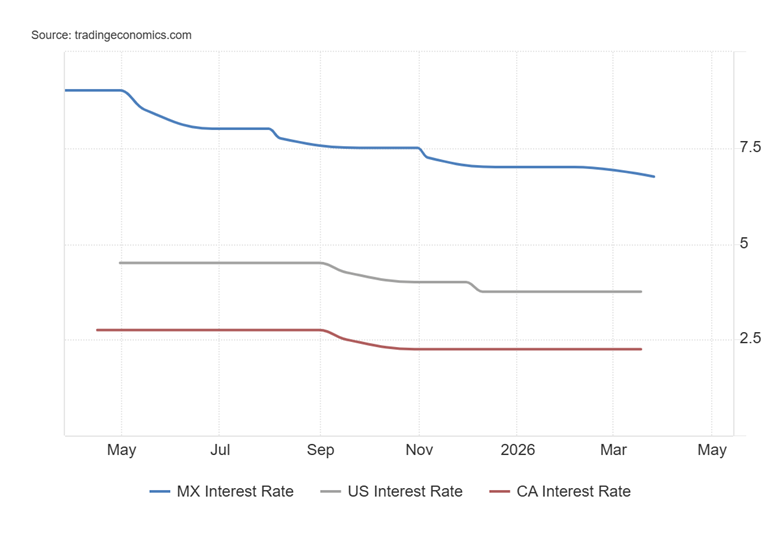
Source: Tradingeconomics
The key question is what path North American central banks will follow for the remainder of 2026, as this factor could prove decisive for the performance of their currencies in the coming trading months:
It is important to note that inflationary pressures have once again become a key focus for central banks, making it essential to assess how recent inflation data may influence or confirm the outlook for their upcoming policy decisions.
In Canada, inflation declined to 1.8% in February from 2.3% in January, slightly below the 2.00% target. In Mexico, a recent uptick stands out, with inflation rising to 4.02% in February, above 3.79% in January and the 3.00% target. In United States, inflation has remained stable at 2.4% year-over-year for January and February 2026, slightly above the 2.00% target.
North America Inflation Trend 2025–2026
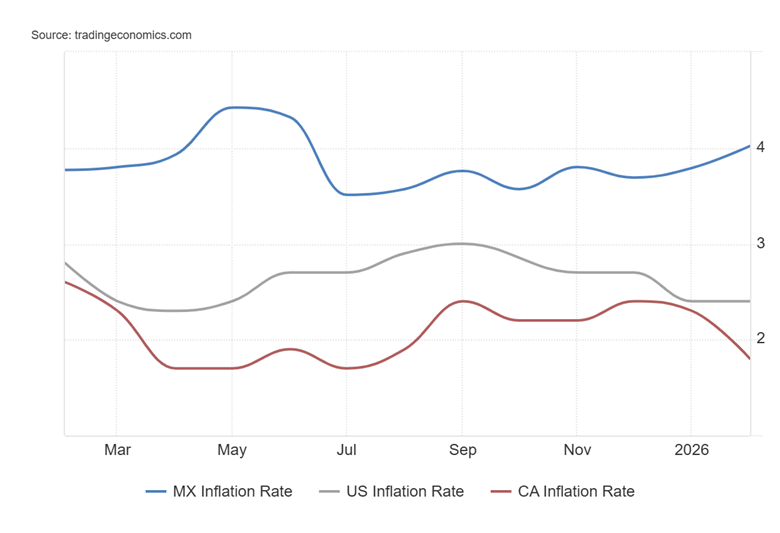
Source: Tradingeconomics
Inflation data is showing a mixed pattern, with Mexico and the United States drifting away from their targets, while Canada maintains a more controlled rate within the region. In the case of Federal Reserve and Bank of Mexico, this could limit further rate cuts, as both have emphasized the need to keep inflation under control. Although there may be more room for Bank of Canada to adjust policy, it is still maintaining a cautious stance due to ongoing external risks that could generate additional inflationary pressures in the coming months.
This environment suggests that monetary policy across the three central banks is likely to remain largely in a hold or stable stance over the coming months. Federal Reserve stands out, as only weeks ago markets expected rate cuts to begin in June 2026, but expectations have now shifted toward 2027, reflecting a more restrictive stance relative to its peers and reducing the likelihood of lower rates in the near term.
Overall, shifts in central bank policy could reshape the strength of North American currencies. Mexico continues to hold the highest interest rate in the region, which helps support the peso’s appeal in a relatively lower-rate global environment; if rates remain near 7.00%, demand for the peso could hold up against its peers, given the relative attractiveness of peso-denominated investments. However, it is important to note that risk perception in Mexico remains elevated, which could limit a sustained recovery.
In Canada, inflation concerns are supporting a more stable policy stance, but its rate remains the lowest in the region, reducing the relative appeal of Canadian dollar–denominated assets compared to alternatives such as the Mexican peso or the U.S. dollar. In contrast, the more cautious stance of the Federal Reserve continues to support the strength of U.S. dollar–denominated assets, as both the bond market and the dollar itself remain global safe-haven benchmarks. Additionally, stable rates and a more aggressive stance relative to its peers help reinforce the dollar’s attractiveness over time.
This scenario suggests that, unlike Mexico and Canada, the U.S. dollar could continue to show a meaningful recovery, as seen at the start of 2026. Over time, this could translate into sustained buying pressure or a stable environment in both USD/MXN and USD/CAD over the medium term.
The big surprise: Middle East conflict
The conflict escalated further, impacting activity in the Strait of Hormuz between March 9 and 12, reaching peak tension with a nearly 90% drop in traffic. Market reaction was immediate: a surge in risk perception, increased demand for safe-haven assets, and a rise in energy prices, with WTI crude approaching the $120 level.
At the time of writing, the situation remains an active conflict with no clear short-term resolution, keeping risk sentiment elevated across major financial markets.
In this context, the U.S. dollar has gained relevance, as since the start of the Middle East conflict it has increasingly been perceived as a temporary safe-haven currency, offering stability and liquidity. In fact, the DXY index, which measures the dollar’s strength against other currencies, moved above the 97 level at the onset of the conflict, later surpassed 99 as disruptions in the Strait of Hormuz intensified, and eventually broke above the 100 psychological level amid continued escalation. This highlights that the dollar has been one of the currencies attracting the strongest demand as the conflict has persisted.
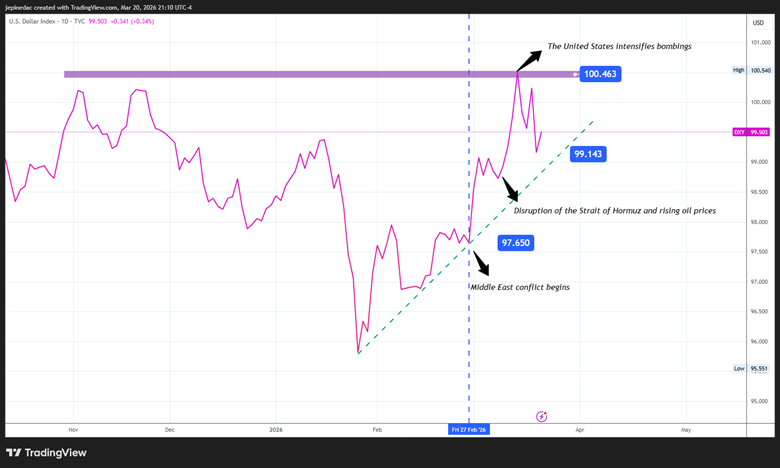
Source: Data TVC - Tradingview
The conflict has begun to generate additional inflationary pressures through rising energy prices, increasing production costs at a global level. This environment has led central banks to adopt a more cautious stance, while the U.S. dollar has regained prominence as a safe-haven currency, gaining ground against currencies such as the Canadian dollar and the Mexican peso.
In this context, if no clear short-term resolution emerges, demand for the U.S. dollar is likely to remain firm, potentially translating into sustained buying pressure in USD/MXN and USD/CAD over the coming months.
USD/CAD attempts to hold its downtrend
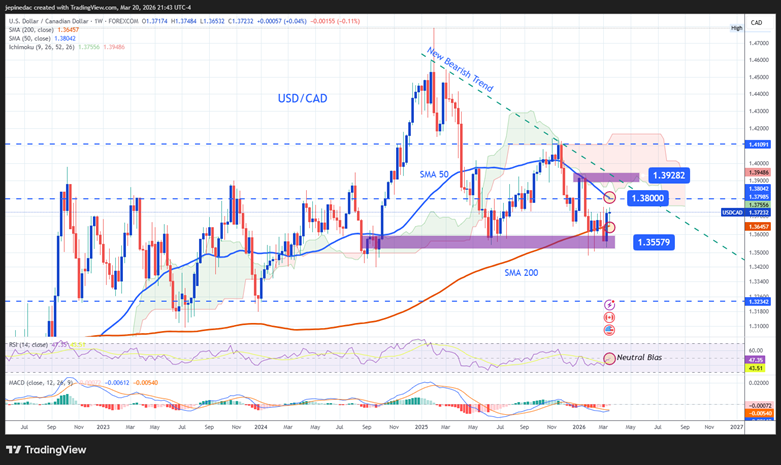
Source: StoneX, Tradingview
Indicators:
Key Levels:
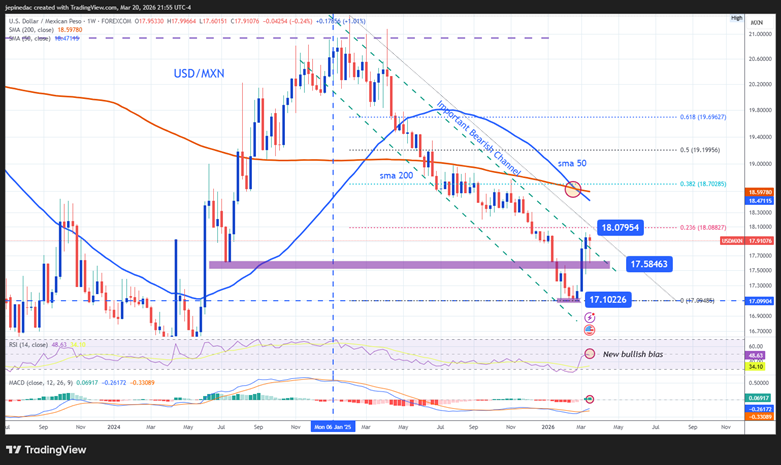
USD/MXN begins to show a relevant bullish bias
Source: StoneX, Tradingview
Written by Julian Pineda, CFA, CMT – Market Analyst
Follow him on: @julianpineda25
StoneX TV content is created, produced, and distributed solely by StoneX Media Ltd (“StoneX TV”) and is provided for informational and educational purposes only. StoneX TV does not provide investment, financial, legal, or tax advice and does not make any recommendation or endorsement of any investment strategy, transaction, or financial instrument. Nothing in this content constitutes, or should be construed as, investment advice or a recommendation to buy, sell, or hold any financial instrument, including securities, futures, derivatives, digital assets, foreign exchange products, or CFDs. This content does not constitute an offer, invitation, or solicitation to engage in any investment activity. The information presented is general in nature and is not tailored to the financial situation, investment objectives, or risk tolerance of any specific person. You should not rely on this content as a substitute for independent professional advice. Investing and trading in financial instruments involves significant risk of loss and is not suitable for all investors. Past performance is not indicative of future results. Any views or opinions expressed are those of the presenter at the time of publication and are subject to change without notice. Such views may not necessarily reflect those of StoneX Media Ltd or its affiliates. StoneX Media Ltd and its affiliates, including StoneX Group Inc., may from time to time have positions in, or engage in transactions involving, the financial instruments referenced. This content may include general market commentary and opinion. It does not constitute independent investment research and has not been prepared in accordance with legal requirements designed to promote the independence of investment research. StoneX Media Ltd is not authorised or regulated to provide investment services and does not act in a fiduciary capacity. StoneX Media Ltd is incorporated in Ireland and operates in accordance with applicable Irish law. It is a wholly owned subsidiary of StoneX Group Inc. and is a separate legal entity from other subsidiaries within the StoneX Group, which may be regulated in various jurisdictions. StoneX Media Ltd does not act on behalf of, or provide services for, any regulated affiliate. This content is not directed at, and may not be distributed to, any person in any jurisdiction where such distribution would be contrary to local laws or regulations. Supporting documentation for any claims, comparisons, statistics, or technical data may be made available upon reasonable request, where applicable.
Our subscribers have access to comprehensive market analysis from StoneX spanning commodities, equities, currencies and more.
The year-end tug-of-war is clear: hawkish Fed pricing supports USD/JPY, while intervention risk limits the upside - read on for the full Q4 outlook!

GBP/USD has fallen just 0.5% across the third quarter. While the pair booked solid gains in July and August, those were unwound in September with the pair falling over 2% - read on for the full Q4 outlook!


The historically-reliable 4-year halving cycle suggests that Bitcoin’s bear market may soon be coming to an end, if it hasn’t already - read on for the full Q4 forecast!

Our market expertise, advanced platforms, global reach, culture of full transparency and commitment to our clients’ success all set us apart in the financial marketplace.
Reach
With access to 40+ derivatives exchanges, 180+ foreign exchange markets, nearly every global securities marketplace and numerous bi-lateral liquidity venues, StoneX’s digital network and deep relationships can take clients anywhere they want to go.
Transparency
As a publicly traded company meeting the highest standards of regulatory compliance in the markets we serve; our financials and record of accomplishment are matters of public record. StoneX’s commitment to “doing the right thing over the easy thing” sets us apart in the industry and helps us build respect, client trust and new partnerships.
Expertise
From our proprietary Market Intelligence platform, to “boots on the ground” expertise from award-winning traders and professionals, we connect our clients directly to actionable insights they can use to make more informed decisions and achieve their goals in the global markets.