


AUD/USD, NZD/USD outlook: Can the antipodeans defy dollar hawks?
Interest rate markets bought the JOLTS headline. The dollar didn't. Here's why that matters for AUD/USD and NZD/USD.
Written by
David Scutt
Market Analyst
- JOLTS beat masks softer labour market internals
- Conference Board survey flags rising US unemployment risk
- Dollar shrugs off hawkish Fed repricing
- Quarter-end flows cloud FX signals
- AUD, NZD rebound faces early technical test
The search for a cleaner signal
It's the first trading day of a new month, and hopefully a period where we can start putting a little more faith in market signals than we've been able to over the past week. Quarter-end flows have muddied the waters across markets recently, making it difficult to know whether moves can be trusted. With those distortions now hopefully behind us, the price action may provide a cleaner signal.
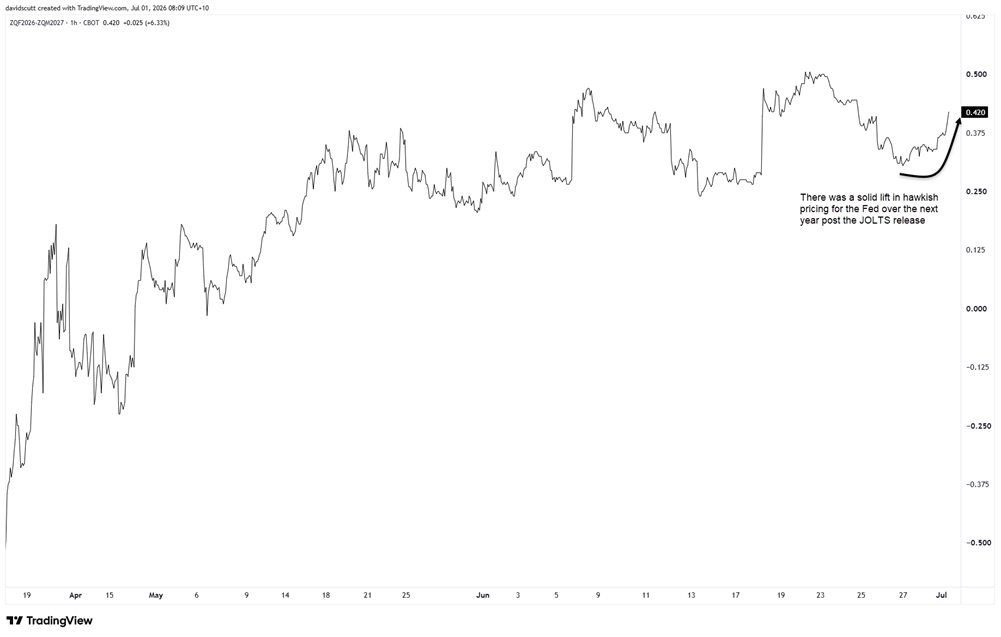
Which brings us to the Aussie and Kiwi, both of which rebounded strongly overnight alongside improving risk appetite. Under normal circumstances, a stronger-than-expected JOLTS report and a sharp repricing higher in Fed rate expectations would have been expected to lift the US dollar. Instead, it fell.
Source: TradingView
That's consistent with another recent development. The relationship between the US dollar and front-end US rate expectations has deteriorated noticeably over the past week, despite remaining strong over longer timeframes. So, can we trust the rebound in the antipodeans, or is quarter-end noise distorting the signal?
A stronger JOLTS report, but...
At first glance, the latest JOLTS report looked strong. Job openings rose to 7.59 million in May, comfortably beating expectations and prompting markets to price in a more hawkish Fed outlook. However, I'd be cautious about reading too much into it. The JOLTS survey has become increasingly noisy as response rates have deteriorated, increasing the potential for outsized surprises in either direction.
Looking beneath the headline, there are reasons to question how much labour demand actually improved. Leisure and hospitality accounted for one of the largest increases in job openings, driven primarily by restaurants and bars. Given the survey covered May, the month before the World Cup got underway, it's plausible preparations for the tournament temporarily boosted vacancies. Beyond that, there wasn't confirmation elsewhere. The quits rate was unchanged at 1.9%. The hiring rate remained subdued at 3.3%. Layoffs, while still historically low, edged higher. It still looks like a low-hire, low-fire labour market.
The Conference Board's consumer confidence survey for June portrayed a far less rosy story. The share of consumers saying jobs were plentiful was little changed at 24.9%. Those saying jobs were hard to get jumped to 22.5%, the highest since January 2021. As a result, the labour market differential, the gap between jobs plentiful and jobs hard to get, fell from 5.0 to 2.4, the lowest level in more than five years.
Historically, that measure has shown a strong relationship with movements in the unemployment rate. If that relationship holds, it points to upside risk for unemployment in the months ahead. If that were to play out in reality, it would cast serious doubt on the Fed's willingness to embark on a fresh tightening cycle, especially now that fears of an energy-led inflation pulse have eased markedly.
The countdown to payrolls
Source: TradingView (US EDT)
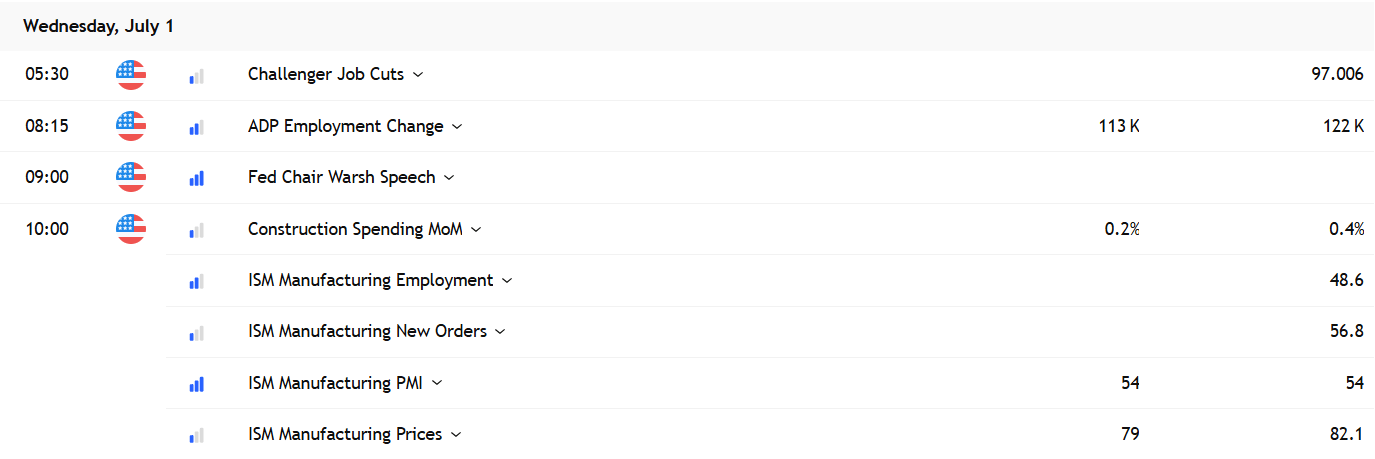
Attention now turns to Wednesday's ADP private sector payrolls report and ISM manufacturing PMI ahead of Thursday's non-farm payrolls release. Markets expect ADP to show private employment increased by 113,000 in June, down modestly from 122,000 in May. If realised, and assuming labour force participation remains relatively steady, that pace of hiring should be enough to keep labour market conditions broadly stable given population growth is now running much slower than it was a few years ago.
The employment component of the ISM manufacturing survey will also be worth watching, although it's unlikely to provide the strongest signal on the labour market. Summer shutdowns and factory retooling can distort hiring patterns at this time of year, while manufacturing accounts for a relatively small share of US employment. The ISM services survey, due early next week, should provide a better read on broader hiring conditions.
The other key event today is Kevin Warsh's appearance on a panel with several other central bankers at the conclusion of the ECB's Sintra conference in Portugal. The discussion runs for an hour. Warsh made it clear after last month's FOMC meeting that he had little interest in providing forward guidance, so expectations should be kept in check. Even so, markets will be parsing every word he says. If he maintains his recent emphasis on returning inflation to target, it's unlikely to do anything to dissuade traders from continuing to price the risk of Fed rate hikes in the months ahead, even if a move as early as July still looks a stretch.
A swing low or potential bull trap?
Source: TradingView
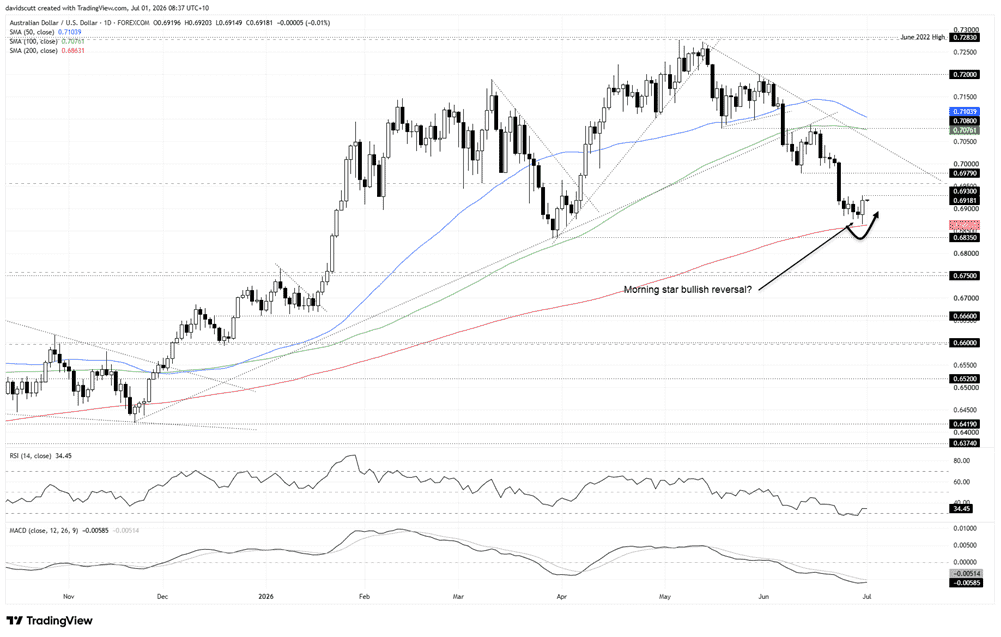
AUD/USD remains in a clear downtrend beneath the 50 and 100-day moving averages, printing a series of lower highs and lower lows since the start of May. However, the decline has stalled over the past week, leaving the pair perched just above the 200-day moving average.
That makes the 200-day moving average and the March swing low at 0.6835 the immediate levels to watch. A break of both would strengthen the case for another leg lower, exposing the 38.2% Fibonacci retracement of the April 2025-May 2026 bull move at 0.6757, followed by former resistance at 0.6750.
The oscillators continue to favour selling into strength, but the signal is becoming less convincing. RSI continues to print lower highs and remains above, but not far from, oversold territory, suggesting downside momentum remains in the ascendancy without strengthening further. MACD tells a similar story. The bearish crossover from May remains intact with the indicator still below the signal line and in negative territory, but the two lines are beginning to converge.
That dovetails with the recent price action. While far from textbook, the past three sessions resemble a morning star reversal pattern following an established downtrend. It doesn't invalidate the broader bearish trend, but it does suggest a swing low may be in place.
If buyers can build on Tuesday's rebound, 0.6930 is the first level to watch after capping the advance overnight. Above that sits the 23.6% Fibonacci retracement of the April 2025-May 2026 bull move at 0.6956, followed by 0.6979, the breakdown point from the latest leg lower.
Resistance stands in the way
Source: TradingView
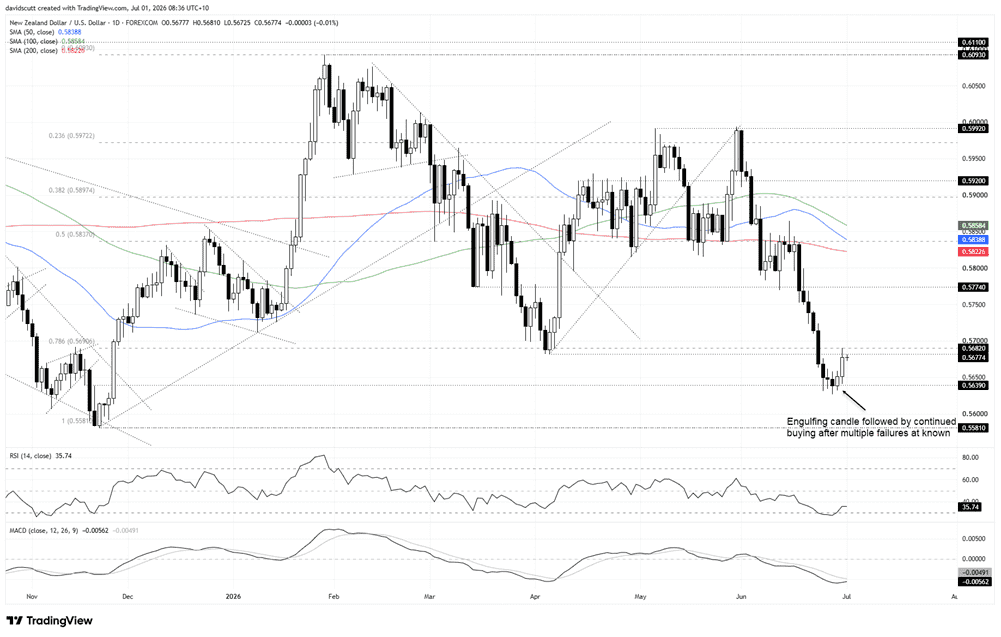
NZD/USD also remains in a broader downtrend, but unlike the Aussie, the recent price action provides a slightly more convincing case that a corrective bounce may be developing.
The immediate focus sits overhead between 0.5676, the April swing low, and the 78.6% Fibonacci retracement of the November 2025-January 2026 bull move. The pair stalled in that zone on Tuesday. A break and close above it would strengthen the case for a corrective rebound, exposing 0.5774, a level that has repeatedly acted as both support and resistance this year.
On the downside, 0.5639 is the key level to watch after marking the low late last week. An engulfing candle followed by Tuesday's follow-through suggests a swing low may be in place. However, a break beneath 0.5639 would put the focus back on the November 2025 swing low at 0.5581.
The oscillators continue to favour selling into strength, although the bearish signal is beginning to weaken. RSI has recovered from oversold territory to around 35 but continues to print lower highs. MACD remains below the signal line and in negative territory, although the two lines continue to converge. It's not yet a cautionary signal for the bears, but it's moving in that direction should recent price action continue.






Web Trader platform
Our sophisticated web-based platform is packed with features.
Open an account today
Experience award-winning platforms with fast and secure execution.
Economic calendar
Related articles

Canadian Dollar Forecast: USD/CAD Weekly Reversal Puts Yearly Uptrend Back in Focus 8 29 2026
USD/CAD has staged its strongest weekly advance since June, shifting the focus to whether a more durable low is finally taking shape.

USD/JPY weekly outlook: Payrolls may challenge the Fed’s hawkish reset
USD/JPY has finally woken from its slumber. Payrolls now loom as the key test of whether the latest hawkish repricing sticks or sinks.

Euro Short-term Outlook: EUR/USD Pullback Nears Pivotal Uptrend Support 8 28 2026
Warsh's comments accelerated the EUR/USD selloff, raising the stakes as buyers look to stabilize the broader recovery.