

What is CFD trading and how does it work?
CFD trading is the buying and selling of contracts for difference (CFDs) – leveraged derivatives that enable you to go long and short on a huge range of markets. Read our guide for an alternative of what CFD means, how contracts for difference work and more.
CFD trading enables you to find trading opportunities across shares, forex, indices, commodities and more. In this step-by-step guide, we’re going to cover all the fundamentals of CFD trading, so you can decide whether you want to start buying and selling contracts for difference yourself.
Skip ahead to a section below, or scroll down to start at the beginning.
- What is a contract for difference (CFD)?
- How does CFD trading work?
- Costs of CFD trading
- CFD trade example
- The advantages of CFDs
- Which financial instruments can I trade with CFDs?
- Managing risk in CFD trading
- Spread betting vs CFD trading
- CFD trading FAQ
Want to try out trading CFDs with no risk to your capital? With a StoneX Trading CFD demo account, you get £10,000 virtual funds to trade our full range of markets. Open your StoneX Trading demo account for free.
What is a contract for difference (CFD)?
The meaning of a contract for difference (CFD) is that it is an agreement between two parties to exchange the difference in a market’s price from when the contract is opened to when it is closed. You can use them to trade thousands of global markets.
CFD trading means that you don’t own the underlying asset, unlike traditional investing. It enables you to speculate on the price movement of a whole host of financial markets such as indices, shares, currencies, commodities and bonds – regardless of whether prices are rising or falling. And because you are speculating on price movement rather than owning the underlying instrument, you will not pay UK Stamp Duty on any profits*.
* Tax laws are subject to change and depend on individual circumstances.
How does CFD trading work?
CFD trading works using contracts that mimic live financial markets. You buy and sell these contracts in the same way that you'd buy and sell the underlying market, but with several extra benefits: including the ability to go short as well as long, leverage and hedging.
Instead of choosing how much of a particular asset you would like to invest in – such as 100 HSBC shares – you pick how many contracts to buy or sell.
If the market moves in your favour, your position will earn a profit. If it moves against you, it will incur a loss. You realise your profit or loss when you close the position by selling the contracts you bought at the outset. Just like traditional investing, your return from a trade is determined by the size of your position and the number of points that the market has moved. If you buy 100 HSBC CFDs at 1100p then sell them at 1150p, you will make (100 x 50p) £50. If you sold them at 1050p instead, you would lose £50.
Learn more about how to trade CFDs.
Going long vs going short in CFD trading
In traditional share dealing, you can only buy markets, so you only profit when prices rise. However, CFDs let you go long or short, which means you can potentially profit whether markets rise or fall.
Going long: buy contracts to open, sell to close. You profit if the market rises.
Going short: sell contracts to open, buy to close. You profit if the market falls.
Every CFD market shows two prices: the buy (ask) price to go long and the sell (bid) price to go short. To close your position, simply reverse your opening trade.
Leverage and margin in CFD trading
Leverage
CFD trading is a leveraged product, which means you can open a trade by paying just a small fraction of its total value.
In other words, you can put up a small amount of money to control a much larger amount. This will magnify your return on investment, but it will also magnify your losses. So, you should make sure to manage your risk accordingly.
Margin
The capital you need in your account to open and maintain a leveraged position is called your margin. Typically expressed as a percentage of your total trade size, the amount varies from market to market.
To open a forex position, for instance, you might need 5% of its total value. For shares, it might be 20%.
As an example, buying 1,000 HSBC CFDs at 1340 gives you a total position size of £13,400 (1000 x 1340p). If HSBC requires 20% margin, you'd only need 20% of £13,400 in your account to open your trade: £2,680.
Hedging with your CFD trades
As CFDs allow you to short sell, they are often used by investors as ‘insurance’ to offset losses made in their physical portfolios. This is known as hedging.
For example, if you hold £5,000 of Barclays shares and you concerned that they are due for an imminent sell-off, you can help protect your share portfolio by short selling £5,000 of Barclays CFDs.
Should Barclays’ share price fall by 5% in the underlying market, the loss in your share portfolio would be offset by a gain in your short trade. In this way, you can protect yourself without going through the expense and inconvenience of liquidating your stock holdings.
Costs of CFD trading
At this point, you might be wondering how you’ll pay for your CFD trade. The cost of CFD trading depends on three factors:
- The spread and commission
- Your CFD deal size
- The trade duration
Spread and commission
When you trade a CFD market, the buy price will always be slightly higher than the market’s current level, while the sell price will be a little bit below. The difference between the two is called the spread and is usually how you’ll pay to open a position.
There is one significant exception to that rule, though. With share CFDs, you pay a commission to open your position – just like when you buy physical shares with a stockbroker.
Choosing your contract size
You decide the size of a CFD position by setting the number of contracts you want to buy or sell. The more CFDs you trade, the more margin you’ll need – and the more spread or commission you’ll pay.
The size of a single CFD will change depending on your asset class. With equities, for example, buying one contract is the same as buying one share. With forex, it’s the equivalent of a single lot.
Choosing your CFD duration
There are two main types of CFD you can choose to trade, depending on your strategy.
- Daily CFDs have the tightest spreads, but you’ll pay overnight financing for each day you keep your position open – so they might not be suitable for longer-term positions
- Forward CFDs have wider spreads, because all the financing costs are built in. They can be a better option if you’re taking a longer view
Learn more about the costs of CFD trading.
CFD trade example
CFD trading on a rising market
For example, say you think gold is going to rise. You place a buy trade of five gold CFDs at its current price of 4500.
The market rises 30 points to 4530. You close by selling your five contracts, exchanging the difference between your opening price (4500) and closing price (4530).
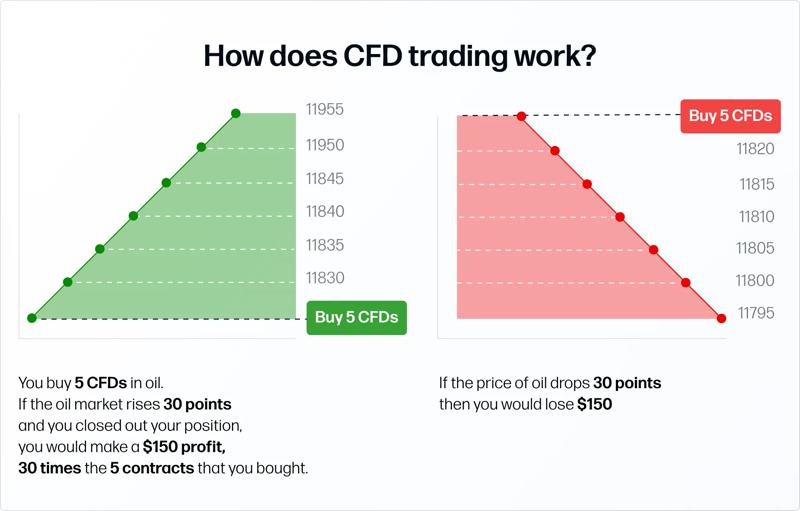
The difference is 30 points, so you would make a $150 profit (5 contracts × 30 points).
Why is your profit in dollars?
With CFD trading, your profit is always calculated in the currency of your underlying market. Gold is internationally traded in USD, so your profit or loss is calculated in dollars.
However, if the market moves against you, you pay the difference instead. If gold falls 30 points to 4470, you'd lose $150.
CFD trading on a falling market
Gold is at 4500, but you believe it is about to fall, so you sell five gold CFDs at 4500.
Your prediction is correct, and gold falls to 4435. When you sell CFDs, you're still agreeing to exchange the difference in an asset's price, but you earn a profit if the market falls and a loss if it rises.
Gold has fallen 65 points, so you earn $65 for each of your five contracts – a profit of $325.
But what would have happened if gold had risen 70 points instead? You would lose $70 for each of your five CFDs, a total loss of $350.
The advantages of CFDs
CFDs are a popular way for investors to buy and sell a range of financial markets, bringing several benefits for active traders:
- Tax efficiency*
No UK Stamp Duty to pay - Flexibility
You can trade on rising and falling markets, without borrowing any stock - Leverage
By using a small amount of money to control a much larger value position, you don’t have to tie up lots of capital - Hedging
You can use a CFD to mitigate losses in an existing portfolio - Suitable for any strategy
You can hold a CFD open for as long as you want – whether that’s seconds or months
Which instruments can I trade?
StoneX Trading offers a choice of 1,000s of CFD markets, including:
- The world’s leading indices: the FTSE 100 (UK 100), Nasdaq (US Tech 100), DAX 40 (Germany 40) and dozens more
- GBP/USD, GBP/EUR, EUR/USD and 80+ more FX pairs
- Global Shares such as Tesla, Amazon and Apple
- Commodities including oil, gold and natural gas
- Other markets such as bonds, interest rates and options
Managing risk in CFD trading
It's important to manage your risk carefully when trading CFDs. Two key tools to help control risk on each trade are take profits and stop losses.
Take profits – also known as limit orders – will automatically close your position if it hits a certain profit level. In doing so, they help you stick to your plan when you may be tempted to hold onto a winning position.
Stop losses also automatically close your position, but they do it once it hits a specified level. They help limit your total risk from any given trade. However, standard stop losses aren’t 100% effective as they can be subject to slippage if your market ‘gaps’ over your stop.
To ensure that your position will always close if your stop level is reached, you’ll need to upgrade to a guaranteed stop.
Learn more about CFD trading risks.
Spread betting vs CFD trading
Like CFD trading, spread betting enables you to open leveraged buy or sell positions on a range of markets without taking ownership of any assets. But these two leveraged products work in slightly different ways.
Instead of buying or selling contracts, when spread betting you bet a set number of pounds per point on the direction in which a market is headed. Your profit will increase for every point that the market moves in your direction, in which you think a market is headed.
Learn more about the difference between spread betting and CFDs.
Find out more about trading CFDs
A better trading experience
Discover how Stonex Trading's platforms can give you an edge.
Improve your strategy
Head over to the StoneX Trading Academy for curated courses.
Open
an account
Fund
via card or bank transfer
Trade
thousands of markets