

USD/JPY weekly outlook: Payrolls may challenge the Fed’s hawkish reset
USD/JPY has finally woken from its slumber. Payrolls now loom as the key test of whether the latest hawkish repricing sticks or sinks.
Written by
David Scutt
Market Analyst
- Payrolls could test whether Fed hike repricing sticks
- September hike now deemed a coin-flip
- US participation has gone eight months without rising
- History suggests once Fed starts hiking, it rarely stops at one
- USD/JPY breakout keeps buy-the-dip bias intact
USD/JPY was given a much-needed jolt last Friday, with Fed Chair Kevin Warsh doing enough to restore some of the Fed’s inflation-fighting credibility. That resulted in a sharp increase in pricing for a Fed rate hike this year, pushing USD/JPY to levels not seen since the latter parts of July.
While Warsh made it clear the Fed’s focus remains on the price stability side of its dual mandate, the week ahead will be all about maximum employment, with a raft of major US labour market data on the calendar, headlined by non-farm payrolls for August on Friday.
On the surface, that suggests this week may be something of a placeholder until we get further information on inflation. The counter-argument is that the data carry the potential to bring the maximum employment side of the mandate back to the attention of the Fed and markets, potentially challenging the hawkish repricing seen since Jackson Hole.
USD/JPY finally wakes up
Source: TradingView, FOREX.com
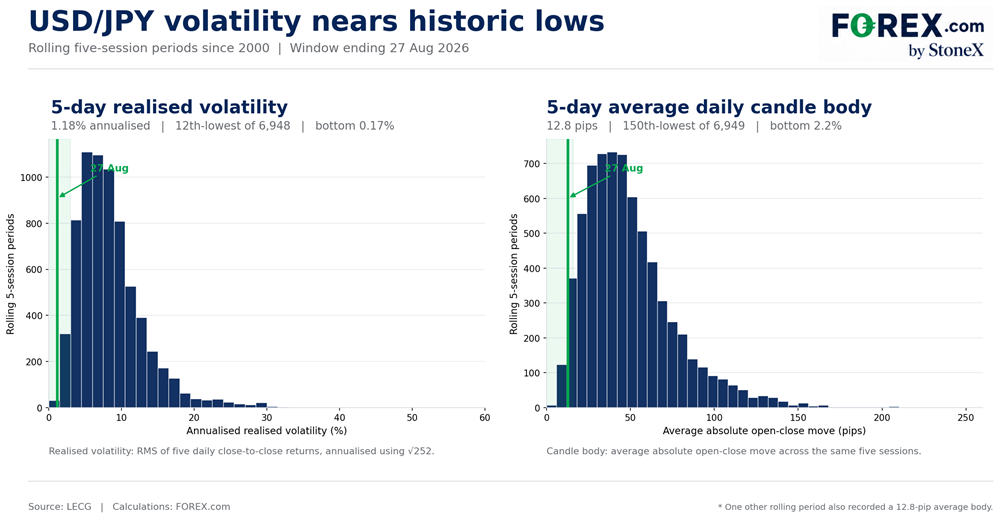
It’s been tough going for USD/JPY traders in August, with the volatility injected by record intervention from Japan’s Ministry of Finance and the US Treasury subsiding quickly, culminating in what has been an historically quiet period for the pair.
Before Warsh’s speech last Friday, five-day realised volatility had fallen to the 12th-lowest reading since 2000, while average daily candle bodies sat in the bottom 2.2% of rankings over the same period.
Thankfully, the Fed chairman finally woke the market from its slumber, sending USD/JPY sharply higher as markets rebuilt expectations for rate hikes this year.
Markets rebuild Fed hike bets
Warsh made it clear that it’s the price stability side of the dual mandate giving the FOMC the most heartache right now, while describing the labour market as stable. That really underlines where the committee’s concern currently sits. Inflation is too high and, if it doesn’t start to subside towards more acceptable levels in a timely manner, the Fed may have to act.
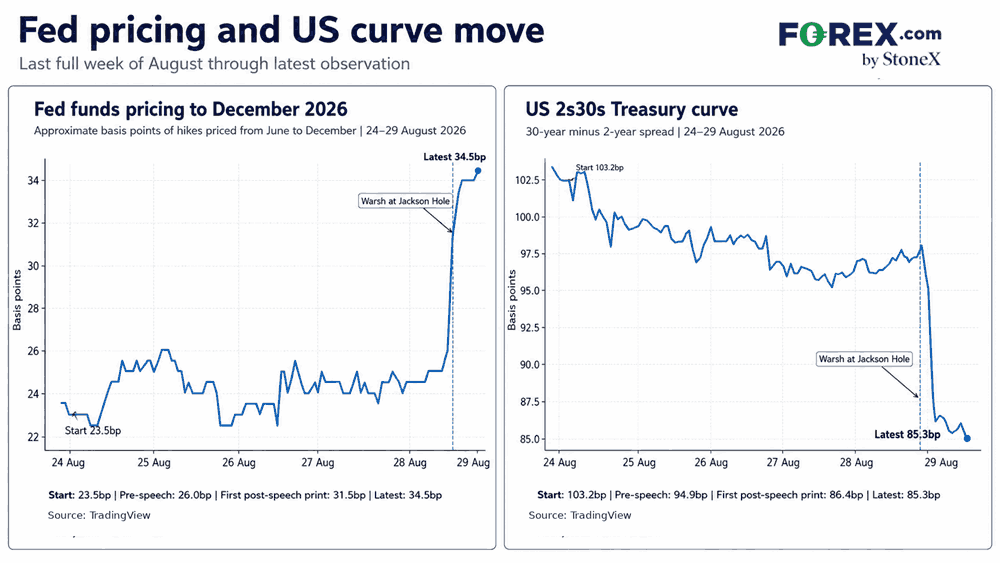
Based on the market reaction, that was enough to restore some of the Fed’s inflation-fighting credibility. Fed funds futures were pricing around 26 basis points of hikes by year-end before Warsh spoke. By the end of the session, that had increased to 34.5 basis points, with September now basically a 50-50 bet.
Source: TradingView, FOREX.com
We also saw a bear move across the US Treasury curve, but importantly it was a bear flattening, with the front end backing up much faster than the long end. That may disappoint the likes of Scott Bessent and Donald Trump, who would like to see that key long-term borrowing cost for the mortgage market lower, but from a market perspective it suggests some credibility was restored, at least for now.
Of course, the proof will be in the pudding if we ever get to the point where it becomes irrefutable the Fed should move and it still doesn’t. But we’re not at that point yet.
Employment mandate back in focus
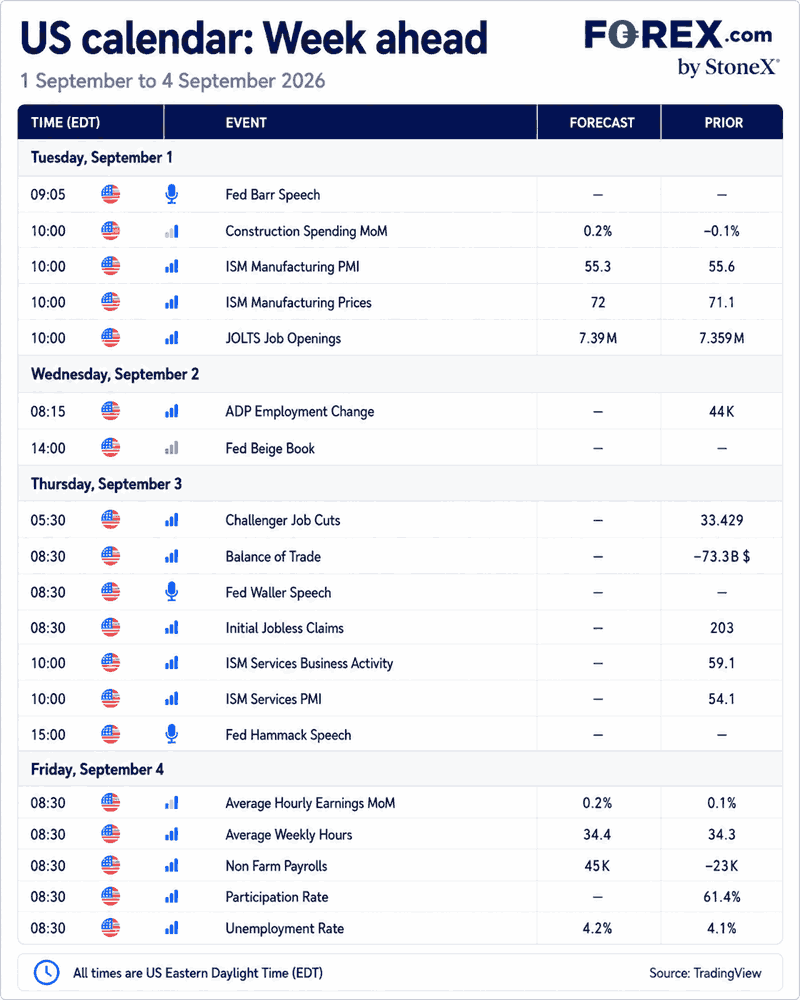
Looking at the US calendar in the week ahead, while the Fed’s priority is on inflation, the data flow will be dominated by the labour market.
Source: TradingView, FOREX.com
Akin to a crescendo, what starts with releases such as JOLTS, ADP and jobless claims will eventually culminate in the key event, August non-farm payrolls on Friday. After the noticeable weakness seen in the July jobs report, it looms as the key test as to whether the US labour market is really as stable as Warsh suggested during his speech.
Payrolls are expected to increase by 45,000 after falling by 23,000 in July, while the unemployment rate is seen ticking up to 4.2% from 4.1%. But given what’s been happening with labour-force participation, the unemployment rate may be the more interesting part of the report.
Participation reversal risk?
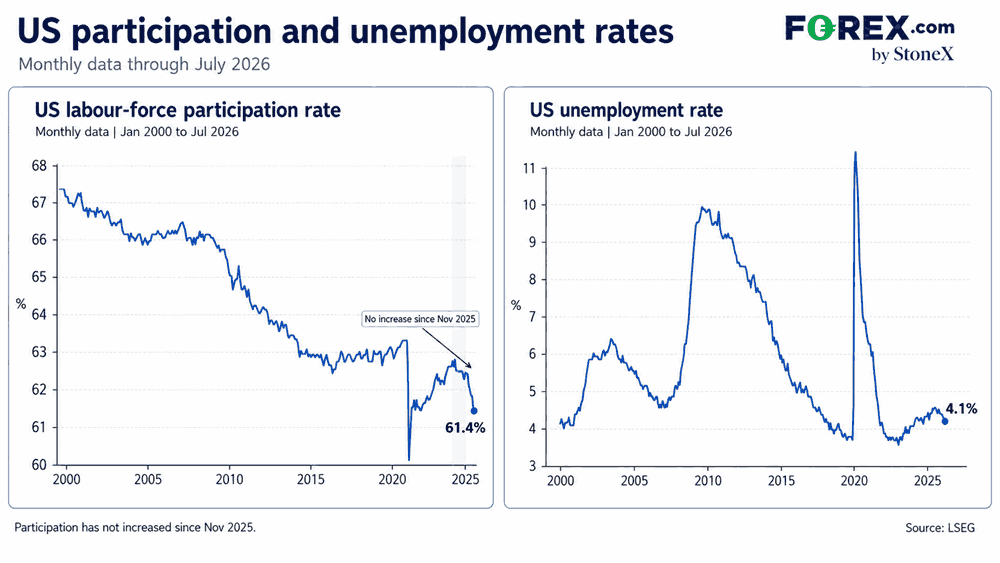
Participation has now gone eight consecutive months without an increase, matching the longest such run in the series going back to 1948. Over that period, it has fallen from 62.5% in November to 61.4% in July. That decline has helped to drag the unemployment rate lower despite continued softness in hiring.
Source: LSEG, FOREX.com
Even though the decline in participation looks structural, after such a historically long run without an increase, the risk of a move counter to the prevailing trend is there. If participation does pop higher, that alone could be enough to see the forecast increase in unemployment delivered, or result in an even larger rise if those re-entering the labour force aren’t immediately hired.
Given markets have been preconditioned to react to the payrolls figure, that may initially grab most of the attention. But a combination of another soft payrolls report and rising unemployment would raise questions over whether the Fed should be paying greater attention to the maximum employment side of its dual mandate.
Of course, the opposite also applies. A blowout payrolls number accompanied by unemployment holding steady or even declining would reinforce the likelihood that the Fed begins tightening policy again. On that front, keep an eye on average hourly earnings given linkages to services inflation.
Will Waller reinforce Warsh?
Fed Governor Christopher Waller’s speech on Thursday is another event of note. He’s one of the more influential voices on the FOMC and has developed a reputation recently for generating volatility across markets.
Waller has sounded more hawkish of late, but has the recent run of softer economic data changed that view? Or does he fall back in line behind what Warsh was communicating last week? By the time he speaks, markets will already have JOLTS, ADP and jobless claims in hand, giving him plenty to go and chew over before payrolls.
The ISM manufacturing and services surveys will also be watched, particularly the prices paid and new orders components, but they’re unlikely to really move the dial when it comes to delivering volatility.
History argues against one-and-done
While, on the surface, the week may come across as something of a placeholder until we receive further information on inflation, the counter-argument is that the incoming data could go and reposition the FOMC’s compass when it comes to its dual mandate.
With markets now basically 50-50 on a September hike, the question isn’t only whether the Fed will resume tightening this year. Historically, when the Fed has started hiking after an extended pause following an easing cycle, it has rarely been a one-and-done move.
Looking back at comparable episodes since 1982, there have been seven occasions where the Fed resumed hiking after at least six months after delivering its last cut. In six of those seven instances, the first hike was followed by at least one more move.
That makes the incoming data flow important not only for determining whether the Fed hikes, but whether it could mark the start of a broader tightening cycle rather than a solitary mid-cycle adjustment.
It’s also relevant for USD/JPY traders, with a noticeable increase recently in the correlation between the pair and implied pricing for Fed rate hikes this year, based on shifts in the shape of the Fed funds curve.
This content was created by an affiliate of FOREX.com and represents the views and opinions of the author/speakers, not the views and opinions of FOREX.com, StoneX Group Inc., or its subsidiaries. The content has not been independently reviewed by FOREX.com.
Japan calendar remains secondary
Source: TradingView, FOREX.com
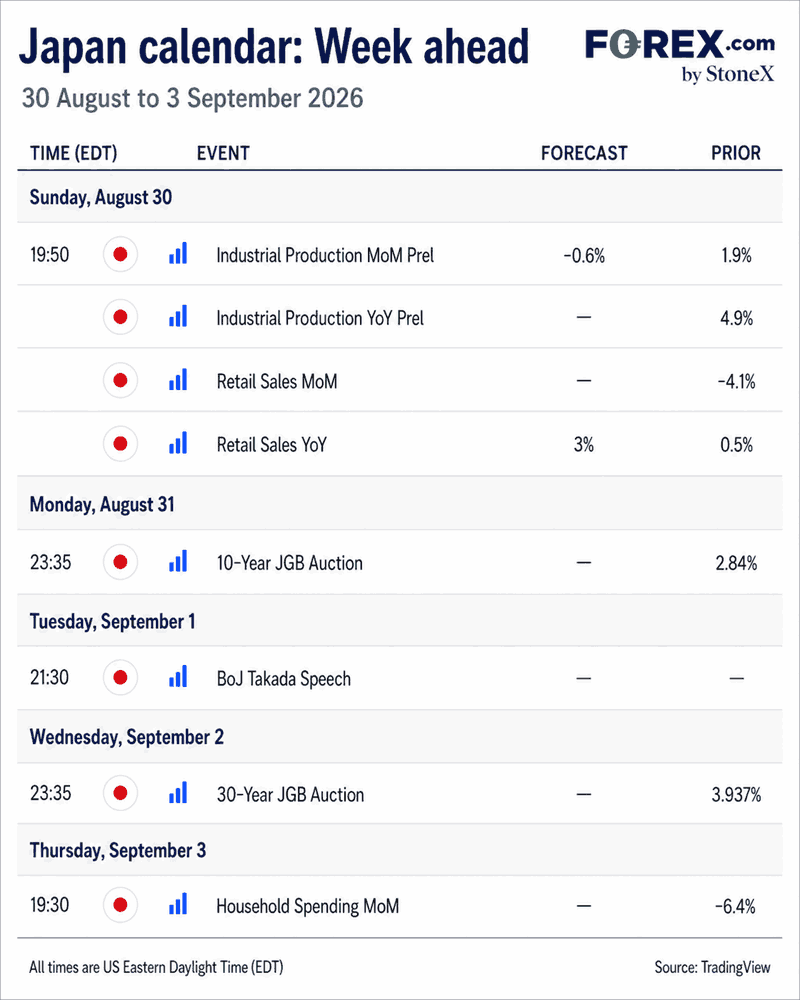
As has been the case for a while, the Japanese side of the equation remains secondary in nature, especially with few risk events on the calendar.
JGB auctions on Tuesday and Thursday are probably the most interesting given the pressure seen on the back end of the Japanese curve recently. Further weak outcomes would only reinforce the bearish trend we’ve seen in the yen.
Takata’s speech on Wednesday should also be on the radar. Having dissented at the BOJ’s July meeting in favour of a hike, he’s a known hawk. So unless he suddenly starts sounding dovish, it’s hard to see his comments meaningfully changing pricing for a September BOJ hike, which is already north of 80%.
USD/JPY breaks higher
Source: TradingView
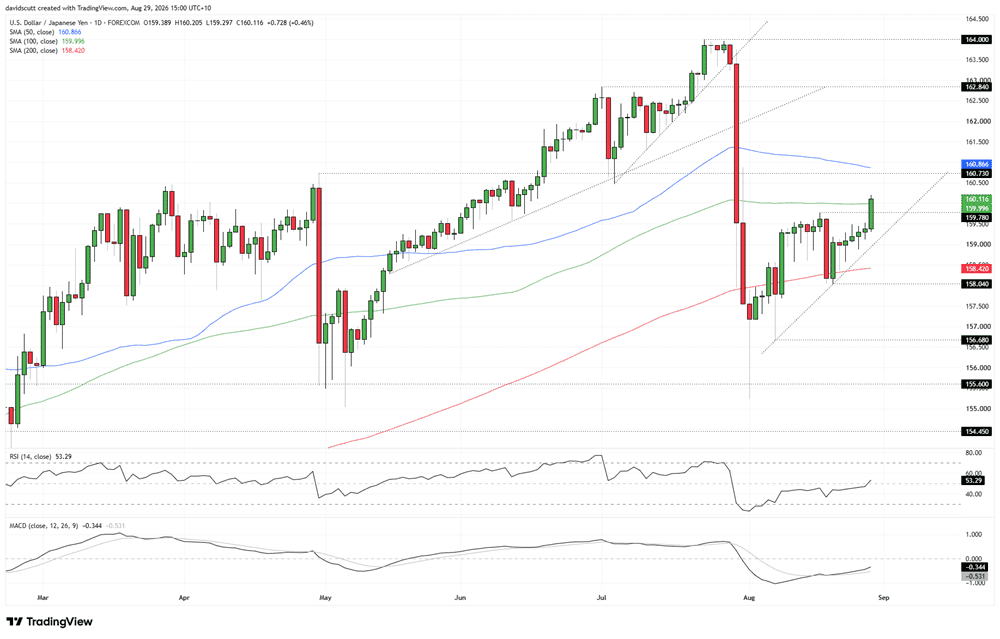
USD/JPY had been crawling higher in what loosely resembled an ascending triangle, even though it wasn’t the cleanest structure. But in the wake of Warsh’s speech on Friday, we saw a breakout that took out the August 18 high of 159.78, while also reclaiming the 100-day simple moving average.
The latter is now the immediate focal point underneath where the pair trades, along with a support zone running from 159.78 down to 159.50, which capped the pair for several weeks during August. Below that, the 200-day moving average is the next major level to watch.
Overhead, the confluence of the former record high of 160.73 and the 50-day moving average around the same level is the one to watch. A break above the latter that sticks would increase the odds of a retest of the high set earlier this year, even with the threat of intervention, with only 162.84 standing out as a level of note in between.
The message from the oscillators is one of a gradual shift in momentum. RSI 14 has moved marginally above the neutral 50 level for the first time since late July, while MACD has staged a bullish crossover but remains negative.
The broader message is that the downside momentum that had been building in the wake of the intervention episode is now all but over, with upside pressure arguably starting to build. While the oscillators remain broadly neutral, the string of higher lows and higher highs since the intervention episode reinforces the view that USD/JPY remains a buy-on-dips play.






Web Trader platform
Our sophisticated web-based platform is packed with features.
Open an account today
Experience award-winning platforms with fast and secure execution.
Economic calendar
Related articles

USD/JPY weekly outlook: Payrolls may challenge the Fed’s hawkish reset
USD/JPY has finally woken from its slumber. Payrolls now loom as the key test of whether the latest hawkish repricing sticks or sinks.

Euro Short-term Outlook: EUR/USD Pullback Nears Pivotal Uptrend Support 8 28 2026
Warsh's comments accelerated the EUR/USD selloff, raising the stakes as buyers look to stabilize the broader recovery.


EUR/USD forecast: All eyes on Warsh at Jackson Hole - Forex Friday
For much of this week, the EUR/USD has been edging lower with the US dollar regaining some ground after last week’s sell-off that was triggered, in part, by the bond market worries. Investors have been unwilling to bet further against the US dollar so far this week ahead of Kevin Warsh’s keynote speech at the Jackson Hole summit, due later today.
