


The Fed's Credibility Test Starts This Week
The Fed may be running out of meetings to deliver the multiple rate hikes many policymakers projected in June. If markets are underpricing the risk of action this week, AUD/USD and USD/CAD could be among the biggest movers.
Written by
David Scutt
Market Analyst
- Markets may be underpricing July hike risk
- Only four FOMC meetings remain this year
- Inflation still looks too sticky for comfort
- Front-end rates remain the key dollar driver
- Why AUD/USD and USD/CAD stand out
The Case for a July Surprise
Markets continue to favour the Fed holding rates steady this week. But when you step back and look at what's happened since the June FOMC meeting, that confidence may be misplaced. Policymakers delivered an unequivocally hawkish message six weeks ago, inflation remains well above target and, if the Committee is serious about restoring credibility in its fight against inflation, the window to act this year is beginning to narrow. With only four meetings remaining, including this week's decision, the risk of a rate hike may be greater than market pricing suggests.
June FOMC Left the Door Open
Futures currently assign a 40% probability of a hike at this week's FOMC meeting. I can understand why it's not more. Under the previous Fed leadership, significant policy changes were typically delivered alongside quarterly Summary of Economic Projections rather than at intervening meetings. But with a new Chair at the helm, the old rulebook may no longer apply, leaving open the possibility that the risk of a move this week is being underpriced.
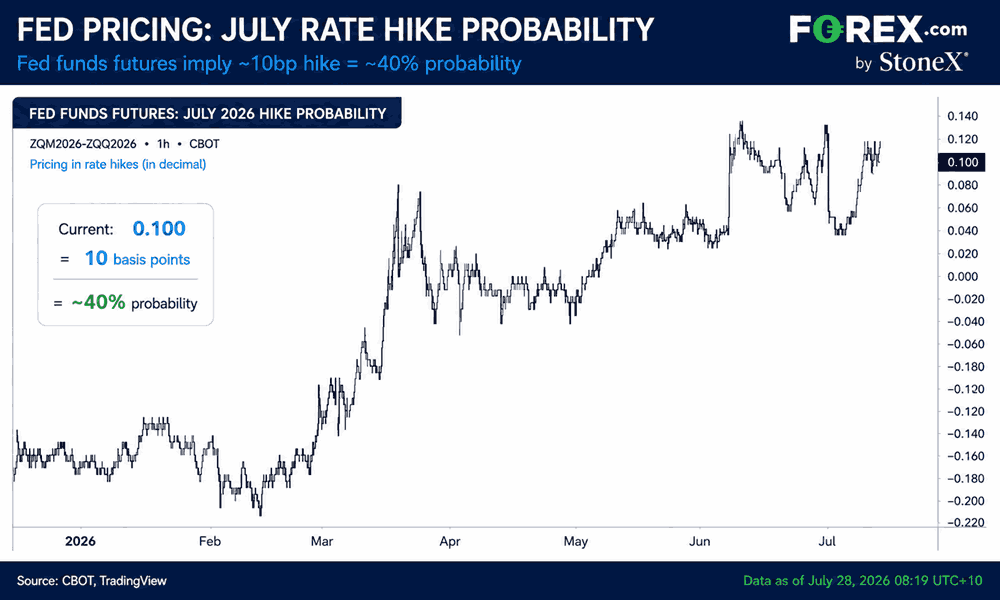
Source: TradingView, FOREX.com
At the June meeting, nine of the 18 participants who submitted forecasts saw a need for at least one rate hike this year, with six expecting multiple increases. While Kevin Warsh didn't provide a projection of his own, the final line of the FOMC statement declared simply that "the Committee will deliver price stability".
Six weeks on, the burning question remains: at what point does talking about price stability need to become acting on it?
Inflation Problem Hasn't Gone Away
While the US June CPI report was softer than expected, helped in part by lower energy prices, the broader inflation picture facing the Fed remains uncomfortable.
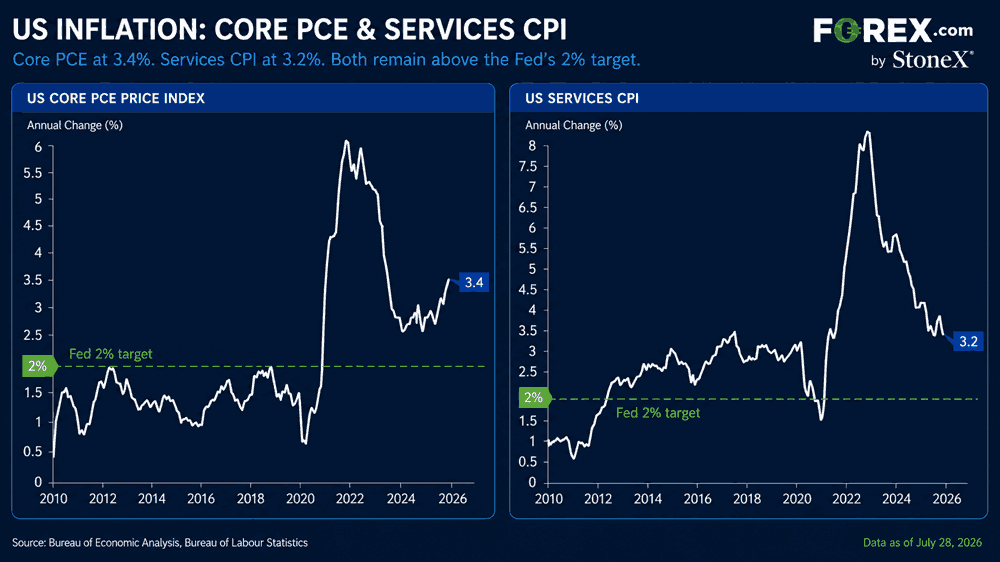
Source: TradingView, FOREX.com
Core PCE inflation, for now it's preferred inflation gauge, has remained above the 2% target for more than five years. The same can be said for services inflation. While the measure shown above is not core services CPI and includes a sizeable housing component, it has also remained well above levels that would normally be considered consistent with achieving the Fed's inflation objective.
What makes this cycle different from many that came before it is the apparent absence, at least for now, of the persistent disinflationary or outright deflationary impulse from goods prices that helped offset sticky services inflation in the past. Tariffs have played a role, but so too have higher energy prices, with crude oil now trading well above where it was at the June FOMC meeting.
Put it all together and inflation remains above target, services inflation remains sticky, the labour market continues to look tight, while goods prices are no longer providing the same offset they once did. The natural question then becomes: why is the Fed only flagging the risk of higher rates rather than delivering one?
Follow the Front End
If markets are underpricing the risk of a rate hike this week, history provides a useful guide as to where the adjustment is likely to occur.
As the correlation matrix below shows, there has been a consistently strong positive relationship between movements in US interest rate expectations, particularly at the front end of the Treasury curve, and the US Dollar Index over recent weeks. While correlations ebb and flow over time, the message has remained largely unchanged: when markets price a more hawkish Fed, the US dollar tends to strengthen.
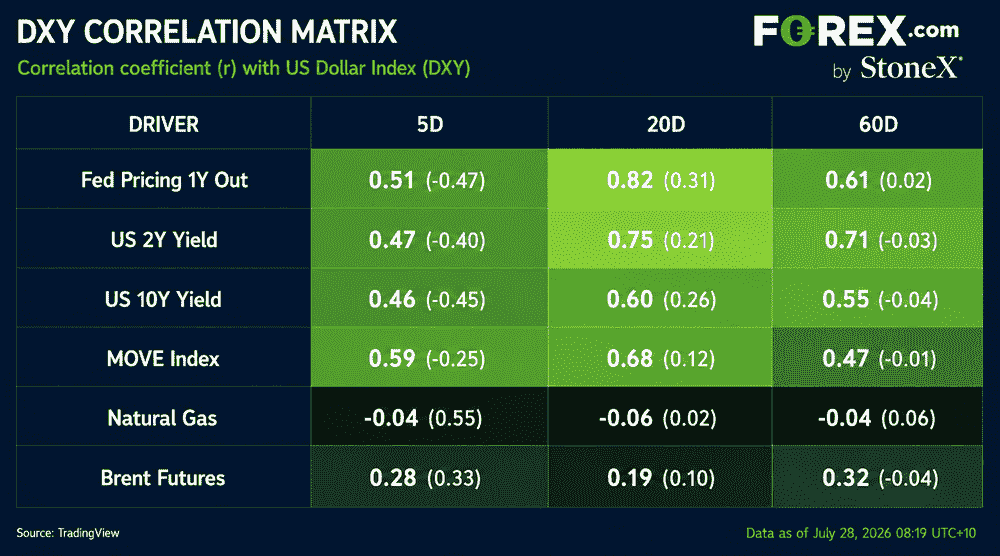
Source: TradingView, FOREX.com
That's the backdrop heading into this meeting. Following the June FOMC, markets have already delivered a significant hawkish repricing, with swaps now implying more than two full 25 basis point rate hikes by the middle of next year, including a fully priced increase at the September meeting.
If markets are underpricing the risk of a move this week and the Fed delivers, the adjustment is unlikely to be limited to a single 25 basis point hike. Instead, investors would likely be forced to reassess the Fed's reaction function and the expected path for policy rates. Rather than assuming policymakers will wait for quarterly meetings to act, markets may conclude this Committee is prepared to tighten whenever it believes it's necessary. That could trigger a violent repricing at the front end of the Treasury curve alongside another leg higher in the US dollar.
Importantly, the relationship between the US dollar and energy appears to have weakened noticeably in recent months. While oil prices were an important driver of the dollar early in the Iran war, that influence has steadily faded, leaving US interest rate expectations as the dominant force driving direction.
Why AUD/USD and USD/CAD?
If the Fed surprises with a hike this week, there are plenty of ways to trade it. But AUD/USD and USD/CAD stand out because they combine sensitivity to US interest rate expectations with commodity exposure and broader shifts in risk appetite.
As a result, they often deliver larger directional moves than lower-beta currency pairs such as EUR/USD, GBP/USD and USD/JPY when expectations around the Fed shift. If markets are forced to aggressively reprice the policy outlook, both could offer attractive trading opportunities.
Two Australian Events Matter First
While the Fed is likely to dominate broader US dollar direction later this week, there are also two important domestic event risks that Australian dollar traders need to navigate beforehand.
The first arrives at lunchtime Tuesday in Australia when RBA Governor Michele Bullock delivers a speech to the Anika Foundation in Sydney. Historically, this event has often provided markets with a useful steer on the RBA's thinking around the interest rate outlook, making it one to keep firmly on the radar.
Attention then shifts to Wednesday's Australian June inflation report, released just hours before the FOMC decision. Alongside the monthly CPI print, traders will also receive the quarterly trimmed mean measure, the RBA's preferred gauge of underlying inflation. Given its importance in shaping the Bank's policy outlook, the release has the potential to materially shift expectations for Australian rates before the Fed later that day.
As such, AUD/USD could be especially sensitive to shifting interest rate expectations on both sides of the Pacific, potentially creating plenty of volatility before the FOMC decision even arrives.
AUD/USD: Momentum Begins to Fade
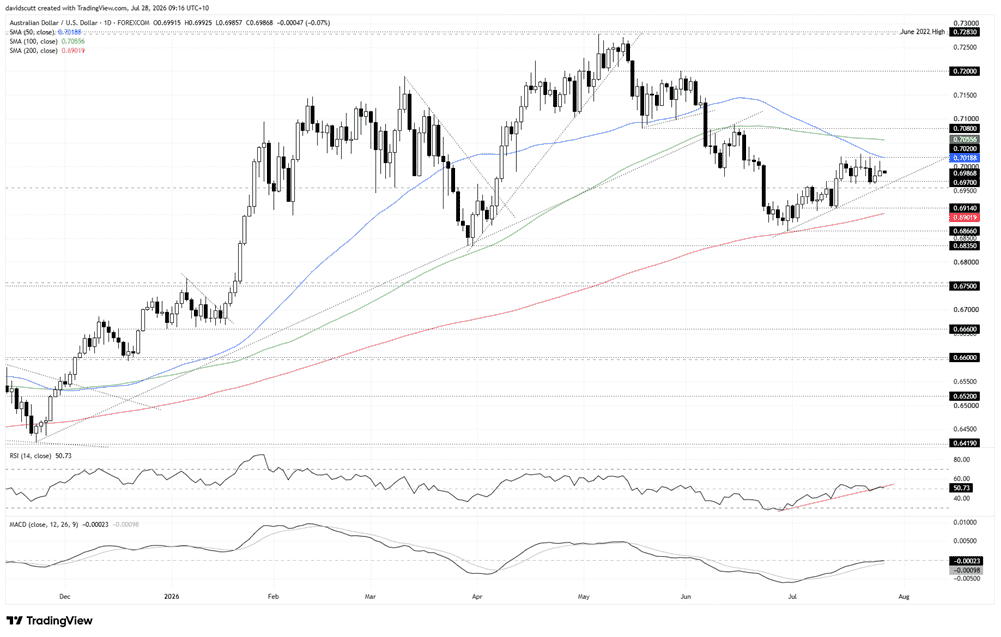
Source: TradingView
AUD/USD remains trapped in a narrow sideways range on the daily timeframe between resistance at 0.7020 and support at 0.6970, where it's spent the better part of the past two weeks.
For now, the pair remains in a minor uptrend. But the momentum picture is beginning to soften. RSI (14) is threatening to break the shallow uptrend that's been in place throughout July, while MACD has flattened and is converging back towards the signal line, albeit while remaining marginally in negative territory. It's still a neutral signal, but there's a growing sense the tepid rebound from the late-June lows may be running out of steam.
In the near term, a break beneath 0.6970 would bring the minor uptrend from the late-June low into play. Below there, attention shifts to 0.6914, followed by the 200-day simple moving average at 0.6902 and the late-June swing low at 0.6866. A convincing break beneath that level would have bears eyeing a retest of the March swing low at 0.6835.
On the topside, a clean break above 0.7020 and the falling 50-day simple moving average would bring the 100-day moving average at 0.7055 into view, followed by 0.7080, a former breakdown level that has repeatedly acted as both support and resistance in recent months. A break above there would shift the focus to resistance at 0.7200.
While an open mind should be kept on directional risks, the broader price action and message from the momentum indicators suggest risks remain modestly skewed to the downside.
USD/CAD: Bulls Regain Control
Source: TradingView
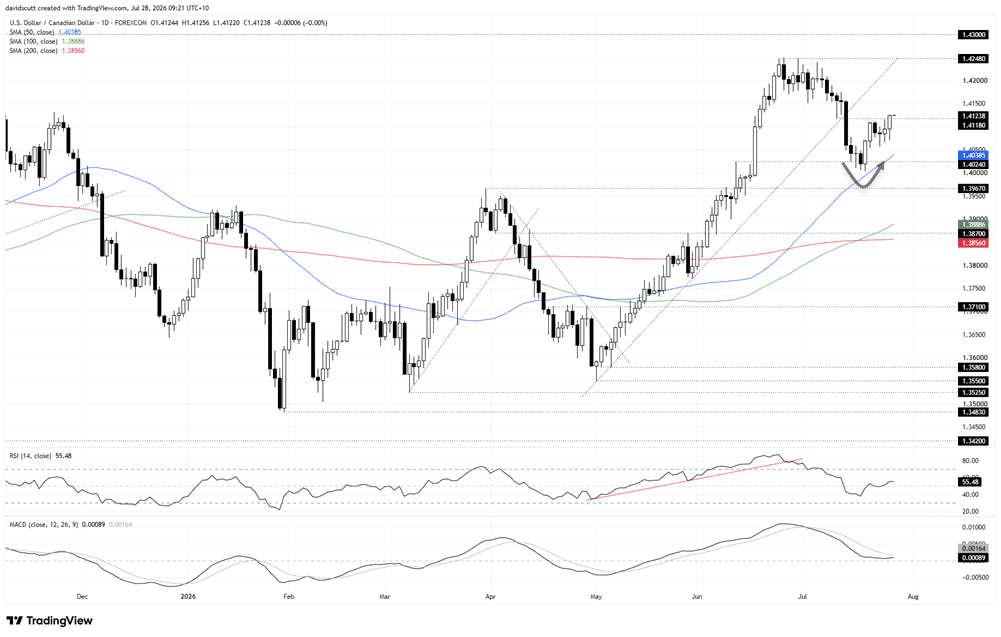
The breakdown in USD/CAD seen earlier this month looks to have run its course, with former resistance at 1.4024 reverting to support above the rising 50-day simple moving average.
Last week delivered a bullish engulfing candle, followed by renewed upside momentum. Monday then saw the pair reclaim 1.4118, the breakdown level from July 14. With USD/CAD continuing to post a series of higher lows, that break opens the door for longs to be established above the level with a tight stop beneath it, initially targeting a retest of resistance at 1.4248, which capped the pair on multiple occasions in June. A convincing break above there would bring 1.4300 into view.
On the downside, 1.4024 and the rising 50-day simple moving average now form an important support zone. A break beneath the July 20 low would expose 1.3967, the former swing high from late March. Below there, attention shifts to the 100 and 200-day simple moving averages, along with 1.3870, a level that has repeatedly acted as both support and resistance throughout the year.
The message from the momentum indicators is more neutral than outright bullish. However, RSI (14) has rebounded back above the neutral 50 level and is beginning to post higher highs, while MACD is converging on the signal line while remaining in positive territory, setting the scene for a potential bullish crossover. Taken together, the signals suggest directional risks remain modestly skewed to the upside.





Web Trader platform
Our sophisticated web-based platform is packed with features.
Open an account today
Experience award-winning platforms with fast and secure execution.
Economic calendar
Related articles

Canadian Dollar Forecast: USD/CAD Weekly Reversal Puts Yearly Uptrend Back in Focus 8 29 2026
USD/CAD has staged its strongest weekly advance since June, shifting the focus to whether a more durable low is finally taking shape.

USD/JPY weekly outlook: Payrolls may challenge the Fed’s hawkish reset
USD/JPY has finally woken from its slumber. Payrolls now loom as the key test of whether the latest hawkish repricing sticks or sinks.

Euro Short-term Outlook: EUR/USD Pullback Nears Pivotal Uptrend Support 8 28 2026
Warsh's comments accelerated the EUR/USD selloff, raising the stakes as buyers look to stabilize the broader recovery.