

USD/CAD and USD/MXN Q4 2026 Outlook: Will the U.S. Dollar Dominate North America Again?
The final stretch of 2026 is approaching, and North America's major currencies have begun to show a shift in the strength dynamics seen earlier in the year. New expectations of a more aggressive monetary policy stance, particularly in the United States, could be significantly reshaping the outlook for the region. At the same time, this backdrop, combined with potential trade tensions across North America, may become one of the most important drivers of currency performance in the months ahead.
Written by
Julian Pineda
Market Analyst
The final stretch of 2026 is approaching, and North America's major currencies have begun to show a shift in the strength dynamics seen earlier in the year. New expectations of a more aggressive monetary policy stance, particularly in the United States, could be significantly reshaping the outlook for the region. At the same time, this backdrop, combined with potential trade tensions across North America, may become one of the most important drivers of currency performance in the months ahead.
In this environment, both the Canadian dollar and the Mexican peso continue to show difficulties in consistently recovering against a U.S. dollar that has regained strength, particularly after the recent shift in expectations surrounding the Federal Reserve. If confidence in the USD remains resilient through the final part of the year, both USD/CAD and USD/MXN could continue to reflect a meaningful degree of indecision or even develop more sustained bullish pressure during the months ahead.
Are North America's Central Banks Moving in Different Directions?
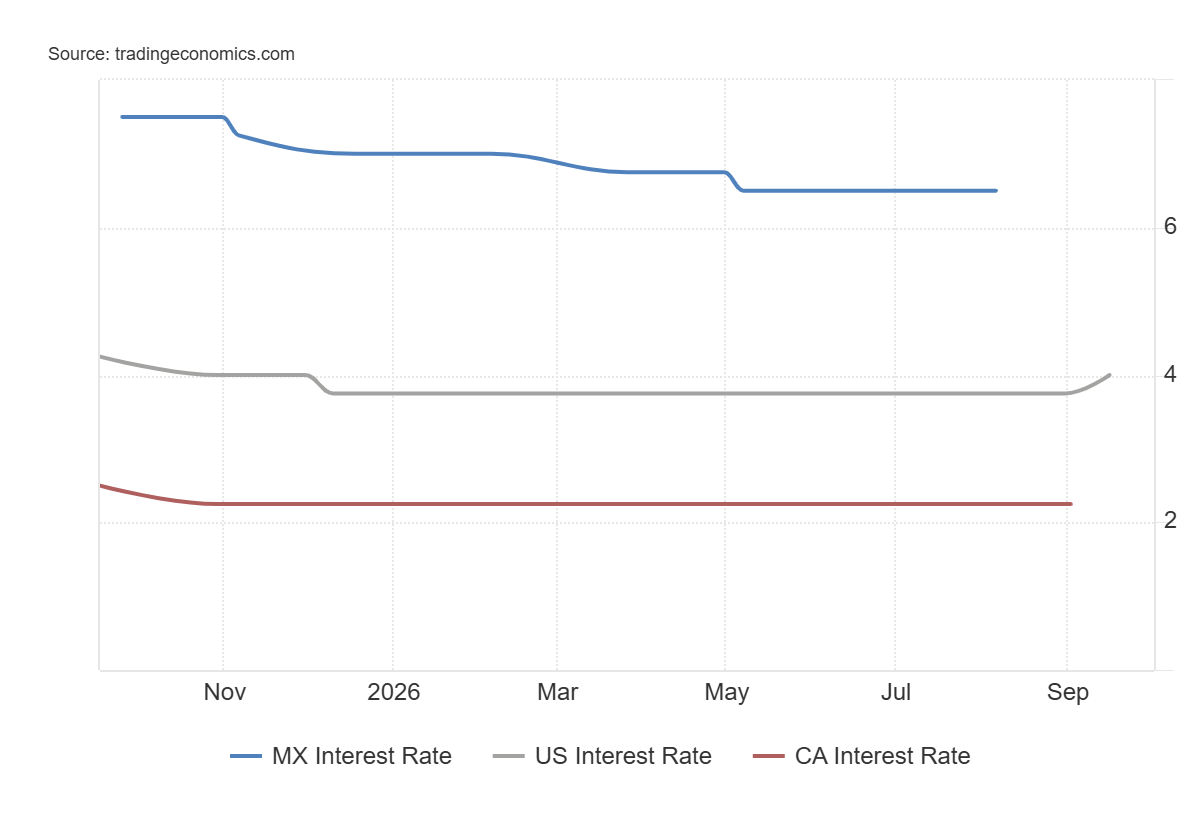
As this article is being written, North America's central banks continue to follow different monetary policy paths. For now, Banco de México still maintains the highest interest rate in the region at 6.5%, although it has already reduced the benchmark from the 7.00% level seen at the beginning of the year. The institution continues to adopt a cautious approach while evaluating incoming economic data, supporting a relatively neutral outlook for the coming months.
Bank of Canada, meanwhile, remains the institution that has made the fewest changes compared with its regional peers. It has not adjusted interest rates since October 2025, leaving the policy rate unchanged at 2.25%, the lowest level in North America. This reflects a wait-and-see strategy as policymakers continue to assess economic conditions before making any new adjustments.
The Federal Reserve, by contrast, has begun to reshape the regional landscape. It is currently the only central bank that has resumed raising interest rates, moving the benchmark rate from 3.75% to 4.00%. In addition, the institution has started to signal a more aggressive stance for the months ahead, a dynamic that could continue to support the U.S. dollar against its regional counterparts.
North America Interest Rates Table 2025–2026

Color scale: Green to red. Green represents higher interest rates, while red represents lower rates in each country.
Source: Data - Tradingeconomics
North America Interest Rates Chart 2025–2026
Source: Tradingeconomics
The contrast between the three institutions becomes clear when looking at the evolution of interest rates over recent months. Mexico continues to maintain the highest policy rate in the region, the Bank of Canada the lowest, while the Federal Reserve stands out as the only institution that has resumed rate hikes during 2026. These differences not only reflect distinct rate levels but also monetary policy approaches that are becoming increasingly divergent across the three economies. These differences are also evident in the most recent communications from each central bank:
- During its latest meeting, the Bank of Canada left rates unchanged at 2.25% on September 2. Although policymakers continue to acknowledge upside inflation risks, they made it clear that they are not yet prepared to begin a new tightening cycle, meaning any future adjustments will remain data dependent.
- Banco de México's most recent decision took place on August 6 and concluded with rates unchanged at 6.5%. While the prolonged easing cycle appears to have come to an end, the institution continues to stress that rate hikes are not part of its base-case scenario, maintaining a prudent stance while assessing inflation trends.
- In contrast, the Federal Reserve raised rates to 4.00% during its September 16 meeting. Policymakers highlighted the strength of economic activity and the labor market, while inflation continues to show insufficient signs of slowing, leaving the door open to further rate increases.
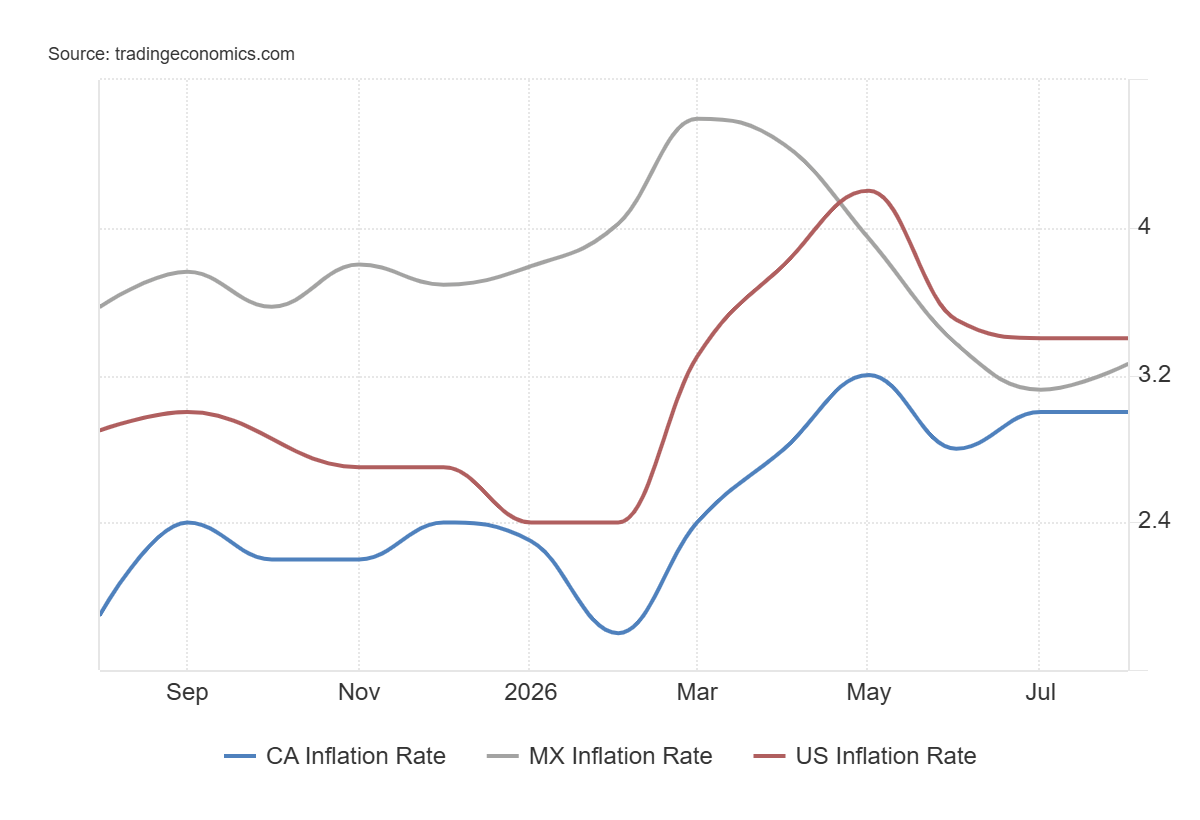
With that in mind, inflation remains one of the most important drivers of monetary policy decisions across the region. In Canada, inflation has eased to the 3.0% area from 3.2% in May. Although still above the 2.00% target, price pressures continue to moderate gradually. In Mexico, inflation slowed to 3.26% in August, making it the economy that has shown the clearest signs of disinflation across North America. In the United States, however, inflation remains near 3.4% after reaching a peak of 4.2% in May, still well above the Federal Reserve's 2.00% objective.
North America Inflation Trends 2025–2026
Source: Tradingeconomics
These figures paint a mixed picture. Mexico continues to display a more pronounced moderation in inflationary pressures, while Canada and especially the United States are still dealing with more persistent price pressures. This distinction is significant because it helps explain why markets are beginning to price in a more aggressive path for the Federal Reserve, supported both by recent comments from policymakers and by inflation data that has yet to show sustained improvement. Meanwhile, both Banxico and the Bank of Canada appear to have greater room to maintain cautious policy approaches in the months ahead.
Taken together, the differences that have started to emerge among North America's central banks could become one of the most important drivers of currency performance through the final months of 2026. While the Federal Reserve is moving toward a more restrictive stance supported by inflation that continues to show resilience, both Banxico and the Bank of Canada are maintaining more cautious approaches, aided by greater relative stability in their inflation trends. This divergence could begin to alter the balance of strength that prevailed throughout much of the year and restore some momentum to the U.S. dollar within the region, particularly if expectations for higher interest rates continue to build in the months ahead. Under this backdrop, the Mexican peso could begin to lose part of the advantage derived from its interest rate differential, while the Canadian dollar may continue to face challenges against a U.S. market supported by higher bond yields and the dollar's traditional role as a safe-haven asset. As a result, both USD/CAD and USD/MXN could begin to develop periods of greater indecision or even more sustained buying pressure over the coming months.
Has the Trade War Made a Comeback?
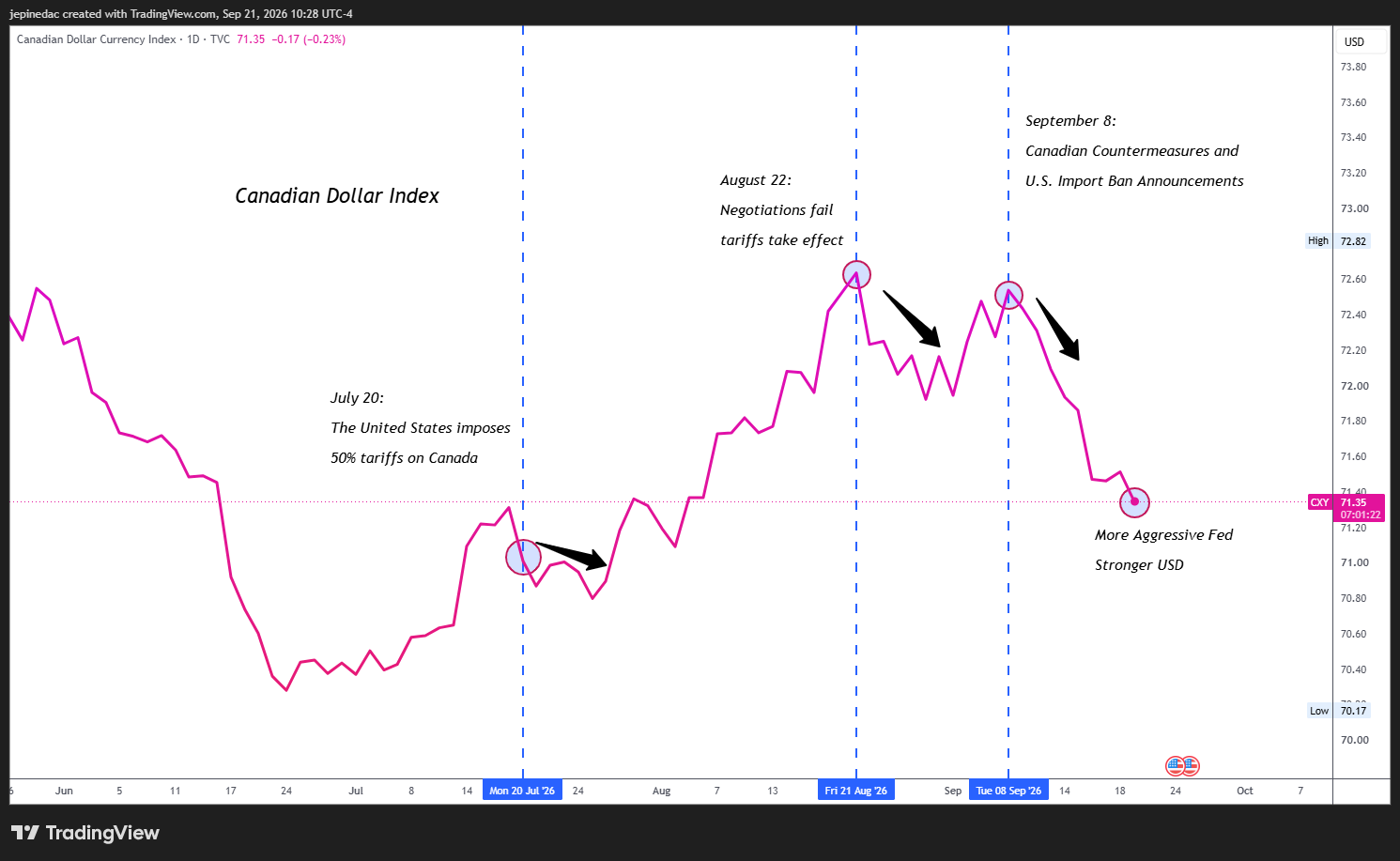
As 2026 draws to a close, one of the developments regaining attention is the growing trade dispute between the United States and Canada. On July 20, the United States announced tariffs of up to 50% on selected Canadian products and, following the collapse of negotiations, those measures took effect on August 22. In response, Canada imposed retaliatory measures on approximately CAD 27 billion worth of U.S. goods, including tariffs that also reach 50%.
Tensions escalated again on September 8, when the new Canadian measures officially came into force and the United States announced potential import restrictions on selected Canadian products. This measure, which would go beyond traditional tariffs, is expected to take effect on September 29.
Against this backdrop, sentiment toward the Canadian dollar has started to weaken. Not only has there been little progress toward a resolution, but the dispute could also begin to undermine perceptions of Canada's economic stability. This impact can be observed in the CXY, the index that measures the average strength of the Canadian dollar, where several episodes of trade escalation have coincided with declines in the indicator. Moreover, the currency has struggled to regain the highs seen months ago near the 72-point level, suggesting that the trade conflict is having a meaningful impact on demand for CAD beyond monetary policy considerations.
Source: Data TVC - Tradingview
This situation could also extend some of its effects to Mexico over the coming months. The dispute increases the risk that the United States adopts a tougher stance during the review of the USMCA, creating additional uncertainty around regional trade. In addition, Mexico is participating in discussions involving some of the sectors currently at the center of the dispute with Canada, meaning it cannot be ruled out that similar pressures could eventually emerge for Mexico as well. Under that scenario, the review of the trade agreement could increase the risk premium attached to both CAD and MXN.
As a result, while the recent escalation helps explain part of the weakness observed in the Canadian dollar, it also leaves the door open to indirect effects on Mexico. Unless meaningful diplomatic progress or stronger trade agreements emerge, a sense of caution may continue to dominate sentiment around USD/MXN. At the same time, with Canada being the primary target of the current measures, the dispute could continue to support more sustained buying pressure around USD/CAD in the months ahead.
USD/CAD Shows Signs of Growing Indecision
Source: StoneX, Tradingview
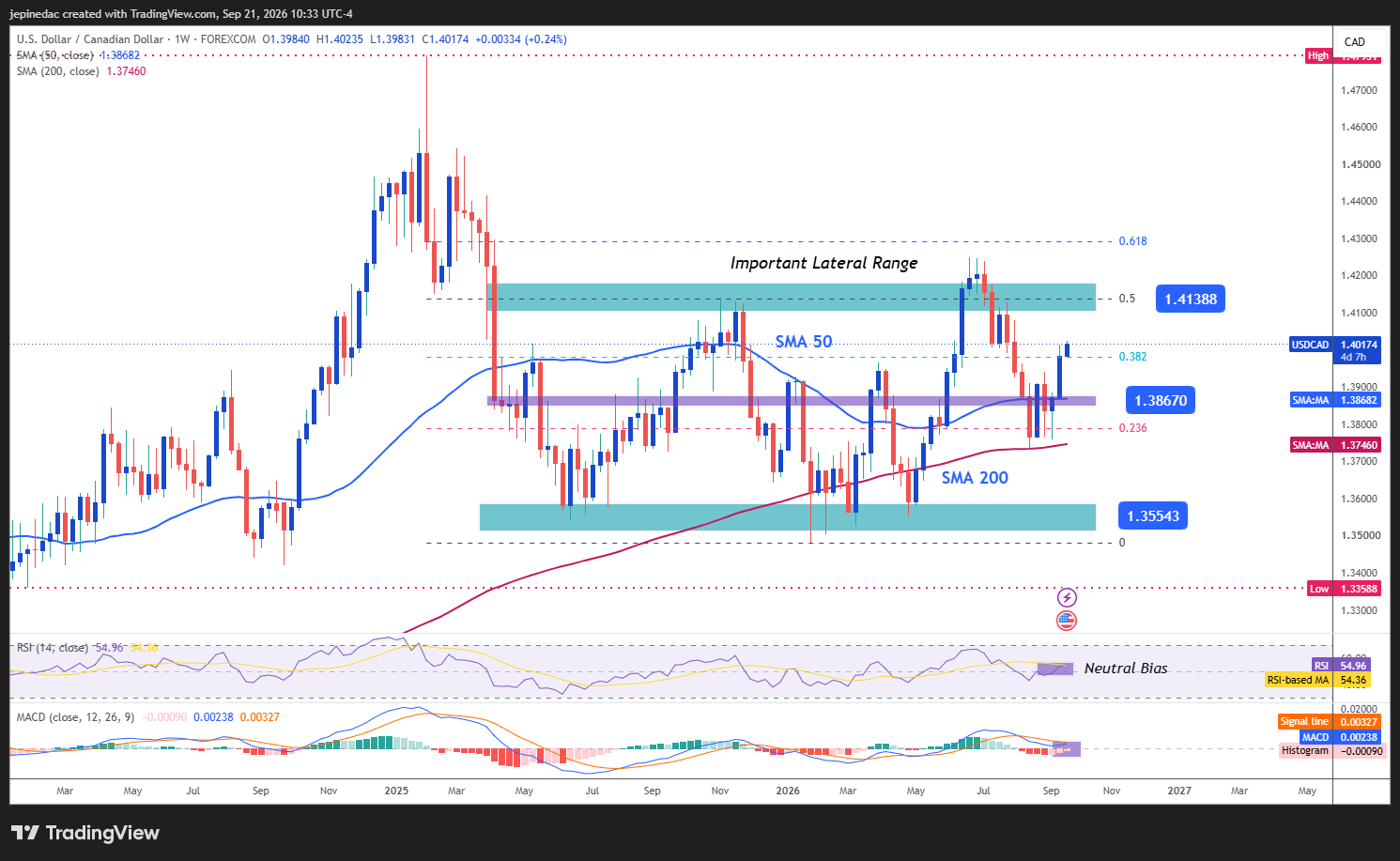
- A Potential Trading Range Emerges: Price action in USD/CAD over recent months has started to reflect a lack of clear direction on the weekly chart. So far, the pair has been unable to develop a meaningful trend and has instead continued to trade within a broad range that contains most of the recent price activity. If prices remain within this structure, it may be difficult to see the beginning of a more defined trend, leaving the current range as the most important technical reference for the months ahead.
- RSI: The RSI continues to trade near the 50 neutral level, a situation that reflects a balance between buying and selling pressure over the past 14 weeks. If this behavior persists, the sense of market indecision is likely to remain a relevant feature of the chart.
- MACD: A similar scenario can be observed in the MACD, whose histogram continues to fluctuate around the 0 neutral line. This reading also reflects balance in the average strength of moving averages and reinforces the idea of a market that currently lacks a dominant direction.
Key Levels:
- 1.41388: Key resistance level that coincides with the upper boundary of the trading range and the 50% Fibonacci retracement level. Price action that manages to consolidate above this area could begin to favor a more dominant bullish bias and support the development of a more relevant upward structure in the months ahead.
- 1.38670: The midpoint of the chart, which coincides with an important equilibrium zone and the 50-period simple moving average. As long as prices continue to develop near this reference, the current neutral outlook may continue to dominate and reinforce the importance of the existing lateral range.
- 1.35543: Key support level located at the lower boundary of the range and below the chart's most relevant moving averages. Sustained price action below this area could signal a significant break of the current structure and open the door to a more dominant bearish bias over the coming months.
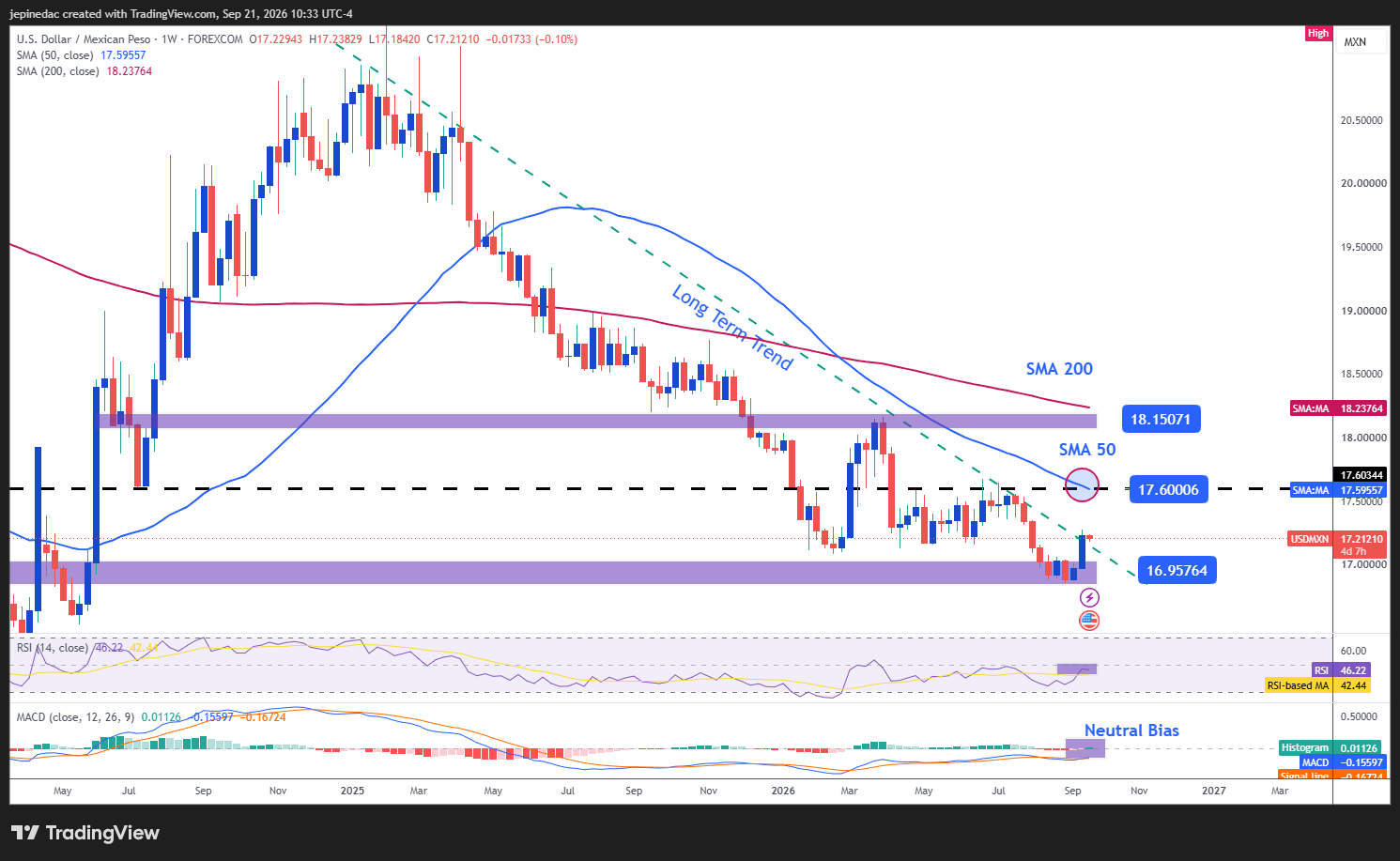
USD/MXN Begins to Challenge Its Dominant Downtrend
Source: StoneX, Tradingview
- The major trendline enters a risk zone: One of the most relevant features of USD/MXN price action is the broad downtrend that has dominated the pair for several months. However, this structure has started to show signs of exhaustion and is increasingly moving into a risk zone. If selling pressure fails to regain momentum, the prevailing downtrend could lose relevance and give way to a period of greater indecision or even a more pronounced bullish bias in the months ahead.
- RSI: The RSI continues to fluctuate around the 50 neutral level, reflecting a balance between buyers and sellers. This reading supports the possibility that the market may continue moving through a period of uncertainty and limited directional conviction.
- MACD: A similar picture can be observed in the MACD, whose histogram remains very close to the 0 level, reflecting balance in moving average momentum and the absence of a dominant trend. As long as this dynamic persists, indecision may continue to play a significant role within the chart.
Key Levels:
- 18.15: Major resistance located near important highs from previous months and also aligned with the 200-period simple moving average. Price action that manages to consolidate above this level could signal the beginning of a more dominant bullish bias and support the formation of a new long-term uptrend.
- 17.60: A nearby barrier that coincides with the 50-period simple moving average and an important retracement zone on the chart. If price continues to trade around this level, a lack of clear direction could remain the dominant theme, potentially increasing the relevance of a broader trading range.
- 16.95: Key support located at the 2026 lows and considered the most important downside barrier on the chart. A sustained break below this level could restore momentum to the bearish bias and extend the downtrend as the dominant market structure over the coming months.
Written by Julian Pineda, CFA, CMT – Market Analyst
Follow him on: @julianpineda25
Latest market news










Web Trader platform
Our sophisticated web-based platform is packed with features.
Open an account today
Experience award-winning platforms with fast and secure execution.
Economic calendar
Related articles

USD/CAD, Gold Forecast: Two trades to watch
USD/CAD rises as US-Canada trade tensions escalate. Gold extends rally to fresh three-month high ahead of Fed Chair Warsh's speech and inflation data.


FX Futures Positioning: USD Falls, CAD Strengthens, JPY Shorts Return | COT Report
USD weakness, rising CAD demand and renewed JPY shorts shape this week’s COT report ahead of Jackson Hole.


USDMXN Forecast Mexican Peso Reaches Levels Not Seen Since 2024
One of the most notable developments in recent weeks has been the sustained strength of the Mexican peso against the U.S. dollar. During today's session alone, USD/MXN is down approximately 0.5%, reinforcing the bearish bias that currently dominates the currency pair.