


Wall Street Forecast: DJIA falls as treasury yields hit new highs and ahead of the Trump-Xi summit
U.S. stocks are falling, further extending losses from the previous session, as oil prices move higher alongside Treasury yields and caution reigns ahead of the summit between President Trump and Xi Jinping.
Written by
Fiona Cincotta
Senior Market Analyst
US futures
Dow futures -0.20% S&P 500 futures -0.35% & Nasdaq futures -0.84%
European futures
FTSE 0.05%, DAX -0.10%
- US stocks fall as Treasury yields rise further
- US 30 yet treasury yield reaches its highest level since 2004.
- USD climbs to a 2-month high on Fed rate hike expectations
- Oil rises as US-Iran diplomatic efforts show few signs of progress
U.S. Stocks Fall as Oil and Treasury Yields Rise
U.S. stocks are falling, further extending losses from the previous session, as oil prices move higher alongside Treasury yields and caution reigns ahead of the summit between President Trump and Xi Jinping.
An exchange between U.S. and Iranian leaders at the U.N. General Assembly this week has sent Brent back above $100 a barrel. Combined with stronger-than-expected U.S. PMI data yesterday, this has added to inflationary concerns.
The yield on the 30-year Treasury has reached its highest level since 2004 as investors price in expectations of a prolonged conflict and higher borrowing costs.
Meanwhile, the U.S. 10-year Treasury yield is hovering around its highest level in 19 years at 5.1%. Higher Treasury yields hurt demand for riskier assets such as equities by increasing the opportunity cost of holding stocks.
The market is now pricing in a 75% probability of a 25-basis-point rate hike in December, up from 50% just a day ago.
This increase came following the PMI data and commentary from several Fed officials, who have supported the view that rates may need to be hiked again this year.
Attention is now turning to the Trump-Xi Jinping summit, where the two leaders are expected to discuss trade, the Middle East conflict, Taiwan and AI regulation.
On a positive note, U.S. Treasury’s Scott Pearson said the two economic superpowers had agreed to extend their truce until January 10.
Corporate Movers
Meta is down 2%, following an almost 12% gain so far this week on optimism surrounding its Muse AI agent. Mark Zuckerberg also unveiled the company’s Meta VR glasses and Muse Charm, a handheld device that works with Muse.
Oracle shares are falling sharply, down 4%, on reports the company sent a force majeure notice tied to its New Mexico data centre project to protect itself from higher expenses. The company is looking to delay payment on Project Jupiter if it does not come online as expected in 2028.
Dow Jones Forecast – Technical Analysis
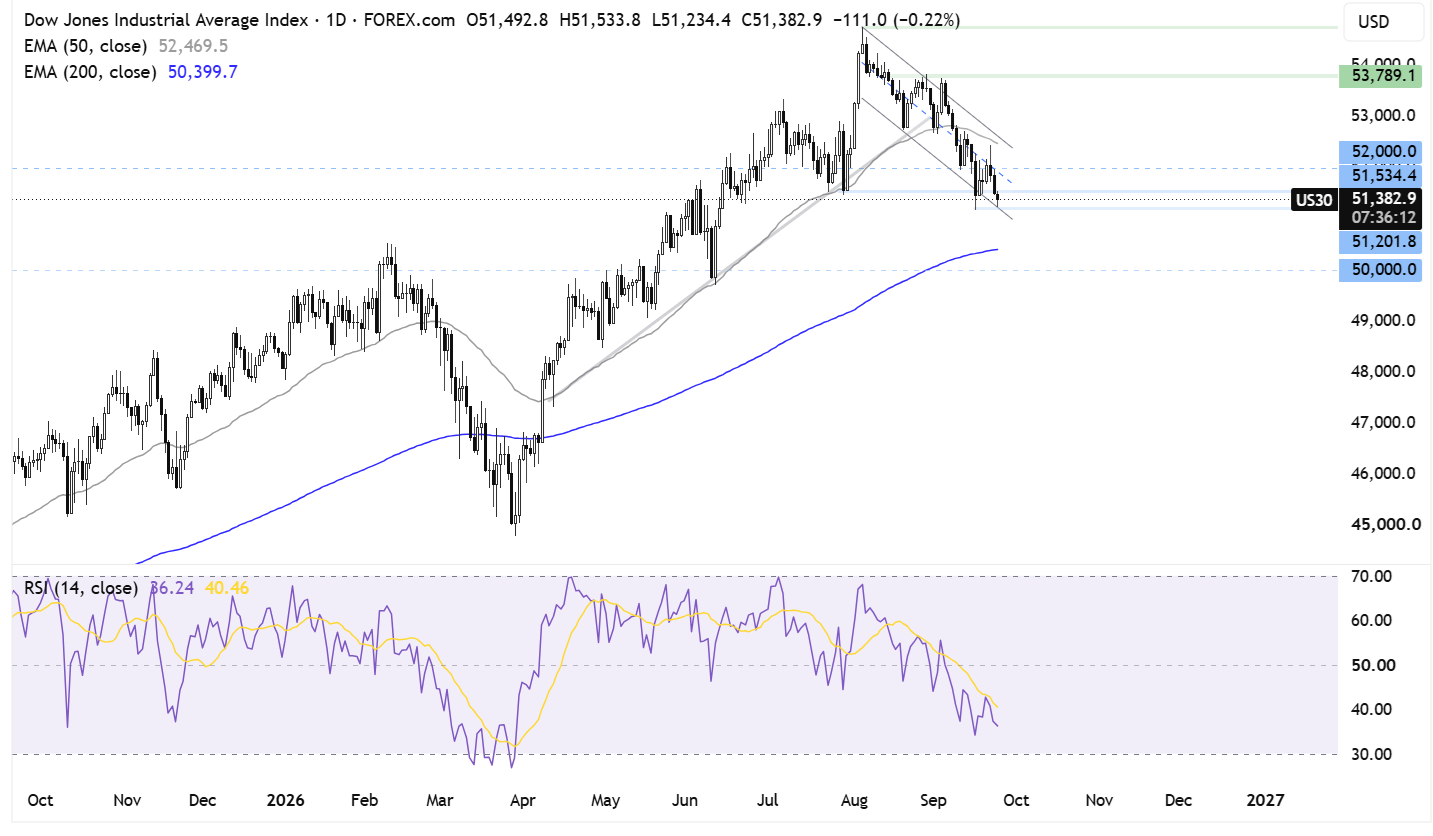
The Dow Jones trades within a descending channel and below the 50 EMA, which, combined with the RSI below 50, keeps the technical picture bearish.
Sellers will need to break below 51,200, the lower band of the channel and September low, to create a lower low and extend the bearish move towards 50,400, the 200 EMA.
On the upside, buyers will need to rise above 51,500, the July low, before turning attention towards the upper band of the falling channel and the 50 EMA around 52,500, bringing 53,800 into focus, the September high.
FX Markets – Dollar Rises, GBP/USD Falls
The USD is rising for a second straight day to a fresh eight-month high, supported by the U.S. rate outlook. Markets have ramped up Fed rate hike expectations following strong economic data and hawkish Fed commentary this week.
EUR/USD has fallen to an almost two-month low at 1.1370 amid U.S. dollar strength, despite the German IFO business climate improving by more than expected. ECB-Fed divergence continues to keep the pair under pressure. With the Fed expected to tighten rates further, the ECB faces a delicate balancing act between keeping inflation in check and protecting the fragile economy.
GBP/USD has fallen to an almost two-month low around 1.3225, weighed down by the diverging BoE-Fed monetary policy outlook.
According to the OECD, the Bank of England does not need to raise interest rates further, with UK monetary policy already tight enough to keep inflation in check. The OECD expects the BoE to keep rates unchanged at 3.75% until 2027 before cutting them by 25 basis points in the third quarter.
This contrasts with the Fed, which is looking to tighten policy further in the coming months.
Oil Prices Rise as Diplomatic Hopes Fade
Oil prices are rising more than 1% on Thursday as diplomatic talks between the U.S. and Iran show few signs of progress and investors remain concerned about a potential U.S. ban on diesel exports.
Brent rose above $106 earlier in the day, while WTI is around $93, after reports that Iran has given the U.S. one week to remove naval blockades. Iran said it would never surrender to U.S. pressure.
Tehran is, however, reviewing Washington’s response to its peace proposal, but the lack of concrete signs of progress is supporting oil prices.
A potential U.S. ban on diesel exports is also keeping oil prices under the spotlight. The Trump administration is looking to ease diesel prices domestically; however, a U.S. diesel export ban could do little to ease high energy prices and could worsen global supplies, further disrupting economies.
Latest market news







Web Trader platform
Our sophisticated web-based platform is packed with features.
Open an account today
Experience award-winning platforms with fast and secure execution.
Economic calendar
Related articles
Nasdaq 100 Forecast: NDX slips ahead of Fed Chair Warsh’s speech
U.S. stocks are edging lower on Friday, giving back some of yesterday's gains after Nvidia's strong outlook revived the tech trade. The focus has now shifted firmly to Fed Chair Kevin Warsh's Jackson Hole speech, with investors looking for more clarity on the outlook for interest rates.

S&P 500 Forecast: SPX after Nvidia revives confidence in the AI trade
U.S. stocks are heading higher on Thursday, with technology leading the move after Nvidia's stronger-than-expected outlook revived confidence in the AI trade.

Oil, EUR/USD Forecast: Two trades to watch 2608
Oil falls further on diplomatic hopes for a Middle East resolution. EUR/USD consolidates ahead of U.S. inflation and Jackson Hole.