

S&P 500 forecast: Stocks extend drop as correction risks grow
US and global equity markets have extended Wednesday’s sell-off, with Wall Street opening lower after a weak handover from Asia and Europe. The deterioration in risk appetite has been spreading across global markets. The dollar was firmer, Treasury yields were holding onto yesterday’s gains, while gold, silver and bitcoin were all under pressure alongside equities and major currencies.
Written by
Fawad Razaqzada
Market Analyst
US and global equity markets have extended Wednesday’s sell-off, with Wall Street opening lower after a weak handover from Asia and Europe. The deterioration in risk appetite has been spreading across global markets. The dollar was firmer, Treasury yields were holding onto yesterday’s gains, while gold, silver and bitcoin were all under pressure alongside equities and major currencies. Against this backdrop, our S&P 500 forecast remains tilted to the downside in the near-term outlook.
Why are the market struggling?
The backdrop is becoming increasingly difficult for US and indeed global stocks. On Wall Street, market breadth has deteriorated sharply, bond yields are breaking higher and concerns about the US fiscal position are resurfacing, just as expectations of further Federal Reserve tightening are building. With fewer stocks doing the heavy lifting, the risk of a more meaningful correction has increased.
The weakness in risk assets has gathered pace over the past few sessions, as last week’s post-FOMC bounce has faded. Higher interest-rate expectations, elevated oil prices and a stronger dollar have combined to take some of the air out of the rally. I was never particularly convinced that equities could remain comfortably supported against such a challenging macro backdrop in the first place, but things could potentially get worse before they get better.
Wednesday’s move was particularly telling. The main catalyst was the sharp sell-off in the bond market, with yields breaking higher across the curve. Some stronger-than-expected US data and hawkish comments from Fed officials added to the pressure.
Trump-Xi summit matters, but the bond market matters more
The meeting between Donald Trump and Xi Jinping will command attention today, but it may not be the most important driver of markets. Any agreement to extend the existing trade truce would probably be mildly supportive for risk appetite, although much of that outcome appears to be anticipated already. Progress on artificial intelligence and related technology restrictions could also be welcomed.
The bigger issue is what is happening in the Treasury market.
As long as crude oil remains elevated, the combination of inflation concerns, a stronger dollar and higher Treasury yields is likely to keep pressure on risk assets. The US 10-year yield has surged above 5 per cent this week, while the 30-year yield is testing levels last seen around the 2007 highs.
Higher long-term yields raise the opportunity cost of owning growth stocks and other low- or zero-yielding assets like gold and silver. If yields continue to climb, the pressure on equity valuations is likely to intensify.
Market breadth is flashing warning signs
The weakness in breadth is another reason yesterday’s sell-off should not have come as a major surprise.
The S&P 500’s return towards record highs had increasingly been driven by a relatively narrow group of stocks, particularly the hyperscalers and semiconductor names that have carried much of the market’s gains.
As of Tuesday’s close, 52 per cent of S&P 500 constituents were trading below their 200-day moving averages, according to MarketWatch. That is an unusually weak level of participation for an index sitting, at the time, within 1 per cent of a record high.
Indeed, the last time the market displayed a similar combination of weak breadth and proximity to a record was around March 2000, at the peak of the dotcom bubble.
There is another worrying statistic. MarketWatch has highlighted that as of Monday, roughly 60 per cent of S&P 500 stocks were more than 20 per cent below their all-time highs.
None of this means the current market is about to repeat 2000. But it does highlight how narrow the rally has become. Add widening credit spreads and rising nominal Treasury yields to the equation, and the foundations underneath the index look considerably less comfortable than the headline level suggests.
Technical S&P 500 forecast and levels to watch
From a technical analysis perspective, the S&P 500 remains in a bullish trend and most of the important support levels are still intact. So, at this stage, there is no definitive confirmation that the market has peaked.
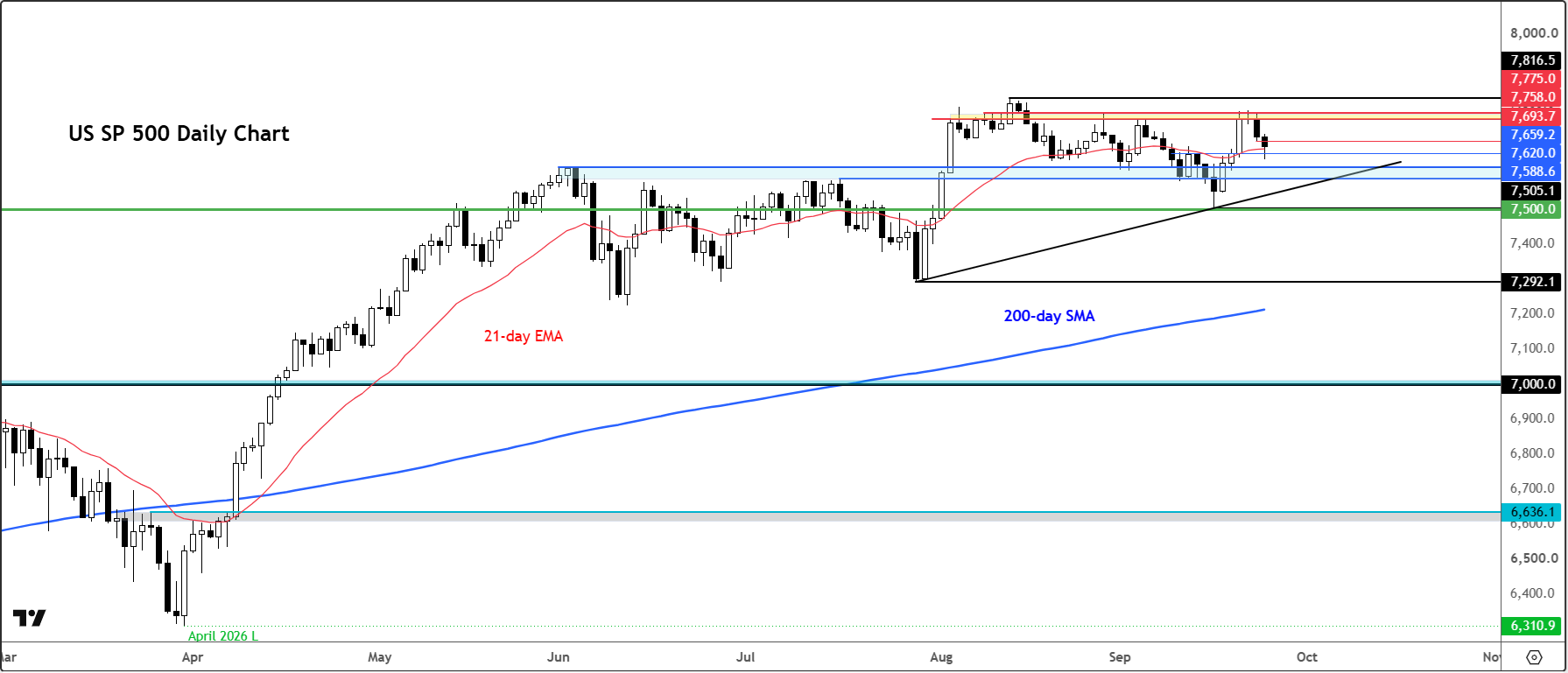
There is, however, a growing warning sign. Our SPX 500 index, which is derived from the underlying S&P 500 futures, has tested the 7,755 to 7,775 area several times without managing to break through decisively. That repeated failure raises the prospect that we may have seen at least a near-term peak.
Similar price action has occurred in the past before the market eventually pushed through resistance, so a renewed attempt at the highs cannot be ruled out. But the macro backdrop is deteriorating, although technically I would still want to see more evidence before declaring the broader uptrend over.
The immediate test is around 7,588-7620, which represents an important short-term support zone.
Below that, 7,505 becomes important. This was the most recent swing low. That is the line in the sand for me tactically. A decisive break would materially weaken the technical picture and increase the likelihood of a deeper correction.
In that scenario, the index could break below 7,500, opening the door towards the summer lows around 7,292.
There could ultimately be scope for an even deeper retracement, but there is little point in getting ahead of the market.
For now, the question is whether the S&P 500 can stabilise above these nearby support levels — or whether the deteriorating macro backdrop finally forces a more meaningful technical break.
Latest market news









Web Trader platform
Our sophisticated web-based platform is packed with features.
Open an account today
Experience award-winning platforms with fast and secure execution.
Economic calendar
Related articles

Gold and S&P 500 analysis: What now after Warsh’s hawkish speech?
The dollar surged across the board after the Fed Chair Kevin Warsh surprised with a hawkish-leaning speech at the Jackson Hole summit. All the bearish dollar bets that had been accumulated since last Friday on the back of data weakness and bond market troubles had to be squared and that triggered a short squeeze rally for the dollar. Gold and silver dropped, as a result, as too did bitcoin, while US indices were giving back earlier gains.

EUR/USD forecast: All eyes on Warsh at Jackson Hole - Forex Friday
For much of this week, the EUR/USD has been edging lower with the US dollar regaining some ground after last week’s sell-off that was triggered, in part, by the bond market worries. Investors have been unwilling to bet further against the US dollar so far this week ahead of Kevin Warsh’s keynote speech at the Jackson Hole summit, due later today.

S&P 500 Forecast: SPX after Nvidia revives confidence in the AI trade
U.S. stocks are heading higher on Thursday, with technology leading the move after Nvidia's stronger-than-expected outlook revived confidence in the AI trade.
