


USDMXN Forecast Mexican Peso Remains Under Pressure Following Jackson Hole
Over the last few trading sessions, a loss of momentum in the Mexican peso has become increasingly evident. USD/MXN has gained approximately 0.57% over the past four sessions, reflecting a moderate recovery in the U.S. dollar against the Mexican currency.
Written by
Julian Pineda
Market Analyst
Over the last few trading sessions, a loss of momentum in the Mexican peso has become increasingly evident. USD/MXN has gained approximately 0.57% over the past four sessions, reflecting a moderate recovery in the U.S. dollar against the Mexican currency. This dynamic has remained intact even after the developments at Jackson Hole, largely because Federal Reserve comments have helped stabilize confidence around the dollar. As long as this environment remains in place, the bullish bias in USD/MXN could continue to be relevant in the coming trading sessions.
Is the U.S. Dollar Finding Stability?
The end of last week was particularly important for the U.S. dollar following remarks from Kevin Warsh. During his speech, he emphasized that inflation in the United States remains above the Federal Reserve's 2% target and reiterated that achieving price stability continues to be a key responsibility of the central bank. He also noted that the labor market remains strong and that the economy continues to operate near full-employment conditions.
Although no explicit confirmation of a September rate hike was provided, the overall tone of the speech was interpreted as a sign that the Federal Reserve may maintain a more hawkish stance than markets anticipated just a few weeks ago. As a result, expectations have started to shift toward the possibility that additional rate hikes could remain on the table if inflation fails to show meaningful signs of easing in the coming months.
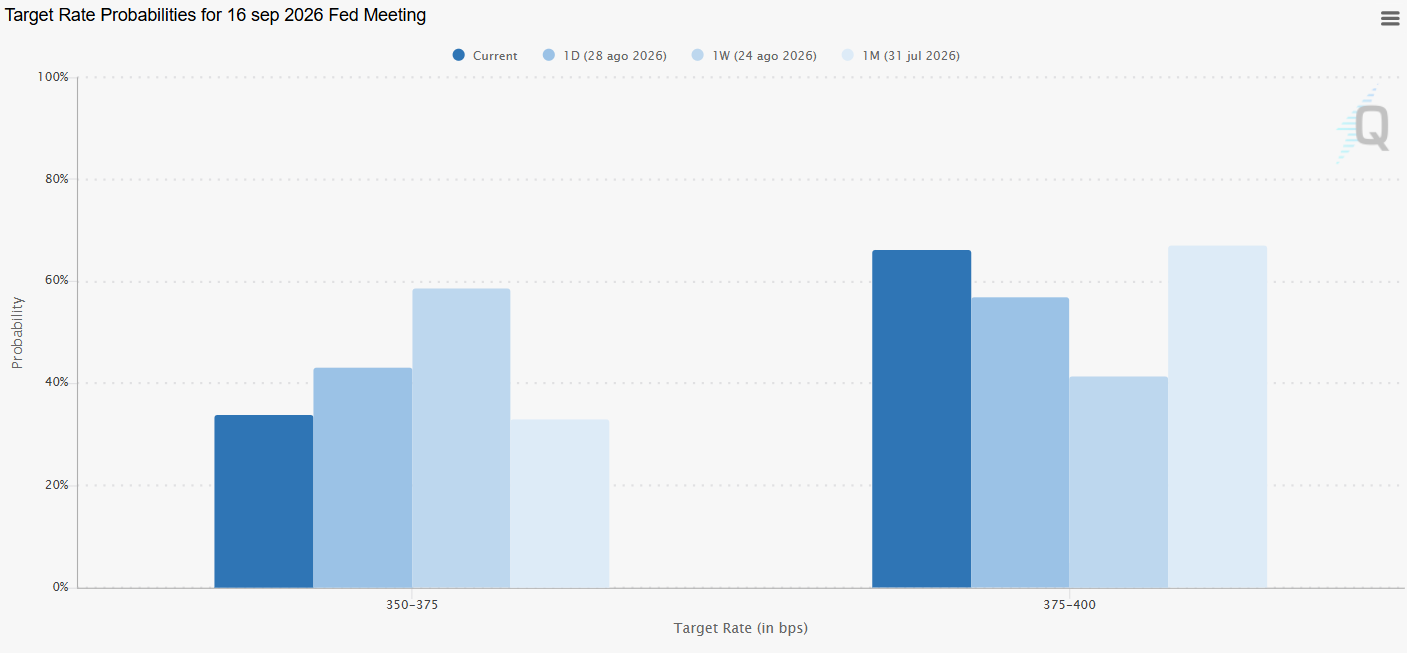
This perception is already reflected in market expectations. According to CME Group estimates, there is currently a probability above 66% that the benchmark interest rate could move toward the 4.00% level at the September 16 meeting, compared with the current 3.75% rate. This shift is particularly relevant given that only a week ago the dominant market view was for rates to remain unchanged.
Source: CMEGROUP
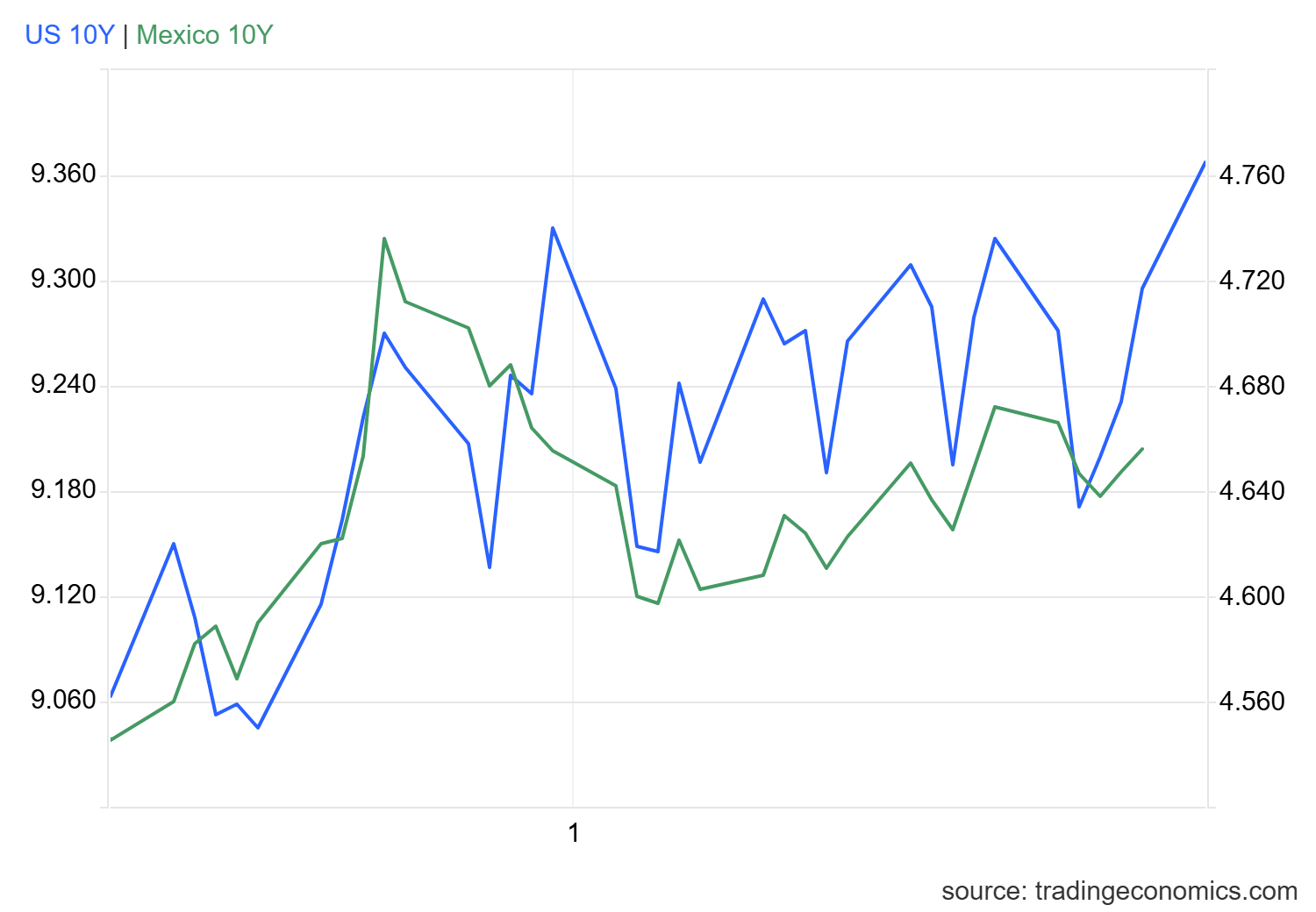
The change in expectations has also had a significant impact on the U.S. bond market. Following Jackson Hole, 10-year Treasury yields resumed their upward trajectory and reached new highs for 2026 around the 4.8% area.
Although Mexican government bonds continue to offer attractive yields near 9.2%, the recent dynamics have been notably different. While Mexican yields have remained relatively stable, U.S. Treasury yields have continued to climb, increasing the relative appeal of dollar-denominated investments compared with other markets.
Source: TradingEconomics
This situation remains relevant for USD/MXN because a more hawkish Federal Reserve could continue supporting U.S. Treasury yields and sustaining investor interest in dollar-denominated assets. As long as these expectations remain in place, the U.S. dollar may be able to preserve part of the strength it has recently recovered.
At the same time, the lack of a similar upward move in Mexican bond yields limits some of the peso's relative attractiveness against the dollar. As a result, while the combination of higher-rate expectations and rising U.S. yields persists, buying pressure around USD/MXN could continue to be an important factor in the coming sessions.
USD/MXN Technical Outlook
Source: StoneX, Tradingview
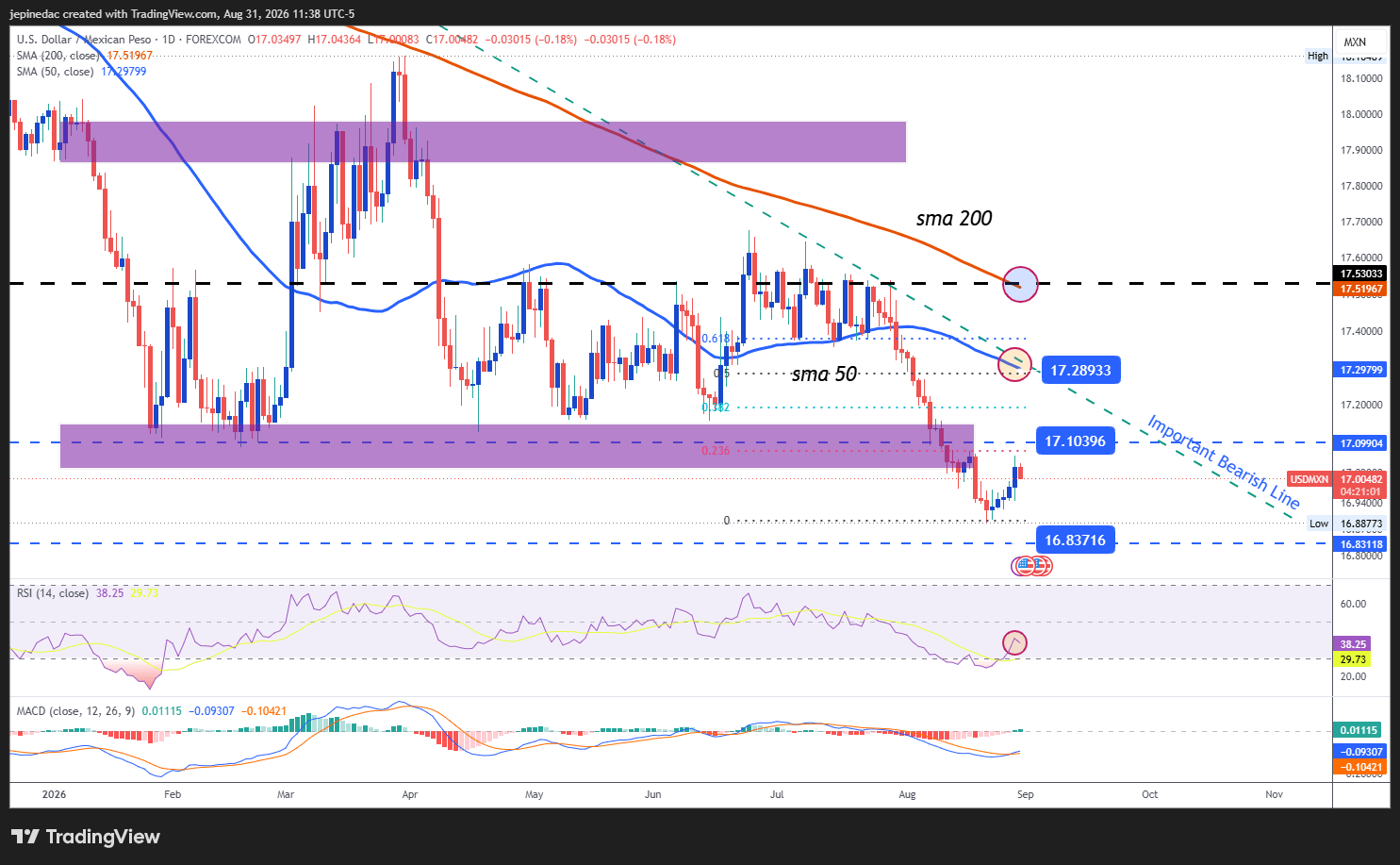
- The Bearish Trend Remains Dominant: Despite the recent recovery in USD/MXN, the most important technical structure on the chart continues to be the bearish trendline that has remained in place for several months. For now, the rebound does not appear strong enough to threaten this formation. Unless buying pressure becomes more firmly established, the broader downtrend is likely to remain the primary technical reference.
- RSI: Although the indicator continues to trade below the neutral 50 level, it has started to develop a notable upward slope. This behavior could be reflecting a slowdown in the selling pressure that dominated previous weeks and may indicate that the market is beginning to build a gradual recovery in buying momentum.
- MACD: The MACD presents a similar reading. The histogram has already moved above the neutral 0 line, signaling that short-term moving averages are beginning to favor a moderate bullish bias. If this behavior persists, it could support a more consistent recovery in price action over the next few sessions.
Key Levels to Watch:
- 17.28 – Major Resistance: A recent high that coincides with the 50-period Simple Moving Average and the 50% Fibonacci retracement of the most relevant move on the chart. Sustained trading above this area could put the dominant bearish trendline at risk and potentially create room for a stronger bullish bias over the coming weeks.
- 17.10 – Current Barrier: A level that previously represented an important low in 2026 and also aligns with the 23.6% Fibonacci retracement. It remains one of the chart's main equilibrium areas. As long as the pair continues to fluctuate around this level, a lack of clear direction could remain a dominant feature of price action.
- 16.83 – Key Support: A low not seen since 2024 and one of the most important downside barriers within the current structure. A return toward this area would reinforce seller control and could favor an extension of the dominant bearish trend in the weeks ahead.
Written by Julian Pineda, CFA, CMT – Market Analyst
Follow him on: @julianpineda25
Related tags:
Latest market news








Web Trader platform
Our sophisticated web-based platform is packed with features.
Open an account today
Experience award-winning platforms with fast and secure execution.
Economic calendar
Related articles

EUR/USD, AUD/USD, Gold Weekly Technical Outlook 8 31 2026
Sr. Technical Strategist Michael Boutros highlights the levels that matter on the Euro, Aussie and Gold this week.


FX Futures Positioning: Dollar Rebound Meets Diverging Forex Bets | COT Report
US dollar longs held firm into Jackson Hole, while euro, yen and commodity FX positioning diverged ahead of ISM and NFP.


Australian Dollar Outlook: AUD/USD Faces RBA-Fed Rate Tug-of-War
AUD/USD faces competing RBA and Fed hike bets this week, with Australian GDP and US payrolls set to test the eight-week rally.