
Costs of CFD trading
Learn about CFD costs, including CFD commission, how overnight financing works and more.
CFD commission vs the spread
There are two types of transaction charge when you open or close a CFD trade, either via a commission or through the spread. The charge type applied to your trade depends on the asset class you’re trading:
- Indices, currencies, commodities, and bonds are commission free. You only pay the spread on these markets
- Share CFDs are subject to commission charges. This commission charge is based on the overall value of the trade
Learn more about how to trade CFDs.
What is CFD commission?
CFD commission is typically charged when opening and closing a contract for difference (CFD) position on equities. Equities is the name given to individual companies, also referred to as shares or stocks. The amount of commission you’ll pay depends on where the company is listed. There is also a minimum commission charge in place. For most equities, the charges are as follows:
UK | European | US | APAC | |
|---|---|---|---|---|
Commission | 0.08% | 0.08% | 1.8¢/share | 0.2% |
Minimum | £10 | €10 | $10 |
You can also find commission details for any asset on the Market 360 tab in the StoneX Trading web platform.
For UK, European and Asian stocks, your commission is charged as a percentage of the total size of your position. For US stocks, you’ll pay a set number of cents for every CFD you purchase. We refer to this as a cents per share (CPS) rate.
CFD commission example
Say, for instance, that you want to buy 10,000 Tesco CFDs when the stock is at 485p. The total value of your position is (10,000 * 485p) £48,500, and Tesco has a commission of 0.08%, so you’d pay (0.08% of 48,500) £38.80.
If you only wanted to trade 5,000 Tesco CFDs, meanwhile, then you’d pay the minimum commission of £10.
But what if you were trading a US share CFD? As we covered above, your commission here is calculated based on how many shares you’re trading. For example, if you wanted to sell 600 Amazon CFDs, you’d pay (1.8c * 600) $10.80.
US equity CFDs have a minimum commission of $10. If you sold 300 Amazon CFDs instead, you’d pay $10.
Spreads with CFDs
StoneX Trading quotes a two-way price on all our markets, a bid price and an offer price.
- You trade at the bid to sell a market
- You trade at the offer to buy a market
The spread is the difference between the sell and the buy prices. On commission-free asset classes, the spread is in effect your cost of trading the market. The tighter the spread, the quicker the trade can potentially move into profitable territory.
On share and ETF CFDs, the spread simply reflects the difference between the buy and sell prices of the underlying market, since the cost of the transaction is charged via commission.
Overnight CFD financing
Overnight financing is a charge that you pay to hold a CFD position open for more than a single day. Essentially, it is an interest payment to cover the cost of the leverage that you use overnight. You may also see this referred to as your cost of carry.
There is no financing charge for CFDs with expiry dates (forwards). Instead, these contracts have wider spreads as the cost of carry has been incorporated into the price.
Overnight financing is charged at 3% plus the equivalent base rate of your instrument on long positions. You will alternatively ‘receive’ 3% minus the rate benchmark on short positions. The percentage will be calculated based on the size of your trade at end of the day and divided by 365 to get a daily rate.
These are the rate benchmarks for markets in priced EUR, GBP, JPY, SGD and USD:
Currency | New benchmark |
|---|---|
EUR | €STR |
GBP | SONIA |
JPY | TONAR |
SGD | SORA |
USD | SOFR |
However, depending on the level of the underlying interest rate you may be charged rather than paid on short positions.
CFD financing example
You decide to buy 1.5 CFDs on the UK 100 at 10,330. The trade is doing well, and its price has increased to 10,360 by the end of the day. However, it is still some way from your target price of 10,400. You decide to keep the position open overnight.
The value of your position at close is (£1.5 × 10,360) £15,540. To calculate your overnight financing, you add 3% to the current SONIA rate, multiply that percentage by 15,540, then divide by 365.
If SONIA is 3.73%, then:
- 3.73% + 3% = 6.73%
- 6.73% × 15,540 = 1,045.84
- 1,045.84 / 365 = £2.87
- Your overnight financing charge is £2.87
You must have sufficient funds in your account to cover both your open positions and any financing charges you may incur, or your position could be closed out.
The daily financing fee will be applied to your account each day that you hold an open position (including weekend days).
Guaranteed stop loss orders
There is no charge for placing standard orders such as stops and limits. There is, however, a charge for using a guaranteed stop loss order (GSLO).
These are charged if your GSLO triggers and are non-refundable.
Rolling CFD futures
When futures contracts are near to expiry, you can, if you wish, roll your trade into the following contract. You can do this by selecting the auto–roll tick box in the order ticket. You’ll pay half the spread to carry out this transaction.
- If you’re going long, your position will be closed at the mid-price and re-opened in the next contract at the buy price
- If you’re going short, your position will be closed at the mid-price and opened again at the sell price in the following month
It’s cheaper to roll over to the next contract than to close the trade yourself and then reopen it. This is because when closing and opening a trade manually, you pay the full spread, whereas by "rolling over" you only pay half.
For example, you have decided to roll over your long March CFD position in Company XYZ into the next contract.
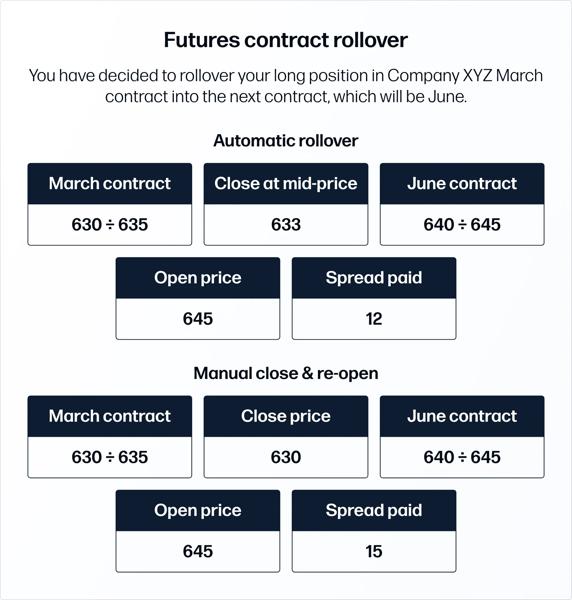
At the time of the rollover the March price is 630 / 635 and the June price is 640 / 645. Your long CFD position is closed at the March mid-price of 633 and then automatically reopened at the June buy price of 645.
Any P&L as a result of a Futures contract trade is registered on your account automatically.
Had you closed the trade yourself, you would have closed at 630, before reopening at 645, therefore paying a wider spread.
Ready to start trading CFDs? Open a live account here, or try a free demo.
A better trading experience
Discover how Stonex Trading's platforms can give you an edge.
Improve your strategy
Head over to the StoneX Trading Academy for curated courses.
Open
an account
Fund
via card or bank transfer
Trade
thousands of markets