

Factors affecting gold prices
Gold is prized for its stability – when other markets fall, gold can retain its value. But that doesn’t mean it’s free from volatility. Explore what moves gold prices here, or open your StoneX Trading account to start trading gold today.
- Why is gold valuable?
- What moves gold prices?
- Gold supply factors
- Gold demand factors
- How to start trading gold
Why is gold valuable?
Gold has long held a value in society, being used as currency as early as 550BC. More recently, currencies used to frequently be pegged to gold to preserve their value.
Nowadays, currencies have moved to a fiat-based system where they hold no intrinsic value. However, gold is still used in coins today and most central banks will hold large amounts of gold in reserve to support the national currency. Gold also has many practical uses that help it to retain its value over the long term.
In terms of trading, however, gold is valued because it's seen as a safe-haven market. This means that it's believed gold will hold its value in the long term.
Take your position on gold, with no risk to your capitalYou can gain exposure to the gold market without committing any capital by opening a StoneX Trading demo account. It enables you to trade on live gold prices with virtual funds – a great way to practise with with no risk to your capital. |
|---|
What moves gold prices?
Like any market, gold's price is primarily affected by supply and demand. Let's take a closer look at both.
Gold supply
Gold's supply doesn't quite work like other major commodities, such as oil. Why? Because gold is very rarely used up - pretty much all the gold that's ever been mined is still in circulation.
In theory, this should harm gold's price. Supply is constantly rising, which should cause its price to fall. But a quick look at a long-term gold price chart tells you that this isn't the case.
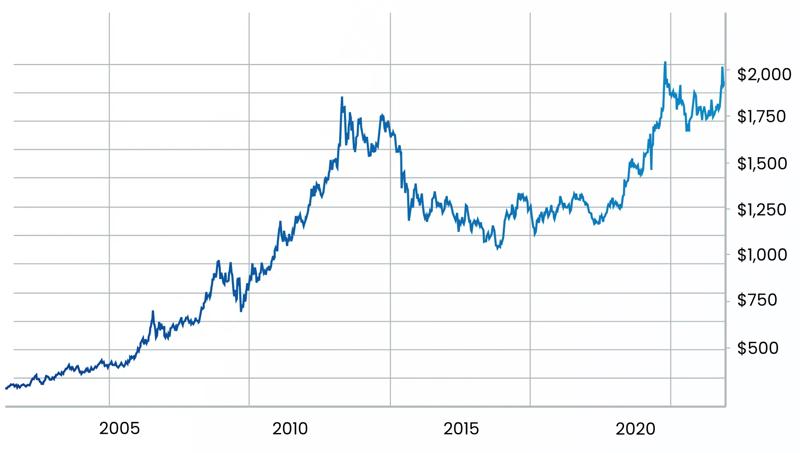
There are several reasons why. For one thing, demand is often on the rise (more on that later). But also, a lot of the world's gold isn't being used. Lots of different institutions and people will hold onto gold over the long term, whether as an investment or as a piece of jewellery. So while there's more of it around, it isn't necessarily available to purchase.
Gold miners
There's also a finite supply of the precious metal.
Gold is still being mined today, but it's estimated that 100% of gold will be mined anywhere between 2035 and 2070. And all of the gold that's 'easy' to mine has already been mined, which means the gold that's left is more expensive to get out of the earth.
Sometimes, this can cause gold's price to rise.
Gold demand
The picture for gold demand is a little more complicated, with numerous different factors that can cause its price to rise or fall on any given day. Here's an introduction to four important areas to watch: jewellery and industrial use, central banks, investors and the US dollar.
What is gold used for?
Gold may be a 'safe haven' for investors, and the backing for global economies. But it's also used in global industry - lots of products, from medical devices to smartphones, GPS units and more rely on its unique properties.
However, far exceeding industrial use is demand for gold jewellery. The jewellery industry has historically been the cause of most of the world's gold demand, buying more than 2,000 tonnes of the precious metal in 2023 alone. However, since 2024, central banks and investors have taken the number one spot, driven by geopolitical uncertainty and the continued growth in AI adoption.
Central banks
According to Reuters, global central banks - such as the Federal Reserve, Bank of England and European Central Bank - hold roughly a fifth of all the gold ever mined in their reserves. In recent years, the central banks of Russia, China, Turkey and India have started buy huge amounts of gold.
Gold is useful to central banks. Holding huge amounts of currency is risky. If the currency drops in value, then your reserves will fall in value too. And during times of economic certainty, when central banks may need to print more money to kickstart the economy, currency devaluation is a very real concern.
Gold, on the other hand, keeps its value. When other assets fall, its price even rises - helpfully offsetting the losses in your reserves elsewhere.
What gold can't do, though, is generate a return. Unlike, say, a bond, it won't secure you interest. So when the economy is booming, central banks might sell some of their gold, which causes its price to fall.
The main banks have an agreement not to sell too much gold at once, to prevent crashing its price.
Investor demand
As we've seen, gold can be a useful investment to own. It diversifies your portfolio, can hedge against the risk of a market downturn and rarely loses its value. Just as central banks have become wise to this fact, so have investors.
When other markets look likely to fall - say, because of a recession or political instability - gold will often rise as investors flock to it to try and protect their portfolios.
Of course, most individual investors aren't buying huge amounts of bullion and storing it themselves. Instead, they use alternative methods to buy gold. Exchange-traded funds, for example, have become a hugely popular way to get exposure to gold.
The SPDR Gold Trust fund holds over 1000 tonnes of gold alone. This, and other gold ETFs, now make up a significant share of global demand.
The US dollar
Gold is usually bought and sold in US dollars, under the trading name of XAU/USD. This gives the commodity a negative price correlation with the dollar, which can be a major volatility driver.
When USD falls in value, you can buy more gold for the same amount of money – which tends to increase demand, and in turn sends its price higher. If the US dollar is gaining strength, on the other hand, gold is more expensive to buy. This lowers demand and sends its price down.
When you combine this with the fact that many people believe gold can keep its value as other assets dwindle, you get one major reason for investing in gold: as a hedge against inflation.
How to start trading gold
To take your position on gold today, follow these five steps:
- Open your StoneX Trading account, or try a demo if you're not ready for live trading
- Add funds via credit card, debit card, PayPal or bank transfer
- Search for 'gold' in our trading platform
- Choose whether to go long or short
- Execute your trade
A better trading experience
Discover how Stonex Trading's platforms can give you an edge.
Improve your strategy
Head over to the StoneX Trading Academy for curated courses.
Open
an account
Fund
via card or bank transfer
Trade
thousands of markets