


Crude oil outlook: WTI climbs amid Strait of Hormuz hostilities
Crude oil prices rose more than 2.5% on Tuesday, extending their recent recovery. Reports that commercial vessels transiting the Strait of Hormuz had come under attack, reminded markets that geopolitical risks in the Middle East remain far from being resolved completely. Markets are also wary of a still tight market and the expected buying of oil to fill up emergency stocks.
Written by
Fawad Razaqzada
Market Analyst
Crude oil prices rose more than 2.5% on Tuesday, extending their recent recovery. Reports that commercial vessels transiting the Strait of Hormuz had come under attack, reminded markets that geopolitical risks in the Middle East remain far from being resolved completely. Markets are also wary of a still tight market and the expected buying of oil to fill up emergency stocks. As before, the near-term crude oil outlook is starting to look a bit more constructive now with the bulk of the selling behind us. Consolidation and dip-buying is what I am expecting to see in the coming days.
Strait of Hormuz hostilities
Apparently, Iran fired missiles at two commercial ships travelling through the waterway on Monday evening. The incident casts doubt over the fragile understanding reached between Washington and Tehran last month. Although both sides agreed to a memorandum aimed at ending months of military confrontation, subsequent negotiations have yielded little tangible progress towards a permanent settlement. Even so, both governments continue to have strong incentives to avoid a prolonged conflict. With US mid-term elections approaching and Iran seeking relief from economic sanctions, neither side appears keen to trigger another sustained disruption to global energy markets.
OPEC raises production but markets expected this
Oil prices have refused to fall further even if Saudi Arabia slashed its official selling prices this week, and the OPEC+ approved another production target increase starting in August, all the while exports through the Strait of Hormuz recovered further. The OPEC+ raised its output target by 188,000 bpd from August, adding to similar increases for June and July. But due to the Iran war, which had resulted in the closer of the Strait, key OPEC producers, including Saudi Arabia, Kuwait and Iraq, had been unable to meet their output targets. Still, that didn’t stop the United Arab Emirates to raise its crude output to near record highs of above 3.8 million barrels per day in June after it quit the OPEC.
Much of the geopolitical premium has already disappeared
Following the recent sharp falls, oil has surrendered much of the risk premium accumulated as military tensions escalated. The market has increasingly priced in the view that, while sporadic incidents remain possible, a wider regional conflict is becoming less likely. The market is no longer paying a substantial premium for geopolitical risk, but nor is it completely dismissing the possibility of further disruptions.
Inventory rebuilding may provide an important floor
One factor that could prevent oil prices from falling much further is the need to replenish inventories. During the period of heightened uncertainty, several countries relied on strategic petroleum reserves to help cushion supply disruptions and stabilise domestic markets. As prices retreat, governments may see an opportunity to rebuild those stockpiles at more attractive levels. Large consumers such as China, Japan and the United States could all increase purchases over the coming months if crude continues to soften. That additional buying would help absorb excess supply and may provide an important source of support for the crude oil outlook, even if geopolitical tensions continue to ease. At the same time, however, supply dynamics remain relatively favourable. Higher production from countries including Iran and Venezuela could gradually increase global availability, limiting the scope for any sustained rally unless fresh geopolitical shocks emerge.
Technical crude oil outlook: WTI levels to watch
WTI crude oil had been consolidating over the last 3 or 4 sessions, probing key support between the $66.50 and $67.30 levels. This area is where crude oil was trading before the conflict first escalated. And so now that oil prices have bounced back from here, is hardly a surprise.
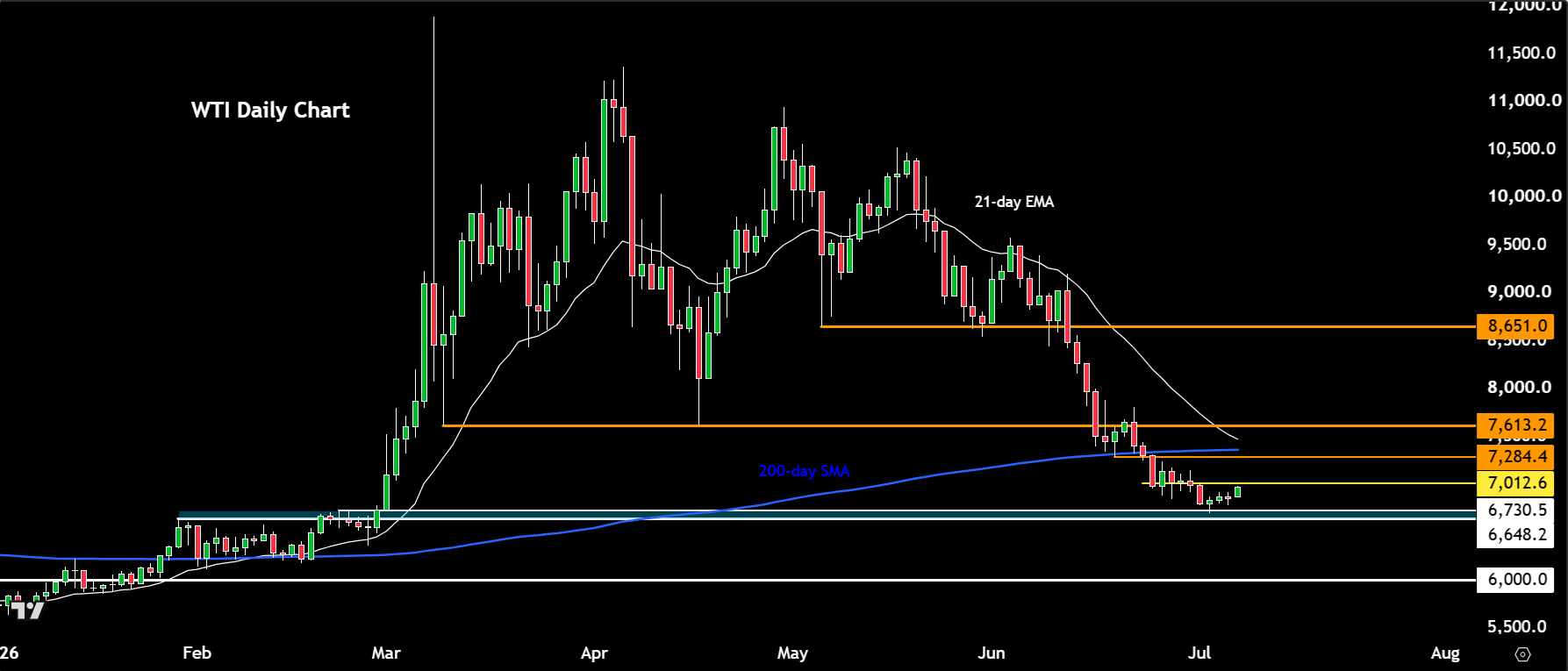
The key question now is whether oil prices will break below this area, given the prospect of increased supplies from Venezuela and Saudi lowering its prices for Asian buyers, or whether we’ll see a recovery from current levels amid expectations of strong demand.
From a purely technical point of view, all I’m looking for is a rebound, which we’ve already started to see.
Prices have bounced from the key support zone mentioned and are now testing resistance around the psychologically important $70 per barrel level to around $71.50 mark.
It’s important that this area now holds as resistance, else we could see a quick pop towards the 200-day average near $73.60 or possibly even the $65.00 level. Above that, the next area of resistance comes in around $76.20. This was the low from mid-April, which was broken in mid-June, and prices have remained below it ever since. That would be the next upside target should bullish price action continue to develop.
On the downside, the next major support below the $66.50 to $67.30 region comes in around $65, which is another psychologically important level. Below that, $60 would become the next downside target.
In summary
Overall, the trend remains technically bearish. However, the recent loss of bearish momentum, combined with the fact that prices have returned to their pre-war levels, suggests that the worst of the selling may now be behind us. That increases the chances that prices could find support and begin reversing from current levels, which may well be underway already. Consolidation and dip-buying is what I am expecting to see in the coming days.
-- Written by Fawad Razaqzada, Market Analyst
Follow Fawad on Twitter @Trader_F_R
Related tags:






Web Trader platform
Our sophisticated web-based platform is packed with features.
Open an account today
Experience award-winning platforms with fast and secure execution.
Economic calendar
Related articles

Nasdaq 100 Forecast: NDX slips ahead of Fed Chair Warsh’s speech
U.S. stocks are edging lower on Friday, giving back some of yesterday's gains after Nvidia's strong outlook revived the tech trade. The focus has now shifted firmly to Fed Chair Kevin Warsh's Jackson Hole speech, with investors looking for more clarity on the outlook for interest rates.


S&P 500 Forecast: SPX after Nvidia revives confidence in the AI trade
U.S. stocks are heading higher on Thursday, with technology leading the move after Nvidia's stronger-than-expected outlook revived confidence in the AI trade.

Oil, EUR/USD Forecast: Two trades to watch 2608
Oil falls further on diplomatic hopes for a Middle East resolution. EUR/USD consolidates ahead of U.S. inflation and Jackson Hole.